
Modafinil can affect appetite in some people, but it is not an FDA-approved weight-loss medicine. Reduced eating during a short experiment, appetite loss reported as a side effect, and sustained improvement in body weight are different outcomes. None should be treated as a promise of how many pounds someone will lose.
If your appetite or weight changes while taking prescribed modafinil, the useful next step is to review the change with the prescriber. That review should include why you take the medicine, how much you are eating, other symptoms and other medications. Increasing a dose to suppress hunger is not a weight-management plan.
What modafinil is actually prescribed to treat
The current PROVIGIL prescribing information identifies modafinil as a medicine to improve wakefulness in adults with excessive sleepiness associated with narcolepsy, obstructive sleep apnea or shift work disorder. It is a Schedule IV controlled substance.
For obstructive sleep apnea, the label distinguishes treatment of excessive sleepiness from treatment of the underlying airway obstruction. A person should not assume that feeling more awake means their sleep apnea treatment is no longer needed.
The label does not identify weight loss as an approved indication. A wakefulness benefit, less snacking during a shift or an appetite change does not transform the product into an approved obesity treatment.
Poor sleep and fatigue can also have several causes. Our low testosterone versus stress and poor sleep guide explains why symptoms should not be assigned to a hormone problem without evaluation. The same principle applies to choosing a wakefulness medicine or a weight medicine from symptoms alone.
Does the label report appetite loss?
Yes. In the label’s pooled placebo-controlled trials involving patients with narcolepsy, obstructive sleep apnea or shift work disorder, “anorexia” was reported in 4% of PROVIGIL-treated patients and 1% of placebo-treated patients. The pooled groups included 934 and 567 patients, respectively.
In that adverse-event table, the term concerns appetite loss; it does not establish a diagnosis of anorexia nervosa. It also does not mean that 4% achieved a particular amount of weight loss.
An adverse-event percentage describes what was reported in the studied population under those trial conditions. It is not a prediction of your personal response. It does not show whether the appetite change was nutritionally beneficial, tolerable or sustained.
Other reported effects, such as nausea, anxiety, insomnia or dry mouth, can also complicate eating and daily functioning. A person who is eating less because they feel unwell needs a symptom review, rather than a conclusion that the medicine is “working for fat loss.”
What the short food-intake experiment found
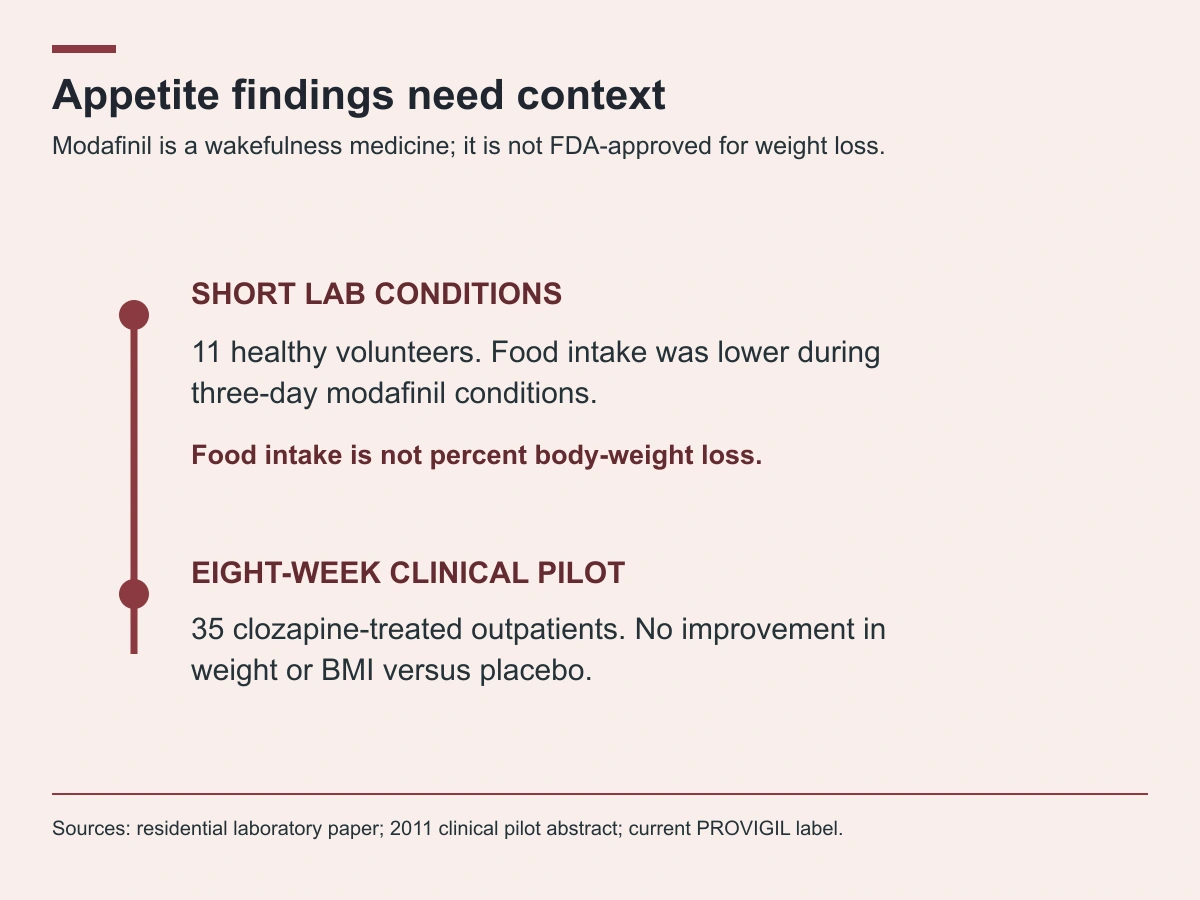
An original residential laboratory study evaluated eating during day and night work conditions in 11 healthy volunteers. The participants were generally normal weight, with a mean BMI of about 24.3. The experiment involved three-day modafinil conditions within a longer residential protocol.
Food intake was lower relative to placebo during the experimental 200-milligram and 400-milligram conditions: the paper reported reductions of 18% and 38%, respectively. Those percentages describe food intake in the experiment, not percentage loss of body weight.
The study’s amount of drug is a research detail, not a weight-loss dose recommendation. Eleven volunteers observed over short conditions cannot establish the long-term benefit, nutritional consequences or safety of prescribing modafinil for weight management.
The authors discussed limitations, including uncertainty about longer exposure and how findings would generalize to people with obesity. A finding that motivates further research is different from evidence supporting a routine treatment recommendation.
If you see a claim that modafinil caused “38% weight loss,” it has changed the outcome measured in this experiment. That claim is not supported by the paper.
A clinical pilot did not show weight benefit
The original abstract of an eight-week clinical pilot describes 35 clozapine-treated outpatients with schizophrenia who received modafinil or placebo. It reported no improvement in weight, BMI, glucose or lipid outcomes compared with placebo.
That finding also has limits. It concerns a small, specific clinical population, rather than everyone taking modafinil for a sleep disorder. It does not prove that the medicine never changes anyone’s appetite.
Together, the short laboratory experiment and the clinical pilot show why the endpoint and population matter. A change in food intake in healthy volunteers does not establish a lasting weight benefit in clinical care. A negative pilot in one treatment setting does not answer every question about every patient.
| Evidence | What it can help describe | What it does not establish |
|---|---|---|
| Current PROVIGIL adverse-event table | Appetite loss reported in pooled sleep-disorder trials | A percentage of body weight someone will lose |
| Eleven-person laboratory experiment | Short-term food intake during specific experimental conditions | Sustained weight loss, long-term safety or a weight-loss prescription dose |
| Thirty-five-person, eight-week clinical pilot | No weight or metabolic improvement versus placebo in clozapine-treated outpatients | A universal response in all modafinil users |

Weight loss can be a reason for assessment
If you are unintentionally losing weight, explain the timing and extent to your prescriber. Note whether the change began after starting modafinil, after a dose adjustment or after another change in your health or routine.
It helps to distinguish reduced appetite from nausea, trouble arranging meals, changes in sleep, increased activity or another medical problem. The prescriber may need to consider several possibilities rather than attributing the change automatically to one drug.
Bring a brief account of what you can eat and drink. Mention persistent vomiting, difficulty swallowing, abdominal pain, mood changes or symptoms that make daily functioning difficult. The review may be different if you have diabetes, a condition affecting nutrition or a history of an eating disorder.
Do not compensate by adding an appetite stimulant, a weight-loss supplement or another prescription without review. A lower scale number is not automatically a desirable medication effect.
Our calorie-intake guide discusses why adequate intake and an intentional deficit are different from simply eating less. Balanced meal planning may help organize questions about your meals, but it cannot replace assessment of an unexplained change.
Important modafinil safety considerations
The current label includes serious rash, hypersensitivity, psychiatric and cardiovascular precautions. These need to remain part of the discussion even when a person is focused on appetite.
Rash and allergic symptoms
The label says to discontinue PROVIGIL at the first sign of rash unless the rash is clearly unrelated to the medicine. Contact the prescriber promptly; do not continue it while waiting for a routine appointment on the assumption that a rash is harmless.
Difficulty breathing or swallowing, swelling of the face or throat, or other signs of a severe reaction require urgent care. Serious skin reactions cannot be ruled out solely because a photograph looks mild or because the medicine has been taken for a while.
Mood, sleep and cardiovascular symptoms
Discuss new or worsening anxiety, agitation, unusual behavior, mood symptoms or insomnia. The label includes psychiatric reactions that can require a treatment change. Suicidal thoughts or a mental-health crisis require immediate help.
Chest pain, fainting, significant palpitations or other concerning symptoms also need assessment. Blood pressure, heart rate and cardiovascular history can affect the monitoring plan. Do not treat being more awake or eating less as a reason to dismiss these changes.
Other medicines and contraception
Modafinil can affect other medicines. The label advises alternative or additional contraception during use and for one month after stopping when steroidal contraceptives are involved. Ask the clinician or pharmacist how that applies to your specific contraceptive method.
Bring your full prescription, nonprescription and supplement list to the review. Pregnancy or pregnancy planning also needs a direct discussion. A generic online interaction checker does not establish that a combination is safe for your circumstances.
Can modafinil be combined with a GLP-1 medicine?
Do not use the short appetite experiment as a reason to combine modafinil with semaglutide or tirzepatide. The reviewed evidence does not establish such a combination as a weight-loss strategy.
Someone prescribed both medicines for separate reasons needs an individualized review of indications, symptoms, intake and other medications. If appetite is already low, adding another medicine or supplement to reduce it further can obscure the reason for poor intake.
Our semaglutide questions guide and tirzepatide protein and muscle guide explain practical questions about treatment and adequate nutrition. They do not provide authorization to add a wakefulness medicine for weight loss.
If you are exploring weight-management treatment, semaglutide product information is a starting point for a clinician-led discussion of the exact formulation, eligibility and monitoring. It should not be read as a recommendation to combine it with modafinil.

Questions to bring to the prescriber
Prepare a short list that connects the medicine’s intended benefit with what has changed:
- Is modafinil still addressing the sleepiness problem for which it was prescribed?
- Is my appetite change expected, or does it need another explanation?
- Am I getting enough food and fluids for my needs?
- Could my other medicines or my shift schedule be contributing?
- What symptoms should prompt immediate contact, and what follow-up is appropriate?
Ask for a clear plan if the medicine needs to change. Do not independently stop and restart it, increase it to suppress hunger or replace it with an online weight-loss product. The appropriate plan depends on the original indication and your current health.
Frequently asked questions
How much weight will I lose on modafinil?
There is no established number from the reviewed evidence. Modafinil is not approved for weight loss, and food-intake percentages from a short experiment are not pounds or percentages of body-weight loss.
Does appetite loss mean the medicine is benefiting my weight?
Not necessarily. It may be a side effect, and it can coexist with inadequate intake or other symptoms. Review unintended weight change and poor appetite with the prescriber.
Is modafinil a substitute for an obesity medicine?
No such role is established by its approved indications or the reviewed studies. The NIDDK’s prescription weight-management overview describes a different clinical evaluation and treatment context.
Can I increase modafinil because I am still hungry?
Do not increase a prescribed dose to chase appetite suppression. Hunger does not establish that a wakefulness medicine needs adjustment. Discuss the medicine’s intended benefit and any side effects with its prescriber.
Is a new rash just another manageable side effect?
Do not assume so. The current label directs discontinuation at the first sign of rash unless it is clearly unrelated. Contact the prescriber promptly and seek urgent care for severe skin or allergic symptoms.
Educational information for adults; individual treatment decisions require a qualified clinician. Sources reviewed October 2, 2026. Original AI-generated article images depict fictional people and objects, not patient outcomes. Other editorial images are illustrative. Graphics summarize the cited sources.