
The current U.S. Ozempic injection label has adult indications, and pediatric safety and effectiveness are not established in that label. Being an adult does not automatically mean Ozempic is appropriate: the condition being treated, medical history, other medicines and the exact prescription also matter.
Age limits differ across related products and indications. A pediatric indication for Wegovy injection or Mounjaro does not become an Ozempic indication. This article reviews selected current U.S. labels and explains the questions adults can bring to a treatment consultation.
How old do you have to be to take Ozempic?
The reviewed Ozempic injection prescribing information describes treatment in adults. It includes glucose control in adults with type 2 diabetes and specified cardiovascular and kidney-risk indications in defined adult diabetes populations. Its pediatric section says safety and effectiveness have not been established. Ozempic label.
For an adult considering treatment, the next question is therefore not simply “Have I reached the right age?” It is “What condition are we treating, and is this exact product appropriate for it?” Someone seeking weight-management care should discuss that goal openly rather than assuming every semaglutide brand has the same indication.
This discussion focuses on the reviewed Ozempic injection label. Do not apply an injection’s directions or eligibility context automatically to a tablet, a different brand, or a compounded formulation. The product name and route belong in the question from the beginning.
Why are there different ages for other products?
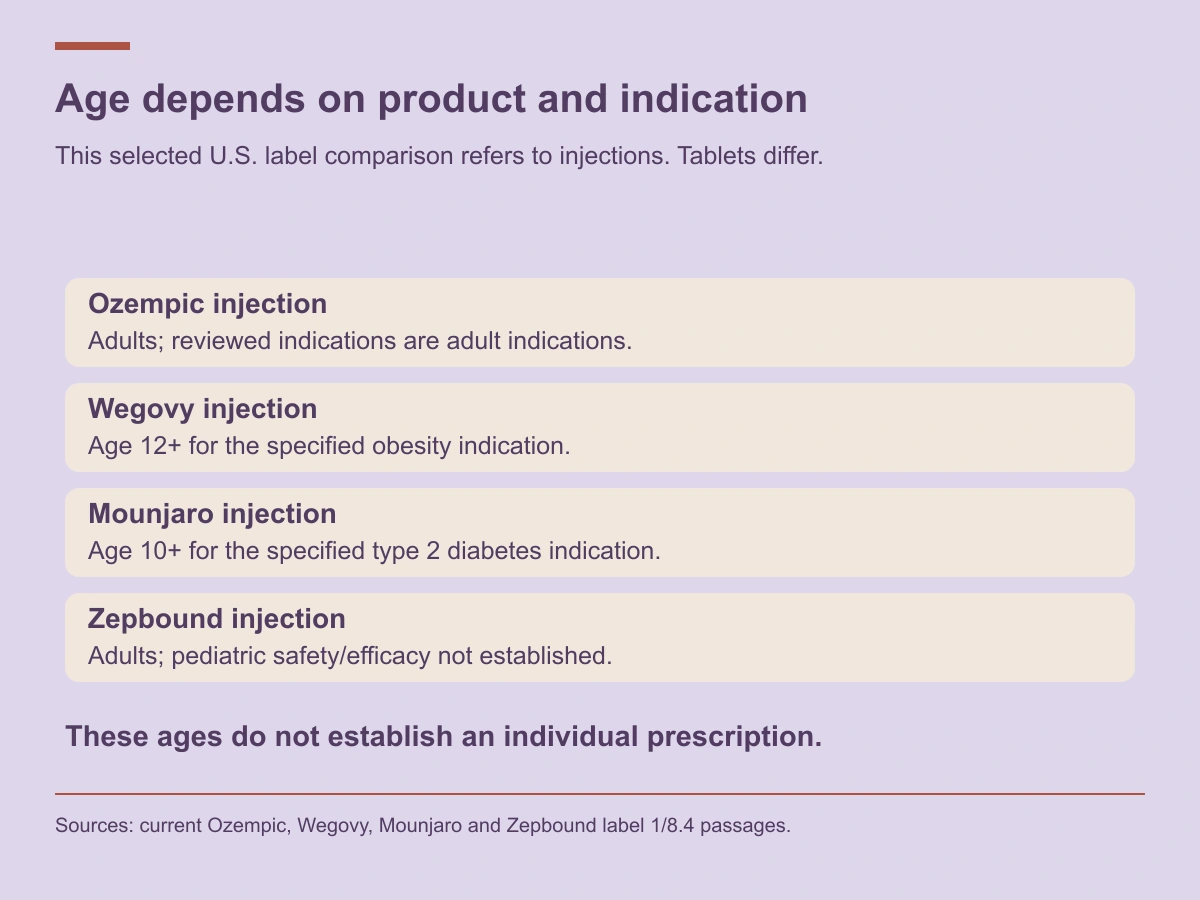
Approvals attach to a particular product and use. The following table summarizes selected age contexts in the labels reviewed on October 3, 2026. It is not a complete list of every indication, a prescribing recommendation, or a list of services offered by CoreAge Rx.
| Product and route | Selected age context | Important boundary |
|---|---|---|
| Ozempic injection | Adults | Pediatric safety and effectiveness are not established in the reviewed label. |
| Wegovy injection | Age 12 and older for its specified pediatric obesity indication | The pediatric indication does not cover every Wegovy use or formulation. |
| Wegovy tablets | Adults for the reviewed indications | Do not transfer the injection’s pediatric obesity indication to tablets. |
| Mounjaro injection | Age 10 and older for its specified type 2 diabetes indication | This is not a general pediatric weight-loss indication. |
| Zepbound injection | Adults for the reviewed indications | Pediatric safety and effectiveness are not established in the reviewed label. |
Wegovy label, Mounjaro label, Zepbound label.
The Wegovy injection pediatric obesity context also includes specific BMI criteria, and other indications are adult indications. A label age is one element of an assessment, not an invitation to select a product without the appropriate clinician.
Our GLP-1 product overview explains why brands and formulations need to be kept distinct. The Wegovy prescription guide addresses the appointment and coverage questions more broadly.
What if the question concerns a child or teenager?
Ask the child’s treating clinician or an appropriate pediatric specialist about the actual condition and product. Growth, development, medical history and family circumstances need an assessment designed for that patient. An adult weight-management article cannot provide that evaluation.
Do not use an adult relative’s prescription or device, or treat a pediatric age mentioned in another brand’s label as permission to use Ozempic. The appropriate treatment, if any, must be prescribed for the individual patient.
CoreAge Rx’s adult education and product information should not be interpreted as an offer of pediatric treatment. If you are comparing clinics for a younger patient, verify the provider’s age scope and clinical services directly. A general article about product labels does not establish that a clinic treats minors.
Does turning 18 make me eligible?
Adult status alone cannot establish a prescription. A consultation should identify the condition, treatment goal, relevant history and alternatives. The clinician also needs to know which medicines you already use and whether another team is managing diabetes or another ongoing condition.
It helps to be specific about the goal. Improving glucose control, addressing an approved cardiovascular-risk context and exploring weight-management care are different conversations. Do not rely on a social-media description of a medicine as simply “a weight-loss shot.”
Ask which measurements or records are needed for the assessment and how follow-up will work. There is no universal checklist in this article that guarantees acceptance. Our online prescription guide discusses the clinical and pharmacy questions to ask before paying for a service.

Is there an upper age limit for Ozempic?
The reviewed Ozempic label does not establish a blanket upper age cutoff. Its geriatric section reports no overall safety or effectiveness differences between older and younger adults in the studied settings, while noting that greater sensitivity in some older people cannot be excluded. Ozempic geriatric information.
That is not a guarantee of suitability for every older adult. The individual’s health, nutrition, medicines, function and treatment goals remain relevant. Nor should a finding in one product’s trials be transferred to every related medicine or indication.
If you are older, discuss practical issues as well as diagnoses. Can you manage meals and fluids, obtain refills, use the prescribed device and attend follow-up? Is a caregiver involved in medicine organization? These questions can make a plan easier to carry out without assuming that everyone of the same age needs the same assistance.
Review function and nutrition alongside the treatment goal
Ask how the care team will assess daily function, adequate intake and unwanted changes. A scale reading alone may not capture weakness, a reduced ability to perform usual tasks or trouble eating. Describe those concerns when they occur rather than waiting for a routine weight check.
Our semaglutide, protein and muscle guide organizes nutrition and function questions. The strength-training guide discusses general activity planning, which should be adapted to the individual’s abilities. Neither article sets a universal protein target or workout for every age group.
The balanced-meals guide can help you describe what a normal day of eating looks like. If appetite is already low, meals are difficult to prepare, or food access is limited, say so before treatment decisions are made. Those circumstances matter even when a product’s age context appears to fit.
Other medicines can change the conversation
Bring the entire prescription list, including occasional medicines and supplements. Ozempic’s label identifies increased low-blood-sugar risk when it is used with insulin or insulin secretagogues. It also describes dehydration-related kidney injury following gastrointestinal effects. Ozempic safety passages.
These considerations are not unique to one birthday. An older adult using several medicines and a younger adult with a complex treatment plan may both need close coordination. Ask which clinician manages each medicine and whom to contact about symptoms or a change in intake.
Do not adjust a diabetes medicine on your own to qualify for another treatment. Likewise, do not assume that a prescription will be simpler because a friend of the same age had an uncomplicated experience. Your list and circumstances are the relevant ones.
Prescription eligibility, insurance coverage and service access differ
A clinician’s assessment is separate from an insurer’s payment decision. An insurance plan may have requirements for a particular product, indication or prior authorization. A clinic may also have its own age scope and available services.
Ask three distinct questions: Is this clinically appropriate? Does this provider offer the relevant care? What will my payment arrangement cover? A yes to one does not establish the other two.
If you receive a quote, identify the exact medicine and presentation, consultation fees, pharmacy charges and follow-up costs. An advertised starting price does not verify your individual coverage. Keep the written quote and ask what happens if the clinician recommends a different treatment.

What to bring to an appointment
Prepare a short record of the condition you want help with, relevant diagnoses, current medicines, prior treatment and recent symptoms. Include your usual eating pattern and any barriers to meals, hydration or activity.
If a family member is helping, decide what they need to know about appointment organization and the medicine plan. The person receiving care should remain central to the discussion. Bring specific device questions if vision, hand function or remembering a schedule is a concern.
| Appointment question | Useful detail |
|---|---|
| Which product is being considered? | Brand, route and intended indication |
| Why might it fit my situation? | The diagnosis, goal and relevant history |
| What should be monitored? | The measures and follow-up the clinician recommends |
| What if eating or symptoms change? | Who to contact and when |
| What does the service include? | Pharmacy, consultation, refill and follow-up arrangements |
You do not need to make a perfect self-assessment before seeking care. These details simply help turn a broad age question into a useful consultation about your actual needs.
Frequently asked questions
Can a teenager use Ozempic because Wegovy is approved for some adolescents?
The reviewed labels do not support transferring that indication. The Wegovy injection pediatric obesity context is specific to that product and use. Ozempic injection’s pediatric safety and effectiveness are not established in its reviewed label. A pediatric clinician should assess the actual patient and condition.
Is Mounjaro’s age 10 indication for weight loss?
The age 10 and older indication discussed here concerns type 2 diabetes glucose control. It is not a general pediatric weight-loss indication. Keep the diagnosis and the exact product attached to the age information when comparing labels or asking a clinician about treatment.
Can someone over 65 be considered for treatment?
Age alone does not answer the question. The reviewed Ozempic label includes geriatric information rather than a blanket upper cutoff. A clinician should assess goals, medical history, other medicines, intake and function. Ask about your own circumstances instead of using age as an automatic approval or exclusion.
Where can adults learn about CoreAge Rx care?
The semaglutide service page and tirzepatide service page describe the services. Consultation determines eligibility and the exact prescription. These pages do not establish that a particular brand is supplied, that every adult qualifies, or that pediatric care is offered.
Educational information for adults; individual treatment decisions require a qualified clinician. Sources reviewed October 3, 2026. Original AI-generated article images depict fictional people and objects, not patient outcomes. Other editorial images are illustrative. Graphics summarize the cited sources.