
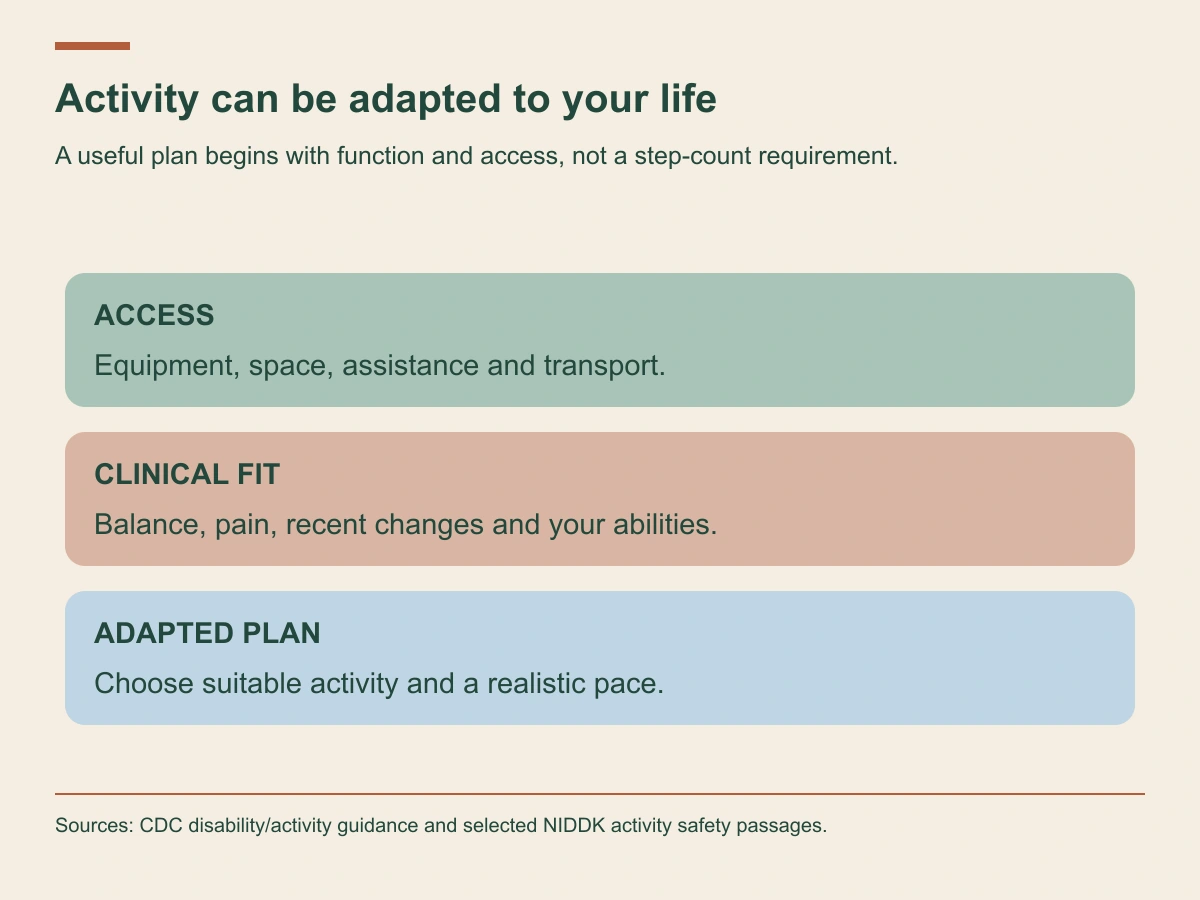
Limited mobility does not require one standard exercise routine while using Ozempic. A useful activity plan should fit your abilities, health conditions, pain, balance, equipment and access to support. Treatment decisions and movement decisions both need individual assessment; neither a step count nor a medication name predicts your weight response.
Adapted activity can include seated options, accessible community programs or professionally guided exercise, depending on the person. The aim may be better daily function, confidence or participation as well as general health. You do not have to make walking your only measure of progress.
Start with what “limited mobility” means in your life
Mobility limitations differ. Someone recovering from surgery, someone with joint pain and someone who uses a wheelchair may have very different needs. Even two people with the same diagnosis may differ in strength, fatigue, balance, sensation and available help.
Describe the activities that are difficult and those that are manageable. Can you sit comfortably? Are transfers painful or tiring? Is standing safe? Do symptoms change during the day? Is there a recent change that needs medical assessment before you try more activity?
CDC recommends discussing appropriate activity with a healthcare professional or a qualified physical activity specialist. Its disability guidance emphasizes matching options to abilities and supporting daily living and independence. CDC activity guidance.
Ask which clinician or therapist should help develop the plan. A general online workout cannot assess a healing joint, a balance problem or the equipment you use. If you already have a rehabilitation plan, coordinate changes with that team rather than adding another routine without review.
Ozempic is a prescription, not an exercise requirement
The current Ozempic injection label describes adult type 2 diabetes treatment and specified cardiovascular and kidney-risk indications in defined adult populations. A mobility limitation alone does not establish an Ozempic indication. Ozempic prescribing information.
Other products and formulations have different indications. Our GLP-1 product overview explains why the exact prescription matters. The online weight-loss prescription guide describes the information to discuss when exploring treatment.
Tell the prescriber about your mobility needs as part of the appointment. They may affect how you obtain medicines, attend follow-up, handle an injection device or organize meals. These practical issues deserve attention even when the prescription is being assessed for another condition.
Do not interpret an inability to complete a generic workout as a medication failure. Likewise, taking medicine does not remove the need to assess new weakness, falls, pain or a decline in ordinary function.
How do general activity guidelines apply?
CDC describes an adult aerobic activity goal of at least 150 minutes of moderate activity per week, with muscle-strengthening activity on at least two days. It also explicitly says that adults unable to meet the guidelines should be active according to their abilities and discuss appropriate amounts and types with a doctor. CDC clinician guidance.
The guideline is a population-level reference. It is not a requirement to begin with a 30-minute session, make up missed minutes, or ignore symptoms. Activity can be accumulated in shorter periods, and an adapted plan may begin well below that general goal.
Ask how to recognize an appropriate effort for your circumstances. Someone with limited upper-body function, cardiopulmonary disease or fatigue may need advice that a generic “walk briskly” instruction does not provide. Your plan should be understandable enough to follow on an ordinary day.
Consider options with the right assessment
CDC lists examples such as hand-crank cycling, aquatic activity, wheeling a wheelchair and adapted sports. NIDDK discusses seated dancing, recumbent cycling and water workouts in its broader activity guidance. CDC options, NIDDK activity information.
These are possibilities to ask about, not a menu that is safe for everyone. Pool access involves transfers and supervision; seated activity still requires appropriate positioning; and equipment must fit the person using it.
| Area | Question for the clinician or therapist |
|---|---|
| Seated activity | What seating, support and movements fit my balance and abilities? |
| Strength work | Which muscle groups and equipment can I use safely? |
| Water activity | Are access, transfers, temperature and supervision suitable? |
| Wheeling or cycling | Does the equipment fit, and are repetitive movements appropriate? |
| Home activity | Which everyday tasks can fit the plan without creating a fall risk? |
| Group programs | Are the space, instructions and support genuinely accessible? |
Choose an option you can reach and enjoy. An attractive program that requires inaccessible transport or unavailable assistance may be less useful than a suitable home option. The practical plan should include access, not just a list of movements.

Strength and daily function deserve their own goals
A scale does not show how easy it is to get dressed, carry a usual object, move around the home or transfer with your usual level of assistance. Ask which functional changes are useful to follow and how to assess them safely.
Our strength-training guide discusses function and gradual progression. Its general examples should be adapted to your existing restrictions and clinical plan. Increasing difficulty without appropriate assessment can work against the goal of making daily life more manageable.
If you notice new weakness or need more assistance than usual, report the change. Do not assume every change is inevitable with weight loss or that simply adding protein will explain it. Illness, pain, inadequate intake, inactivity and other medical issues may all need consideration.
Ask the therapist how to distinguish ordinary effort from symptoms that should stop a session. You should also know whom to contact when a change persists between sessions. A clear follow-up route helps prevent a small difficulty from becoming a reason to abandon the whole plan.
Use walking only when it fits your abilities
Walking may be appropriate for some people, with or without an assistive device. For others, wheeling or a different activity is more suitable. A universal daily step target can leave out meaningful activity and create an unhelpful comparison.
Our walking guide and walking after meals article can support questions if walking is part of your plan. They do not replace assessment of balance, pain, a recent injury or a device you have been prescribed.
Track the activity that matters to you in a practical way. That might be the sessions you complete comfortably, how often you participate in an accessible activity, or a therapist’s agreed function measure. Do not test a difficult transfer or balance task alone merely to create a progress number.
Meals and fluid intake are part of the discussion
When appetite changes, consider whether you still manage regular, adequate meals. Shopping, lifting cookware, standing to prepare food and opening packages can each be a barrier. Those challenges should be included in nutrition planning.
Discuss practical options such as seated preparation, easy-to-handle containers, assistance with shopping or meals that require less work. These are organizational ideas, not assumptions about what equipment or support you have. A dietitian or occupational therapist may help address the particular problem.
Our balanced-meals guide and semaglutide, protein and muscle article organize food and function questions. The water and drinks guide addresses hydration without a universal fluid target.
Ozempic’s label warns about dehydration-related kidney injury when gastrointestinal effects lead to fluid loss. Ozempic volume-depletion warning. Persistent vomiting, difficulty keeping fluids down or a substantial decline in intake needs medical review, not an instruction to push through more exercise.
Plan for symptoms and variable days
NIDDK advises stopping activity and seeking help for warning signs such as chest discomfort, extreme breathlessness or dizziness. Activity safety guidance. Severe or sudden symptoms warrant appropriate urgent assessment; do not wait to finish a session or blame the medication automatically.
Ask the care team how to manage days when pain, fatigue or digestive symptoms are worse. The plan may need flexibility, but this article cannot prescribe a dose change, a compensatory workout or a required recovery interval.
If you use insulin or another medicine that can cause low blood sugar, ask about your established monitoring and activity plan. The Ozempic label identifies increased hypoglycemia risk with insulin or insulin secretagogues. Ozempic glucose warning. Do not change those medicines simply because an activity routine changed.

A practical appointment checklist
Bring a short description of current activity, the tasks you want to make easier, your main symptoms, and any equipment or assistance you use. Include recent falls, surgery or changes in your usual level of function.
Also bring the complete medicine list and the actual injection product if device handling is a concern. Ask whether positioning, hand function, vision or assistance changes how the treatment should be administered. Follow training for the prescribed device rather than adapting an unfamiliar pen yourself.
Finally, identify access barriers: transport, cost, bathroom availability, fatigue during travel, or a lack of suitable space. These details make the plan more realistic. A program should fit your life closely enough that you can participate without repeatedly solving the same obstacle.
Frequently asked questions
Can I benefit from activity without walking?
CDC recognizes adapted activity and ability-based participation. The appropriate form depends on your circumstances, so ask about options that support your goals. Wheeling, seated activity or another suitable approach can belong in the discussion. A step count does not capture every kind of movement or define everyone’s health progress.
Will Ozempic work if I cannot exercise much?
No general article can predict your treatment response. The prescriber should assess the indication, the exact product, relevant clinical measures and follow-up. Discuss activity according to your abilities, along with meals and function. Avoid promises that medication guarantees a particular result regardless of all other circumstances.
Are chair exercises automatically safe?
No. Sitting does not eliminate concerns about balance, positioning, pain, repetitive movement or the condition affecting mobility. Ask a qualified professional which movements and supports fit your situation. Stop and seek appropriate advice when a new symptom or difficulty arises.
Where can adults explore medication care?
The CoreAge Rx semaglutide page explains the service. Consultation must determine eligibility and the exact prescription. Discuss accessibility and existing care needs as part of that assessment; a product page does not establish suitability or a particular brand prescription.
Educational information for adults; individual treatment decisions require a qualified clinician. Sources reviewed October 3, 2026. Original AI-generated article images depict fictional people and objects, not patient outcomes. Other editorial images are illustrative. Graphics summarize the cited sources.