Walking after a meal can be a manageable way to add movement to your day. Small studies suggest that timing activity after eating can improve short-term blood sugar responses in some settings. That does not establish a special fat-burning window or guarantee weight loss. A useful walking routine fits your mobility, treatment plan, schedule, and ability to repeat it comfortably.
What does walking after eating actually help with?
There are two different questions: whether a walk changes the glucose response to a meal, and whether a routine helps you reach a longer-term weight goal. A study measuring glucose for a few hours can answer part of the first question. It cannot, by itself, predict how much weight someone will lose over months.
The practical appeal is straightforward. A meal is an existing event in your day, so pairing it with movement can make a habit easier to remember. A short walk may be more realistic than finding a separate long exercise session. You can build a routine around that convenience without treating it as a precise metabolic prescription.
For the larger role of movement, see our walking for weight management guide. The most useful routine is one you can continue as your schedule and health needs change.
What the walking studies measured
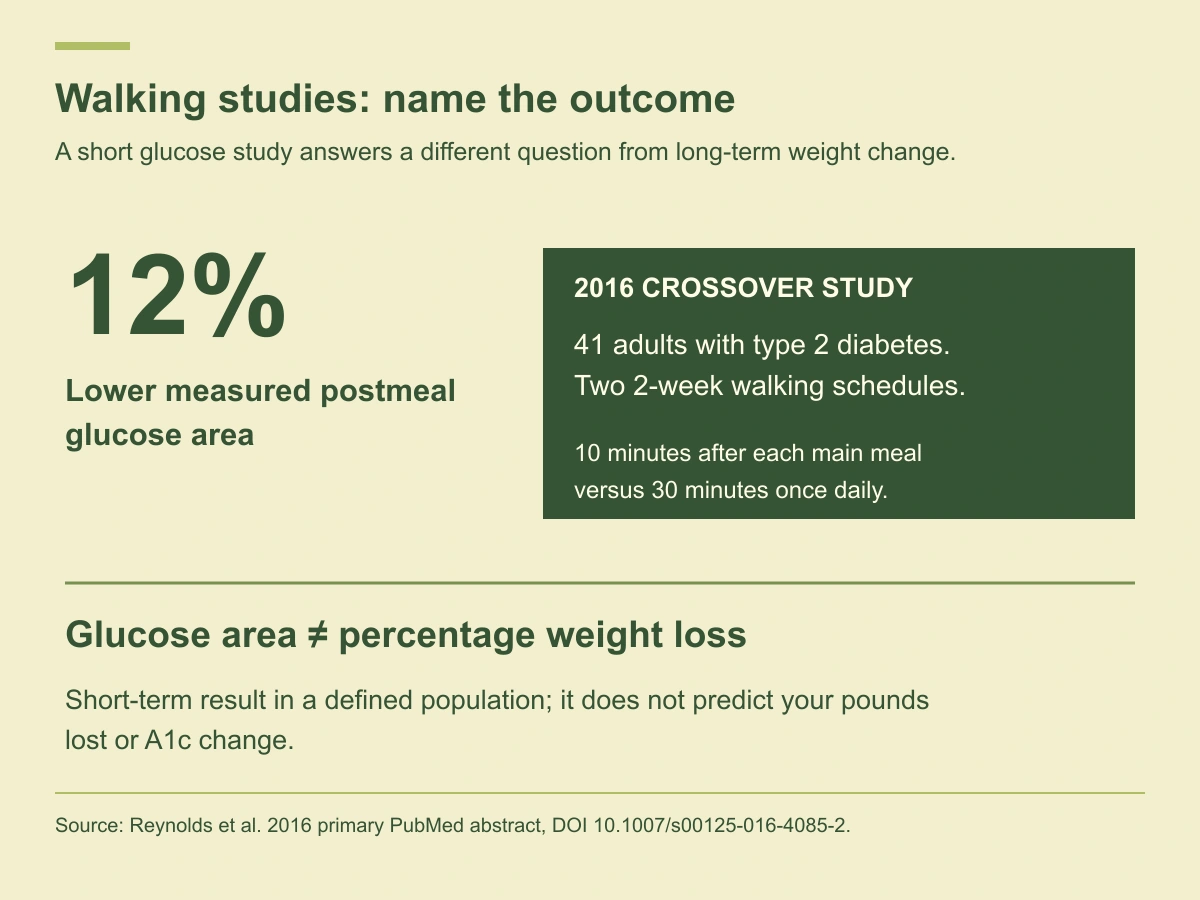
One randomized crossover study included 41 adults with type 2 diabetes. Participants followed two different two-week walking schedules: ten minutes after each of three main meals, and thirty minutes once a day without a specified meal time. The researchers measured glucose with continuous monitoring. Three-hour incremental postmeal glucose area was about 12% lower during the after-meal walking schedule. Reynolds and colleagues, 2016.
That result refers to the area of the glucose response over a defined period. It is not a 12% reduction in body weight, a 12% change in A1c, or a promise that everyone’s glucose reading will fall by that amount. The study was short and involved a specific group with diabetes. Its schedules can inform a conversation, but they do not establish the ideal schedule for every reader.
A 2025 crossover study involved twelve healthy young adults and a glucose drink. It compared walking conditions with sitting and measured short-term glucose responses. A glucose drink is a controlled test, not the same experience as every mixed meal. The 2025 study.
A separate 2022 publication described two crossover studies with twenty-one healthy volunteers in total, using mixed meals or glucose drinks and brisk walking. Again, the outcome concerned postmeal glucose, rather than a long-term weight-loss program. The 2022 studies.
| Evidence | What it can tell you | What it does not establish |
|---|---|---|
| Short crossover trial in adults with type 2 diabetes | Meal timing of walking can affect measured postmeal glucose in that population. | A universal glucose reduction or weight-loss percentage. |
| Small studies in healthy volunteers | Movement after a defined meal or glucose load can alter short-term responses. | The exact effect after your usual meals or with your medicine regimen. |
| General adult activity guidance | Regular aerobic and strengthening activity supports health. | A requirement to do all exercise immediately after meals. |
Do you have to walk immediately?
There is no single waiting interval that these studies establish for all people and meals. Their protocols differed in timing, duration, intensity, and what participants consumed. A study’s clock is part of its design; it should not become a rigid rule that makes an ordinary routine difficult.
For everyday planning, consider how you feel after eating and whether movement is comfortable. If a full meal makes you feel nauseated or uncomfortable, do not force a brisk walk to satisfy a timer. Persistent pain, dizziness, or other concerning symptoms call for assessment rather than a different walking schedule.
You can choose a repeatable cue: after putting away lunch dishes, during a break after dinner, or after an evening phone call. Consistency does not require hitting an exact minute after the last bite. If you have diabetes, ask your care team whether meal and medication timing change the advice for you.
How long should a postmeal walk be?
The ten-minute schedule in the diabetes trial is one studied approach. It is not a minimum duration below which movement has no value. CDC recommends that adults work toward at least 150 minutes of moderate-intensity aerobic activity a week, together with muscle strengthening on at least two days. Activity can be divided into shorter periods. CDC adult activity overview.
If you are starting from little movement, a route that feels manageable may be more useful than copying a research protocol on day one. Think about a comfortable loop, appropriate shoes, and an easy way to return home. Adjust the route for weather, fatigue, and mobility. Increase the routine with your health needs in mind rather than chasing a precise calorie display.
A slow stroll and a brisk walk do not necessarily count the same way toward moderate-intensity minutes. Still, an easy walk can be a reasonable starting habit. Your clinician can help adapt activity if you have heart symptoms, balance problems, nerve damage, or an injury.

Does walking after dinner burn more fat?
The cited studies do not establish a special after-dinner fat-loss advantage. They measured glucose responses under defined conditions. Weight changes depend on a broader pattern of intake, activity, treatment, sleep, and individual circumstances over time.
It is also easy to overinterpret a watch’s calorie number. A displayed estimate is not a direct measurement of the exact energy deficit created by that walk. Avoid automatically subtracting the number from food intake or treating movement as a requirement to earn dinner. Our exercise calorie guide explains the difference between a device estimate and a reliable weight prediction.
The net-calorie article adds context about exercise estimates and intake calculations. A postmeal routine can have value even when you do not count calories for each walk.
Diabetes medicines make the safety plan important
Physical activity can lower blood glucose. NIDDK highlights greater low-glucose risk for people using insulin or medicines such as sulfonylureas, and recommends discussing monitoring and medication or carbohydrate needs with the care team. Glucose effects can continue beyond the activity itself. NIDDK diabetes activity guidance.
Before making a new daily routine, ask what readings or symptoms should change your plan, what treatment to carry, and when to check glucose. Follow your existing low-glucose instructions if symptoms arise. Do not independently reduce insulin, skip meals, or change prescribed diabetes treatment to make a walk fit a schedule.
Foot care matters too. Comfortable footwear, attention to skin problems, and advice about neuropathy or balance can make a routine safer. If you have an active foot problem, a clinician may recommend another kind of movement. The goal is appropriate activity, not completing a route despite warning signs.
What if you use semaglutide or tirzepatide?
A walking routine can be part of daily life during a prescription, but nausea, vomiting, diarrhea, and reduced intake may affect how you feel. Give the care team the full medicine list, particularly if insulin or another glucose-lowering treatment is also involved. Treatment-related symptoms need their own plan.
Avoid making the walk a test of whether your medicine is working. Feeling less hungry, walking farther, and having a lower scale reading are different observations. Record the things that matter to your goals, such as being able to move comfortably after work or maintaining a routine during a busy week.
Our articles on semaglutide, protein, and muscle and tirzepatide, protein, and muscle explain why food intake and strength training deserve attention alongside aerobic movement. A walk does not answer every question about maintaining strength during weight management.
Make the routine fit real life
You do not need a scenic trail. A short indoor route, accessible hallway, safe sidewalk, or another appropriate setting may be easier to repeat. Decide in advance what you will do when it rains or gets dark. If work limits your break time, consider which meal offers the most practical opportunity.
Try tracking completion and comfort rather than judging every walk by speed. A simple note about energy, symptoms, and whether the route fit your schedule can help you adjust. If the routine repeatedly feels like a burden, shorten it or discuss an alternative instead of abandoning all movement.
Pair the habit with meals that suit your needs. Our balanced-meal guide and meal-prep ideas offer starting points for planning. Walking should complement eating adequately, not compensate for skipping meals or force a restrictive intake target.

Where strength training and supplements fit
CDC’s recommendations include strengthening activity as well as aerobic movement. That is a reason to think about the whole week rather than asking one short walk to accomplish every fitness goal. The appropriate exercises depend on your experience, mobility, and health history.
If you are comparing supplements, our creatine-versus-protein guide explains the distinction. Strong Suit is a creatine monohydrate product; it is not protein, a meal replacement, or a requirement for walking. Supplement decisions should follow an appropriate review, especially with kidney disease or other medical concerns.
For readers considering prescription treatment, CoreAge semaglutide and CoreAge tirzepatide describe their respective intake pathways. Those pages do not determine whether a medicine or activity plan is appropriate for you.
Frequently asked questions
Is ten minutes after each meal better than thirty minutes once a day?
The 41-person diabetes study found a more favorable measured postmeal glucose response with its ten-minute-after-each-meal schedule. That specific comparison does not establish the best schedule for every health goal. Choose activity you can repeat and discuss diabetes-specific precautions with your care team.
Can I walk after eating at night?
Consider lighting, route safety, how you feel, and whether the routine disrupts your evening. There is no requirement to walk outside. A suitable indoor option may be more practical. New pain, dizziness, or low-glucose symptoms should change the plan.
Does walking replace medicine?
No study described here supports independently replacing prescribed treatment with a walk. Activity and medical treatment address related but distinct needs. Share changes in your routine and glucose patterns with the clinician managing your prescription.
Can I do another activity instead?
General activity guidance includes several forms of movement. The exact glucose response from one walking protocol cannot automatically be assigned to every alternative. Ask for an activity suited to your mobility and goals; a workable alternative is preferable to forcing painful walking.
How quickly will I lose weight?
The short-term glucose studies cannot answer that question. Evaluate your overall plan and progress over time rather than converting a study’s glucose percentage into pounds. Walking can be a useful habit without producing a guaranteed scale change.
Educational information for adults; individual treatment decisions require a qualified clinician. Sources reviewed October 2, 2026. Original AI-generated article images depict fictional people and objects, not patient outcomes. Other editorial images are illustrative. Graphics summarize the cited sources.