Wegovy before-and-after stories can make weight treatment feel easier to picture, but a photograph cannot tell you the dose, duration, health history, side effects or care behind the change. Clinical trials give a more useful starting point when their population and time frame are stated. Their averages still do not predict an individual’s result.
This guide explains the labeled weight-change findings, what to expect from a timeline discussion, and how to evaluate progress beyond a pair of pictures. It focuses on realistic questions to bring to a clinician, including tolerability, nutrition, ongoing treatment and access.
What did the major injection trial find?
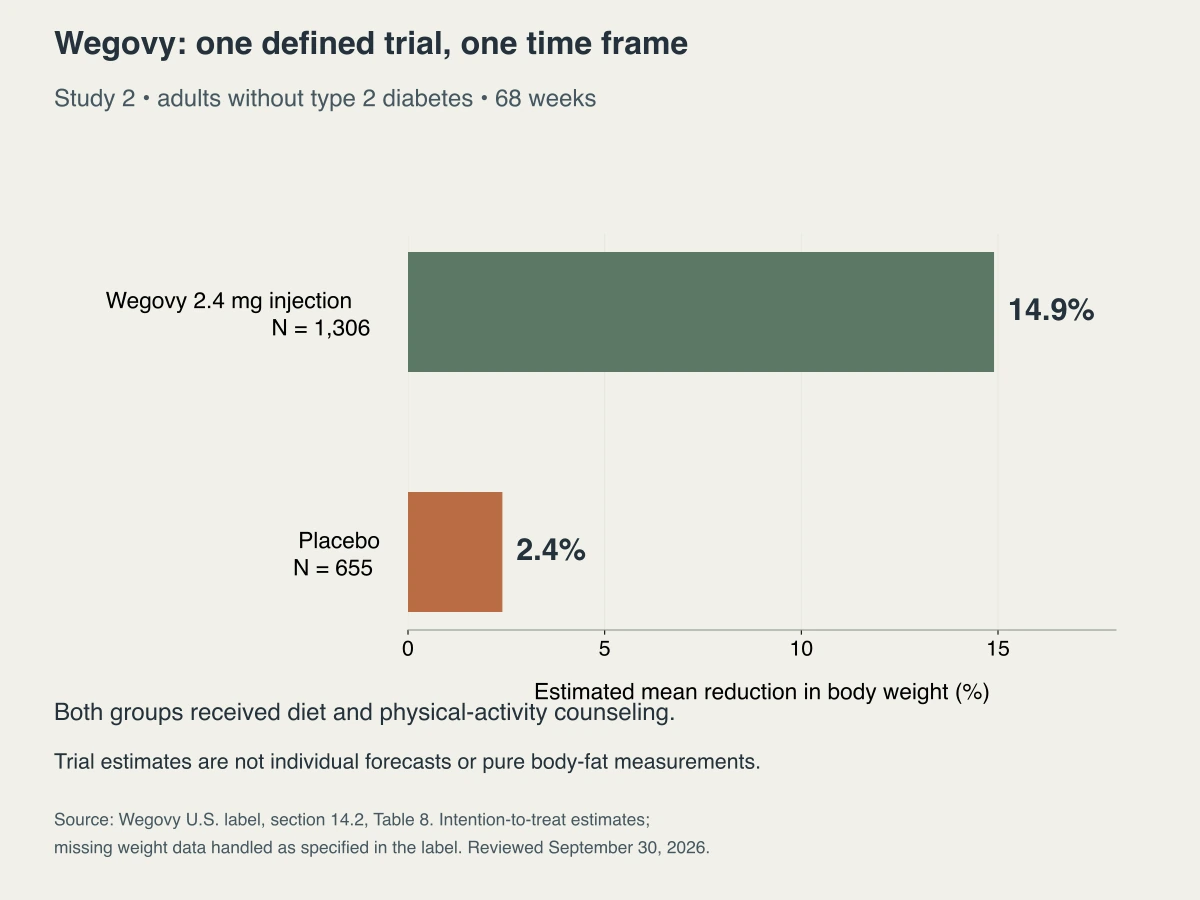
In Study 2 in the current Wegovy prescribing information, 1,961 adults with obesity or overweight and a weight-related condition were randomized to Wegovy injection or placebo. People with type 2 diabetes were excluded. At 68 weeks, the estimated mean body-weight change was −14.9% with Wegovy 2.4 mg injection and −2.4% with placebo. Both groups received reduced-calorie diet and physical-activity counseling. Wegovy label, section 14.2, Table 8.
The randomized groups included 1,306 people assigned to Wegovy and 655 assigned to placebo. The analysis includes all randomized participants and uses specified methods for missing weight measurements. It is not simply the average of a few people whose transformations were selected for an advertisement.
A 14.9% change is a percentage of starting body weight, not 14.9 pounds. For a purely illustrative starting weight of 200 pounds, 14.9% equals 29.8 pounds. That calculation helps interpret the percentage; it is not a forecast that a person starting at 200 pounds will lose that amount.
Why do different trial results appear online?
Wegovy has been studied in different populations and with different treatment programs. Results should be kept attached to those conditions. The same label reports these 68-week findings for 2.4 mg injection:
| Labeled trial | Population or program | Mean change with Wegovy | Mean change with placebo |
|---|---|---|---|
| Study 2 | Adults with obesity or overweight plus a condition; no type 2 diabetes | −14.9% | −2.4% |
| Study 3 | Adults with type 2 diabetes and overweight or obesity | −9.6% | −3.4% |
| Study 4 | Adults without type 2 diabetes, with intensive lifestyle therapy | −16.0% | −5.7% |
Wegovy prescribing information, Table 8.
These were separate trials, not a head-to-head comparison showing that one type of person will always lose a certain amount. The populations, support and methods matter. It would also be misleading to report the medication group’s change while pretending that diet and activity counseling were absent.
The current label includes separate studies of Wegovy tablets and 7.2 mg injection. Their results have different doses, durations and populations. Do not use the familiar 2.4 mg figure as a universal result for every formulation. Current formulation-specific clinical studies.
Does the average describe everyone?
No. An average summarizes a group whose outcomes varied. In Study 2, the label reports that 47.9% of the Wegovy group reached at least 15% weight loss at 68 weeks. That is a defined threshold in that trial, not a claim that every participant achieved the mean result or that every new patient will do so. Wegovy Table 8 threshold outcomes.
Some people respond more, some less, and some cannot continue treatment. A result should be interpreted alongside symptoms, ability to eat and drink, other health goals, adherence and follow-up. A larger change is not automatically the better outcome if the person’s health or nutrition is suffering.
Ask the clinician what would count as useful progress for your situation and when to review it. That is more informative than comparing yourself with the most dramatic image in a search result.
What should you expect in the first month?
The long-term study percentages are not first-month targets. Treatment uses a product-specific escalation plan, and the initial period is also a time to review tolerability and practical routines. Do not accelerate the schedule to imitate a rapid result someone posted online.
Notice how you feel, whether you can eat and drink adequately, how you are using the prescription and whether questions are reaching the care team. Appetite changes and scale changes are not the only information worth recording.
Our semaglutide first-month guide covers useful early-treatment questions. The Wegovy dosage guide provides separate product information; the actual prescription and current formulation instructions should govern your care.
Why can early scale changes look dramatic?
A scale measures total body weight. It cannot show how much of a short-term change reflects body fat, water or other components. Changes in eating, fluid balance and the timing of measurement can affect what you see.
Use a consistent measurement routine if you and your clinician decide tracking is helpful. Avoid repeatedly weighing under different conditions and interpreting every difference as new fat loss or treatment failure. The water weight versus fat-loss guide explains this distinction.
A photo has similar limitations. Clothing, posture, lighting and camera distance can change appearance. A useful private record uses comparable conditions and includes dates. It does not need to become a public transformation story.
For a public-figure example, our guide to Christina Aguilera and weight-loss rumors distinguishes the reviewed body-image comments from unverified medication or weight-change claims.
What should a trustworthy before-and-after account include?
Look for the actual treatment duration, exact product, relevant clinical context and an honest account of the broader care. Ask whether the image represents a real person who consented to its use and whether the result is typical, selected or promotional.
Even an authentic account can omit important information. It may not explain treatment interruptions, side effects, other medicines or how the person ate and exercised. A picture cannot establish that a particular prescription is suitable for you.
The original artwork in this article depicts fictional people and objects for illustration. The graphic summarizes cited trial evidence; it is not a generated patient’s weight-loss result. That distinction makes the visual useful without treating an invented transformation as clinical proof.

Track function, symptoms and nutrition too
Bring the goals that matter to you into the treatment discussion. Those might involve mobility, a particular health condition, comfort with daily activities or another clinician-defined outcome. Do not assume that appearance is the only meaningful measure.
Also review eating and hydration. Lower appetite does not remove the need for adequate nutrition. If meals become very limited, discuss the pattern before it becomes the routine. The semaglutide protein and muscle guide covers related questions about preserving nutrition during treatment.
A simple record can include weight measurements at agreed intervals, symptoms, missed or delayed treatment, and questions for the next appointment. It should help the clinician understand your experience, rather than become a scorecard that encourages you to ignore symptoms.
What if progress slows?
A period of slower change should prompt a review of the full situation. Check the exact product and prescribed use, whether access has been interrupted, how meals and activity fit your needs, and whether symptoms or another health issue are affecting the plan.
Do not increase the dose, combine weight-loss medicines or buy an unverified product to match someone else’s timeline. The semaglutide plateau guide provides questions for a clinical review.
The aim is to decide whether the current approach is appropriate and sustainable. A clinician can assess continued treatment, another option or a different goal. An online average cannot make that decision for you.
What happens when treatment stops?
Maintenance deserves discussion before starting. The label includes a separate trial in which participants first received Wegovy during a 20-week run-in, then eligible participants either continued 2.4 mg injection or switched to placebo. From week 20 to week 68, mean weight changed by −7.9% in the continuation group and +6.9% in the switched group. Wegovy label, Study 5, Table 9.
Those figures are measured from week 20, not the original starting weight. The randomized phase also excluded people who discontinued during titration or did not reach the dose. The label notes that this selected group may not reflect people first starting treatment. Do not combine its percentages with Study 2 to create an invented timeline.
The practical point is to plan ongoing care and any discontinuation with the clinician. Ask about nutrition, follow-up, access and what to do if treatment is interrupted. A “before and after” pair does not show the maintenance work that follows.
Side effects are part of the result
The current Wegovy label includes gastrointestinal adverse reactions and other important warnings. Symptoms that interfere with eating, drinking or daily life deserve review. Severe or persistent abdominal pain, repeated vomiting, inability to keep fluids down or a serious allergic reaction should receive prompt medical attention. Wegovy safety information.
The label also includes specific contraindications, including a personal or family history of medullary thyroid carcinoma or MEN2. Discuss your actual health history, other medicines and pregnancy plans before treatment. A weight-change chart cannot screen for those issues.
Our Wegovy side-effects guide explores common follow-up questions. The best progress assessment includes both benefits and tolerability, rather than counting weight lost while ignoring how the person feels.
How do costs and coverage affect the timeline?
Refill access and recurring costs are practical parts of treatment. Ask about the actual pharmacy quote, benefit requirements, renewal and what happens if availability changes. An affordable first fill does not necessarily establish a workable long-term plan.
The Wegovy cost guide, Cigna coverage article and Medicaid coverage guide explain different payment questions. Use the one relevant to your circumstances, then verify the member-specific answer.
An interruption can also affect the clinical plan. Ask the prescriber about restarting rather than assuming the previous dose remains appropriate after a gap.

Do these results apply to compounded semaglutide?
The cited trials concern the specified branded Wegovy formulations. FDA explains that compounded GLP-1 products are not FDA approved and do not receive the same premarket review as approved medicines. Their outcomes or quality should not be asserted as equivalent because the ingredient name is similar. FDA compounded GLP-1 information.
CoreAge Rx’s semaglutide service page describes an assessment-based compounded option for eligible adults. Review the actual medication source, clinical suitability, price and follow-up with the service. This article’s branded trial chart is not a promised result for that preparation.
Common questions
Can I compare Wegovy pictures with tirzepatide pictures?
Pictures do not create a controlled comparison of medicines. The tirzepatide before-and-after guide covers its own evidence and expectations. A clinician should assess suitable options using more than selected images.
Will I lose the trial average by 68 weeks?
That cannot be promised. The number summarizes a particular trial population and treatment program. Your response, tolerability, access and health goals need individual review.
What is a sensible starting expectation?
Expect a clinical process: assessment, product-specific instructions, review of symptoms and nutrition, and follow-up over time. Use trial evidence to understand possible benefits and limitations, then build a plan around your own health rather than another person’s photograph.
Educational information for adults; individual treatment decisions require a qualified clinician. Sources reviewed September 30, 2026. Original AI-generated article images depict fictional people and objects, not patient outcomes. Other editorial images are illustrative. Graphics summarize the cited sources.