
Cigna may cover a GLP-1 medicine under some plans and circumstances, but the insurer’s name alone cannot tell you whether your prescription will be covered. The answer depends on your particular benefit, the exact drug and formulation, the reason it is prescribed, and any approval requirements. A public coverage policy is useful evidence; it is not a personal approval letter.
This guide explains how to check Wegovy, Ozempic and Zepbound without treating every Cigna plan as identical. It also uses a dated example from Cigna’s actual Wegovy injection policy. Documents were reviewed September 30, 2026; confirm the current rules for your own prescription before making a financial commitment.
Start with the plan, then the medicine
Find the prescription-benefit information attached to your current coverage. An employer plan may have different benefits from another employer’s plan, even when both use Cigna. The organization administering the pharmacy benefit can also matter. Have your member information available when you contact the plan, but do not post those details in a public forum.
Next, identify the medicine precisely. “Semaglutide” is an ingredient name, while Ozempic and Wegovy are product names. “GLP-1” describes a medicine class, not a single covered item. Strength, formulation and the intended clinical use can affect the applicable rules.
Cigna’s public policy explicitly says that the member’s benefit-plan document can take precedence over the general policy. It also distinguishes coverage criteria from treatment guidance. A clinician’s decision that a medicine is appropriate and an insurer’s decision about payment are related but separate questions. Cigna Wegovy injection prior-authorization policy.
Our GLP-1 insurance guide explains the broader process. The medicine-selection guide provides context for discussing options with a clinician before focusing only on reimbursement.
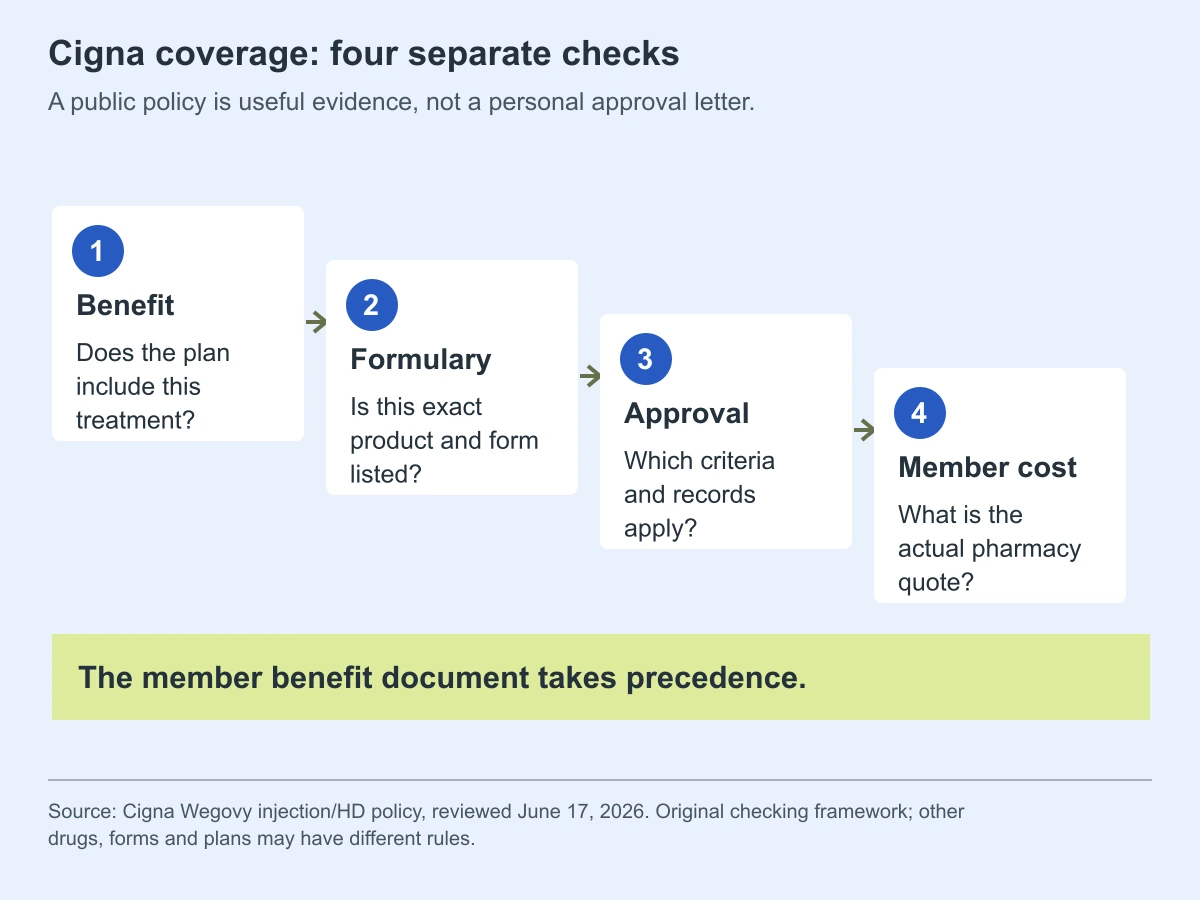
Four checks that determine a useful coverage answer
Ask about these items in order. A favorable answer to one does not settle the next.
| Check | Question to ask | Why it matters |
|---|---|---|
| Benefit | Does my plan include this treatment benefit? | A benefit exclusion can differ from a missing document. |
| Formulary | Is this exact product and formulation listed? | Ingredient names and brand names are not interchangeable entries. |
| Approval | What criteria and records are required for my clinical indication? | Initial approval and renewal may have different requirements. |
| Member cost | What would I pay for this prescription at this pharmacy? | Coverage does not necessarily mean a small out-of-pocket charge. |
Request the document name, effective or review date, and any reference number for the answer. This makes it easier for your prescriber’s office to resolve a discrepancy later. You do not need to memorize the entire formulary; you need the rule that applies to the prescription being considered.
What does Cigna’s Wegovy injection policy actually say?
One current public document reviewed for this article is Cigna’s Wegovy injection prior-authorization policy, reviewed June 17, 2026. It covers Wegovy injection and Wegovy HD injection. It contains separate sections for adult weight management and other specified clinical indications. It should not be substituted for every Wegovy formulation or another medicine’s policy. Actual policy document.
In its adult weight-management section, the initial-therapy pathway specifies an eight-month approval period when all listed requirements are met. Those requirements include adulthood, at least three months of behavioral and dietary measures, qualifying baseline BMI with any required weight-related condition, and continued behavioral measures with a reduced-calorie diet.
The same section has a separate continuation pathway for eligible patients who have completed the initial period. It considers baseline eligibility, at least 5% loss of baseline body weight, and continued lifestyle measures, with a one-year approval period. These are features of the cited policy, not a promise that your benefit includes weight-management drugs or that your own renewal will follow this exact pathway.
The most useful takeaway is the importance of baseline records and renewal timing. A current weight after treatment may not provide all the information a reviewer needs. Ask the prescriber’s office which prior measurements and clinical records are relevant. Do not create a diagnosis, change a medical record or guess missing measurements to satisfy an application.
Does meeting a BMI threshold guarantee approval?
No. BMI can be one criterion within a larger set of requirements. The policy may also address the clinical indication, prior measures, documentation, concurrent treatment or other factors. Your benefit may exclude a category of treatment even when a general clinical policy exists.
It is also possible to need a different policy pathway. The cited Wegovy injection document includes distinct criteria for cardiovascular risk reduction in adults with established cardiovascular disease and overweight or obesity, and a separate section for certain MASH circumstances. Those sections are not interchangeable with the adult weight-management criteria. A clinician should identify the applicable diagnosis and supporting records. Cigna policy by indication.
Do not assume that a different diagnosis can be used simply because one route was denied. The indication needs to describe your actual care. Insurance questions should be resolved through accurate documentation and the plan’s process.
Does Cigna cover Ozempic for weight loss?
Ask about Ozempic, the exact formulation, and the actual reason for the prescription. The current Ozempic injection label has defined adult type 2 diabetes-related indications, including cardiovascular and kidney-risk indications in specified populations. It is not the same label as Wegovy’s weight-management labeling. Ozempic injection prescribing information.
An insurer may apply indication-specific requirements. Approval for one person with type 2 diabetes does not establish coverage for another person seeking weight treatment. A shared active ingredient also does not mean the plan will treat Ozempic and Wegovy as interchangeable.
Ask whether the proposed use is covered, whether a separate prior authorization applies, and whether the prescriber needs to provide particular clinical information. Our Ozempic cost guide explains why cash prices, savings offers and insurance charges need to be considered separately.

What about Zepbound?
Zepbound contains tirzepatide and has its own approved labeling. Its weight-management indication and its indication for moderate-to-severe obstructive sleep apnea in adults with obesity should be distinguished. A coverage answer for semaglutide cannot be transferred to tirzepatide or to every Zepbound presentation. Zepbound prescribing information.
Request the current Zepbound policy applicable to your plan and clinical indication. Ask about preferred alternatives, any previous-treatment requirement, the exact formulation, and renewal. This article’s Wegovy policy example does not establish Zepbound’s criteria.
The Zepbound cost guide and tirzepatide questions guide can help you separate the financial question from the clinical discussion. A medicine that appears more affordable on a public webpage still needs to be appropriate and realistically accessible over time.
What does prior authorization mean?
Prior authorization is a request for the plan to review whether the prescription meets its payment rules. The prescriber usually supplies clinical information, but you may need to help identify the correct benefit, pharmacy or existing records. Ask the office how it tracks submissions and requests for additional information.
Avoid assuming that silence means approval. Find out whether a request was submitted, whether it is complete, and whether the plan has issued a decision. If a pharmacy reports a rejection, ask whether it reflects pending approval, an incorrect claim detail, an excluded benefit or another issue.
A prior-authorization approval also has a scope and duration. Keep its dates and ask when renewal needs attention. A dose or product change may require another review. The Wegovy prescription guide covers preparation for a clinical appointment and the difference between prescribing and payment.
If the claim is denied, identify the reason
Read the written notice rather than relying only on a brief message at the pharmacy. Different reasons suggest different next steps. Missing records may require a complete submission. A product preference may require the clinician to review alternatives or explain why one is unsuitable. A benefit exclusion is a different issue from failing a clinical criterion.
Ask the plan which review or appeal process applies, what information is needed, and what deadline is stated in your notice. Your clinician can help address medical facts. This guide cannot determine appeal rights or predict the outcome for a particular plan.
Keep a simple record: the date, the decision, the document named, the next action and the person or office responsible. That can prevent repeated calls that start from the beginning. Do not stop or switch treatment on your own while the payment question is being resolved.
Covered does not mean free
Once coverage is confirmed, request a pharmacy quote for the actual prescription. Ask how the deductible, copayment or coinsurance applies and whether the pharmacy is in network. A public drug price or another member’s charge does not establish your final cost.
If considering a savings offer, read that offer’s current eligibility and limits separately. Do not assume a discount can be combined with insurance or applied to a government program. The Wegovy cost guide helps frame those questions without promising a universal monthly amount.
Also consider continuity. A first fill is only part of the decision. Ask about renewal, future benefit changes and how to contact the care team if access is interrupted. An affordable introduction can become difficult if the ongoing charge or refill requirements were not understood.

Is compounded semaglutide a covered substitute?
Compounded medication is a separate product category. FDA explains that compounded GLP-1 drugs are not FDA approved and do not receive the same premarket review as approved medicines. A branded medicine’s label, trial findings or coverage policy should not be used as proof of a compounded preparation’s approval, equivalence or reimbursement. FDA compounded GLP-1 information.
CoreAge Rx’s semaglutide and tirzepatide service pages describe assessment-based compounded options for eligible adults. Review the actual service, medication source, total charges and follow-up arrangements with the team. Those pages do not determine whether Cigna will reimburse a prescription.
Questions to bring to your plan and clinician
- What exact medicine, formulation and indication are we checking?
- Is the benefit included in my current plan?
- Which dated coverage document applies?
- What baseline records and prior-treatment details are needed?
- Who will submit the request and respond to missing-information notices?
- What will the actual pharmacy charge be if approved?
- When does approval expire, and what does renewal require?
- If denied, what reason and next process appear in the written notice?
The strongest answer to “Does Cigna cover GLP-1 medicines?” is therefore a documented answer about your plan and prescription. Start with the benefit, verify the product-specific rule, and coordinate the clinical records. That is more useful than a universal yes or no based only on the insurer’s name.
Educational information for adults; individual treatment decisions require a qualified clinician. Sources reviewed September 30, 2026. Original AI-generated article images depict fictional people and objects, not patient outcomes. Other editorial images are illustrative. Graphics summarize the cited sources.