
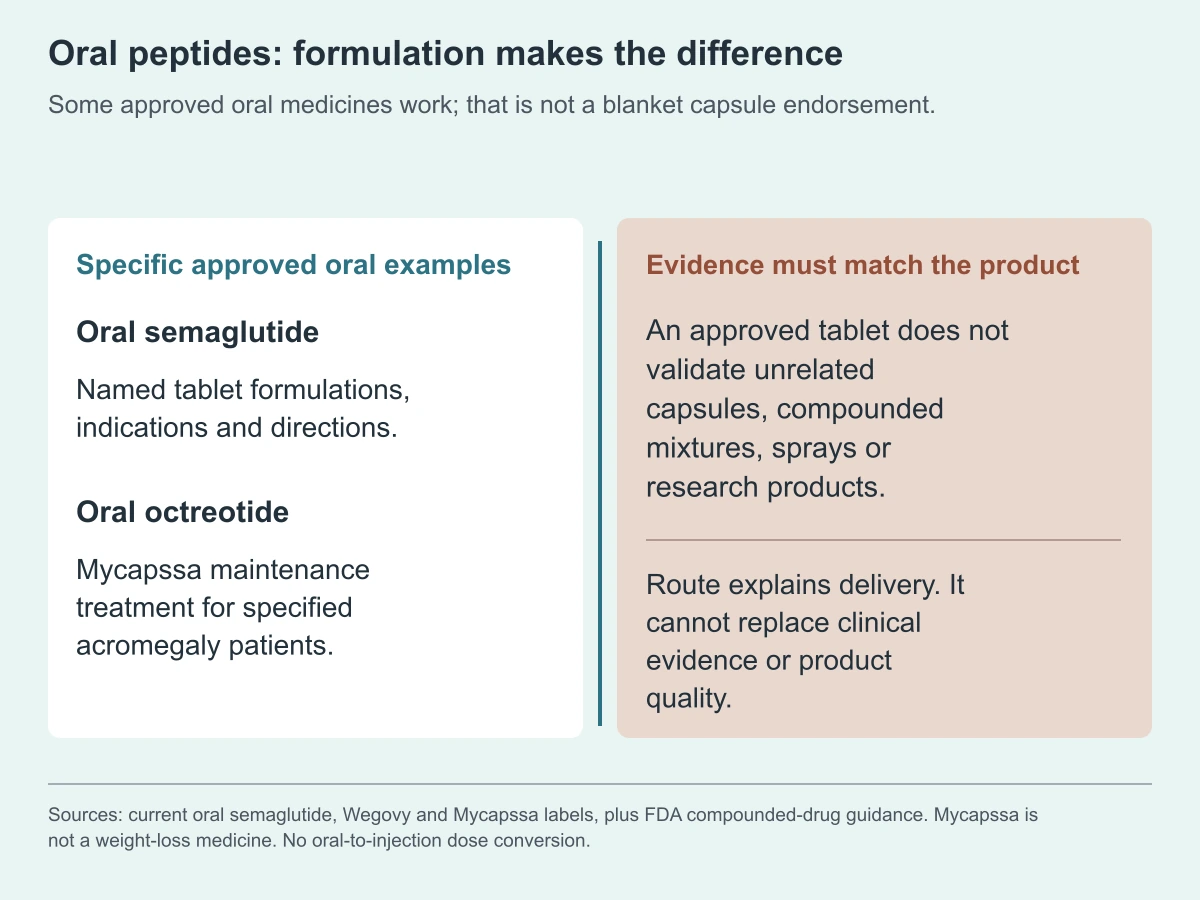
Some oral peptide medicines work because their specific formulations have been developed and tested to address absorption barriers. Others lack that evidence. It is inaccurate to say all oral peptides are ineffective, and equally inaccurate to assume an approved oral medicine validates every capsule, spray, or compounded preparation described as a peptide.
The useful comparison begins with the exact ingredient, formulation, approved indication, and supporting study. Route is one part of that assessment. This guide explains why oral absorption is challenging, how approved examples address it, and which questions help separate established medicines from unsupported product claims.
What is a peptide, and why does swallowing one pose a challenge?
Peptides consist of linked amino acids. Therapeutic peptide medicines need to reach their target in a usable form and at an appropriate exposure. When swallowed, they face digestive enzymes and barriers to movement across the gastrointestinal lining.
An injection can bypass the initial gastrointestinal route, but that alone does not establish effectiveness, quality, or safety. An unapproved injected product does not gain evidence merely because the route avoids digestion. The ingredient and formulation still require appropriate testing.
Conversely, scientists can develop oral formulations designed to address particular absorption barriers. Whether that succeeds is a product-specific scientific question, not a universal conclusion about the word “oral.”
An original semaglutide absorption study illustrates this distinction. It investigated a specific peptide coformulated with an absorption enhancer, rather than an ordinary unmodified capsule of any peptide. Original oral-semaglutide mechanism abstract
How does oral semaglutide address absorption?
The original study describes semaglutide coformulated with the enhancer SNAC. Clinical and preclinical dog studies indicated localized absorption in the stomach near the tablet surface, requiring that coformulation. The authors described protection against enzymatic breakdown and a temporary, compound-specific absorption effect. Semaglutide and SNAC research
This review accessed the original author abstract, not the full paper. It therefore does not invent detailed trial methods or extend the mechanism to every peptide. The finding does not mean digestive barriers have disappeared for all substances sold in oral form.
The practical lesson is about formulation matching. A tested oral semaglutide tablet and an unrelated capsule cannot be treated as equivalent simply because both are swallowed. Nor is the research an instruction to mix an enhancer into a product at home.
Approved clinical labeling adds a separate layer of evidence about the actual medicine’s use. Mechanism research explains how exposure may occur; an approved indication and its studies address treatment for a specified condition.
Which approved oral peptide examples are relevant?
Current U.S. labels provide examples that disprove the blanket claim that peptide medicines must always be injected. The examples also show why one product’s instructions cannot be transferred to another.
| Specific medicine example | What the label establishes | What it does not validate |
|---|---|---|
| Oral semaglutide formulations, including Rybelsus and Ozempic tablets | Product-specific type 2 diabetes uses and administration | Every compounded oral semaglutide preparation |
| Wegovy tablets | A specific oral semaglutide formulation with its own adult indications and directions | Milligram-for-milligram substitution with injections |
| Mycapssa, oral octreotide delayed-release capsules | Long-term maintenance treatment for specified acromegaly patients who responded to and tolerated octreotide or lanreotide | Weight-loss use or unrelated oral peptides |
Sources: oral semaglutide label, Wegovy label, Mycapssa label.
The current combined semaglutide label distinguishes Rybelsus and Ozempic tablet strengths. Using older information that recognizes only one oral brand can create confusion. Check the current package and prescribing information rather than relying on a familiar name.
Mycapssa is a useful example precisely because its clinical purpose is different. It is not a weight-management medicine. Its approval supplies evidence for that particular formulation and indication, not an endorsement of every oral octreotide product or wellness capsule.
Do oral and injectable versions have the same directions?
No. Directions are specific to the actual formulation. The current Wegovy tablet instructions involve morning administration on an empty stomach with no more than four ounces of plain water, followed by a wait of at least 30 minutes before food, drinks, or other oral medicines. Weekly injectable Wegovy has different directions. Route-specific Wegovy administration
Mycapssa’s oral label uses a different fasting interval. That difference reinforces that “oral peptide” is not one standard routine. A pharmacist can help coordinate the actual medicine with meals and other prescriptions. Mycapssa administration information
A tablet’s water instruction concerns the dose, not all-day hydration. Our Wegovy thirst and dry-mouth article explains why that distinction matters when someone is worried about drinking too little.
Do not crush, split, dissolve, change timing, or convert a product based on another medicine’s directions. Ask about any problem following the actual prescribed routine before improvising a different route.
Can you convert oral milligrams into injection milligrams?
Not through a simple home calculation. The amount swallowed and the exposure achieved are different concepts. Formulation, absorption, administration, and the approved treatment schedule all matter.
Even oral formulations containing the same ingredient can have different strength systems and switching directions. The current semaglutide label distinguishes products rather than treating every tablet milligram as interchangeable. Oral semaglutide formulation information
The prescribing clinician should manage any change, including what to do with the previous product and how to monitor the transition. Do not overlap medicines or assume that doubling an oral amount compensates for a missed injection.
Our Wegovy dosage guide, Ozempic dosage guide, and semaglutide questions guide can help you read the label’s structure. They do not supply a personalized conversion.

Is an injection always more effective?
Route alone cannot answer that. Effectiveness should be evaluated for the actual product, population, dose regimen, and clinical outcome. A trial measuring glucose control is not automatically a trial of weight loss, muscle gain, cognition, or healthy aging.
An injection may have a convenient weekly routine for one person and create a practical barrier for another. An oral medicine may remove needles but require administration habits that are difficult for someone’s schedule. Those practical differences belong in the consultation alongside evidence and safety.
Compare the outcome you actually need: symptom treatment, a specific disease measure, or another defined clinical goal. Avoid ranking all injected products above all oral ones using a mechanism diagram alone.
Also ask about tolerability, interactions, monitoring, and continuity. Convenience does not establish that a medicine is clinically appropriate, and inconvenience does not automatically mean it is less effective.
Does a sublingual product solve every absorption problem?
No automatic conclusion follows from the word “sublingual.” A claim about absorption through the mouth needs evidence matched to the ingredient and formulation. Some of the material may be swallowed, and product-specific exposure still needs to be established.
Likewise, “liposomal,” “advanced delivery,” or “high absorption” is not a substitute for an actual study. Ask what was measured, in whom, and whether the product sold matches the formulation studied.
Absorption data also do not establish every claimed clinical benefit. Showing that a substance reaches blood is different from showing a meaningful improvement in function or disease outcomes.
Our Sermorelin versus other peptides guide explains why ingredient names and evidence should be kept separate. A growth-hormone-related claim should not borrow an oral semaglutide absorption result simply because both products are discussed under a peptide heading.
What is different about compounded products?
Compounded medicines are not FDA approved. FDA does not review them for safety, effectiveness, or quality before marketing in the same way as an approved product. They may address a specific medical need, but should not be described as automatically equivalent to an approved brand. FDA compounded-drug information
For GLP-1 products, the FDA identifies concerns including dosing errors, product quality, salt forms, and misleading equivalence claims. Its current guidance recommends using compounded drugs only when medical needs cannot be met by an approved drug. FDA GLP-1 guidance
A product’s route does not remove that distinction. A compounded oral preparation is not validated merely because approved oral semaglutide exists. A compounded injection is not validated merely because approved injectable semaglutide exists.
Ask the clinician to explain the specific medical rationale, pharmacy identity, ingredient and formulation, available evidence, and monitoring. Do not assume a national shortage exception or a personal need based solely on a low advertised price.
What about products sold “for research only”?
A research label does not establish that a product is suitable for personal treatment. The FDA warns against unapproved GLP-1 products sold to consumers under research-purpose or not-for-human-consumption descriptions. Their quality and safety may be unknown. FDA research-product concerns
Do not use an absorption comparison as a way to choose between experimental vials and capsules for self-treatment. The missing issue may be appropriate clinical evidence and legitimate prescribing, not which route appears to be strongest.
Our Sermorelin guide and Sermorelin product guide show how to review a named ingredient and service separately. An article about a product category does not establish that every supplier’s preparation is the same.
How should you compare a clinic’s offerings?
Identify the actual prescription and ask what the service supplies. CoreAge Rx’s semaglutide page and tirzepatide page describe separate offerings. A service name alone does not prove it dispenses an approved oral brand, a particular injection device, or a formulation tested in a study you have read.
For hormone-related products, ask the same formulation questions without transferring unrelated evidence. Our TRT injections versus gel guide covers another route comparison whose clinical evidence needs to stand on its own.
Pricing should also identify the product. The Wegovy cost guide separates tablet strengths, injections, pharmacy payments, and care fees. A low starting price does not establish equivalent exposure or clinical suitability.

A practical evidence checklist
Before accepting an oral or injectable claim, ask:
- What is the exact ingredient and formulation?
- Is the product FDA approved for the condition being discussed?
- Does the cited research test this product, population, and outcome?
- Are the administration and monitoring requirements manageable?
- If it is compounded, what medical need and evidence support that choice?
- Who answers questions or manages adverse effects after prescribing?
Our online prescription guide can help assess the clinical process. A complete answer should be understandable without needing to infer details from a category name.
Common oral-peptide questions
Are all oral peptides destroyed before they can work?
No. Approved oral formulations demonstrate that specific delivery approaches can work. That does not validate unrelated capsules.
Does an absorption enhancer work with every peptide?
The semaglutide research describes a compound-specific formulation. Do not generalize it to every ingredient or make a mixture at home.
Is swallowing easier than injecting?
It may be for some people, but food, water, timing, tolerability, and the indication also matter. Compare the actual routine.
What is the most important distinction?
Evidence must match the product and outcome. Route helps explain delivery; it cannot replace clinical proof, product quality, or an appropriate prescribing decision.
Educational information for adults; individual treatment decisions require a qualified clinician. Sources reviewed October 1, 2026. Original AI-generated article images depict fictional people and objects, not patient outcomes. Other editorial images are illustrative. Graphics summarize the cited sources.