
Blood pressure can change during semaglutide treatment, but Ozempic is not labeled as a medicine for treating hypertension. Research on semaglutide, changes in weight or intake, gastrointestinal symptoms, and existing blood-pressure medicines can all be relevant. A lower reading is not a reason to stop another prescription on your own.
If readings change, record them using a reliable technique and include any dizziness, faintness, vomiting, diarrhea, or other symptoms. Your clinician needs that context to decide whether the change is helpful, concerning, or related to something else.
Is Ozempic approved to lower blood pressure?
Ozempic’s current label includes specific uses in adults with type 2 diabetes, including glucose control and certain cardiovascular and kidney outcomes. It does not list treatment of hypertension as an indication. Ozempic prescribing information
A cardiovascular-risk indication is not the same as a claim that the drug replaces blood-pressure treatment. Similarly, an average pressure change in a study does not establish that the medicine is the best hypertension therapy for an individual.
Ask which treatment goal applies to you. Glucose control, cardiovascular risk, kidney health, weight goals, and blood pressure may all be part of care, but they should not be collapsed into one outcome. Our semaglutide questions guide provides a starting point for that discussion.
What does research show about semaglutide and pressure?
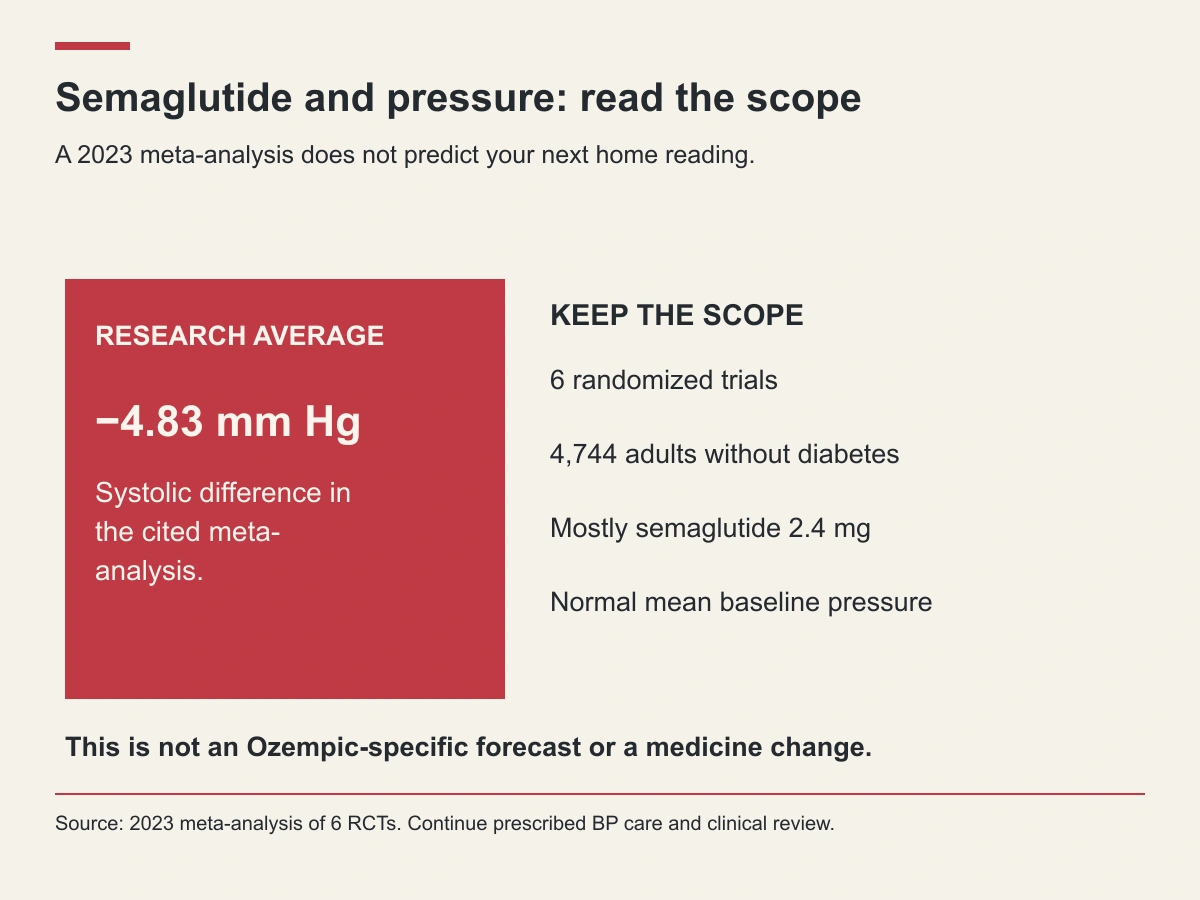
A 2023 systematic review and meta-analysis combined six randomized trials involving 4,744 adults without diabetes. The average between-group reduction was about 4.83 mm Hg for systolic pressure and 2.45 mm Hg for diastolic pressure. Most included trials studied semaglutide 2.4 mg, and the cohorts had mean baseline blood pressures in the normal range. 2023 semaglutide blood-pressure meta-analysis
The population and formulation context matter. These results are not an Ozempic-specific prediction for a person with type 2 diabetes, and they do not mean every participant’s pressure fell by the same amount. The review also noted greater variation between studies for the diastolic result.
| Research detail | What it means for interpretation |
|---|---|
| Six randomized trials, 4,744 adults without diabetes | The analysis does not directly describe every Ozempic-treated diabetes population |
| Most trials used semaglutide 2.4 mg | The result should not be assigned automatically to every product or dose |
| Mean baseline pressure was normal in the cohorts | It is not a personal forecast for uncontrolled hypertension |
| Average systolic difference about −4.83 mm Hg | An average comparison, not a promised individual reduction |
| Trials lasted approximately 52–104 weeks | The result is not a timetable for next-day pressure changes |
Use the finding to inform questions, not calculate your next reading. If you need hypertension treatment, your clinician should evaluate that condition directly.
Why might a lower reading be concerning?
Some people have lower readings without concerning symptoms. Others experience dizziness, faintness, confusion, fatigue, or blurred vision. The American Heart Association emphasizes symptoms and context when discussing low blood pressure. AHA: low blood pressure
During Ozempic treatment, persistent vomiting or diarrhea and difficulty drinking are relevant because the label warns about volume depletion and associated kidney injury. Ozempic prescribing information A sudden symptomatic change should not automatically be described as a beneficial medication effect.
Tell the clinician whether the reading is unusual for you and what was happening at the time. A low number after illness or poor intake raises a different question from a gradual change in repeated readings while you feel well.
Our Ozempic dizziness guide and semaglutide nausea and vomiting guide help organize the symptom history. Do not use the scale or a single reading to decide whether you are dehydrated.
What if you take blood-pressure medicine?
Keep your prescriber informed about changes in home readings, symptoms, intake, and weight. The AHA says not to stop blood-pressure medicine based on home readings without checking with your healthcare professional. AHA: home blood-pressure monitoring
The care team may need to review the whole regimen. That includes diuretics, other pressure medicines, and medicines taken for unrelated conditions. A statement that two drugs have no obvious online interaction does not address every practical concern about symptoms or volume status.
Ask who is coordinating the plan if different clinicians prescribe your medicines. A shared medication list and reading log can reduce confusion about which treatment changed and why. Do not make several dose changes at once without a supervised plan.

Ozempic and hydrochlorothiazide
Hydrochlorothiazide is a diuretic used for high blood pressure and some fluid-retention conditions. It helps the kidneys remove water and salt. Its patient information also discusses dehydration and electrolyte-related warning symptoms. MedlinePlus: hydrochlorothiazide
That is a reason to review active vomiting, diarrhea, poor intake, or dizziness with the care team when both medicines are part of your regimen. It is not a universal conclusion that the combination is prohibited, nor a personal clearance to continue through significant symptoms.
Bring the exact doses, other medicines, recent changes, and home readings. Ask whether you need laboratory assessment or specific instructions during illness. Do not stop hydrochlorothiazide because Ozempic seems to have lowered your pressure, and do not change fluid or salt intake substantially without considering your prescribed plan.
How to take useful readings at home
The AHA recommends an automatic upper-arm cuff monitor, an appropriate cuff size, and a validated device. Ask your clinician or pharmacist for help selecting and checking it. A poorly fitting cuff or inconsistent technique can make readings misleading. AHA: home monitoring
Before measuring, avoid smoking, caffeinated beverages, and exercise for 30 minutes, empty your bladder, and rest quietly for at least five minutes. Measure on a bare arm, support it at heart level, and follow the monitor’s instructions. Take two readings one minute apart and record them.
Keep the routine consistent enough that comparisons are useful. Include the date, time, symptoms, and any unusual circumstances. One reading is a snapshot; a series gives the clinician a better picture.
The article’s monitor photograph is illustrative and has no displayed result. It is not a demonstration of cuff placement or a claim that a particular reading is safe. Use the actual device instructions and clinical training for measurement.
What if the reading is high?
A high reading should not be assumed to be caused by Ozempic. Check the measurement technique, record the result, and follow the plan your clinician has given you. If an ordinary reading is higher than expected, the AHA advises repeating it and discussing the pattern with the healthcare professional. AHA: home monitoring
The AHA identifies readings above 180 systolic and/or 120 diastolic as needing immediate attention. Without emergency symptoms, wait at least one minute, retest, and contact your healthcare professional immediately if it remains very high. With symptoms such as chest pain, shortness of breath, weakness, vision change, or difficulty speaking, call 911 rather than waiting for the pressure to come down.
Do not delay urgent care to decide whether a medication is responsible. Our Ozempic chest pain and palpitations guide addresses related warning signs, but a web article does not replace emergency assessment.
What to discuss at follow-up
Bring the monitor if the clinician wants to check technique or compare it with office equipment. Include the reading log, full medication list, recent gastrointestinal symptoms, and any change in your ability to eat or drink.
Ask what range and symptom pattern should prompt a call in your particular circumstances. A personalized plan is more useful than adopting an online target intended for someone with a different history.
If testosterone therapy is also part of your care, our TRT and blood-pressure guide covers another medication-specific monitoring question. Do not attribute every pressure change to the newest prescription without reviewing the rest of the regimen.
Common questions about Ozempic and blood pressure
Does Ozempic always lower pressure?
No. An average study result is not a guarantee. Your readings depend on multiple factors, and symptoms or a sudden change need their own assessment.
Can it make my blood pressure too low?
Low pressure symptoms can occur in many circumstances, including dehydration and other medicines. Report the readings and symptoms so the care team can assess the cause and plan. Do not diagnose the cause from timing alone.
Should I take Ozempic instead of a hypertension medicine?
No substitution is established by its label or the research discussed here. Continue prescribed treatment and ask your clinician about any proposed change.
Does feeling dizzy mean my pressure is low?
Dizziness has several possible explanations, including glucose-related problems in some treatment combinations. A symptom alone cannot identify the cause. Use appropriate measurements and clinical advice rather than assuming a pressure change.
Can weight loss change my existing treatment needs?
It may prompt a review, but the decision needs repeated readings, symptoms, and clinical context. The practical step is follow-up, not an automatic dose reduction.
The CoreAge Rx semaglutide page provides information for a treatment conversation. Bring your blood-pressure questions to that conversation alongside the actual diagnosis, medicines, and monitoring plan.
Educational information for adults; individual treatment decisions require a qualified clinician. Sources reviewed October 3, 2026. Original AI-generated article images depict fictional people and objects, not patient outcomes. Other editorial images are illustrative. Graphics summarize the cited sources.