
A metallic, bitter, or otherwise strange taste can occur during semaglutide treatment, but timing alone does not establish the cause. Ozempic and Wegovy labeling includes dysgeusia, the medical term for altered taste. Dental problems, dry mouth, other medicines, smell changes, and reflux can also be relevant.
The practical next step is to describe the change, check for accompanying symptoms, and review it with your clinician or dentist when it persists or affects eating. Taste is not a test of whether your semaglutide dose was delivered or whether treatment is working.
What is dysgeusia?
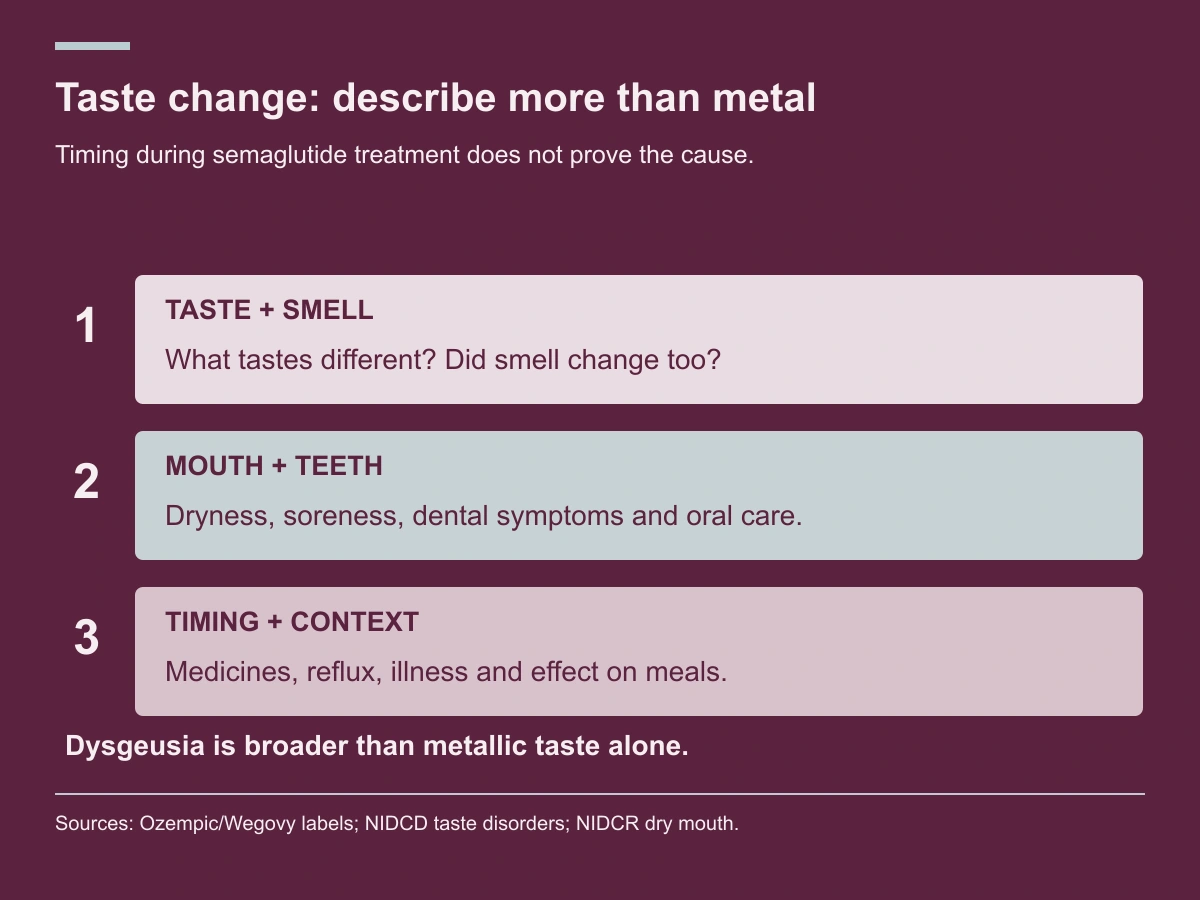
Dysgeusia means a distorted sense of taste. People may describe a metallic taste, an unpleasant taste that remains between meals, or familiar foods tasting different. Losing some ability to smell can also make food seem flavorless or unusual, even when the primary problem is not the taste receptors.
The National Institute on Deafness and Other Communication Disorders explains that taste and smell work together in the experience of flavor. It also lists several possible causes of taste disorders, including certain medicines, infections, dental issues, and oral hygiene problems. A symptom description helps guide evaluation, but it does not identify the cause by itself. NIDCD: taste disorders
“I taste pennies all day” and “food tastes different only when I eat” are useful distinctions. So are changes in smell, mouth discomfort, and when the symptom first appeared. Try to use your own description rather than forcing it into a term you found online.
What do Ozempic and Wegovy studies actually report?
The Ozempic label lists dysgeusia among other adverse reactions reported at a frequency greater than 0.4% in the relevant discussion. It does not give a metallic-taste-only rate there. The Wegovy label reports dysgeusia in 1.7% of treated adults versus 0.5% with placebo in adult weight-reduction trials. Ozempic prescribing information, Wegovy prescribing information
These figures describe a broader category of altered taste in particular studies. They do not tell you the chance of tasting metal after your next injection, establish why it happens, or predict how long an individual symptom will last.
Do not compare the two figures as though the trials used identical populations and methods. Product, dose, indication, and trial context matter. Our semaglutide product questions guide explains why semaglutide is an ingredient shared by distinct products rather than a single universal treatment routine.
What details help separate possible explanations?
Start with a timeline. Include the start of treatment, recent dose changes, dental work, an illness, and changes to prescription or nonprescription medicines. Avoid changing several things at once just to see whether the taste disappears; that can make the history harder to interpret.
| Observation | Information to bring to the care team |
|---|---|
| Taste persists between meals | When it begins, how long it lasts, and whether it wakes you at night |
| Foods taste wrong but smell also changed | Recent illness and whether familiar odors are different |
| Mouth feels dry or sticky | Drinking pattern, other medicines, swallowing difficulty, and oral discomfort |
| Sour taste or regurgitation | Relation to meals, lying down, and reflux symptoms |
| Tooth or gum symptoms | Pain, bleeding, swelling, dentures, and recent dental treatment |
| Several medicines recently changed | Names, doses, and the dates each change occurred |
This table is a conversation aid, not a diagnostic checklist. More than one issue may be present. You can have a dry mouth and reflux, for example, without knowing which contributes most to the taste change.
Could dry mouth be involved?
Saliva helps with tasting, swallowing, and oral health. A persistently dry mouth can therefore be relevant to an altered taste. NIDCR lists several possible causes of dry mouth, including some medicines and health conditions, and recommends clinical or dental evaluation when needed. NIDCR: dry mouth
That does not establish that semaglutide directly causes every dry-mouth complaint. Review your full medication list, mouth symptoms, and fluid intake rather than assuming a single mechanism. If nausea or vomiting has reduced your ability to drink, tell your prescriber about those symptoms as well.
Small sips of water and appropriate oral care may be helpful while you arrange advice. NIDCR also discusses sugar-free gum for people who can use it safely. Individual fluid restrictions still apply; avoid adopting a fixed daily water target from a general article.

Could reflux explain a bad taste?
Reflux can bring stomach contents into the throat or mouth and may cause a sour or unpleasant taste. NIDDK describes regurgitation and other symptoms that may accompany gastroesophageal reflux. That is a possible explanation to discuss, not proof that reflux is responsible for a metallic taste. NIDDK: reflux symptoms
Note whether the symptom follows meals, appears when you lie down, or occurs with burning, belching, or nausea. Our Ozempic burping and reflux guide covers related symptom questions. Omeprazole and Ozempic discusses medication review rather than assuming everyone needs an acid-reducing drug.
Do not start a reflux medicine solely because you have an unusual taste. A dental issue or another medicine may need a different response. Difficulty swallowing, persistent vomiting, bleeding, or concerning pain deserves assessment rather than repeated changes to food or over-the-counter products.
What about other medicines and dental problems?
Bring a complete medication list to the review, including supplements, mouth products, and any recently prescribed antibiotic. NIDCD identifies some medicines among possible causes of taste disorders. Which medicine matters for you requires a review of the actual product and timeline. NIDCD: taste disorders
Dental evaluation is especially useful when taste changes occur with tooth pain, gum symptoms, mouth sores, or a persistent oral complaint. Do not assume a new medication explains an issue that also needs dental care.
If you are taking an antibiotic, avoid attributing all symptoms to semaglutide. Our doxycycline and semaglutide guide shows how separate medicine instructions and gastrointestinal symptoms can affect the conversation. The relevant comparison is your actual regimen, not a broad list of every drug that might change taste.
What can you do while arranging a review?
Keep up with routine oral hygiene and follow advice from your dentist. Try foods with different textures or temperatures if familiar foods are unappealing, while maintaining a varied diet that fits your needs. Do not compensate for reduced taste by automatically adding large amounts of salt or sugar. NIDCD discusses ways to make food appealing while avoiding that approach. NIDCD: taste disorders
A short symptom record may be enough: when the taste appears, what you ate, whether your mouth felt dry, and any reflux or smell symptoms. You do not need to repeatedly test the taste with supplements or extreme foods.
If you are eating much less because everything tastes wrong, say so directly. The effect on eating, drinking, and daily function can matter more than how unusual the taste sounds. Our GLP-1 meal guide and semaglutide nausea guide can help you prepare specific questions about intake.

When should you seek medical help?
Contact your care team if the symptom persists, worsens, or substantially interferes with eating or drinking. Seek prompt assessment for significant mouth pain, swelling, swallowing difficulty, or persistent vomiting. These concerns should not be dismissed as a harmless taste side effect.
An unusual taste alone is different from a severe allergic reaction. Breathing trouble, swelling of the face or throat, or a severe reaction with faintness requires immediate medical help. Ozempic labeling includes serious hypersensitivity warnings. Ozempic prescribing information
Do not stop, restart, or increase a prescription just to test whether the taste changes without discussing the plan with your prescriber. If treatment needs adjustment, the decision should account for the reason you take it and the rest of your symptoms.
Common questions about semaglutide and metallic taste
How long does the metallic taste last?
There is no reliable personal timetable in the label passages discussed here. Duration depends on the cause and individual circumstances. A fixed promise such as “it disappears after a week” may delay review of a persistent dental, medication, or intake problem.
Does a metallic taste mean semaglutide is working?
No. It is not a marker of glucose control, weight change, or dose delivery. Review treatment progress using the measures your clinician recommends. Our guide to semaglutide response and plateaus explains why a single sensation cannot establish response.
Can Wegovy cause a taste in the mouth even though Ozempic is a different brand?
Both labels discuss dysgeusia, but the products and study contexts differ. That supports considering treatment in the history. It does not justify assuming the same rate, mechanism, or management for every semaglutide product.
Should I take zinc or another supplement?
Do not infer a deficiency from taste alone. Ask whether your diet, symptoms, or medical history warrants assessment. A supplement selected without that information may not address the cause and can add another variable to the medication review.
Is switching to oral semaglutide a solution?
A route change is a treatment decision, not an established remedy for metallic taste. The oral semaglutide comparison explains product-specific instructions. The CoreAge Rx semaglutide page provides information for a clinician discussion rather than a guaranteed way to eliminate a symptom.
Educational information for adults; individual treatment decisions require a qualified clinician. Sources reviewed October 3, 2026. Original AI-generated article images depict fictional people and objects, not patient outcomes. Other editorial images are illustrative. Graphics summarize the cited sources.