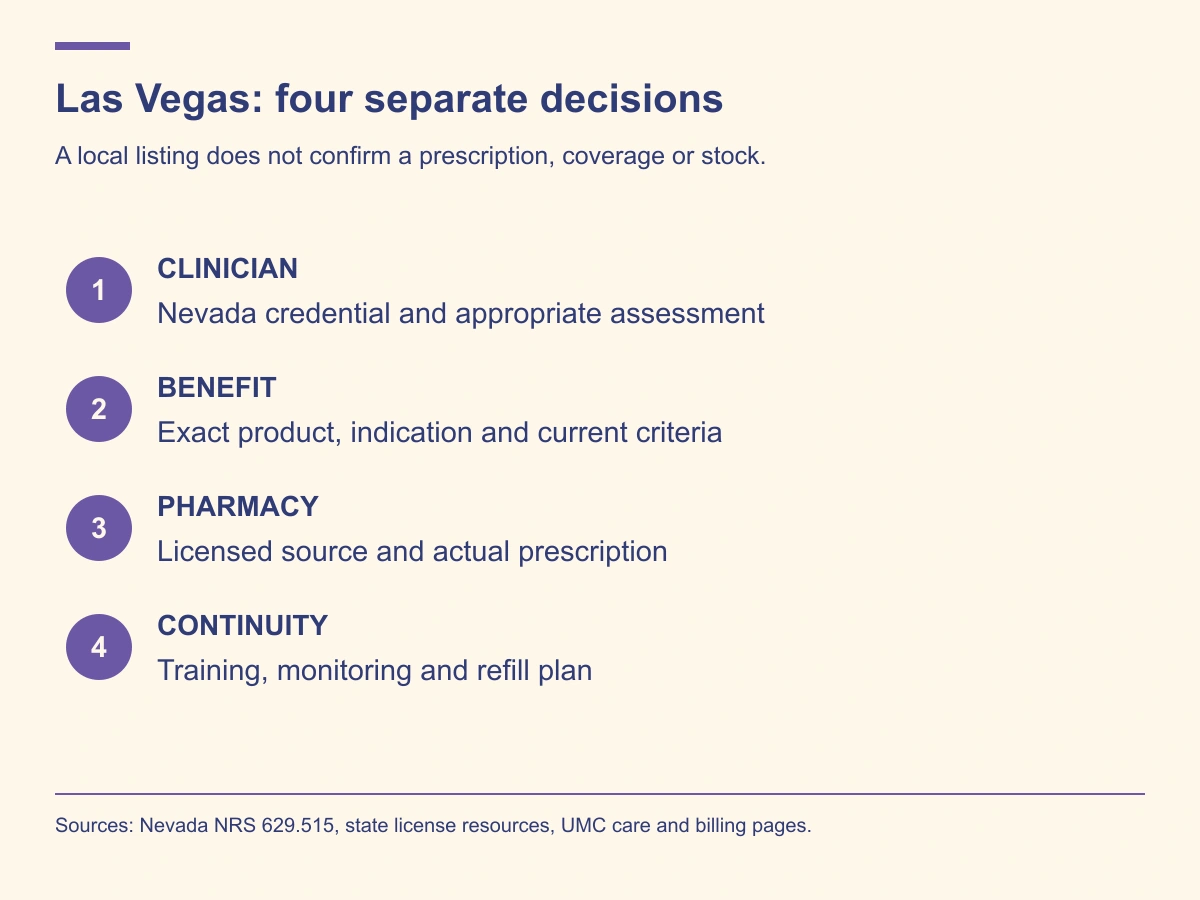
Searching for Ozempic in Las Vegas usually involves several separate questions: who can evaluate you, whether your health plan covers the prescription, which pharmacy can fill it, and who will manage treatment afterward. A local search result cannot settle all four. Start with the medical reason for treatment, then verify the clinician, exact prescription, pharmacy, and ongoing costs.
This guide explains a practical route through those decisions for adults in the Las Vegas area. It includes Nevada licensing resources and University Medical Center of Southern Nevada information. These resources help you investigate care; they do not establish that a particular office prescribes Ozempic, that a pharmacy has stock, or that your plan will pay.
Start with the condition being treated
Ozempic contains semaglutide. The U.S. injection label includes blood-sugar management in adults with type 2 diabetes and cardiovascular and kidney risk reduction in specific adult diabetes populations. Those indications have defined conditions. A wish to lose a few pounds, an insulin-resistance concern, or a photograph of your body does not establish that you meet them. Ozempic injection prescribing information.
Ask the clinician to explain the treatment goal in plain language. Is the plan addressing diabetes, a related risk, weight management, or several conditions? What measurements will show whether it is helping? Which alternatives deserve consideration? Knowing the purpose makes it easier to understand the prescription and the insurer’s questions.
The guide to how Ozempic works explains the medication’s actions. If your main question is weight treatment, the semaglutide product and formulation guide helps you prepare for a product-specific discussion. Sharing an ingredient does not make different branded products, routes, devices, or doses interchangeable.
Nevada telehealth: check who is treating you
An online visit can be convenient, especially when work, transportation, or appointment availability makes in-person care difficult. It still needs an appropriate clinical assessment and follow-up plan.
Nevada’s NRS 629.515 generally requires an appropriate Nevada license or certificate before a distant provider diagnoses, manages care, or writes a prescription for a patient located in Nevada. The statute includes an exception involving services for an urban Indian organization. It also preserves professional scope and standards of care, and permits establishing a relationship through telehealth when clinically appropriate. Nevada telehealth statute.
For a prospective service, ask for the actual treating professional’s name and profession. Verify the relevant credential through the appropriate Nevada licensing board. The Nevada Board of Medical Examiners provides physician-related verification resources; other professions may use a different board. A company logo, national advertising campaign, or a clinician licensed somewhere else is not a substitute for checking the credential relevant to your care.
Also ask where you should turn for an examination or urgent issue. A message portal may be useful for routine questions, but it should not leave you guessing when symptoms need prompt attention. Check what happens if you travel, move, or need records transferred to a local clinician.
A local primary-care starting point
UMC describes its adult primary-care services as including preventive care, chronic-disease management, and coordination with specialists. Its published appointment contact is 702-383-2273, with weekday phone hours listed as 7 a.m. to 5:30 p.m. Confirm current scheduling details directly. UMC primary care.
That is a resource for investigating general medical care. The page reviewed does not confirm Ozempic prescribing, specific appointment availability, or medication coverage. When calling any practice, describe the condition or concern you want evaluated and ask whether the practice offers that assessment. A question such as “Do you manage adult type 2 diabetes and coordinate prescription follow-up?” is more useful than assuming every primary-care office runs a particular medication program.
If you already have a diabetes clinician, start there before adding a separate subscription service. Bring the other service’s proposed plan to the existing team. Two offices independently adjusting diabetes treatment can create confusion about medications, laboratory tests, and responsibility for follow-up.
Separate office coverage from drug coverage
An office accepting your insurer does not establish that Ozempic is covered. Your plan may use different networks and rules for medical appointments, laboratory work, and prescription benefits. Even a covered medication may require prior authorization, a qualifying indication, or a particular dispensing pharmacy.
Use the member-services and pharmacy-benefit contacts on your own insurance information. Ask about the exact product and route on the proposed prescription. Request the current formulary status, required documents, and an estimate for the prescribed supply. Note whether the estimate assumes that prior authorization has already been approved.
| Question | Who can usually clarify it? | What to record |
|---|---|---|
| Is this office in network? | Medical-plan member services and the office | Clinician, location, visit type, reference number |
| Is the prescribed product covered? | Prescription-benefit administrator | Exact medication, formulation, indication requirements |
| Is authorization needed? | Insurer and prescribing office | Criteria, documents, submission status |
| What will this fill cost? | Dispensing pharmacy after benefit processing | Supply, patient payment, offer used, quote date |
| What will follow-up cost? | Office and laboratory provider | Visits, tests, subscription or cancellation terms |
The GLP-1 insurance guide explains authorization and appeal questions in more depth. Ask for the written denial reason if a claim is rejected; changing pharmacies may not solve an indication exclusion or missing documentation.

What local financial-assistance information can tell you
UMC’s billing page describes financial-assistance resources and possible discounts for qualifying uninsured Clark County residents. It lists an Eligibility Financial Service contact of 702-383-2350. UMC billing and insurance.
These are hospital billing and eligibility resources. They should not be presented as an Ozempic coupon or a promise of free outpatient medication. Ask the team which services a program covers, what documentation it requires, and whether a separate medication-assistance application is necessary. If care involves multiple organizations, confirm which bill each application addresses.
Keep assistance paperwork and insurance decisions together. A hospital discount, pharmacy savings arrangement, and clinician membership may have different eligibility rules and renewal dates. A written list helps you avoid assuming that approval for one pays for the others.
Choose and verify the dispensing pharmacy
Get the pharmacy’s name before paying a medication service. For Nevada pharmacy-license questions, the Nevada Board of Pharmacy verification resource provides the official lookup route. Verify the relevant pharmacy rather than relying only on a telehealth company’s marketing page.
Then discuss the actual prescription with the pharmacy. Ask whether it can obtain the specified presentation, whether your plan requires another pharmacy, and how it handles temperature-sensitive dispensing or delivery. An inventory statement is temporary. Avoid building a long-term care plan around a single unconfirmed stock report.
If the prescription is transferred, ask which pharmacy now holds it and whether an authorization, offer, or refill request also needs to be updated. Do not assume that a completed transfer automatically preserves the same patient payment.
Confirm the product before comparing prices
“Semaglutide” alone is not a sufficiently detailed price description. Confirm the brand or compounded preparation, route, presentation, strength, quantity, and supply. A compounded vial should not be priced or described as an FDA-approved Ozempic product. FDA explains that compounded drugs do not receive the same premarket approval review as approved medicines. FDA compounding questions and answers.
A prescription quote also differs from the total cost of care. Add visits, required laboratory work, supplies, and any membership or delivery charges. Ask for the likely refill cost after introductory terms expire. The Ozempic cost guide provides a framework for comparing these separate expenses.
For broader care options, CoreAge Rx’s semaglutide product information explains the service to review with a clinician. Verify current eligibility, the exact dispensed preparation, and availability for your location directly before assuming that a website serves every Nevada patient or provides a particular branded product.

Plan for the first prescription and later refills
Before starting, know who will review your response, adverse effects, glucose results when relevant, and refill requests. Ask how to contact the team if you cannot keep food or fluids down or if another clinician changes one of your medicines. Share the complete medication list, including insulin, sulfonylureas, supplements, and nonprescription products.
Get training for the device actually dispensed. The Ozempic pen and syringe guide explains why instructions depend on the presentation. For delivery and travel, use the semaglutide storage guide, the product instructions, and the pharmacist’s advice. A hot vehicle, uncertain shipment, or accidental freezing needs product-specific review.
If a refill is delayed, contact the prescriber before inventing a substitute dose or restarting after a long gap. Have a plan for continuing diabetes care even when a medication is unavailable or unaffordable. A subscription cancellation should not leave your local team unaware of a change in treatment.
Questions people ask about Ozempic in Las Vegas
Can I get Ozempic through telehealth in Nevada?
Potentially, when a qualified professional can appropriately evaluate and manage your condition and the relevant licensing and prescribing requirements are met. Telehealth access does not guarantee a prescription. Confirm who treats you, the credential, required records, and the local follow-up route.
Does a Las Vegas clinic need to be a weight-loss clinic?
The appropriate practice depends on the medical problem being assessed. A clinician managing type 2 diabetes may already be able to discuss treatment options. If weight management is the main goal, ask whether the practice provides that evaluation and ongoing care rather than choosing solely by a medication advertisement.
Does UMC provide Ozempic for free?
The primary-care and billing pages reviewed do not establish that. UMC describes care and financial-assistance resources. Contact the relevant team about your needs and the program’s actual scope; medication coverage requires a separate confirmation.
Which Las Vegas pharmacy has Ozempic in stock?
Stock changes and depends on the exact presentation. Ask the dispensing pharmacy about the prescribed product and timing. This article does not provide a live inventory directory or guarantee a particular branch has it.
Can I use an out-of-state online service while visiting Las Vegas?
Tell the service where you are physically located during care and ask whether it can legally and clinically provide the visit there. An existing account does not settle the applicable Nevada requirements. Plan travel and refills early enough to avoid an improvised treatment change.
What should I have ready for an appointment?
Bring your medication list, relevant diagnoses and recent results, insurance information, prior treatment history, and any adverse effects or pregnancy plans. Add three written questions: what condition are we treating, how will we judge response, and who is responsible for follow-up? Those answers are the foundation of a useful local care plan.
Educational information for adults; individual treatment decisions require a qualified clinician. Sources reviewed October 3, 2026. Original AI-generated article images depict fictional people and objects, not patient outcomes. Other editorial images are illustrative. Graphics summarize the cited sources.