
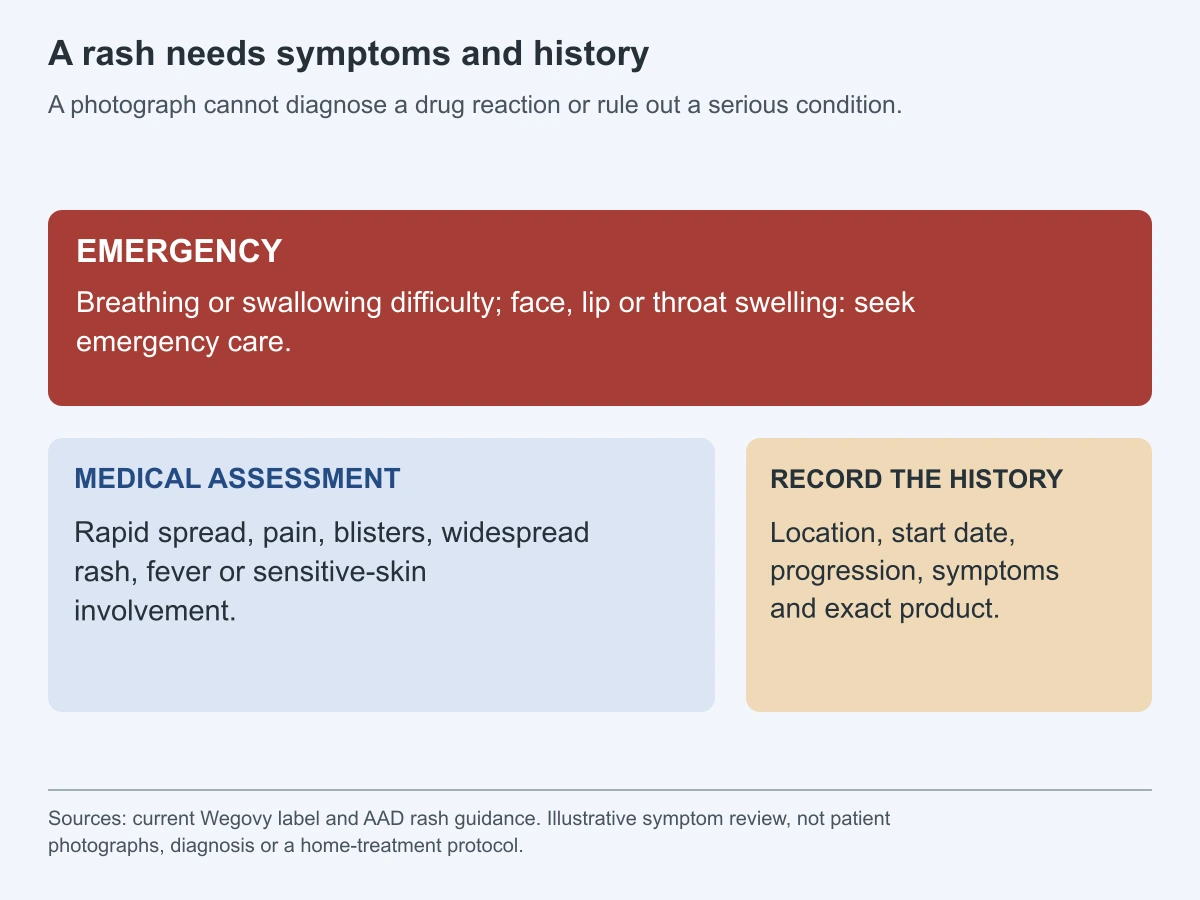
Wegovy can be associated with local injection-site reactions, and serious allergic reactions have also been reported. A new rash needs to be assessed by its location, symptoms, timing, and other possible causes. A photograph alone cannot tell you whether semaglutide caused it. Trouble breathing or swallowing, or swelling of the face, lips, or throat, requires immediate medical care.
A small itchy area where an injection was given and a rapidly spreading rash with illness are different situations. This guide explains what the current label says, what information helps a clinician, and why comparing your skin with internet “Wegovy rash pictures” can be misleading.
What does the Wegovy label say about skin reactions?
The current Wegovy prescribing information, revised June 2026, describes injection-site reactions including itching, redness, inflammation, firmness, and irritation. In the adult weight-reduction trials described in that section, these reactions occurred in 1.4% of Wegovy-treated participants and 1% of participants receiving placebo.
That number covers a category of local reactions. It is not an adult rate for every possible rash, and it does not predict the cause of an individual’s skin change. The same label separately reports serious hypersensitivity reactions, including anaphylaxis and angioedema.
The pediatric weight-reduction trial reported rash and urticaria in separate categories. Those pediatric findings should not be presented as an adult rash rate. Age, study population, formulation, and the outcome being counted matter when reading an adverse-event percentage.
Our Wegovy side-effects guide places these skin questions alongside the medicine’s other warnings. A side-effect list helps you describe a concern; it cannot replace an examination when the pattern is uncertain or concerning.
Local reaction, hives, or another skin problem?
“Rash” is a broad description. It can mean a flat patch, raised itchy bumps, scaling, blisters, or several other appearances. Useful distinctions include whether the change stays near the injection site, appears elsewhere, comes and goes, or involves pain and systemic symptoms.
| Observation | Information to report | What the observation cannot establish |
|---|---|---|
| Itching or irritation near the injection site | Location, size, when it started, and whether it is improving | That it is harmless or definitely caused by the medicine |
| Raised itchy areas appearing elsewhere | Distribution, movement or recurrence, and associated swelling | Whether an allergic reaction is mild enough to manage alone |
| Warmth, increasing tenderness, drainage, or crusting | Progression, fever, skin injury, and recent injection history | Whether infection or another cause is present without assessment |
| Blisters, painful skin, rapid spread, or mouth or eye involvement | Symptoms and how quickly they developed | A safe waiting period based on a photograph |
The American Academy of Dermatology’s rash guidance identifies rapid spread, pain, blisters or open skin, fever or illness, and involvement of the eyes, lips, mouth, or genital skin as reasons to obtain medical attention. Widespread involvement also deserves assessment.
Other explanations may include a new skin product, an adhesive, another medication, or an unrelated skin condition. Bring those possibilities to the clinician rather than selecting a cause from timing alone. A reaction beginning after treatment is important history, but the sequence does not prove causation.
When is a rash an emergency?
Seek emergency care immediately for trouble breathing or swallowing, or swelling involving the face, lips, or throat. Do not spend time finding a matching online picture before getting help. Serious allergy can involve symptoms beyond the visible skin.
The Wegovy label directs discontinuation and prompt treatment when hypersensitivity occurs. If serious allergy is suspected, urgent clinical care and the label’s instructions take priority over the next scheduled dose. A clinician must determine the subsequent treatment plan; do not test the reaction by taking another dose yourself.
Rapidly spreading, painful, blistering, or widespread rash, fever with a rash, and involvement of sensitive skin or mucous membranes need medical assessment even when breathing feels normal. Increasing warmth, swelling, pain, pus, or crusting can also signal a problem that should be examined.
An ordinary-looking photograph cannot rule out a serious process. Similarly, a small affected area does not make accompanying faintness, breathing changes, or marked illness irrelevant. Tell the care team about the full symptom pattern.
Can Wegovy rash pictures help?
Pictures can document a change for your own clinician, but internet comparison has limits. Lighting, camera processing, skin tone, image age, and the part of the body photographed all affect appearance. A caption may be inaccurate, and an image may show a different diagnosis or product exposure.
The AAD notes that skin around an infection may look red, purple, or brown. Searching only for bright-red examples can therefore miss how a concerning change looks on another person’s skin. Color alone is less useful than the combination of spread, pain, warmth, swelling, drainage, and other symptoms.
If your care team accepts photographs, ask how to submit them securely. A clear overview and a closer image, taken in consistent light, can help show distribution and change. Include when the image was taken and when symptoms began. Avoid filters that alter color or texture.
Record symptoms that the camera cannot capture: itching, tenderness, fever, breathing changes, or whether the area feels hot. Photographing a rash should support appropriate care rather than delay it. This article’s editorial images and graphics are illustrations, not diagnostic patient photographs.
What should you record after an injection-site change?
Write down the exact product, presentation, dose, injection date, and location. Wegovy now has multiple presentations with their own instructions, so “a semaglutide shot” may not identify the device or preparation accurately.
Describe how soon the change appeared, whether it remained local, and how it progressed. Note previous similar episodes and whether symptoms occurred at a site that had not recently been injected. These details help separate a repeated local pattern from a new generalized concern.
Include recent medicines, supplements, illnesses, topical products, and changes in skin preparation. Bring the package or a photograph of its label if the formulation is uncertain. Your clinician or pharmacist can review whether administration instructions or another exposure needs attention.
The Wegovy injection guide explains presentation-specific training and permitted sites. The label calls for rotating sites. Rotation and correct technique are part of routine administration; they do not make a new or worsening rash safe to ignore.
Should you change sites, stop, or treat the rash yourself?
The next step depends on the symptoms and suspected cause. Emergency features need immediate care. For a new, persistent, recurrent, or uncertain reaction, contact the prescriber or pharmacist before deciding how to proceed with the next dose.
Ask whether the affected skin needs examination, whether an administration issue is relevant, and what instructions apply to the exact presentation. Do not inject into an affected area simply to see whether the same reaction occurs again. A switch to another site is not a test that excludes allergy.
There is no single cream, antihistamine, or home remedy appropriate for every rash. A product that helps one skin problem may be unsuitable for another. Describe what you have already used, including over-the-counter treatments, so the clinician can interpret the response and review safety.
If treatment is interrupted, obtain a specific restart plan. The missed-dose and restart guide separates short missed doses from longer gaps. Resuming the former dose independently after an interruption can create additional problems and does not establish that the skin reaction has resolved safely.
Does switching to Ozempic or compounded semaglutide solve the issue?
Wegovy and Ozempic both contain semaglutide, but they have distinct labeled uses and product instructions. A different brand name does not establish that a suspected hypersensitivity reaction will disappear. The reason for the reaction and the exact ingredients need clinical review.
A compounded product can differ in concentration, excipients, packaging, and instructions. The FDA explains that compounded drugs are not FDA-approved, meaning the agency does not review their safety, effectiveness, or quality before marketing. A label finding for Wegovy does not validate every compounded preparation.
Our semaglutide side-effects guide discusses formulation and symptom review. If you are considering CoreAge Rx’s semaglutide treatment information, use the assessment to discuss the exact prescription and your reaction history. Do not treat a provider change as permission to rechallenge a medicine after possible allergy.

Questions for your care team
Prepare a short, practical list:
- Does this pattern need an in-person skin examination?
- Which features should prompt urgent or emergency care?
- Could another medicine, product, or skin condition explain it?
- Should the next dose be held, and who will give the written plan?
- What treatment is appropriate for the actual skin finding?
- If treatment changes, what monitoring and device training are needed?
If the rash affects sleep, work, or ordinary activities, say so. Symptom burden matters even when a reaction does not match a dramatic online image. Recurrent mild-looking changes also deserve a clear plan rather than repeated improvisation.
Frequently asked questions
Is every itchy injection site an allergy?
No. Local irritation and hypersensitivity are separate possibilities, and other causes can occur. Location and timing help the assessment, but they do not establish the diagnosis. Report recurrence, spread, swelling, or other symptoms.
Can a rash occur away from the injection site?
A generalized rash is a different question from local injection irritation. The label includes hypersensitivity reports, while many unrelated conditions can also cause widespread skin changes. Seek appropriate assessment rather than assuming the location excludes a drug reaction.
How long should I wait for it to go away?
There is no universal waiting period for an unidentified rash. Emergency symptoms need immediate care, and the AAD’s concerning rash features need medical attention. Ask your clinician what follow-up applies to the specific finding.
Does a picture prove Wegovy caused it?
No. An image can document appearance and progression, but it cannot establish medication causation or rule out a serious condition. The exposure history, symptoms, examination, and clinical judgment remain essential.
Educational information for adults; individual treatment decisions require a qualified clinician. Sources reviewed October 1, 2026. Original AI-generated article images depict fictional people and objects, not patient outcomes. Other editorial images are illustrative. Graphics summarize the cited sources.