
On a body-composition report, SMM usually means skeletal muscle mass: the estimated mass of the muscles that help you move. It is one part of your body composition, and it is different from total body weight, body fat, or all of your lean tissue.
An SMM number can help organize a conversation about nutrition, activity, and changes over time. It does not diagnose a muscle disease, measure strength, or prove that a medicine is working. The measurement method and testing conditions matter as much as the abbreviation.
What does SMM stand for?
In the body-composition setting, SMM stands for skeletal muscle mass. Skeletal muscles include those involved in walking, lifting, maintaining posture, and many other movements. The term does not mean every muscle type in the body, such as heart muscle.
The abbreviation has other meanings in unrelated fields. If you see “SMM” on a document that is not a health or body-composition report, ask what the author means. Even within health reports, the device’s definitions, units, and method should be confirmed.
InBody’s explanation of body-composition terms distinguishes skeletal muscle mass from lean body mass and fat-free mass. That distinction is useful when comparing a clinic report with a bathroom scale app that uses a less specific “muscle” label.
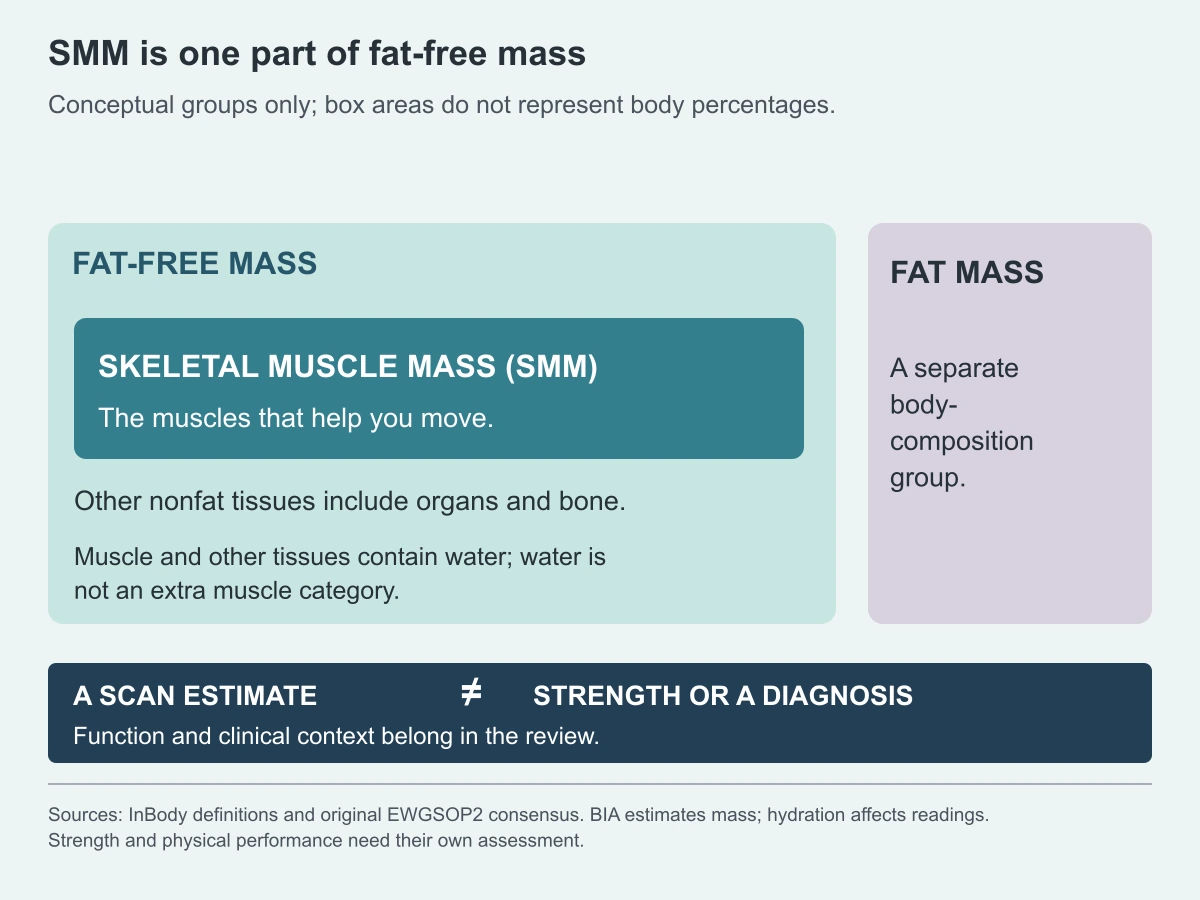
Muscle mass, lean mass, and fat-free mass are different
Fat-free mass includes the parts of body mass that are not fat. It encompasses skeletal muscle as well as other tissues, including organs and bone. Water is contained within those tissues; it should not be added as if it were a separate extra muscle compartment.
“Lean mass” may have a particular definition in a device or a research method. It should not automatically be translated into pounds of skeletal muscle. A study describing a change in lean mass may therefore be answering a different question from the SMM estimate on your report.
| Report term | What to clarify |
|---|---|
| Body weight | Total mass, without identifying which components changed |
| Fat mass | The estimated or measured fat component |
| Fat-free mass | The nonfat components, not skeletal muscle alone |
| Lean mass | The method’s definition and whether it includes other tissues |
| SMM | The estimated skeletal muscle component and its units |
| Appendicular muscle or lean mass | A limb-specific measure that is not automatically whole-body SMM |
| Strength or performance | A separately assessed ability, rather than a scan component |
Ask for the device’s explanation instead of assuming similar-looking labels are interchangeable.
How does a body-composition device estimate muscle?
Many clinic and consumer devices use bioelectrical impedance analysis, or BIA. They assess electrical properties of the body and use equations to estimate components. They do not directly weigh each muscle.
The original EWGSOP2 sarcopenia consensus explains that BIA estimates muscle mass through electrical conductivity and prediction equations. Those equations are developed and evaluated in particular populations. Results can differ across instruments and reference groups.
Other methods include DXA and imaging approaches used for specific clinical or research questions. They also have limitations and may report different components. A change from one method to another can create an apparent difference that is not a biological change.
Why hydration and testing conditions matter
Water affects electrical measurements and is a major component of fat-free tissue. A reading after a different meal pattern, exercise session, illness, or fluid change may therefore be difficult to compare with a previous test.
The InBody result-sheet guide identifies preparation and testing factors that can affect consistency. Follow the instructions for the exact device rather than inventing a routine intended to produce a preferred score. Ask how to handle a test after illness or an unusual day.
For tracking, record the device, date, and whether conditions differed. Comparable conditions improve interpretation, but they do not turn the estimate into a direct measurement. A small change still needs to be considered alongside the method’s uncertainty and the broader trend.
Is there a normal SMM number everyone should reach?
No single whole-body SMM number applies to every adult. Body size, age, sex, health, and the measurement method affect interpretation. A reference bar on a device report is not automatically a personal treatment target.
Ask whether the comparison is an absolute mass, a percentage of weight, or a value adjusted for body size. Those calculations answer different questions. A percentage can also change because another component changes, even when the absolute muscle estimate changes little.
For example, a hypothetical report might show the same estimated muscle mass while total weight falls. The muscle percentage would rise because the denominator changed. That arithmetic does not establish new muscle growth. Always look at what was measured and what calculation produced the displayed result.
Does a low reading mean sarcopenia?
A low device reading alone does not establish sarcopenia, a clinical condition involving impaired muscle health. Assessment considers strength, muscle quantity or quality, and physical performance, with appropriate methods and context.
EWGSOP2 places low strength at the center of its assessment approach. Additional muscle findings help confirm the diagnosis, while poor physical performance contributes to assessing severity. Its thresholds and assessment pathway are not a universal consumer-scale interpretation rule.
Mention difficulty rising from a chair, slower walking, falls, or a new loss of everyday ability. Those problems deserve attention even if the device’s SMM bar looks reassuring. Conversely, a flagged estimate in someone functioning well still needs interpretation before a diagnosis or treatment is assigned.

What if SMM falls while body weight is falling?
Weight reduction can involve several components, and the exact measurement method matters. Review the absolute estimates, the total weight change, testing conditions, food intake, and physical function rather than reacting to one percentage.
The GLP-1 nutrition advisory emphasizes nutrition and muscle preservation during treatment. Discuss limited appetite, persistent gastrointestinal symptoms, skipped meals, or difficulty obtaining food. A more restrictive diet is not automatically the right response to a lower muscle estimate.
The macros guide and protein shake meal guide can help frame practical meal questions. Protein is one part of the plan; adequate overall intake, tolerable meals, and appropriate activity also belong in the discussion.
What should you track besides the scan?
Consider activities that matter to you: carrying groceries, climbing stairs, getting up from a chair, keeping up with a walk, or managing your usual work. Report a persistent decline or a meaningful improvement without assuming the scan must explain it.
A clinician may use a standardized strength or performance assessment when indicated. A home observation and a formal test have different purposes, and neither should be performed in a way that creates a fall or injury risk.
The exercise-calorie guide also explains why exercise has value beyond a calorie estimate. An activity plan can support strength and function without turning it into punishment for a body-composition number.
Does a higher estimate prove muscle gain?
It may be consistent with a change, but interpretation requires comparable methods and conditions. Hydration changes, a different instrument, or the prediction equation can influence the estimate. Ask whether the size and consistency of the trend are meaningful for that method.
Look for supporting information, such as a change in function, training history, or other clinical measures. The goal is not to dismiss all scans; it is to use them at the level of precision they can support.
The same caution applies to a lower estimate. A single unexpected reading can justify checking conditions and reviewing the result, while continuing weakness or a substantial trend may warrant a broader assessment.
Does SMM tell you whether you need TRT or a peptide?
No. A body-composition reading does not diagnose testosterone deficiency or growth-hormone deficiency. Those questions require their own symptoms, medical evaluation, and appropriately interpreted testing.
The low-testosterone testing guide explains the TRT assessment. The TRT and strength guide and sermorelin body-composition guide separate specific evidence from promises about physique.
If a separate clinical question makes hormone evaluation appropriate, discuss it with a qualified clinician. For service information, see CoreAge Rx’s TRT page. A low SMM estimate is not a recommendation to start that service or change a hormone prescription.
Preparing for a results review
Bring the actual report, not just its score. Include previous reports, the device names, dates, units, and any changes in testing conditions. Explain the reason the test was done and what decision you hope it will inform.
Useful questions include:
- Does this report estimate skeletal muscle, all lean tissue, or another component?
- Is the difference larger than the uncertainty of the method?
- Were the two tests performed on comparable equipment and under comparable conditions?
- Does my strength or everyday function suggest a separate concern?
- Should food intake, illness, medicines, or activity be reviewed?
- What would change the next step, and when should we reassess?
A useful interpretation should produce a manageable plan. It should not require constant scanning or make a brand’s composite score the sole definition of progress.

When should you seek assessment sooner?
New weakness, recurrent falls, unexplained weight change, or a noticeable decline in everyday ability deserves clinical review. A scan does not explain sudden neurological symptoms or make a new inability to move normally safe to wait on.
Also mention prolonged poor intake, continuing vomiting or diarrhea, and a loss of activity caused by illness or pain. Addressing those problems may be more urgent than repeating a body-composition test.
The semaglutide questions guide is relevant when medication-related nutrition or symptom questions are part of the history. Product and treatment details should remain separate from what the scan itself can establish.
Frequently asked questions
Is SMM the same as my “muscle percentage” on an app?
Not necessarily. Check the app’s definition and units. A percentage may use a different component or equation and cannot automatically be compared with whole-body SMM in pounds or kilograms.
Can water change the reading?
Yes. Hydration can affect BIA estimates and the interpretation of some other methods. Follow the device’s preparation instructions and report unusual conditions rather than manipulating fluid intake for a desired number.
Is all lean-weight loss skeletal muscle loss?
No. Lean or fat-free measures include other components. The research method and definitions must be checked before equating a reported lean-mass change with muscle loss.
Should I compare my SMM with a friend’s?
That comparison can miss differences in body size, health, method, and reference population. Discuss the significance of your own report and trend rather than adopting someone else’s number as a target.
Does a normal bar rule out a strength problem?
No. Strength and performance are separately assessed. Report a decline in daily function even when a body-composition report appears reassuring.
How often should I repeat the scan?
There is no universal schedule. Ask what decision another measurement would inform, which method should be used, and what conditions are needed for a useful comparison.
Educational information for adults; individual treatment decisions require a qualified clinician. Sources reviewed October 1, 2026. Original AI-generated article images depict fictional people and objects, not patient outcomes. Other editorial images are illustrative. Graphics summarize the cited sources.