
Plain rice supplies a substantial amount of carbohydrate, so a usual rice portion can be difficult to fit into a very low-carbohydrate ketogenic eating pattern. Brown rice still contains starch; changing its color or choosing a whole-grain version does not make it a low-carbohydrate food.
That does not mean rice has to be removed from every weight-management plan. The useful question is which eating pattern you are following, why you chose it, and how the complete meal fits your nutrition and health needs. Keto and weight loss are not interchangeable terms.
Is rice a keto food?
Rice is a grain with carbohydrate as a major component. A ketogenic plan generally restricts carbohydrate enough to support a particular metabolic state. There is no one rice allowance that can be approved for every person from the name of the diet alone.
If your plan has an agreed carbohydrate target, a rice portion must be considered within that target and the rest of the day. A label saying “whole grain,” “organic,” or “brown” does not establish that it fits. Neither does a small photograph of a serving.
If you are choosing an eating pattern primarily for weight management, ask whether severe carbohydrate restriction is necessary for your goals. The macros guide explains how protein, carbohydrate, fat, and the complete eating pattern belong in that discussion.
How much carbohydrate is in cooked rice?
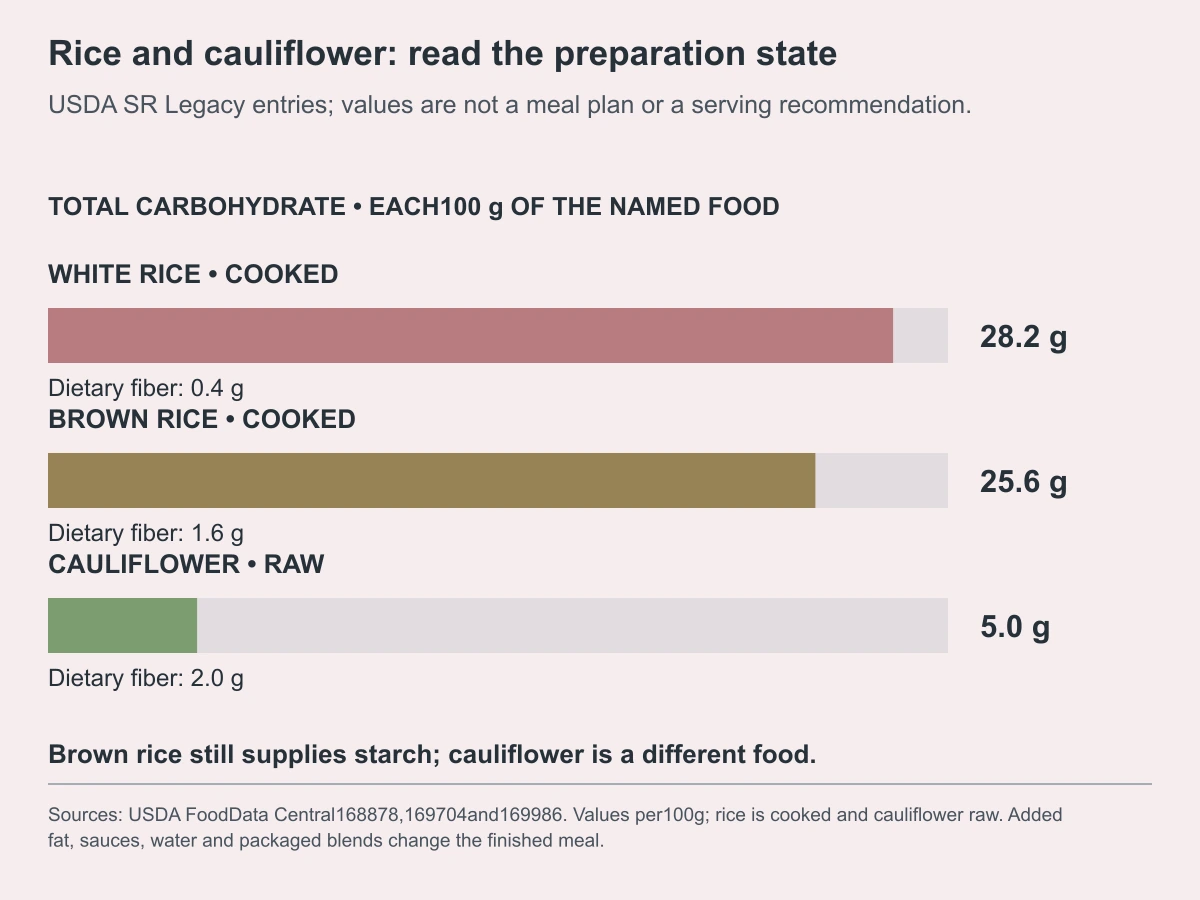
The following figures come from the actual USDA FoodData Central white-rice record, brown-rice record, and cauliflower record. Each row refers to 100 grams of the named food, with its preparation state explicitly identified.
| Food and preparation state | Energy | Total carbohydrate | Dietary fiber | Protein |
|---|---|---|---|---|
| White long-grain enriched rice, cooked | 130 calories | 28.2 g | 0.4 g | 2.7 g |
| Brown long-grain rice, cooked | 123 calories | 25.6 g | 1.6 g | 2.7 g |
| Cauliflower, raw | 25 calories | 5.0 g | 2.0 g | 1.9 g |
These are database examples, rounded for readability. They are not prescribed servings or the nutrition panel of every packaged product. The cauliflower row describes raw cauliflower, rather than a finished frozen blend or a sautéed dish.
The important point for the rice question is that both cooked rice examples contain meaningful carbohydrate. Brown rice has more fiber in these entries, but it is not a carbohydrate-free substitute.
Why cooked and uncooked values cannot be mixed
Cooking adds water to rice. A given weight of dry rice therefore describes a different quantity of food from the same weight after cooking. Comparing a dry-rice label with a cooked-rice database entry can produce an apparently dramatic difference that mostly reflects preparation state.
Check whether a packet’s serving is uncooked, cooked, or prepared as directed. Ready-to-eat pouches may include oil, seasoning, or sauce, while a plain dry-rice bag may describe only the grain. The number of servings in the container also matters.
The FDA nutrition-label guide explains serving size and the relationship between the label and the amount eaten. A serving on a package is information for interpreting the panel, rather than an instruction that every person should eat that amount.
Are total carbs and net carbs the same?
Total carbohydrate is the labeled category to check first. “Net carbs” is a term commonly used in low-carbohydrate marketing and tracking, often involving subtraction of fiber or selected other components. It should not be assumed to have one standardized calculation across products.
If a clinician or dietitian has given you a carbohydrate plan, ask which measure should be used. Do not replace that approach with a manufacturer’s preferred marketing calculation without checking it.
Subtracting fiber also does not turn rice into an unlimited food. In the cooked-rice entries above, most of the carbohydrate remains even under a simple carbohydrate-minus-fiber calculation. The exact amount eaten and other meal ingredients still need consideration.
Does brown rice fit better than white rice?
Brown rice can offer different texture and more fiber in a comparable example, but “better” depends on the purpose of the comparison. Choosing a whole grain and meeting a very low-carbohydrate target are different questions.
For a person following a less restrictive pattern, rice may be one carbohydrate food in a varied meal. For someone following a clinically chosen ketogenic plan, its carbohydrate contribution may make a different base more practical. The overall diet still needs adequate energy, protein, micronutrients, and variety.
There is no need to interpret this as a moral ranking of foods. A tolerable, affordable meal you can prepare consistently may fit a long-term plan better than a complicated substitute you dislike.
What about jasmine, basmati, wild rice, or black rice?
Names and colors do not establish the carbohydrate content of the exact product. Read the panel or use a matching food-composition entry, including its cooked or uncooked state. Blends can include several grains and other ingredients.
A discussion about glucose response is also different from the question “does it contain carbohydrate?” Individual response, preparation, meal composition, and the amount eaten can matter. A marketing claim about a particular rice should not be treated as permission to ignore its panel.
If diabetes management is part of the question, the NIDDK eating and activity guidance describes why an individualized plan and medicine review matter. A grain name alone cannot select a safe meal strategy.

Is cauliflower rice actually rice?
Cauliflower rice is cauliflower cut into small rice-like pieces. It is a vegetable preparation, rather than a low-carbohydrate variety of the rice grain. It may be a useful texture or meal-base alternative for some people.
Check the finished product. A frozen bag may contain plain cauliflower, while another includes cheese, sauce, other vegetables, or actual rice. A restaurant dish can include added fat and ingredients that are not obvious from its name.
The raw cauliflower numbers above illustrate a food-composition difference; they do not describe every cauliflower-rice recipe. “Low carb” does not mean that additions, portion, or the rest of the meal become irrelevant.
Other ways to adapt the meal
You can change the base, the amount, or the surrounding foods depending on the eating pattern agreed with your care team. An adaptation does not have to reproduce rice exactly to be useful.
Possible approaches include using a vegetable base, combining a smaller amount of rice with vegetables, or choosing a different side while preserving a familiar protein and seasoning. If you prefer ordinary rice and are not required to follow keto, a meal can be planned around it rather than replaced automatically.
Think about how the dish functions. Is it lunch after a busy morning, an easy dinner, or a food that feels manageable during low appetite? The protein shake meal guide and overnight oats guide offer other examples of building meals around practical foods rather than a single diet label.
Do oil, butter, and sauces change the answer?
They change the finished meal’s composition. Adding fat does not remove carbohydrate from the rice. A high-fat rice dish is therefore not automatically ketogenic simply because it contains plenty of butter or oil.
Likewise, sweetened sauces can add carbohydrate, while cheese, nuts, and other toppings contribute their own nutrients and energy. Use the actual ingredients when estimating the meal rather than logging plain rice for every preparation.
The goal is an honest description of what you eat, not a need to make every meal mathematically perfect. The net-calories guide explains why app calculations remain estimates and should not become an exact forecast of body-weight change.
Does cooling rice remove its carbohydrates?
Do not treat cooled or reheated rice as carbohydrate-free. Preparation can affect starch properties, but a cooling method does not erase the food’s total carbohydrate or establish a personal weight-loss effect.
Food safety also matters. The FDA storage guidance recommends prompt refrigeration of perishable prepared food and a refrigerator at or below 40°F. Follow appropriate preparation and storage instructions instead of leaving cooked food on the counter to pursue a claimed nutrition trick.
If you use a packaged refrigerated rice product, follow its label. A method seen in a short video is not a substitute for handling the actual food safely.
Do you need keto when using a GLP-1 medicine?
A GLP-1 prescription does not by itself establish a need for a ketogenic diet. The food plan should account for nutrition, symptoms, medical history, treatment goals, and any other medicines.
The GLP-1 nutrition advisory emphasizes adequate intake and preservation of muscle and bone. Someone struggling with nausea or very little appetite may need help eating enough rather than an additional restriction based on a diet trend.
The semaglutide treatment guide covers those broader questions. For service details, see CoreAge Rx’s semaglutide information. CoreAge Rx describes a compounded offering; compounded medicines are not FDA-approved, and branded-product evidence does not establish the same safety or effectiveness for a compounded preparation.

Questions before choosing a very low-carbohydrate plan
Ask what benefit the plan is intended to provide, whether another pattern could meet the same goal, and which health conditions or medicines affect suitability. If diabetes medicines are involved, substantial changes in intake need to be coordinated with the treating team.
Discuss how you will obtain adequate nutrition, handle meals outside the home, and recognize a plan that is becoming too difficult or restrictive. A dietitian can help preserve familiar foods and identify realistic substitutions.
The safe weight-management program guidance supports evaluating an approach by its full structure and ongoing support. Removing rice is only one food decision; it is not a complete long-term plan.
Frequently asked questions
Can a small amount of rice ever fit a keto plan?
It depends on the intended carbohydrate limit and the rest of the intake. The fact that a small amount can be counted does not establish a universal allowance. Ask how your specific plan should be applied.
Is brown rice low carb?
No. The cooked brown-rice example above still supplies about 25.6 grams of total carbohydrate per 100 grams. Its fiber and texture differ from white rice, but it remains a starch-containing grain.
Is cauliflower rice unlimited?
No food needs to be treated as unlimited to be useful. Check the product, added ingredients, tolerance, and the complete meal. A vegetable alternative is not the same as a finished dish containing sauces or actual rice.
Will eating rice stop all weight loss?
That cannot be concluded from one food. Weight-management outcomes depend on the complete pattern and many individual factors. Rice does not need to be removed from every appropriate plan.
Should I count dry rice or cooked rice?
Use the state specified by your label or matching database entry. Do not apply the same amount per gram to both dry and cooked rice.
Is a keto label enough to choose a packaged substitute?
No. Read its serving size, carbohydrate, fiber, ingredients, and preparation instructions. The label can help you compare options, while the eating pattern and health context determine fit.
Educational information for adults; individual treatment decisions require a qualified clinician. Sources reviewed October 1, 2026. Original AI-generated article images depict fictional people and objects, not patient outcomes. Other editorial images are illustrative. Graphics summarize the cited sources.