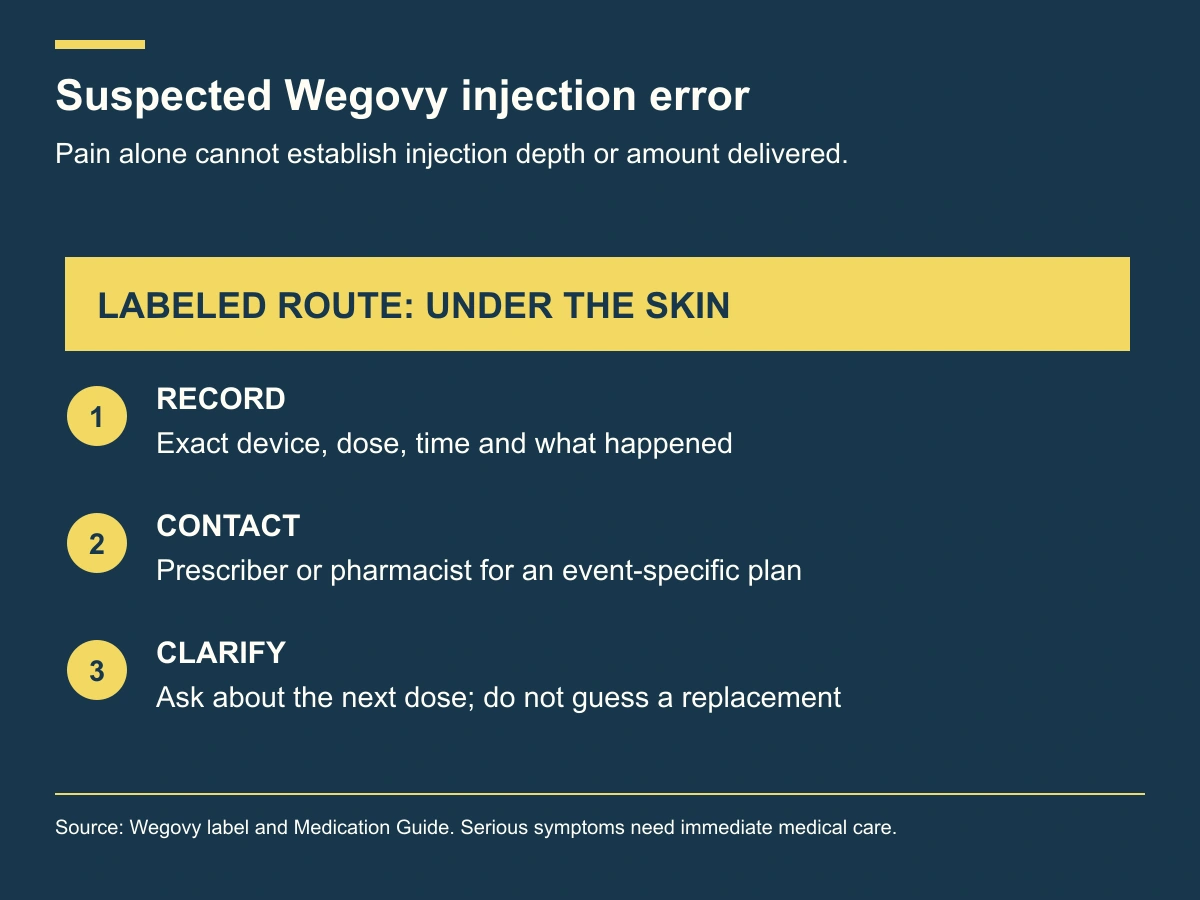
Wegovy injection is intended for the tissue under the skin. If you think you injected it into a muscle, contact your prescriber or pharmacist promptly with the exact product, dose, time, and what happened. Do not give yourself another injection to compensate for an uncertain dose. The instructions explicitly say to avoid injection into a muscle or vein; they do not provide a reliable forecast of what an accidental muscle injection will do. Wegovy prescribing information and Medication Guide
A painful injection does not, by itself, tell you how deep the medicine went. Likewise, feeling normal afterward cannot confirm that the dose was delivered as intended. A useful response starts with checking symptoms and reporting the event accurately, rather than trying to diagnose the route from a sensation or an online photograph.
What route is Wegovy supposed to use?
The labeled route for Wegovy injection is subcutaneous, meaning beneath the skin. The labeled areas are the abdomen, thigh, or upper arm. The Medication Guide specifically says not to inject into a muscle or vein. Rotate injection sites according to the instructions for your actual presentation. Wegovy administration instructions
This article concerns an injection error. Wegovy tablets have different administration instructions and are not an injectable substitute. A tablet schedule cannot answer what to do after an uncertain injection.
The product in your hand also matters. Current labeling describes several injection presentations, including a single-dose pen or syringe and a single-patient-use pen. Instructions from a different country, an older video, or a different semaglutide product may describe a device that is not yours. Ask the pharmacist to identify your presentation before using another tutorial.
For routine preparation and labeled sites, use the Wegovy injection guide. For a suspected error, begin with your clinician or pharmacist because a general technique guide cannot determine how much medicine you actually received.
What should you do after a suspected muscle injection?
If you have a serious symptom, seek medical help first. If you are stable, contact the prescribing office or dispensing pharmacist and describe the event without assuming that the route is confirmed.
Have the carton or prescription label available. Explain whether the concern came from unexpected pain, a device problem, the location you used, an unfamiliar needle, or a technique change. Those details help the care team distinguish a suspected route error from an incomplete dose, leakage, an ordinary injection-site reaction, or another problem.
Do not repeat the dose while delivery is uncertain. An additional injection could expose you to more medicine than intended. Ask for a specific decision about the next scheduled dose and any monitoring, and write the advice down. Do not turn the ordinary missed-dose rules into a replacement-dose plan: a dose that may already have entered the body is a different situation from a dose that was never taken.
The manufacturer’s Medication Guide directs people who take too much Wegovy to contact their healthcare provider, the Poison Help line at 1-800-222-1222, or the nearest emergency room right away. It identifies severe nausea, vomiting, and low blood sugar as possible overdose symptoms. That instruction is about excess dosing; it does not establish that every suspected route error is an overdose. Wegovy Medication Guide
What information should you give the care team?
A brief written account is more useful than “I injected it wrong.” Include what you know and clearly mark what you are uncertain about.
| Detail | What to record | Why it helps |
|---|---|---|
| Product and presentation | Exact name, prescribed strength, pen or syringe type | Different devices have different instructions |
| Timing | Date, time, and previous scheduled dose | Helps reconstruct possible exposure |
| Technique | Area used and the step that concerned you | Describes the event without guessing the depth |
| Device behavior | Leakage, unexpected stop, or other visible problem | Helps evaluate possible incomplete delivery |
| Symptoms | Pain, swelling, dizziness, vomiting, breathing difficulty | Helps the team prioritize care |
| Other medicines | Especially insulin or a sulfonylurea | These can change low-glucose risk |
Do not handle an exposed needle again to inspect it. Follow your usual sharps-disposal instructions. Retain nonsharp packaging and device information if the pharmacy asks for them, and ask how to report a device concern without creating another injury.
If you can safely photograph the area or packaging, ask whether the clinician wants a photo. A picture may document a visible reaction, but it cannot show where an injected drug traveled or prove that a muscle received it.
Does pain mean the injection reached muscle?
Pain is a symptom to describe, not a depth measurement. The clinician will want to know whether it was brief or persistent, whether it is worsening, and whether there is increasing redness, warmth, swelling, bleeding, weakness, or difficulty using the limb.
Avoid probing, squeezing, or trying to “remove” the medication from the area. Do not apply another medicine to the site as an improvised antidote. Ask the care team what local care is appropriate for the actual reaction.
If the pain is severe, the area is changing quickly, or you have symptoms beyond the injection site, arrange prompt assessment. A route concern should not distract from a separate injury or illness that needs examination. Conversely, a mild transient sensation cannot provide assurance that every step was completed correctly.

Will Wegovy absorb faster if it goes into muscle?
The reviewed prescribing instructions do not supply a validated intramuscular dosing regimen or a dependable patient-specific absorption prediction for an accidental route error. Statements such as “it will work faster,” “it wears off sooner,” or “you should take another dose tomorrow” go beyond those instructions.
The safe conclusion is that the route was not intended and the circumstances need review. The effect may depend on what actually occurred, the product used, the amount delivered, and your health. None of those details can be settled by a standard injection-site diagram.
This uncertainty is also why you should not interpret a sudden appetite change, nausea, or lack of symptoms as proof that the medicine did or did not enter muscle. Your prescriber can decide whether the event warrants observation, testing, device replacement, or a change in the next-dose plan.
Which symptoms need immediate attention?
Wegovy’s Medication Guide lists serious allergic symptoms including swelling of the face, lips, tongue, or throat; trouble breathing or swallowing; severe rash or itching; and fainting or marked dizziness. Stop using the medicine and get medical help immediately for a suspected serious allergic reaction. Wegovy safety information
Severe persistent abdominal pain, sometimes extending to the back, with or without vomiting, also needs urgent clinical attention because the guide warns about pancreatitis. Persistent vomiting or diarrhea can cause dehydration and kidney problems. Report symptoms that are severe or do not go away.
For people with type 2 diabetes, the label emphasizes low-glucose risk particularly when insulin or a sulfonylurea is also used. Follow your existing glucose-monitoring and low-glucose treatment plan, and seek emergency help if you cannot safely treat yourself. Do not alter diabetes medicines based on a guessed injection depth. NIDDK information on hypoglycemia
For broader symptom context, read Wegovy and water retention. Swelling at one site, generalized fluid-related swelling, and an allergic reaction are different problems and should not be treated as interchangeable.
How can you reduce the chance of another error?
Ask for a demonstration using the same presentation you were dispensed. Then explain the steps back to the pharmacist or clinician. This can reveal a misunderstood step more clearly than saying that you watched a video.
Before the next dose, verify the prescription strength, device type, labeled area, and instructions for completion. Ask what visible sign confirms completion for your device and what to do if that sign does not appear. People using a different pen after a refill should check whether the instructions changed.
Keep the Wegovy dosage guide available for prescribed scheduling questions. Use the Wegovy 0.5 mg guide to understand why a treatment stage is not an individual results forecast. Neither guide replaces instructions for a delivery error.
If travel or handling contributed to confusion, review semaglutide storage and travel questions with the pharmacist. Storage rules and administration steps must match the exact product rather than the active ingredient alone.

Questions to ask before your next scheduled dose
Bring a concise list to the follow-up conversation:
- Does my account suggest a route problem, incomplete delivery, or something else?
- Should I take the next scheduled dose as usual, and who will confirm that decision?
- What symptoms should lead me to seek care immediately?
- Do my other diabetes medicines change the monitoring plan?
- Can someone demonstrate my exact device and watch me explain its steps?
- Should the pharmacy or manufacturer receive a device report?
If the first contact cannot answer the dosing question, ask which clinician can and how quickly they can respond. A clear handoff is more useful than collecting conflicting advice from several unrelated sources.
Frequently asked questions
Can I inject an extra dose if I am not sure the first one worked?
Do not give a replacement injection on your own when delivery is uncertain. Report the event and ask for a specific plan. The ordinary missed-dose schedule does not tell you how to replace medicine that may already have been delivered.
Is the thigh automatically a muscle injection?
No. The thigh is one of the labeled areas for a subcutaneous Wegovy injection. The body area and the route are separate concepts. Follow the instructions for your actual device and ask for technique review if something seemed wrong. Wegovy administration instructions
Can I tell the route from a bruise or a photograph?
A visible mark cannot establish the route or amount delivered. Record what you see and how it changes, then let the care team decide whether it needs examination.
Should I switch to a different semaglutide product?
A suspected error is a reason to review technique and symptoms, not to substitute products yourself. The CoreAge Rx semaglutide information page can introduce care questions, but it does not establish equivalence to Wegovy or provide instructions for correcting an injection error.
Educational information for adults; individual treatment decisions require a qualified clinician. Sources reviewed October 4, 2026. Original AI-generated article images depict fictional people and objects, not patient outcomes. Other editorial images are illustrative. Graphics summarize the cited sources.