There is no reliable fixed number of pounds you should expect to lose specifically during Wegovy’s 0.5 mg injection stage. The labeled injection schedule places 0.5 mg in weeks 5 through 8 of escalation, when prescribed and tolerated. Longer-term trial averages describe a different treatment period and dose context; they cannot be divided into a personal four-week forecast.
If you have lost little weight at 0.5 mg, that fact alone does not show treatment has failed. If you have lost weight quickly, it does not establish that the pace is healthy or will continue. The useful review considers your treatment timeline, symptoms, food and fluid intake, and overall progress with the prescriber.
Where does 0.5 mg fit in the injection schedule?
The Wegovy injection label starts at 0.25 mg weekly for four weeks, then describes 0.5 mg in weeks 5 through 8, followed by later escalation stages. It allows the prescriber to consider delaying escalation when a dose is not tolerated. Adult maintenance instructions are separate from the early 0.5 mg stage. Wegovy injection dosage instructions
That schedule provides treatment context. It is not permission to increase your dose despite symptoms, skip a stage, or use a stronger product because the scale is moving slowly. Follow the instructions for your actual prescription and ask the prescriber about any planned change.
| Question | What the labeled stage tells you | What it does not tell you |
|---|---|---|
| When is 0.5 mg generally scheduled? | Weeks 5 through 8 in the injection escalation table | The right start or increase date for every individual |
| Is it an early stage? | Yes, it precedes later injection stages | That it produces a guaranteed four-week weight result |
| Can the schedule change for tolerability? | The label allows consideration of delayed escalation | That you should change the timing yourself |
| Are tablets on the same schedule? | Tablets have separate product instructions | That tablet and injection numbers are interchangeable |
Our Wegovy dosage chart provides a broader schedule overview. The oral semaglutide versus injection guide helps explain why formulation matters. This article’s 0.5 mg discussion refers to the injection, not a conversion between products.
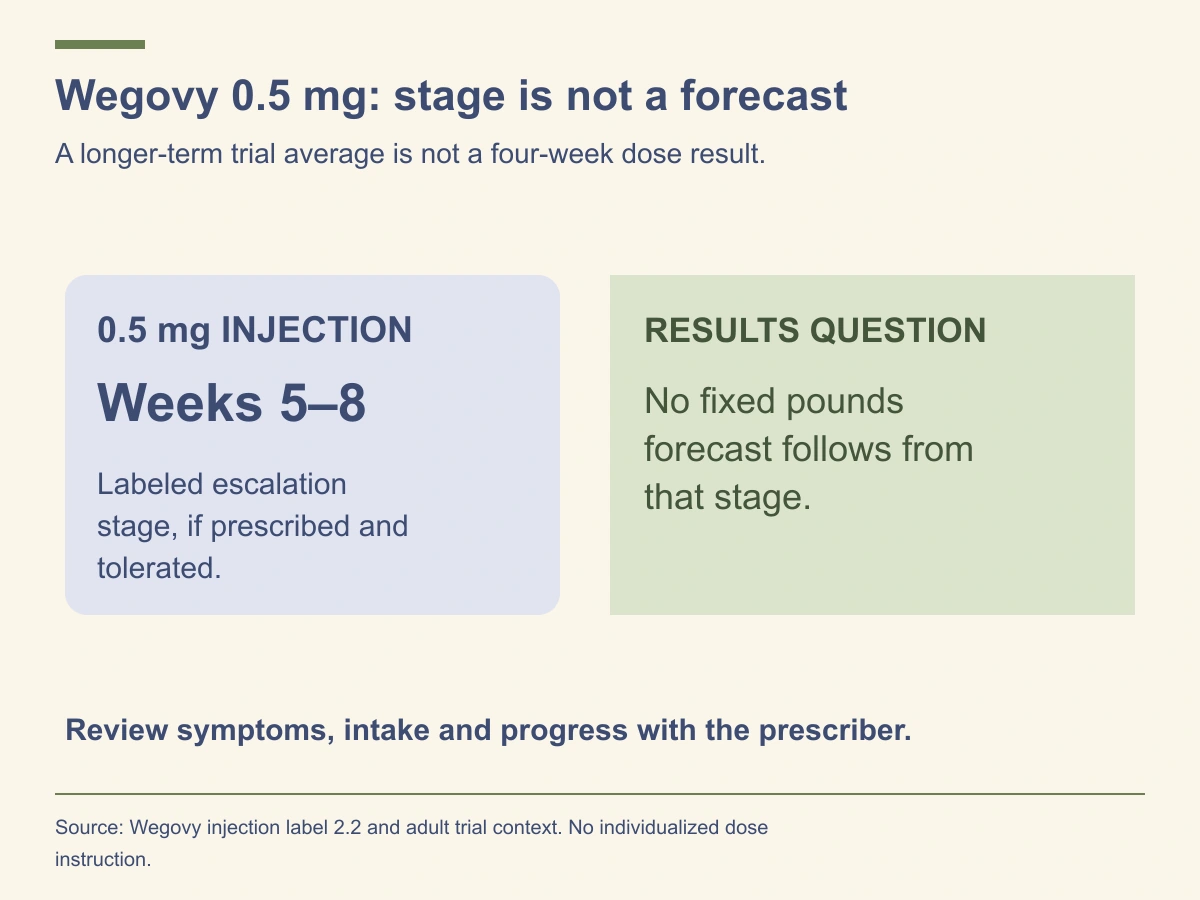
Why there is no dependable pounds-per-dose forecast
The reviewed label passages do not provide an isolated randomized result establishing how much an individual should lose during four weeks at 0.5 mg. The well-known adult study result discussed below comes from much longer follow-up in a different dose context. Absence of a dose-specific figure in these passages is not a claim that no early-treatment research exists anywhere; it means those sources do not support a promised 0.5 mg result.
People reach this stage with different starting weights, health histories, prior treatment, eating patterns, activity, and symptom burdens. A friend’s second-month result is an observation about that person, not a benchmark you must match. A social-media average may also combine different medicines, doses, and follow-up periods.
If someone gives you a precise pounds range, ask which study supports it, what population was studied, how long participants received the dose, and whether the figure is an average or a personal prediction. A number without those details is not a strong basis for changing treatment.
What about the average weight loss in Wegovy trials?
One adult obesity trial described in the label enrolled people with obesity, or overweight with a weight-related condition, and excluded type 2 diabetes. At 68 weeks, the label reports average weight change of about 14.9% with the studied 2.4 mg injection regimen versus about 2.4% with placebo. The result reflects the trial’s longer treatment and lifestyle context. It is not a result assigned to the 0.5 mg stage. Wegovy adult study population and results
Do not divide the average by the number of weeks and multiply by four. That would assume weight change was linear and that every dose stage contributed equally, neither of which follows from the reported average. It would also transform a group result into a personal forecast without justification.
Our Wegovy results and before-and-after guide explains how to interpret longer-term outcomes. The weight-loss timeline calculator guide addresses the limits of projecting a timeline. Use those tools to prepare questions, not to identify a dose that guarantees a deadline.
What if you have not lost weight at 0.5 mg?
Bring the result to follow-up without treating it as a verdict. Your prescriber can review how long you have been taking the actual product, whether doses were administered as directed, what symptoms have occurred, and what the treatment goals are.
Prepare a short account rather than a single number: when treatment started, when 0.5 mg started, what your trend looks like, and how you feel. If you have missed doses, had delivery delays, or been unable to follow the prescribed schedule, include that information. An interrupted timeline should not be compared casually with a continuous trial regimen.
Do not take extra injections, count improvised pen clicks, or shorten the interval to force a response. A small early change can still lead to a useful review; an unprescribed increase creates a different safety problem.
The first-month semaglutide guide helps organize early treatment observations. If access has been inconsistent, our Wegovy cost guide and NovoCare direct-access article can help separate administrative questions from clinical ones.

What if weight is dropping quickly?
Explain both the weight trend and what is happening with eating and drinking. A large early scale change does not tell you how much is body fat, whether you are adequately nourished, or whether the same rate should continue.
If you are skipping meals because of persistent nausea, vomiting repeatedly, or struggling to maintain fluids, contact your clinician. The Wegovy label warns about severe gastrointestinal reactions and kidney injury associated with volume depletion. Rapid loss accompanied by poor intake should not be presented as an ideal treatment response. Wegovy gastrointestinal and volume-depletion warnings
Ask about maintaining adequate nutrition and everyday function. Our semaglutide protein and muscle guide can support that conversation. It does not select a personal nutrition target or replace assessment of persistent symptoms.
Avoid celebrating a short-term number at the expense of how you are functioning. A practical plan should help you sustain appropriate treatment and eating patterns, not simply produce the largest possible weekly change.
Appetite changes are useful observations, not dose tests
People often ask whether they should “feel” 0.5 mg. Report what you notice: hunger, meal size, nausea, fullness, or no clear difference. Those experiences can help a clinician understand treatment, but the absence of a dramatic feeling does not establish that an injection failed or that the medicine should be increased immediately.
Do not repeatedly inject because you are unsure whether appetite changed. If you question an administration or a device, contact the pharmacist or prescriber and use the product-specific instructions. The semaglutide storage and travel guide addresses handling questions; appearance alone does not confirm the medicine was stored or supplied correctly.
Keep appetite and side effects distinct in your notes. “I felt less hungry and ate regular meals” is different from “I could not eat because I was vomiting.” That distinction gives your clinician more useful information than a general statement that the medicine is “working strongly.”
A simple progress record for this stage
Choose a manageable record that you can bring to an appointment. Consistency is more useful than checking the scale repeatedly through the day.
| What to record | Example of useful information | Question it helps address |
|---|---|---|
| Treatment timing | Start date, prescribed dose, and any missed doses | Are we comparing the right treatment window? |
| Weight trend | Measurements under reasonably consistent conditions | What is the trend rather than a single reading? |
| Symptoms | Frequency and effect on meals, fluids, sleep, or work | Is tolerability affecting daily life? |
| Intake and function | Difficulty eating, drinking, or completing usual activities | Does the plan need clinical reassessment? |
| Access questions | Supply gaps or product uncertainty | Is an administrative problem affecting treatment? |
You do not need to turn tracking into a full-time project. The goal is to give the prescriber enough context to understand the result and make a reasoned decision.

Should you stay at 0.5 mg or increase?
That decision belongs with the prescriber. The early stage, the labeled maintenance instructions, and any delay for tolerability should be considered together. Weight change by itself does not establish the appropriate next dose.
Ask: “Given my symptoms, intake, timeline, and progress, what is the planned next step?” If your clinician delays escalation, ask how long the plan lasts and what should trigger a call. If an increase is planned, confirm the exact product and instructions before obtaining it.
If exploring CoreAge Rx care, review semaglutide treatment information and ask about the actual formulation, clinical assessment, follow-up, and total cost. Wegovy’s labeled injection schedule should not be transferred automatically to a different formulation or a compounded vial. The compounded GLP-1 guide explains those product questions separately.
For persistent or concerning symptoms, contact the care team before treating the next refill as a routine administrative step. A plan to escalate can be reviewed when your situation changes.
Frequently asked questions
How many pounds should I lose on Wegovy 0.5 mg?
The reviewed sources do not establish a fixed personal pounds result for that stage. Review your own trend, treatment timeline, and tolerability with the prescriber.
Does no weight loss at 0.5 mg mean Wegovy failed?
Not by itself. It is an early escalation stage, and the result needs context. Do not increase the dose or frequency yourself to compensate.
Can I use the 68-week trial average to predict my second month?
No. That group result reflects longer treatment in a different dose context. Dividing it into equal monthly results is not supported by the reported average.
Should I feel a strong appetite effect at this dose?
Record your experience and discuss it. A particular feeling is not a reliable home test of administration, effectiveness, or the right next dose.
Is it okay to lose weight rapidly because I cannot eat?
Difficulty eating or maintaining fluids needs clinical review. Do not interpret persistent vomiting or poor intake as a desirable outcome just because the scale is falling.
Are 0.5 mg tablets and injections equivalent?
This article addresses Wegovy injection. Different formulations have separate instructions and should not be converted by matching numbers on a label.
Educational information for adults; individual treatment decisions require a qualified clinician. Sources reviewed October 3, 2026. Original AI-generated article images depict fictional people and objects, not patient outcomes. Other editorial images are illustrative. Graphics summarize the cited sources.