
A late, lighter, heavier, or unexpectedly regular period after starting Ozempic deserves attention, but timing alone does not prove that the medication caused it. Pregnancy, contraception, PCOS, changes in food intake or weight, thyroid conditions, and the transition to menopause can all matter. The useful next step is to describe the change and review it with the clinician who knows your history.
This guide separates menstrual questions from claims about fertility or hormone treatment. Semaglutide research in selected people with PCOS does not establish that Ozempic regulates everyone’s cycle, causes every missed period, or replaces contraception. If pregnancy is possible, address that possibility promptly rather than assuming the change is a routine drug effect.
Does Ozempic affect your period?
There is no reliable rule that predicts an individual’s menstrual response. A new symptom can occur during treatment without being caused directly by the drug. The clinical review needs the sequence of events: your previous cycle pattern, treatment start, changes in appetite or intake, weight change, contraception, and other medicines.
NICHD explains that absent periods can have many causes, including pregnancy, PCOS, thyroid problems, some medicines, stress, strenuous exercise, and inadequate energy intake. That list is a reason to investigate the whole picture; it is not a diagnosis from an online checklist. NICHD causes of amenorrhea.
Tell your clinician whether the change is new for you. A person with years of irregular cycles has a different starting point from someone whose previously predictable period suddenly disappears. Someone using a contraceptive that changes bleeding has another context. The same phrase, “my period changed,” can describe several different clinical questions.
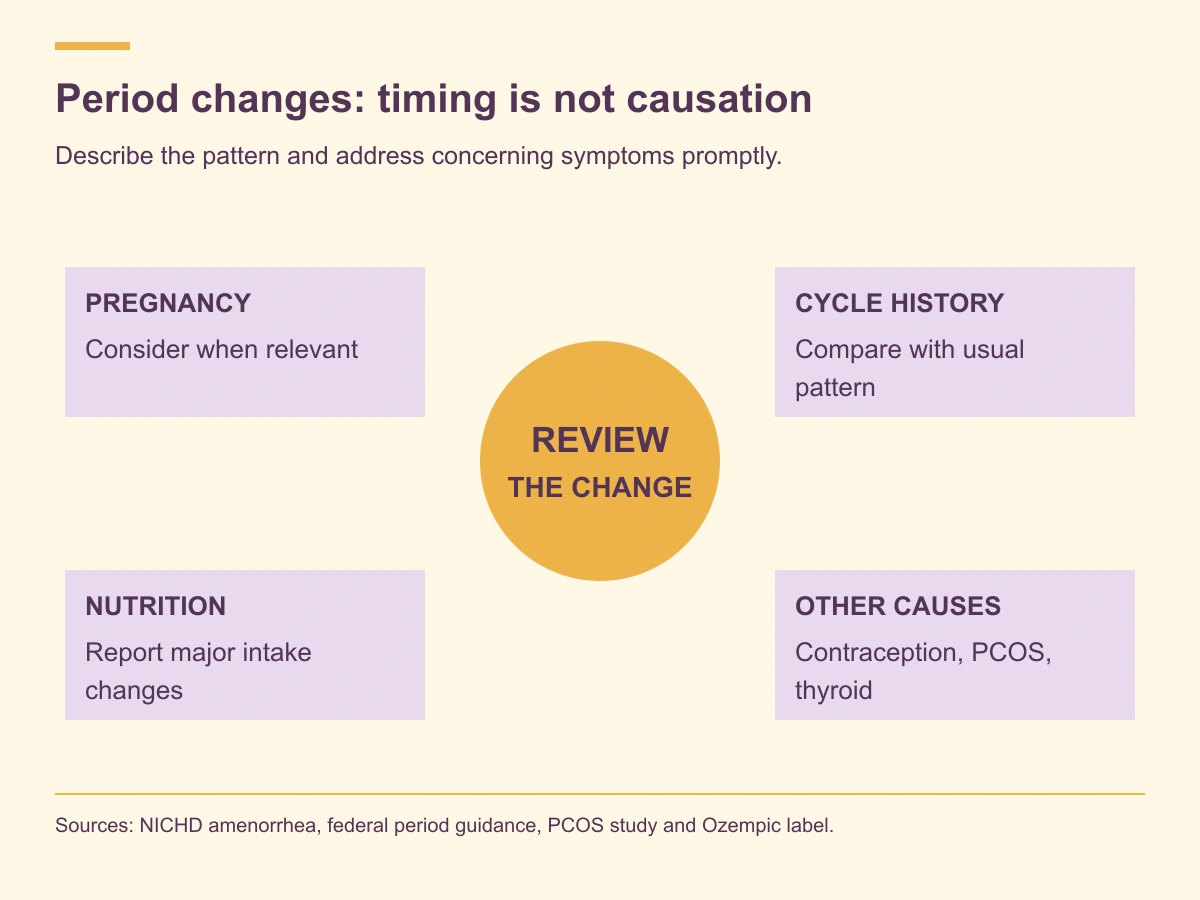
First, consider pregnancy when relevant
If pregnancy is possible and a period is late or missed, take a pregnancy test according to its instructions and contact your care team about the result and next steps. Do not use reduced appetite, nausea, or a weight change to rule pregnancy in or out. Those experiences can overlap with medication effects and other conditions.
For planned pregnancy, the reviewed Ozempic injection label advises stopping at least two months before trying to become pregnant, with a clinician-directed plan for blood-sugar control. An unexpected pregnancy needs prompt review of both medication exposure and the underlying condition being treated. Ozempic injection prescribing information.
Avoid interpreting this as an instruction to leave diabetes unmanaged. Contact the prescribing team and pregnancy-care clinician to coordinate treatment. If a test is negative but the period remains absent or symptoms continue, ask when to repeat testing or arrange evaluation.
Semaglutide is not contraception. Previously irregular periods do not guarantee that pregnancy cannot occur. Discuss an appropriate contraceptive plan if pregnancy is not desired, especially if your cycle pattern is changing during treatment.
What PCOS research does—and does not—show
A small 2023 study treated 27 adults with obesity and PCOS after an unsuccessful lifestyle program. It reported weight and metabolic changes, and cycle normalization in many participants who responded and continued treatment. The menstrual result was reported for the responsive group, not as a guaranteed outcome for every participant or everyone using semaglutide. Primary PCOS study.
This was a small selected cohort without a placebo-control group. Our inference from that design is that it cannot isolate a universal direct menstrual effect or predict an individual’s fertility. It also cannot establish that a new missed period in someone without PCOS has the same explanation.
The Ozempic and PCOS guide covers that condition in more detail. If you have not been diagnosed, irregular bleeding alone is insufficient to diagnose PCOS. Ask about the appropriate assessment rather than treating a search result or a single insulin value as confirmation.
Appetite, nutrition, and weight changes belong in the review
Menstrual health depends on more than body size. NICHD lists very low calorie or fat intake, low body weight, stress, and demanding exercise among features associated with hypothalamic amenorrhea. A clinician must determine whether that mechanism applies to you; a late period is not proof that you are eating too little or exercising too much. NICHD explanation.
Still, it is useful to report persistent nausea, skipped meals, difficulty eating enough, or a major activity change. Appetite reduction should not make adequate nutrition disappear from the care plan. If you are struggling to eat, ask for help with tolerable meals and symptom management.
The semaglutide protein and muscle guide and balanced-meal guide offer practical discussion points. Protein alone does not establish that total intake is adequate. A clinician or dietitian can consider the broader eating pattern, symptoms, and medical history.
Avoid trying to restore a period through an extreme diet, supplement stack, or unsupervised hormone regimen. The right response depends on the cause. A useful food record describes what you can actually tolerate and how often, without turning tracking into punishment or a rigid calorie target.

Contraception and other medicines can change bleeding
Some hormonal contraceptives intentionally reduce or stop bleeding. Changes after starting, stopping, or switching contraception may explain part of the timeline. Other medicines and endocrine conditions can also affect cycles. Bring the entire medication list to the review, including nonprescription products and supplements.
Do not transfer a contraception warning from one medication to another solely because both are discussed as GLP-1 treatments. The tirzepatide and birth-control guide addresses tirzepatide-specific questions. Ask your clinician or pharmacist about the instructions for the product you actually use and about vomiting, missed contraceptive doses, or other problems that may affect your own regimen.
If several changes happened together—for example, a new contraceptive, a semaglutide start, and a change in exercise—write them down separately. That gives the clinician something more useful than an assumption that the most recently advertised medicine explains everything.
Perimenopause, menopause, and hormone therapy
Cycles can become less predictable during perimenopause. That possibility still needs context, especially when pregnancy is possible, bleeding is unusually heavy, or a pattern is new. Age alone does not settle the cause of a missed period.
The perimenopause symptom guide explains questions to discuss when hot flashes, sleep changes, or other symptoms accompany cycle changes. The bleeding on hormone therapy guide addresses a different situation: bleeding in someone already using menopausal hormone therapy.
Ozempic and menopausal hormone therapy have different purposes. A change in weight or appetite does not establish an estrogen deficiency, and an irregular cycle does not automatically mean you need HRT. If you are exploring services, review CoreAge Rx’s estrogen-therapy information with the appropriate clinician and verify the current offering and suitability for your needs.
A useful symptom record
You do not need a perfect chart before contacting the team. Record the first day of bleeding, how it differs from usual, pain, pregnancy-test results when relevant, and the medication timeline. Include symptoms that affect daily life, such as dizziness, marked fatigue, or difficulty keeping fluids down.
| What to record | Why it helps the conversation |
|---|---|
| Previous cycle pattern and last usual period | Establishes your baseline |
| Bleeding dates and changes in flow | Describes the actual problem |
| Treatment start and prescribed changes | Clarifies timing without proving causation |
| Contraception and other medicines | Identifies overlapping influences |
| Appetite, food tolerance, weight, and activity changes | Adds metabolic and nutritional context |
| Pain, faintness, fever, or pregnancy possibility | Helps the team judge urgency |
A pattern is useful even if some dates are approximate. Bring the record to the appointment and ask which changes should trigger earlier contact. Do not postpone care simply because you have not completed several months of tracking.

When to seek care
Contact a clinician about persistent missed periods, a major change in bleeding, pain that interferes with daily life, or bleeding after menopause. Heavy bleeding or severe pain should not be dismissed as an expected consequence of weight treatment. The Office on Women’s Health describes several menstrual problems and reasons to arrange assessment. Period-problem guidance.
Seek urgent care for severe symptoms, such as fainting, severe pelvic or abdominal pain, or significant bleeding with weakness or breathing difficulty. Possible pregnancy with concerning pain or bleeding needs prompt assessment. Do not wait for the next routine medication refill to raise an urgent symptom.
For ongoing nausea or abdominal symptoms during treatment, describe both the gastrointestinal and menstrual concerns. The semaglutide side-effect guide can help you organize questions, but it cannot determine the cause of pain or bleeding remotely.
Questions about Ozempic and menstrual changes
Can Ozempic make my period late?
A late period can happen during treatment, but the timing does not establish the cause. Consider pregnancy when relevant and discuss the previous pattern, nutrition changes, contraception, and other health conditions with your clinician.
Can Wegovy cause a late period too?
Wegovy also contains semaglutide, but shared ingredient identity does not predict an individual’s menstrual change. The same careful review of pregnancy, cycle history, nutrition, and other causes is appropriate. Use the instructions for your exact product rather than substituting one brand’s entire care plan.
Does a more regular period mean my PCOS is cured?
No. Cycle changes are one observation within a broader condition. Ask how your clinician will assess symptoms, metabolic health, and ongoing treatment needs. A small study’s results do not establish a personal cure or remove the need for contraception.
Should I skip my injection to see whether my period returns?
Contact the prescriber before making a nonurgent change. A trial-and-error interruption can complicate diabetes management and still fail to identify the cause. Suspected pregnancy or a serious symptom needs prompt medical advice rather than an informal experiment.
Do period changes mean I need hormone replacement?
They do not establish that on their own. The appropriate assessment depends on life stage, symptoms, contraception, pregnancy possibility, and other conditions. Hormone treatment should follow an individualized evaluation, not a menstrual change interpreted from a medication forum.
What is the most useful first question for the clinician?
Ask, “What should we rule out first, and which changes should make me contact you urgently?” Then discuss the symptom record and treatment goal. That approach addresses the immediate concern while preserving a clear plan for the condition Ozempic was prescribed to treat.
Educational information for adults; individual treatment decisions require a qualified clinician. Sources reviewed October 3, 2026. Original AI-generated article images depict fictional people and objects, not patient outcomes. Other editorial images are illustrative. Graphics summarize the cited sources.