
Bleeding during menopause hormone therapy can happen for several reasons, including the prescribed hormone schedule, early adjustment to a new regimen, and conditions unrelated to HRT. The timing and pattern are useful clues, but they do not establish the cause. Unexpected bleeding should be reported to a clinician rather than assumed to be a harmless hormone effect.
This is especially important after menopause. In April 2026, ACOG updated its guidance on evaluating postmenopausal bleeding, recommending both transvaginal ultrasound and endometrial tissue sampling as part of the initial assessment for most patients. A reassuring ultrasound measurement alone is not a universal reason to stop investigating.
First, clarify what kind of bleeding is happening
A clinician will want to know whether you are still having menstrual cycles, whether you had already gone at least 12 months without a natural period, and whether your HRT schedule is intended to produce a withdrawal bleed. The same word, “spotting,” can describe very different situations.
Write down whether the blood appears to come from the vagina, whether it occurs after sex, and whether there are urinary or bowel symptoms. It can be difficult to identify the source at home. You do not have to be certain before asking for an assessment; uncertainty itself is useful information.
ACOG’s bleeding FAQ explains common causes and why bleeding after menopause needs evaluation. Bleeding does not automatically mean cancer, but the purpose of assessment is to identify the cause and avoid missing a condition that needs treatment.
Sequential and continuous HRT have different patterns
In a sequential regimen, estrogen is commonly used continuously while a progestogen is taken during part of the cycle. A scheduled withdrawal bleed may be expected. In a continuous combined regimen, estrogen and progestogen are taken together on an ongoing basis, with the aim of avoiding regular bleeding once the regimen settles.
The exact product and prescription matter. A general explanation of HRT schedules cannot tell you whether a particular episode is expected. Ask your prescriber what pattern is anticipated with your regimen and which changes should prompt contact.
Our guide to estrogen and progesterone in HRT explains why both components may be used when the uterus is present. If you have had a hysterectomy, the source of bleeding and the relevant anatomy need a different discussion; see HRT after hysterectomy for questions about the operation and remaining tissues.
Why spotting may occur after a treatment change
Starting HRT, changing a formulation, changing the schedule, or missing part of a regimen can affect bleeding. A clinician may ask about patch adhesion, missed tablets, prescription changes, and how the medicines are actually being used. This is an opportunity to clarify instructions, not assign blame.
Early spotting can occur, but “common” does not mean every episode should be ignored. Amount, persistence, recurrence, time since the change, and personal risk factors all influence the response. Bleeding after an established bleed-free interval deserves particular attention.
The British Menopause Society’s joint guidance on unscheduled bleeding, reviewed in May 2026, uses this combination of history, regimen, and risk factors to guide clinical assessment. Its UK pathways are not a do-it-yourself waiting rule for a US reader. Your clinician should determine whether a treatment adjustment, examination, imaging, tissue sampling, or another step is appropriate.
What changed in US guidance in 2026?
The April 2026 ACOG update recommends a combination of transvaginal ultrasound and endometrial tissue sampling in the initial evaluation of most patients with postmenopausal bleeding. This revises earlier guidance that could support ultrasound alone in some initial presentations with a thin endometrial lining.
For readers, the practical point is to avoid treating a single lining measurement as a guarantee that nothing further is needed. The clinician considers the whole presentation, including continued or recurrent bleeding and personal history. The update also emphasizes shared decision-making about tissue sampling.
This does not mean every episode of spotting in perimenopause follows the same pathway, or that every person on HRT needs an automatic biopsy. It means the distinction between perimenopausal bleeding, a planned withdrawal bleed, and postmenopausal bleeding matters. Ask which situation applies to you and how current guidance informs the evaluation.
A short record that helps the visit
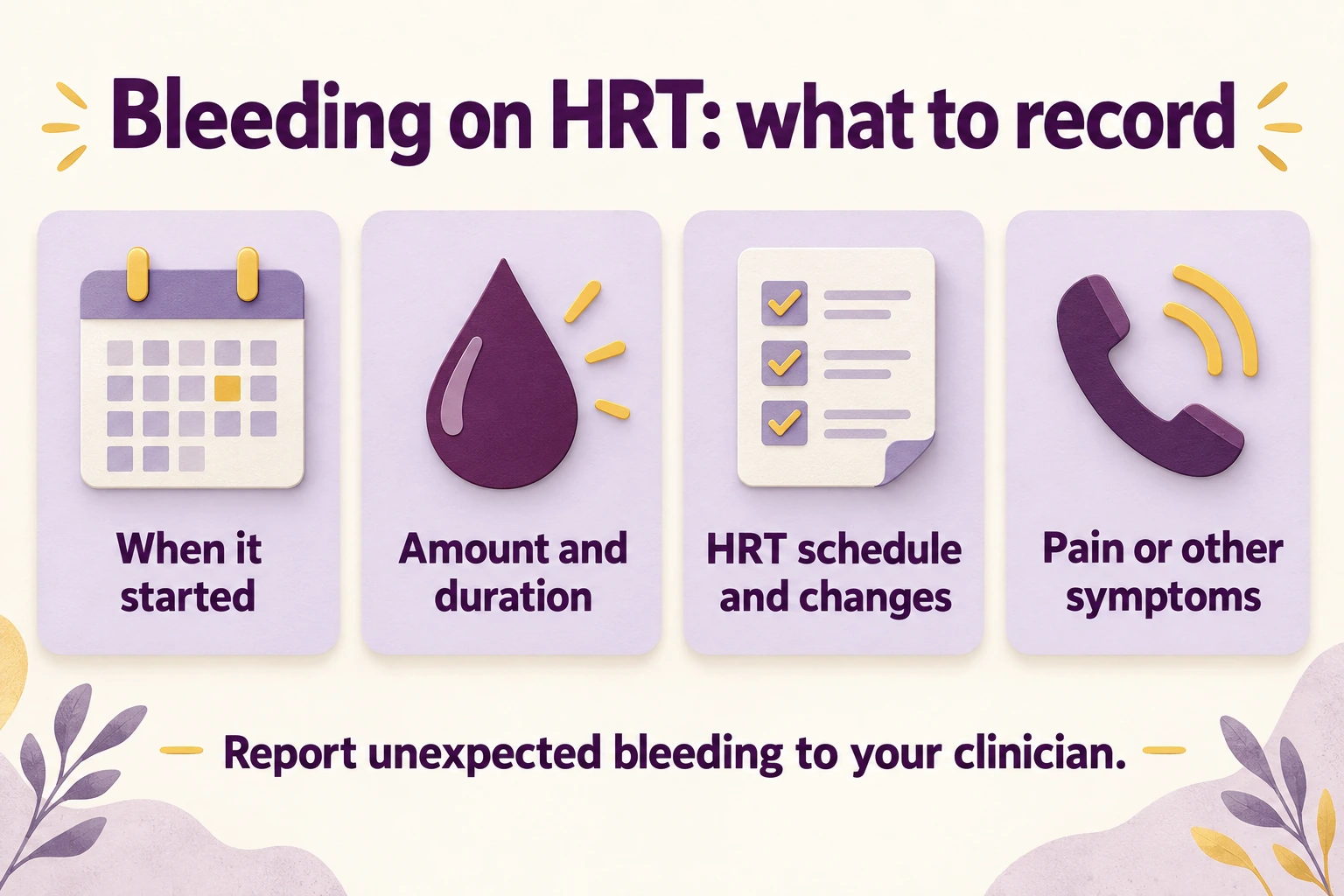
Record the first and last day of each episode, whether it was light spotting or heavier flow, and whether it returned after stopping. Note clots, pelvic discomfort, bleeding after sex, and any dizziness or unusual fatigue. Describe what you observed rather than trying to estimate an exact blood volume.
Include the names and strengths of all hormone products, their schedule, when each was started, and any missed doses or recent changes. A photograph of the prescription label can help you communicate the details accurately, but avoid sending sensitive images through an unsecured channel unless your care team provides instructions.
A useful example is: “I had no bleeding for several months, changed my patch three weeks ago, and now have spotting on four separate days.” That gives the clinician more to work with than “my HRT made me bleed.” The record supports the assessment; it does not prove that the treatment caused the bleeding.

When the amount or associated symptoms are urgent
Seek urgent care for heavy bleeding with faintness, marked dizziness, shortness of breath, chest discomfort, severe weakness, or severe pelvic pain. Feeling acutely unwell, passing out, or having rapidly worsening symptoms should not wait for a routine portal reply. Use emergency services when symptoms are severe.
If bleeding is lighter and you otherwise feel well, contact the prescribing clinician or gynecology team for advice about evaluation. Explain whether you are postmenopausal and whether the pattern is new. Do not postpone contact simply because an online discussion describes spotting as normal during the first months of HRT.
If you cannot reach the original prescriber, another qualified clinician can assess the concern. Bring the medication details and any previous results. A care plan should include a practical route to help, especially when treatment is prescribed remotely and an examination or procedure may need to occur locally.
What an evaluation may involve
The clinician may review medical and family history, examine the abdomen and pelvis, and consider tests based on the likely source of bleeding. An examination can help identify vaginal or cervical causes. Ultrasound provides information about structures and the uterine lining, while endometrial sampling examines tissue.
These tests answer different questions. A normal result from one does not necessarily settle every possible cause. Sometimes a sample is insufficient, or bleeding persists despite an initially reassuring evaluation. In those circumstances, the next step should be explained rather than leaving you to assume that silence means the problem is resolved.
Ask about discomfort management, what to expect during a procedure, and how results will be communicated. Also ask who is responsible for follow-up if imaging, sampling, and prescribing occur in different clinics. Clear ownership of the result is part of a useful plan.
Do not adjust the protective hormone on your own
When systemic estrogen is used in a person with a uterus, adequate endometrial protection is an important part of treatment. Skipping a prescribed progestogen, changing its schedule, or substituting a different product may change that protection. The ACOG HRT overview explains the reason combined therapy is used.
If a component seems to cause side effects, tell the prescriber. The answer may involve reviewing the formulation, dose, schedule, or a different treatment approach, but that decision should be made with the full regimen in view. Simply removing the medicine that seems inconvenient can create a different problem.
Likewise, do not increase estrogen to try to stop bleeding or use someone else’s progesterone instructions. If your clinician recommends a change, ask for a written schedule and clarify the follow-up plan. The goal is to make the treatment understandable enough to follow consistently.
What if the first tests are reassuring but bleeding returns?
Report recurrence. A previous assessment is valuable information, but it is not a lifetime clearance for every later episode. The clinician needs to know whether the pattern is new, heavier, more frequent, or associated with different symptoms.
Keep copies of the ultrasound report and pathology result when possible. “They said everything was fine” may leave a new clinician without details about what was tested, when it was tested, or whether the tissue sample was adequate. A clear record can prevent unnecessary duplication while still allowing appropriate reassessment.
Ask for an explicit instruction before leaving: what should you do if bleeding continues next week, returns next month, or starts after a treatment change? The answer should be tied to your situation. A generic statement that HRT can cause spotting does not replace a follow-up plan.
How to read online advice about bleeding
Look for the population and the regimen being discussed. Advice for a still-menstruating person using cyclic treatment may not apply to someone several years past menopause on continuous combined HRT. UK and US clinical pathways may also differ, and guidance can change over time.
Be cautious with absolute statements such as “spotting is always harmless for six months” or “a thin lining means you never need a biopsy.” Both strip away the clinical context that makes a recommendation useful. Current NICE menopause guidance and specialist bleeding guidance should be interpreted by the clinician in relation to your history.
A good educational article should help you describe the problem and understand the reason for assessment. It should not require you to decide at home whether a possible cancer has been excluded. That responsibility belongs in a clinical evaluation with a clear plan for results and recurrence.

Questions to ask your clinician
- Is bleeding expected with my exact HRT schedule?
- Does this count as postmenopausal or unscheduled bleeding in my situation?
- Could the blood be coming from a source other than the uterus?
- Which parts of my history affect the evaluation?
- Do I need ultrasound, tissue sampling, or both, and why?
- What should I do with my current prescription while the assessment is arranged?
- Who will contact me with the results, and what happens if bleeding returns?
For the larger treatment discussion, the HRT benefits and risks guide and starting HRT checklist can help you prepare. Bleeding deserves its own assessment even when the treatment has otherwise improved your symptoms.
Common questions
Is a small amount of spotting worth reporting?
Yes, particularly after menopause or when it is unexpected for your prescribed regimen. The amount is one part of the history; a small amount does not establish the cause.
Should I stop HRT immediately?
Contact the prescriber for instructions appropriate to your symptoms and regimen. Urgent symptoms require urgent care. Do not use an online article to make an unsupervised hormone change or to delay evaluation.
Does bleeding mean the HRT is too strong?
Not necessarily. Several treatment-related and unrelated causes are possible. The pattern, examination, medication history, and any indicated tests help determine the next step.
Can a normal ultrasound rule out every concern?
No. Ultrasound and tissue sampling provide different information. Current ACOG guidance recommends both as part of the initial evaluation for most patients with postmenopausal bleeding, and persistent or recurrent symptoms need follow-up.
Related reading
- Menopause and Joint Pain: Causes, Care, and the Role of HRT
- HRT After Hysterectomy: Why Ovary Status and Medical History Matter
- How Long Can You Take HRT? Reviews, Stopping, and Symptom Recurrence
- HRT and Migraine: Aura, Hormone Fluctuations, and Treatment Questions
- Menopause hormone therapy: the complete starting guide
- HRT benefits and risks
- Menopausal skin care and changing skin needs
Educational information for adults; personal treatment decisions require a qualified clinician. Sources checked September 16, 2026. Original AI-generated illustrations depict fictional people and are not patient testimonials.