
Blood in the stool while taking Ozempic should be assessed rather than accepted as a normal adjustment to treatment. The medicine, any constipation, and recent dose changes belong in the history, but they do not identify the source of bleeding. A small visible amount can still require medical advice, and severe or acute bleeding needs help right away.
Ozempic’s common adverse-reaction list includes nausea, vomiting, diarrhea, abdominal pain, and constipation. It does not make visible digestive bleeding an expected routine effect to ignore. This guide explains warning signs, possible causes a clinician may consider, and the details that make a bleeding history useful. Ozempic injection prescribing information.
When should you seek help right away?
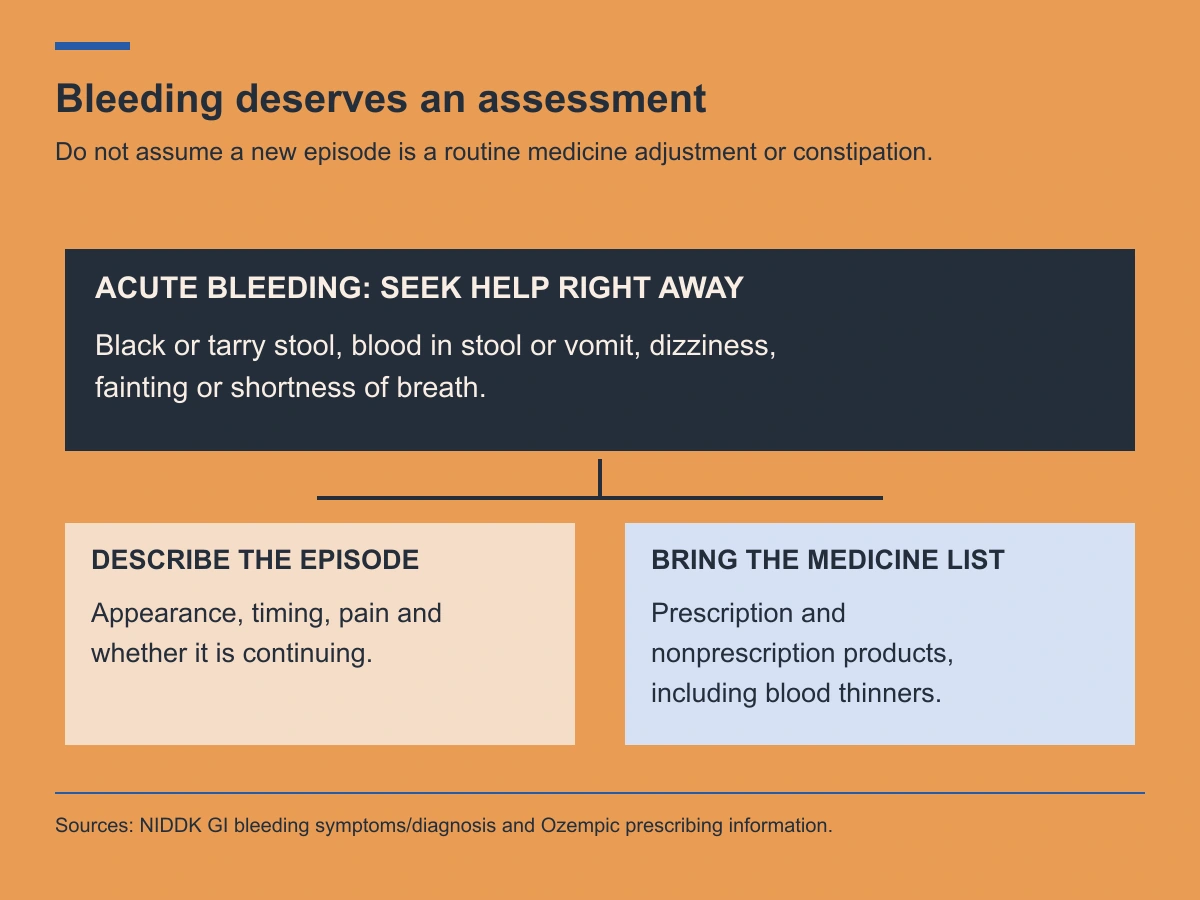
NIDDK lists black or tarry stool, dark or bright red blood mixed with stool, vomiting blood, and vomit resembling coffee grounds among signs of acute gastrointestinal bleeding. Acute bleeding can also occur with abdominal pain, dizziness, fainting, fatigue, or shortness of breath. Seek medical help right away for these symptoms. NIDDK GI bleeding symptoms.
Severe bleeding can cause shock. Warning signs include confusion or loss of consciousness, a rapid heartbeat, pale skin, cold hands or feet, and sweating. Seek emergency help for this pattern. If you are faint, confused, or severely weak, obtain help with transport rather than trying to manage the situation alone.
Do not use the amount you can see as the only measure of seriousness. Symptoms can change, and some bleeding is not visible. A familiar history of hemorrhoids also does not prove that a new episode has the same cause. Mention the history, but allow the clinician to evaluate what is happening now.
Why stool color cannot provide the whole answer
Describe whether blood is on toilet paper, on the outside of the stool, mixed through it, or present in the toilet. Explain whether the stool looks black and tarry and whether this is a new change. These observations can help the history, but they are not a reliable home map of the bleeding location.
NIDDK explains that symptoms vary with the type of bleeding and that chronic bleeding can involve small amounts or blood too limited to see. Occult bleeding means bleeding that is not visibly apparent; clinicians can use tests to investigate it. Over time, chronic blood loss can contribute to anemia, with symptoms such as fatigue, pallor, or breathlessness. NIDDK acute and chronic bleeding guidance.
The useful conclusion is that appearance belongs in the description. It should not be used to declare that the problem is harmless, to choose a treatment, or to decide that a negative-looking stool rules out bleeding.
Does the Ozempic label establish a bleeding risk?
The reviewed common-reaction table does not list blood in stool as a common Ozempic injection reaction. This table comes from specific trials and is not a complete description of every event that could occur during treatment. Its contents cannot establish the cause of an individual bleeding episode. Ozempic label.
The label does identify digestive symptoms and important warnings, including severe gastrointestinal reactions, pancreatitis, and kidney injury associated with volume depletion. Those warnings belong in a clinical assessment when pain, vomiting, or poor intake accompanies bleeding. They should not be combined into an unsupported claim that every episode of blood in stool is caused by Ozempic.
Likewise, a report that bleeding followed a dose increase is information about timing, not proof. The clinician will consider other medicines, prior digestive conditions, bowel habits, examination findings, and tests as needed. A careful explanation can acknowledge uncertainty while still taking the symptom seriously.
What possible causes might a clinician consider?
Gastrointestinal bleeding has several possible causes. NIDDK describes conditions in the upper digestive tract, small bowel, and lower digestive tract that may bleed. The location, medical history, accompanying symptoms, and test results help determine which explanation fits. NIDDK causes of GI bleeding.
| Possible clinical consideration | Why it may enter the assessment | Important limit |
|---|---|---|
| Hemorrhoids or an anal fissure | These can cause bleeding around the anus or lower rectum. | Visible red blood does not confirm either condition. |
| Peptic ulcer or gastritis | These can involve bleeding from the upper digestive tract. | A medicine list and other history are needed. |
| Diverticular bleeding | A blood vessel associated with a colon pouch can bleed. | It cannot be diagnosed from a bathroom description alone. |
| Colitis or inflammatory bowel disease | Inflammation or ulcers can be associated with bleeding. | Infection, blood-flow problems, and other causes require distinction. |
| Polyps, tumors, or other bowel conditions | These are among the causes considered in an evaluation. | Listing a possibility does not mean it is the likely diagnosis. |
The table is a way to understand why evaluation may be broader than one medication. It is not a ranking of causes or a self-diagnosis tool. A previous normal investigation also does not automatically explain a later, different symptom.

Can constipation and straining be part of the story?
Constipation is a listed common Ozempic reaction. If bowel movements became hard or difficult after treatment started, describe that change. Hemorrhoids and anal fissures are possible sources of lower digestive bleeding, so a clinician may ask about straining, discomfort, and stool consistency. Ozempic label, NIDDK lower-GI causes.
That connection does not justify assuming that constipation caused the bleeding. Blood together with persistent pain, vomiting, significant abdominal swelling, or other concerning symptoms deserves assessment before you add laxatives or substantially increase fiber. The symptoms should be considered together.
Our GLP-1 constipation guide covers bowel-history questions and why laxative choice depends on the individual situation. If you are considering a senna tea, the Smooth Move tea review explains its constipation purpose and safety limits. Neither article replaces assessment of bleeding.
Which other medicines should you mention?
Bring a complete medication list, including nonprescription pain relievers, aspirin, blood thinners, supplements, and medicines recently started or stopped. NIDDK specifically identifies medicine history as part of the bleeding evaluation and discusses NSAIDs and blood thinners in relation to certain upper-GI causes. NIDDK diagnosis guidance, NIDDK bleeding causes.
Do not independently stop an important prescription because it appears on a list of possible contributors. Ask the treating team what to do, particularly if you use a blood thinner for a heart or clotting condition. During urgent assessment, provide the actual name, dose, and last administration if you can.
Also identify the exact semaglutide product and presentation. A weekly injection, daily tablet, and compounded preparation have different instructions. The Ozempic dosage guide explains the injection schedule, while our compounded GLP-1 guide addresses formulation and pharmacy questions.
How might the clinician investigate the bleeding?
NIDDK describes an evaluation that can begin with medical and family history, vital signs, and physical examination. Blood testing can help assess the severity of blood loss and anemia; stool testing can identify occult blood. Depending on the situation, endoscopy, imaging, or other investigations may be appropriate. NIDDK GI bleeding diagnosis.
An endoscopy uses a camera to examine part of the digestive tract. The choice of upper endoscopy, colonoscopy, or another procedure depends on the question being investigated. Some procedures can also treat a source of active bleeding. Not everyone requires the same tests or the same order of tests.
If a procedure involving sedation or anesthesia is planned, tell the team that you take Ozempic. Its label describes delayed stomach emptying and reports of pulmonary aspiration during anesthesia or deep sedation. The label does not establish one universal medication-holding interval for every procedure. Obtain instructions from the prescribing and procedure teams. Ozempic anesthesia warning.
What if bleeding comes with abdominal pain or vomiting?
The combination deserves attention to severity, location, and duration. Describe whether pain is persistent or worsening, whether it limits ordinary activity, and whether vomiting prevents you from keeping fluids down. Do not decide that a concerning localized pain is simply gas because digestive side effects can occur with Ozempic.
Our guide to right-sided abdominal pain on Ozempic explains why gallbladder, appendicitis, pancreatitis, and constipation questions require different consideration. Ozempic’s label directs discontinuation and appropriate management if pancreatitis is suspected; persistent or severe abdominal pain needs professional assessment. Ozempic pancreatitis warning.
Vomiting and diarrhea can also contribute to volume depletion. If urine output is low or you cannot keep fluids down, mention that promptly. Our illness and GLP-1 symptom guide discusses why sick-day medication decisions need an individual plan.

A useful symptom account for the appointment
Record the first episode, whether bleeding is continuing or recurring, and the appearance and apparent source. Mention dizziness, shortness of breath, fainting, abdominal pain, vomiting, fever, and changes in bowel habits. If you have previous digestive diagnoses or bleeding investigations, explain those as well.
Include the last Ozempic dose, the prescribed strength and presentation, recent escalation, and other medicines. It helps to say, “This began two days after my prescribed dose changed, and I also became constipated,” rather than, “Ozempic definitely caused it.” The first statement preserves useful observations without replacing an investigation with a conclusion.
Ask what should happen if symptoms recur after the visit, who will communicate results, and whether your next dose requires review. Obtain a clear contact plan rather than relying on reassurance from an internet anecdote.
Frequently asked questions
Is a little blood on toilet paper safe to ignore?
A small amount does not identify the cause. Contact a healthcare professional for advice, particularly if it is new, recurring, or accompanied by pain or other symptoms. Severe or acute bleeding symptoms require help right away; do not wait for a large amount to become visible.
Does black stool always mean Ozempic is the cause?
No. Black or tarry stool is among NIDDK’s acute-bleeding warning signs, and the cause needs assessment. Medication timing cannot establish where blood came from or which condition is responsible. Describe the appearance and the complete medicine history.
Should I take an extra laxative to fix the bleeding?
Do not treat bleeding by automatically adding or escalating a laxative. Constipation may be relevant, but bleeding, pain, and other symptoms need evaluation together. A pharmacist or clinician can advise about constipation after the concerning symptoms have been assessed.
Will reducing my dose solve the problem?
That cannot be predicted from a general article. A medication change may be considered as part of an individualized plan, but it does not diagnose or treat every bleeding source. Ask the prescribing team about the next dose and seek urgent care when warning signs are present.
Where can I discuss treatment options after the episode is assessed?
If you are reviewing a CoreAge service, the semaglutide and tirzepatide pages can help organize treatment questions. Confirm the formulation, indication, and follow-up arrangements with the provider. A product comparison should come after appropriate assessment of active bleeding.
Educational information for adults; individual treatment decisions require a qualified clinician. Sources reviewed October 2, 2026. Original AI-generated article images depict fictional people and objects, not patient outcomes. Other editorial images are illustrative. Graphics summarize the cited sources.