
Whether you need HRT after a hysterectomy depends on more than the fact that your uterus was removed. Your ovaries may still be producing hormones, or they may have been removed at the same operation. The reason for surgery, the type of hysterectomy, your age, symptoms, and medical history all affect the discussion.
For many people who have had a total hysterectomy, systemic estrogen can be used without a progestogen when hormone therapy is appropriate. Important exceptions exist, particularly with a history of endometriosis or uncertainty about remaining endometrial tissue. Understanding the operation you actually had is the best starting point.
Hysterectomy and ovary removal are different procedures
A hysterectomy removes the uterus. A total hysterectomy removes the uterus and cervix; a supracervical or subtotal hysterectomy leaves the cervix in place. Removal of an ovary is called oophorectomy. Removal of both ovaries is a bilateral oophorectomy. These procedures can occur together, but the word “hysterectomy” does not tell you whether the ovaries were removed.
The ACOG hysterectomy FAQ explains the distinctions and what they mean for recovery and health. People sometimes use “complete hysterectomy” informally to mean different things, which is one reason the operative report is more useful than a remembered label.
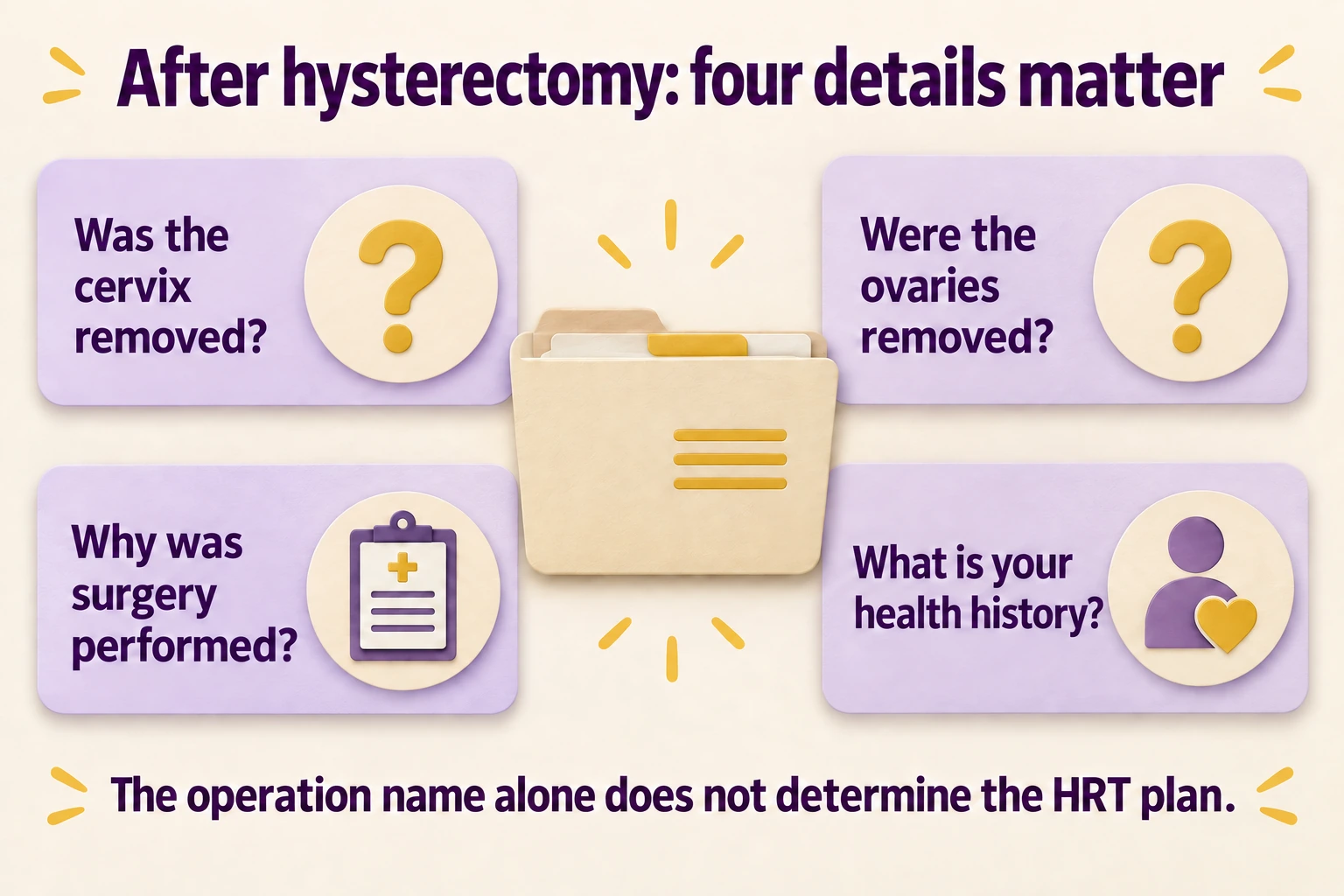
If you are unsure, request the surgical report or a plain-language summary from the surgical team. Ask specifically about the uterus, cervix, both ovaries, and the reason each structure was removed. You should not have to reconstruct these details from scars or from the route used for surgery.
What happens if the ovaries remain?
Removing the uterus stops uterine periods, but retained ovaries may continue their hormone activity. You can therefore experience the menopause transition without having menstrual bleeding to mark it. The absence of periods after hysterectomy does not by itself identify when ovarian menopause occurred.
Hot flashes, night sweats, vaginal symptoms, and other changes may prompt an assessment. A clinician considers age, symptoms, surgery details, medicines, and other possible explanations. In some situations testing is useful; in others the clinical picture is more informative than a single hormone measurement.
Our article on HRT testing and monitoring explains why testing should answer a specific question. Repeatedly checking hormones without a clear purpose can create confusing numbers while leaving the symptom that matters to you unaddressed. Ask what a result would change before assuming that a broad hormone panel is necessary.
What changes when both ovaries are removed?
Removal of both functioning ovaries before natural menopause produces surgical menopause. The change can be abrupt, and the age at which it occurs matters. A treatment conversation after surgery in a younger person is not identical to one about starting systemic HRT many years after natural menopause.
The 2022 Menopause Society position statement addresses early loss of ovarian function and the importance of hormone therapy in appropriate patients without contraindications. Decisions can involve symptom relief, bone health, and the consequences of early estrogen loss, rather than hot flashes alone.
If surgery is planned, ask about this before the operation when possible. The plan should explain who will manage menopause symptoms afterward, when a treatment discussion will occur, and how your surgical diagnosis affects the options. If surgery has already happened, it is still reasonable to ask for a dedicated review rather than trying to fit every question into a brief postoperative wound check.
Why a progestogen is usually linked to the uterus
Systemic estrogen can stimulate the endometrium, the lining of the uterus. A progestogen is commonly included when the uterus is present to protect that lining. If the uterus and its lining have been removed, that particular reason for adding a progestogen generally no longer applies.
ACOG’s explanation of menopause hormone therapy describes estrogen-only and combined treatment. “Progesterone” refers to a particular hormone; “progestogen” is the wider category that includes progesterone and related medicines. Knowing that distinction can make prescription discussions easier.
This does not mean every person after hysterectomy should start estrogen, or that a current progestogen prescription is automatically unnecessary. There may be another reason for the regimen. Ask the prescriber to explain the purpose of each component before making a change. An online rule cannot substitute for the details of your operation and diagnosis.
Endometriosis is an important exception to discuss
Endometriosis can involve tissue outside the uterus, so hysterectomy does not necessarily remove all disease. That matters when considering estrogen exposure after surgery. The history of endometriosis should be visible in the hormone-treatment discussion, even if the surgery was many years ago.
The ESHRE endometriosis guideline supports considering combined menopause hormone therapy in women with a history of endometriosis and advises against estrogen-only regimens because of concern about residual disease and malignant transformation. The evidence is limited, and the decision requires individualized care.
The useful question is not whether one rule defeats another. It is whether your history creates a reason to choose a different regimen from the usual post-hysterectomy approach. Ask whether the surgeon documented residual disease, whether specialist input would help, and which new symptoms should be reported. Do not add or stop progesterone based on someone else’s postoperative prescription.

Subtotal hysterectomy and uncertain surgical details
When the cervix remains, questions about residual endometrial tissue and later bleeding may need a more specific review. The operative report, pathology, and any postoperative bleeding history can help the clinician determine what is relevant. A person who does not know which operation they had should not be expected to make this decision alone.
Bring copies of records if care has moved between health systems. A short note saying “hysterectomy” in a medication chart may omit details that matter now. If records are unavailable, tell the clinician what you know and what remains uncertain so they can plan an appropriate assessment.
This is also a chance to clarify ongoing screening. Cervical screening needs depend on whether the cervix remains and on prior findings and medical history. HRT use does not settle that question. Ask the clinician to record the screening plan separately from the hormone prescription.
Cancer history can change the conversation
The reason for hysterectomy matters. Surgery for fibroids or heavy bleeding raises different questions from surgery involving a gynecologic cancer or a high-risk inherited condition. A history of breast cancer or another hormone-sensitive cancer may also affect whether systemic or local hormone treatment is appropriate.
Bring the exact diagnosis when possible, including the type of cancer, treatment history, and the clinicians involved. “Cancer runs in my family” and “I was treated for a hormone-sensitive cancer” are different pieces of information. Both deserve attention, but they do not lead automatically to the same decision.
A menopause specialist and the treating oncology team may need to coordinate. The aim is a plan that addresses symptoms while respecting the actual diagnosis and evidence. It is reasonable to ask about nonhormonal options and to request an explanation of any uncertainty rather than accepting a simple yes or no without context.
Systemic symptoms and local symptoms may need different care
Hot flashes and night sweats are usually discussed in terms of systemic treatment, which reaches the body more broadly. Vaginal dryness, discomfort with sex, and some urinary symptoms may lead to a discussion of local treatments. A person can have one group of symptoms without the other.
Our guide to vaginal estrogen versus systemic HRT explains why the route and intended use matter. A vaginal product is not interchangeable with an estrogen patch, and a skin cream marketed for facial appearance is not a menopause regimen.
For a related skin-care question, see estriol face cream versus hormone therapy before reviewing the Time Out topical product page. Time Out is a compounded facial product containing estriol and other ingredients. Its product information should not be interpreted as a replacement for systemic or vaginal treatment after hysterectomy.
Choosing a route and setting expectations
If HRT is appropriate, the clinician may discuss oral or transdermal estrogen and the practical differences between products. Personal risk factors, preference, skin tolerance, medication use, and ability to follow the routine can influence that choice. A patch is not universally risk-free, and a pill is not automatically unsuitable for every patient.
The estrogen patch versus pill guide provides a fuller comparison. The important questions are why a route fits your situation, what benefit is expected, and which side effects or changes should trigger review.
Agree on a small number of goals. Examples include fewer night sweats, more comfortable sleep, or improvement in a specific vaginal symptom. A prescription should not be judged solely by whether a laboratory number rises or whether every symptom associated with midlife disappears. Some problems may require their own assessment and treatment.
What to bring to a postoperative hormone review
A practical appointment folder can contain the operative report, pathology summary, current medicine list, and a brief description of symptoms. Include over-the-counter products and any hormones obtained from another clinician. Record the surgery date and whether symptoms began before or after the operation.
Questions worth asking include:
- Were both ovaries removed, and does my age change the treatment discussion?
- Was the cervix removed, and is residual endometrial tissue a concern?
- Does endometriosis or another surgical diagnosis affect the regimen?
- What is the purpose of each prescribed hormone?
- Are my symptoms best addressed with systemic, local, or nonhormonal care?
- Who will review the treatment, and when?
Ask for written instructions that name the exact product. A phrase such as “use your estrogen” may be confusing if you have more than one formulation. If treatment changes, clarify which old medicine is being replaced and which remains part of the plan.

Bleeding and new symptoms still deserve attention
Unexpected vaginal bleeding after recovery from hysterectomy should be discussed with a clinician. Its source may be different from bleeding in a person with an intact uterus, but the absence of a uterus is not a reason to ignore it. The timing relative to surgery, remaining anatomy, local tissue changes, and other symptoms all matter.
Heavy bleeding, faintness, severe pain, fever, or symptoms that seem urgent warrant prompt assessment. Follow the surgical team’s specific recovery instructions in the immediate postoperative period. For the broader distinction between expected patterns and evaluation, see bleeding on HRT.
Common questions
Does everyone need HRT after hysterectomy?
No. Retained ovaries, age, symptoms, health history, and the reason for surgery all affect the decision. Removing the uterus does not automatically mean both ovaries stopped functioning.
Can I stop progesterone because I no longer have a uterus?
Ask the prescriber first. Many people after total hysterectomy do not need a progestogen for endometrial protection, but endometriosis and other specific circumstances can change the plan.
Is there a fixed age when I must stop?
There is no single duration that fits everyone. The article on how long to take HRT explains regular review and why continuing an established treatment differs from starting it much later.
What if my surgery records are missing?
Tell the clinician exactly what is uncertain. They can help request records and decide whether the available history and examination are enough to guide care. Do not guess about ovary or cervix status when choosing a hormone regimen.
Related reading
- Brain Fog During Menopause: What HRT Can and Cannot Do
- Menopause and Joint Pain: Causes, Care, and the Role of HRT
- Bleeding on HRT: Patterns to Track and When to Seek Care
- How Long Can You Take HRT? Reviews, Stopping, and Symptom Recurrence
- Menopause hormone therapy: the complete starting guide
- HRT benefits and risks
- Menopausal skin care and changing skin needs
Educational information for adults; personal treatment decisions require a qualified clinician. Sources checked September 16, 2026. Original AI-generated illustrations depict fictional people and are not patient testimonials.