A stiff morning, an aching shoulder, or knees that object to stairs can make the menopause transition feel like a sudden change in the whole body. Joint symptoms are commonly reported around this stage of life, but timing alone does not identify their cause. Hormonal changes may contribute for some people, while arthritis, tendon problems, injury, and other conditions can produce similar complaints.
HRT may improve joint pain for some women, but it is not a universal treatment for painful joints. The most useful approach is to understand the pattern, preserve comfortable movement, and decide whether menopause treatment and a separate joint evaluation both belong in the plan.
Start by describing the problem accurately
“Joint pain” can mean pain inside a joint, tenderness around it, stiffness, or muscle discomfort nearby. Those differences are hard to sort out without an examination. You do not need to name the diagnosis before seeking care, but you can describe where the problem is and what makes it noticeable.
For example, pain on the outside of a hip while lying on that side is a different story from a visibly swollen finger joint. Knee discomfort after a new walking routine is different from severe pain that appeared overnight with fever. The location, speed of onset, and associated symptoms help a clinician choose the right questions.
MedlinePlus lists several possible causes of joint pain, including osteoarthritis, inflammatory conditions, tendon and bursa problems, injuries, and infections. Menopause can be part of the history while those possibilities remain relevant.
Why menopause and joint symptoms can overlap
Estrogen affects many tissues, and researchers have examined whether changes in estrogen exposure influence joint symptoms. At the same time, the menopause transition occurs during years when previous injuries, changing activity patterns, sleep disruption, and age-related conditions may become more noticeable. A symptom can have more than one contributor.
Poor sleep also changes the experience of a difficult day. Someone who has been awake repeatedly with night sweats may find an already uncomfortable shoulder harder to manage. That does not prove the shoulder pain is caused by low estrogen, or that hormone treatment will resolve it.
Our menopause hormone therapy guide explains the broader treatment discussion. For joint symptoms, the additional question is straightforward: what evidence suggests that the pain is part of the menopause experience, and what findings call for an assessment beyond menopause care?
What a randomized trial found about estrogen and joint pain
A secondary analysis of the Women’s Health Initiative estrogen-alone trial examined joint symptoms in women who had undergone hysterectomy. At one year, joint pain was reported by 76.3% of the estrogen group and 79.2% of the placebo group. This was a modest difference, not elimination of pain. Joint swelling was reported more often in the estrogen group at that point.
The study used oral conjugated equine estrogen in a specific population. It does not show that every estrogen product, patch, dose, or combination with a progestogen has the same effect. It also does not establish HRT as a treatment for rheumatoid arthritis, a torn tendon, or a painful joint infection.
The practical interpretation is that some symptom improvement is plausible, while expectations should remain measured. A person considering HRT for significant hot flashes may reasonably ask whether joint symptoms could also change. Joint pain alone still deserves a careful explanation rather than a promise that estrogen will repair the joints.
How HRT fits into a larger decision
Established reasons to consider systemic HRT include bothersome vasomotor symptoms, meaning hot flashes and night sweats, with other uses depending on the clinical situation. The ACOG hormone therapy FAQ describes benefits, treatment types, and risks that need to be considered together.
Whether a uterus is present affects the need for endometrial protection when systemic estrogen is used. Personal history of blood clots, certain cancers, stroke, unexplained bleeding, and other health conditions can change the plan. Choosing a route or regimen involves more than identifying the symptom that feels most frustrating.
If joint discomfort improves after starting HRT, record the change. If it does not, avoid assuming that a higher hormone dose is the answer. Ask whether the original diagnosis, activity plan, sleep problem, or pain treatment needs reassessment. A useful review separates the response of hot flashes from the response of joint pain instead of combining them into one vague score.
Patterns that deserve a closer look
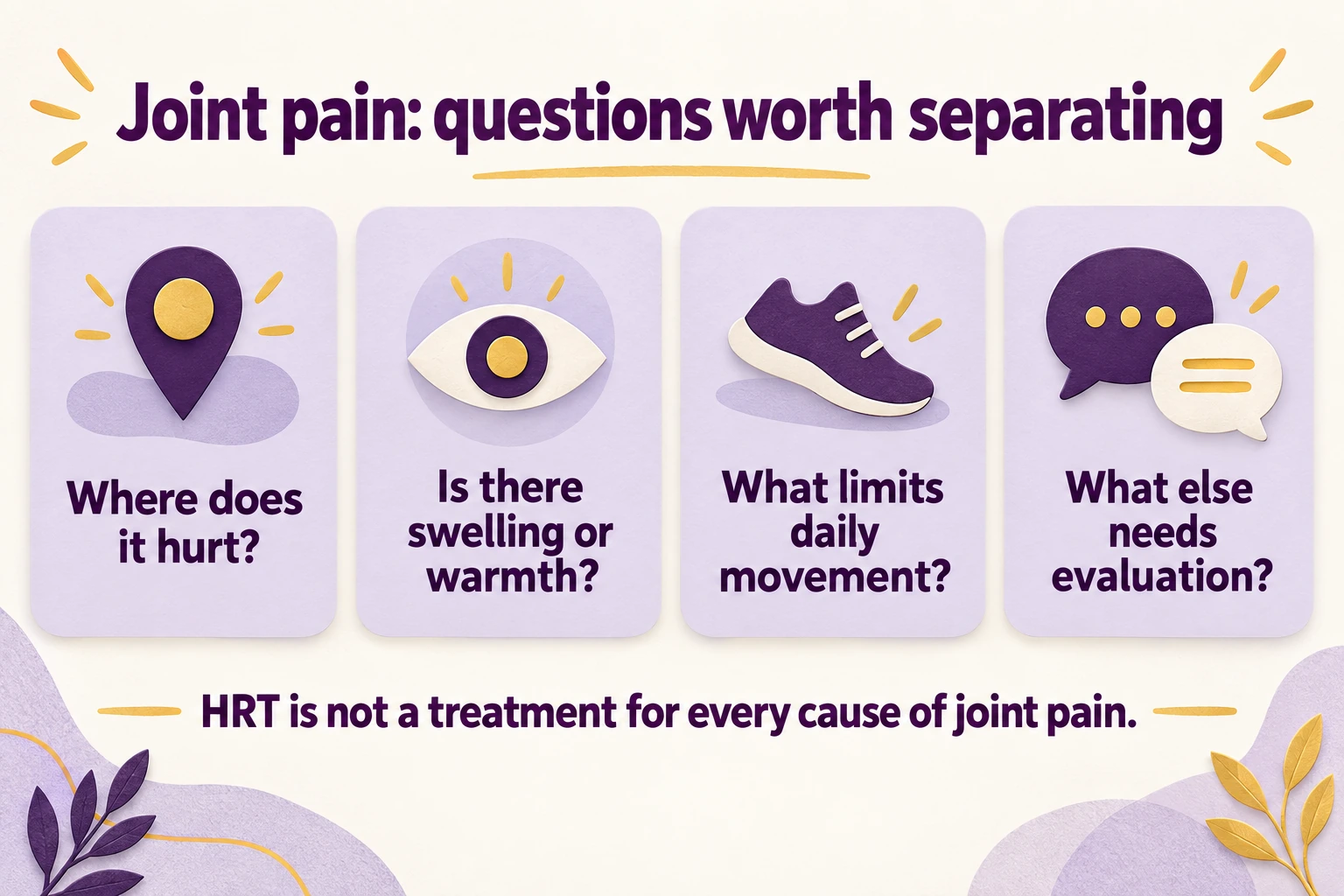
Tell a clinician about swelling, warmth, redness, a new rash, prolonged stiffness, unexplained weight loss, or symptoms affecting several joints. Also describe whether the pain follows an injury or prevents ordinary activities. These details can alter the urgency and type of evaluation.
Seek urgent assessment for a suddenly very painful, hot, swollen joint, especially with fever or feeling unwell. Significant injury, inability to bear weight, or a new loss of function also warrants prompt attention. Waiting for a routine HRT appointment is not an appropriate response to a potentially acute joint problem.
Persistent symptoms can matter even without dramatic swelling. If you have gradually stopped walking, reaching overhead, or carrying groceries because of discomfort, explain that change. Function gives the clinician information that a pain number alone may miss.

A movement plan that starts from current ability
The first question is not how much exercise you should force through. It is what movement is comfortable and appropriate for the problem being assessed. Depending on the cause, a clinician or physical therapist may recommend modifying the activity, building strength, improving range of motion, or temporarily reducing a particular load.
CDC physical activity guidance includes aerobic activity and muscle-strengthening work for adults, with activity adapted to ability and health conditions. Those are broad health goals, not instructions to complete a target while a joint is acutely painful or swollen.
Try describing a practical goal: getting up from a chair, taking a short walk, or returning to a favorite activity. Breaking the goal into manageable steps makes it easier to see progress. Our beginner’s guide to strength training explains how to think about consistency and function before chasing heavier weights or a different appearance.
Track what changes, not just how much it hurts
A brief record can include the location of pain, stiffness after waking or sitting, visible swelling, sleep quality, and one everyday task. Write down any change in exercise, footwear, work demands, or medication. This helps prevent a new symptom from being automatically attributed to whichever treatment was started most recently.
For example, “I could walk to the store with one rest stop” provides a clearer reference than “a little better.” A person with shoulder pain might track whether dressing or reaching a shelf is easier. Choose a task that is meaningful and safe for you.
If several interventions start together, acknowledge the uncertainty. Improved sleep, physical therapy, and a hormone prescription may all contribute to feeling better, and the record will not always reveal which one was responsible. That is acceptable; the purpose is to guide care, not conduct a perfect experiment at home.
Muscle, bone, and joints are different targets
Bone density, muscle strength, and joint comfort are connected to mobility, but they are not the same outcome. Osteoporosis concerns the strength of bone and fracture risk. Joint pain does not diagnose osteoporosis, and the absence of pain does not prove that bone density is normal.
Likewise, a supplement that supports an exercise routine does not diagnose or treat the cause of a painful joint. Readers interested in maintaining strength can start with creatine after 50 and creatine for women. The Strong Suit creatine product page provides the current product details for people comparing supplements with their clinician.
That is a separate decision from HRT or arthritis treatment. Review kidney history, medicines, and the exact supplement before adding it. A product purchase should not delay an examination when pain, swelling, or function is getting worse.
Weight discussions should remain practical and respectful
Body weight may be relevant to some joint problems, but it is not a complete explanation for pain. A useful conversation can address strength, activity, sleep, and treatment options without making weight loss a condition for receiving care. People at different body sizes can have injuries, inflammatory arthritis, and other causes that need assessment.
If weight management is one of your goals, our guide to weight management after 40 discusses the broader context. Progress can include being able to walk farther or climb stairs more comfortably, even before a meaningful scale change occurs.
Avoid treating HRT as a weight-loss prescription. The article on HRT and body composition explains why hormone symptoms, body-fat distribution, and treatment for obesity require related but distinct conversations. A joint-care plan should remain useful even if weight changes slowly or not at all.

Preparing for an appointment
Bring a list of the painful areas and identify the one that most limits your day. Note when symptoms began, whether they fluctuate, and what you have already tried. Include nonprescription pain medicines and supplements, since tolerability and interactions matter when choosing a treatment plan.
Useful questions include:
- Does the pattern suggest a joint, tendon, muscle, or another problem?
- Are there findings that make testing or imaging useful?
- Which movements should I continue, adapt, or pause?
- Would physical therapy help me reach a specific functional goal?
- If HRT is appropriate for menopause symptoms, how will we judge its separate effects?
- When should I return if pain persists or changes?
Ask who will review any test result and what the next step will be if the initial plan does not help. An open-ended instruction to “see how it goes” is easier to follow when it includes a timeframe and clear reasons to contact the office sooner.
Common questions
Is joint pain proof that my estrogen is low?
No. Joint symptoms do not measure hormone levels or establish a hormonal cause. Menopause history may be relevant, but the location, examination, and associated symptoms still matter.
Will an estrogen patch help more than a pill?
There is no reliable general rule that one route will relieve your joint pain better. Route selection is usually based on the overall treatment goal, medical history, risks, and preference. Read estrogen patches versus pills for that broader comparison.
Should I stop moving until the pain disappears?
The answer depends on the cause. Some conditions benefit from adjusted activity and rehabilitation; acute injury or a hot, swollen joint may require prompt assessment and different instructions. Ask for advice that matches the actual problem.
How long should I wait for HRT to help my joints?
There is no established universal joint-pain timeline for HRT. Agree on a review plan for the symptoms HRT is intended to treat, and arrange separate assessment if joint symptoms persist, progress, or restrict daily life. Waiting indefinitely can postpone care for a different condition.
Can I have menopause symptoms and arthritis together?
Yes. One diagnosis does not exclude another. A good plan can address bothersome menopause symptoms while also treating a confirmed musculoskeletal condition and supporting the activities that matter to you.
Related reading
- Brain Fog During Menopause: What HRT Can and Cannot Do
- HRT After Hysterectomy: Why Ovary Status and Medical History Matter
- Bleeding on HRT: Patterns to Track and When to Seek Care
- HRT and Migraine: Aura, Hormone Fluctuations, and Treatment Questions
- Menopause hormone therapy: the complete starting guide
- HRT benefits and risks
- Menopausal skin care and changing skin needs
Educational information for adults; personal treatment decisions require a qualified clinician. Sources checked September 16, 2026. Original AI-generated illustrations depict fictional people and are not patient testimonials.