
Women can use creatine to support appropriate strength and exercise goals; it is not a supplement reserved for men. The most useful discussion is about the activity, the evidence, the labeled amount, and individual health circumstances—not whether the packaging looks “feminine.”
Strength benefits and evidence limits
Creatine research includes women, and some studies find added benefits when supplementation is combined with resistance training. However, the number and design of studies vary across ages and life stages. The review of creatine in women’s health discusses both the potential uses and the remaining gaps.
Evidence about muscle performance should not be turned into a promise to balance hormones, treat menopause, prevent osteoporosis, or improve fertility. Those are different clinical questions. A supplement can be useful for one outcome without being established for every related concern.
Is the amount different for women?
Many adult studies use a maintenance range around 3–5 g daily. Sex alone does not establish a need for a specially marketed low-dose product. The NIH exercise-supplement review describes common protocols, but individual recommendations should account for the product, medical history, and purpose.
Strong Suit’s pictured label directs one scoop daily and lists 5 g creatine monohydrate. Do not take additional servings because an influencer recommends a different regimen. If you need a personalized plan, bring the actual label to a clinician or sports dietitian.

Will it make you bulky?
Taking creatine does not automatically produce a bodybuilder’s physique. Muscle changes depend on training, food intake, time, and individual response. Some people notice early water-related weight changes, which should not be confused with an immediate increase in fat or large amounts of new muscle.
If the scale is a concern, choose practical measures such as getting stronger at a familiar movement or completing planned workouts. The water-weight guide explains why early changes can be misleading.
Pregnancy, breastfeeding, and medical conditions
Do not extrapolate exercise research in nonpregnant adults to pregnancy or breastfeeding. Discuss supplementation with the relevant clinician before use. Strong Suit’s pictured caution also calls for clinician consultation with pregnancy, nursing, medical conditions, or medication use.
Kidney disease or abnormal tests require a separate discussion. More broadly, a product does not become appropriate simply because it contains one ingredient or is sold without a prescription.
Build the surrounding routine
Choose resistance exercises suited to your abilities, progress gradually, and make room for recovery and adequate meals. Compare creatine with protein powder if you are unsure which nutritional need you are trying to address. They do different jobs.
For later-life training questions, read creatine after 50. The goal is a realistic plan that supports function and strength, with expectations matched to the evidence.

Start with a useful goal rather than a gendered product category
Strength, exercise capacity, and everyday function are meaningful goals for women at different ages and training levels. A supplement decision becomes clearer when you name the goal directly. “I want to progress a resistance program” provides a better basis for discussion than “I need the supplement marketed for women.”
Product packaging does not tell you whether the ingredient amount is appropriate or whether the evidence matches your situation. A pink label, a smaller scoop, or a blend described as “toning” can distract from the same practical questions that matter for any creatine product: form, disclosed dose, directions, other ingredients, and quality documentation.
If you are beginning exercise, an appropriate program and consistent attendance are central. If you already train regularly, you may be evaluating whether creatine is a convenient addition to an established routine. Those are different starting points, even if both people are women using the same product.
What research across life stages can and cannot establish
The women’s-health review discusses creatine in relation to different life stages, but the depth of evidence is not identical for every question. A finding about resistance-training outcomes should not be repackaged as proof of a hormonal, reproductive, or menopause treatment.
Pay attention to who participated in a study. Age, training status, the intervention, and the measured outcome all affect how directly the findings apply. A study in one group of nonpregnant adults does not answer a pregnancy question. A short exercise study does not establish a long-term effect on fracture risk or every aspect of healthy aging.
This does not make the research irrelevant. It makes the claims more specific. You can discuss creatine as an exercise-related option while leaving other clinical questions with the appropriate clinician and evidence base. Clear boundaries make the information more useful than broad promises that one scoop addresses every life-stage concern.
Build a strength routine that you can evaluate
Choose movements suited to your abilities and access to equipment. A supervised gym program, a home routine using resistance equipment, or another appropriately designed plan can provide repeatable activities to track. The supplement does not determine which exercises are suitable for your joints, balance, or health history.
Record controlled repetitions and the resistance used in a few familiar movements. Note whether you complete the planned sessions and how recovery feels. Avoid changing the entire program every week while trying to judge a supplement; the comparison becomes harder when the exercise stimulus keeps changing.
Progress does not have to mean a dramatic change in appearance. Carrying groceries more comfortably, feeling more capable during an exercise class, or gradually increasing a familiar resistance can be worthwhile goals. Choose measures that fit your priorities rather than borrowing someone else’s before-and-after standard.
Put concerns about body size in context
The word “bulky” often combines several concerns: visible muscle growth, water-related weight change, fat gain, or a fear of losing control over appearance. Separating those concerns makes it easier to discuss them accurately. Creatine does not automatically produce a predetermined physique.
An early increase in muscle water is different from gaining the same amount of fat. Longer-term muscle changes depend on the training stimulus, food intake, time, and individual response. The water-weight article explains why the first scale readings should not be treated as a complete body-composition assessment.
If the scale is distressing, consider tracking function and training consistency instead. If body-image concerns are affecting food intake or exercise behavior, seek support from a qualified professional. A supplement routine should not create pressure to compensate with restrictive eating or excessive training.
Keep protein and energy needs visible
Creatine does not supply a protein serving. It also does not resolve a meal pattern that leaves you under-fueled for daily life and exercise. If breakfast is routinely missed or appetite is low, the nutrition question deserves attention on its own.
A practical review starts with typical meals: where protein appears, whether meals are regular enough to support your schedule, and whether restrictions or symptoms make eating difficult. A dietitian can help tailor this discussion to weight-management goals, food preferences, and medical needs.
Buying both creatine and protein powder is not automatically necessary. Some people meet protein needs through food and choose creatine for a separate training goal. Others use a protein supplement for convenience. The comparison guide helps identify which problem each product is intended to address.
Questions that deserve individualized advice
Bring the product label to a clinician if you are pregnant, breastfeeding, planning supplementation around a medical condition, or taking medicines that require review. Be clear about the goal and about other products in the routine. “Natural” or “single ingredient” does not answer whether a supplement fits your circumstances.
If you have a history of kidney disease or abnormal kidney tests, discuss that before use. If new symptoms develop, do not rely on reassuring exercise research to self-diagnose them. The appropriate decision may involve additional history or testing that a general article cannot provide.
Frequently asked questions
Do I need a product specifically labeled for women?
Not simply because of the label category. Compare the creatine form and amount, directions, ingredients, and verifiable quality information. Gendered marketing does not establish a different clinical effect or a better fit for your health history.
Can creatine replace strength training after menopause?
No. It should not be treated as a substitute for appropriate exercise or as a treatment for menopause-related conditions. Discuss the training plan and relevant health concerns with your care team. The after-50 guide focuses on function and realistic expectations.
Should I change the amount throughout the month?
Do not invent a cycle-based dosing schedule from general discussions of hormones. Follow the current product directions and seek individualized guidance when needed. Research interest in a topic does not by itself establish a reliable routine for every reader.
Explore Strong Suit™
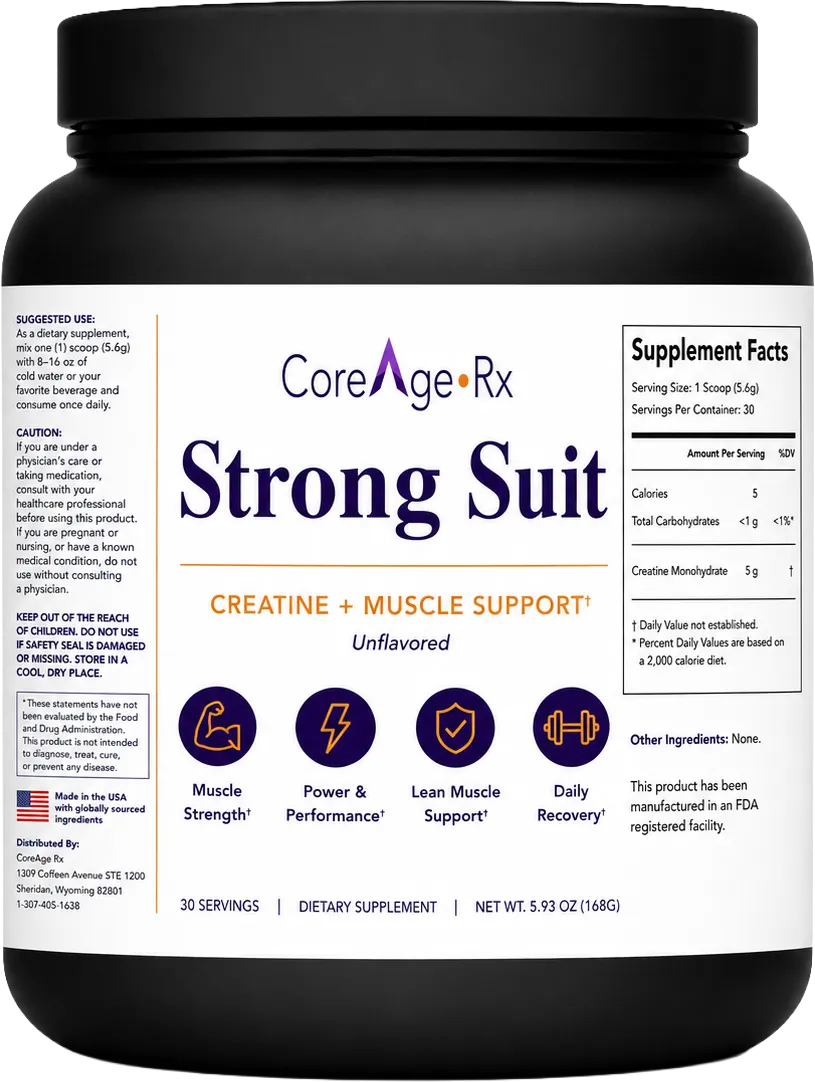
Strong Suit is CoreAge Rx’s unflavored creatine monohydrate powder. The pictured label lists 5 g creatine per scoop and 30 servings. See the current Strong Suit™ page and check the bottle you receive before use.
Related reading
- Creatine Monohydrate: Benefits, Dosing, and What to Expect
- Creatine After 50: How It Fits With Strength Training
- Creatine vs. Protein Powder: Different Jobs, Different Needs
- Nutrition during GLP-1 treatment
Educational information, not individualized medical advice. Product information and linked research checked September 15, 2026. Ingredient research does not establish identical effects for a finished supplement.