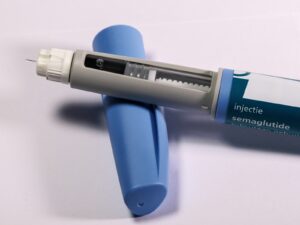
Kidney disease does not have one simple relationship with Mounjaro. The current U.S. label does not recommend a dose adjustment solely for renal impairment, including end-stage renal disease. Separately, nausea, vomiting, and diarrhea can cause dehydration and contribute to acute kidney injury. Whether treatment fits you depends on the reason for prescribing it, your kidney history, other medicines, symptoms, and monitoring plan.
Can someone with kidney disease take Mounjaro?
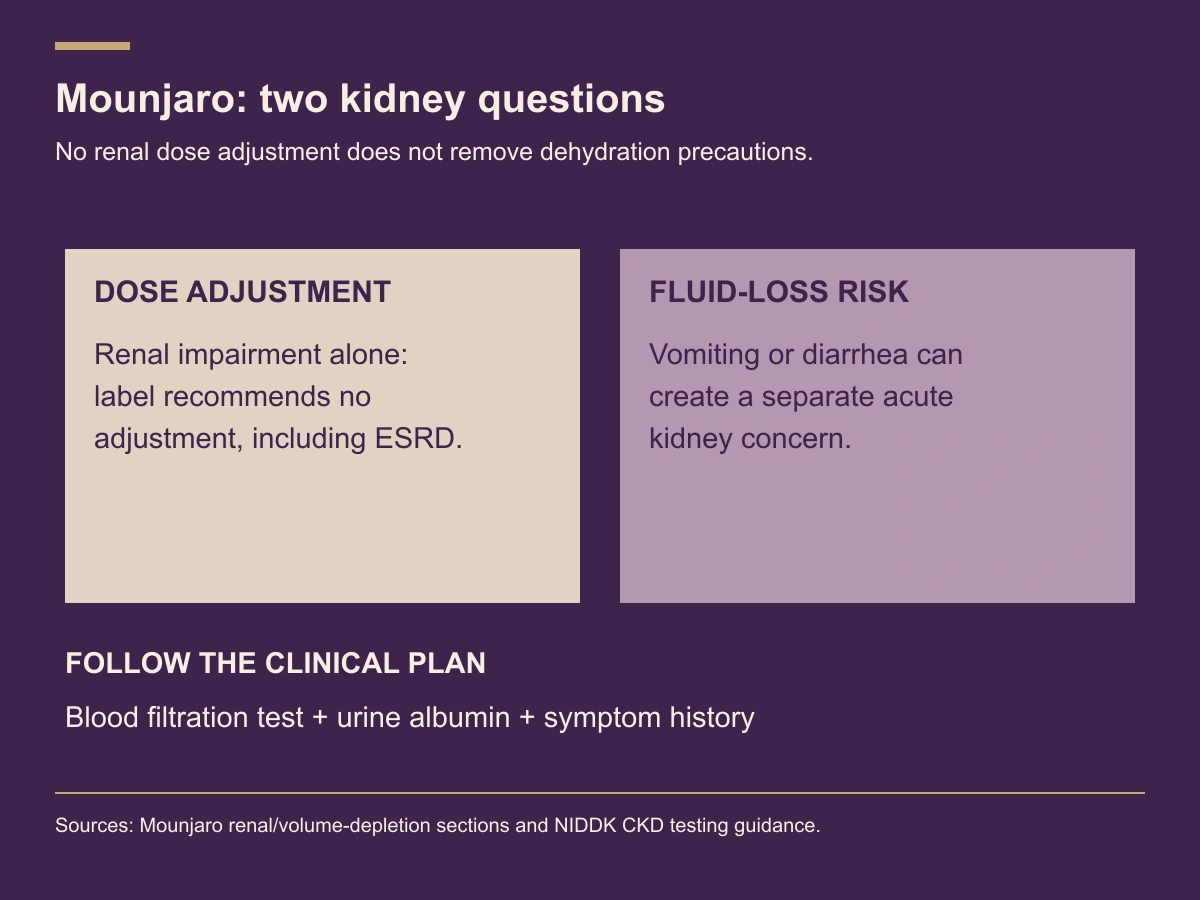
The August 2026 Mounjaro prescribing information says that renal impairment does not require a dosage adjustment. It also describes monitoring kidney function when patients with renal impairment develop severe gastrointestinal reactions during initiation or dose escalation. These statements answer different questions: one concerns drug exposure and dosing; the other concerns illness and fluid loss. Current Mounjaro label.
“No renal dose adjustment” is not the same as “no kidney precautions.” A person with chronic kidney disease may still need coordinated care, a careful medication review, and a specific response to vomiting or reduced intake. It also does not mean that the maximum dose is the right starting dose, or that a person should choose a dose without a prescription.
Bring the actual medicine name and formulation to the appointment. Mounjaro, Zepbound, and a compounded tirzepatide preparation should not be treated as interchangeable labels or devices. Our compounded GLP-1 guide explains the approval and dispensing distinctions.
What is Mounjaro prescribed for?
Mounjaro contains tirzepatide. Its current U.S. label includes use with diet and exercise to improve glycemic control in adults and children aged ten years and older with type 2 diabetes. Its indication should not be confused with another brand’s indication or with every possible use of tirzepatide.
Zepbound also contains tirzepatide but has its own labeled uses and limitations. Ozempic contains semaglutide and has a different prescribing document. A benefit or indication described for one branded product does not automatically become a claim for another.
If you heard that a GLP-1 medicine “protects kidneys,” ask which medicine, population, outcome, and indication were being discussed. Those details matter more than a broad class label. This article does not claim that Mounjaro has Ozempic’s kidney-disease indication or that taking it repairs existing kidney damage.
Chronic kidney disease and acute kidney injury are different
Chronic kidney disease involves a longer-term kidney-health problem. Acute kidney injury is a more sudden decline that can occur during illness or fluid loss, among other causes. They can coexist. A person with stable chronic disease can still develop an acute problem during a week of vomiting or diarrhea.
This distinction helps explain why a medicine may have no renal dose-adjustment requirement while still carrying a warning related to dehydration. The risk does not have to result from drug accumulation. How much fluid you are losing, whether you can drink, and your other medicines can become central to the assessment.
New symptoms need review on their own merits. Do not assume that every change in urine, energy, or discomfort is either a normal medicine effect or proof of permanent kidney damage. A clinician can compare your symptoms with examination findings and laboratory trends.
What tests might your care team follow?
NIDDK describes two important kinds of kidney testing: a blood test used to estimate filtration, commonly reported as eGFR, and a urine test for albumin. Albumin in urine and filtration estimates provide different information. Early kidney disease may not cause obvious symptoms, which is one reason testing matters. NIDDK CKD testing overview.
| Measure or observation | What it adds to the discussion | What it cannot decide by itself |
|---|---|---|
| eGFR and related blood results | A view of kidney filtration that can be compared with previous results. | The entire cause of a change or a personal medicine plan. |
| Urine albumin testing | Information about albumin passing into urine. | A complete diagnosis from a single uncontextualized result. |
| Vomiting, diarrhea, and intake history | Possible fluid-loss context for a new problem. | The severity of kidney injury without assessment. |
| Complete medicine list | Identifies treatments that may affect the illness plan. | Permission to stop or change those medicines yourself. |
Ask which tests are useful for you, when they should be repeated, and whom to contact if symptoms change. There is no universal testing schedule in this article. An existing kidney specialist’s plan should be part of the prescribing conversation.
What about stage 3 kidney disease or dialysis?
Stage labels can help clinicians describe kidney function, but they do not answer every treatment question. The label’s renal-impairment wording includes end-stage renal disease. That does not establish that every person receiving dialysis has the same nutrition, fluid, glucose, or medication needs.
Tell the prescriber about dialysis, a transplant, a recent kidney injury, fluid restrictions, and the clinician managing those issues. Ask how the teams will share information. It is particularly useful to know who will review a new laboratory result or a persistent stomach symptom.
Avoid choosing a Mounjaro dose from an online “kidney stage” chart. The actual prescription depends on more than a filtration category. If you have trouble tolerating treatment, ask whether the next planned dose increase should be reassessed rather than changing it yourself.

Dehydration deserves a written response plan
Mounjaro’s warning about volume depletion makes repeated vomiting or diarrhea an important reason to contact the care team. Reduced intake, dizziness, and urine changes add useful information. Do not wait for a dramatic symptom before reporting a persistent problem.
Prepare an illness plan before you need it. Ask what to do if you cannot keep fluids down, whether any tests are needed, and whom to contact before the next dose. If you have a prescribed fluid limit, clarify how that changes advice during illness. A generic instruction to drink several liters is not appropriate for everyone.
Severe weakness, fainting, inability to keep fluids down, or other serious symptoms can require urgent assessment. A written plan should explain when routine messaging is insufficient. It should also address your diabetes medicines so that you are not left guessing about several prescriptions at once.
Why ibuprofen and other medicines belong on the list
NIDDK warns that NSAIDs such as ibuprofen and naproxen can harm kidneys during dehydration or low blood pressure. It also recommends discussing illness plans when medicines such as blood-pressure treatments or diuretics are involved. NIDDK kidney and medicine safety.
Include over-the-counter medicines, supplements, and occasional pain relievers in the review. The list should contain the active ingredient and actual dose, not only the brand name. Combination cold or sleep products can be easy to overlook.
Our ibuprofen, alcohol, and tirzepatide article addresses that overlapping question in more detail. Do not independently stop a prescribed blood-pressure medicine or replace it with something else because a general article mentions dehydration. Ask for advice based on your own treatment plan.
Does kidney pain mean Mounjaro is damaging your kidneys?
Pain felt in the back or side is not enough to identify the organ or cause involved. New pain needs a description: location, severity, duration, urinary symptoms, fever, vomiting, and any injury. A clinician may need to assess several possible explanations.
Do not use an internet symptom checklist to rule out a significant problem. Severe or persistent pain, fever with urinary symptoms, blood in urine, or feeling very unwell deserves prompt medical advice. If you are also vomiting or unable to drink, mention that when arranging care.
Keep the timing of your prescription in the history, but avoid treating timing as proof of causation. Symptoms starting after a dose change can be relevant without establishing that the medicine caused every complaint.
Food, glucose, and kidney nutrition need coordination
Weight-management advice and kidney nutrition advice can pull in different directions if they are given without context. Tell a dietitian or clinician about kidney disease before adopting a high-protein meal plan, electrolyte supplement, or aggressive fluid target. Your appropriate intake may depend on the stage of disease, dialysis, laboratory results, and other needs.
NIDDK’s diabetes guidance emphasizes individualized meals and physical activity, with extra precautions around medicines that can cause low glucose. Healthy living with diabetes. A change in appetite or food intake should be discussed alongside the rest of your diabetes treatment.
Our tirzepatide protein and muscle article offers questions to bring to that conversation. It should not be used to override a kidney-specific nutrition plan.
Supplements are part of the treatment history
Tell your care team about creatine, greens powders, electrolyte mixes, and other supplements. Product popularity does not establish that a supplement suits your kidney condition. Keep a photograph of the label and disclose how much you actually use.
The creatine and kidney-health guide explains why kidney history and test interpretation deserve attention. If you are considering a greens product, the Green Scene ingredient page identifies what is in the blend; it is a supplement, not treatment for kidney disease or a substitute for a prescribed eating plan.
Questions to ask before starting or increasing treatment
Ask why this particular medicine is being recommended, what benefit the clinician hopes to achieve, and how kidney health will be followed. Then ask what symptoms should trigger a call, whether your fluid instructions need clarification, and who will coordinate changes among prescribers.
If cost or availability is driving a proposed change, discuss the specific product and prescription rather than replacing one formulation yourself. Our switching guide explains the need for a written plan and why milligrams do not provide a conversion between semaglutide and tirzepatide.
The CoreAge tirzepatide service page describes a separate prescription-dependent intake pathway. It does not promise Mounjaro dispensing, kidney-disease treatment, or eligibility for an individual reader.
Frequently asked questions
Is a lower dose required just because my eGFR is lower?
The current Mounjaro label does not recommend a renal-impairment dose adjustment. Your prescriber still chooses the treatment and dose based on the full clinical picture, including tolerability. Do not interpret the label as permission to start or increase treatment yourself.
Can vomiting affect my kidneys even if I never had kidney disease?
Fluid loss can create an acute kidney concern. Report repeated vomiting, diarrhea, or inability to keep fluids down. The appropriate response depends on symptoms and other medicines, not only whether you already have a CKD diagnosis.
Will a normal urine appearance prove my kidneys are fine?
No. NIDDK explains that early kidney disease may have no symptoms. Blood and urine testing answer questions that appearance alone cannot. Follow the testing plan recommended by your care team.
Does Mounjaro heal chronic kidney disease?
This article does not establish that claim. Discuss the specific expected benefit, evidence, and indication with your clinician. Continue kidney care and monitoring rather than substituting a broad medicine claim for your existing plan.
Educational information for adults; individual treatment decisions require a qualified clinician. Sources reviewed October 2, 2026. Original AI-generated article images depict fictional people and objects, not patient outcomes. Other editorial images are illustrative. Graphics summarize the cited sources.