
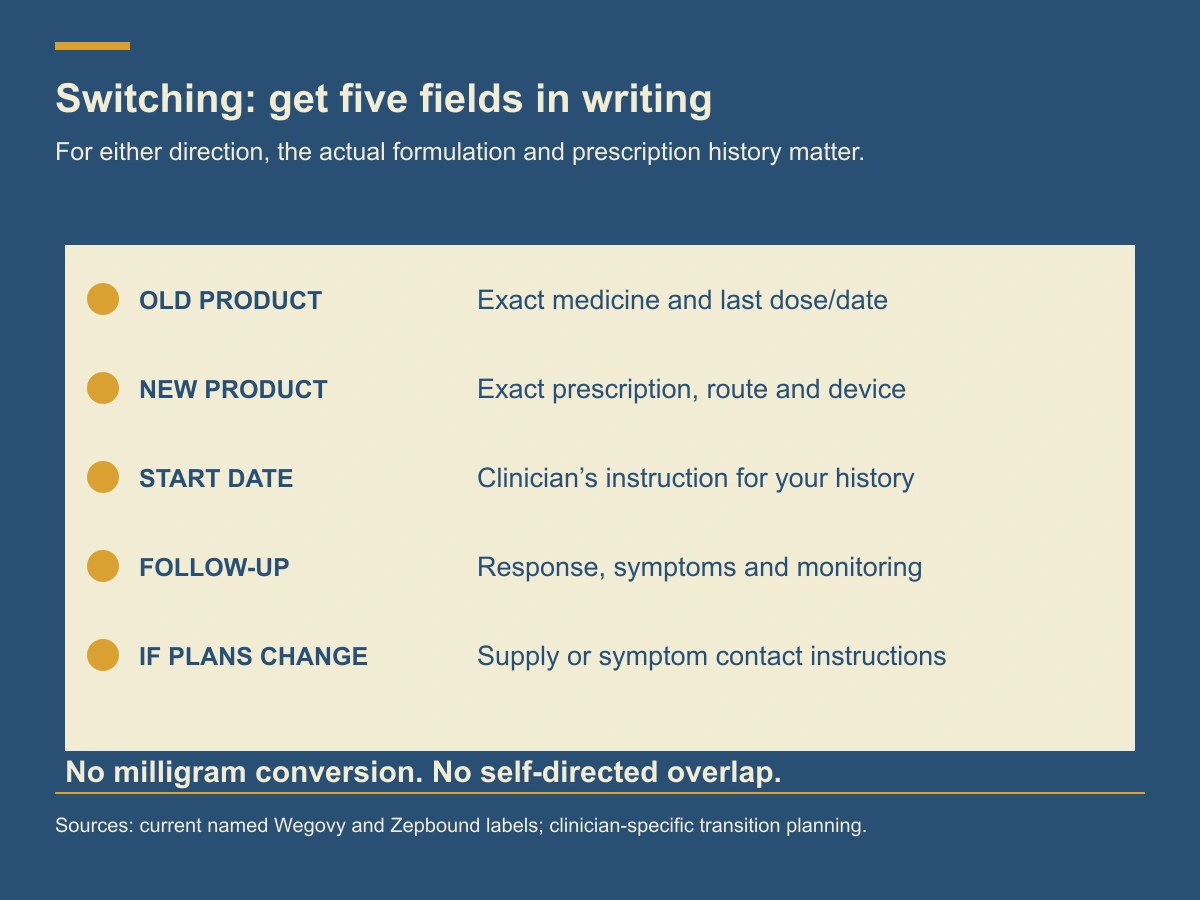
Switching between semaglutide and tirzepatide requires a new prescription plan. Milligrams of one medicine do not convert directly into milligrams of the other, and a branded product’s schedule is not automatically the schedule for another formulation. Ask your prescriber to write down the last dose of the old treatment, the first date and prescribed dose of the new one, follow-up, and what to do if symptoms persist or supply is delayed.
Can you switch from Wegovy to Zepbound, or from Zepbound to Wegovy?
A clinician may consider a change in either direction after reviewing the reason for treatment, response, tolerability, other medicines, access, and preferences. Neither direction should be managed by using a simple conversion chart or overlapping leftover prescriptions.
Wegovy contains semaglutide; Zepbound contains tirzepatide. Their current U.S. prescribing information describes different products, formulations, and initiation instructions. Zepbound’s limitations of use advise against combining it with another tirzepatide product or a GLP-1 receptor agonist. Zepbound label, Wegovy label.
This guide applies to the planning conversation in both directions. It does not provide a personal starting dose or a universal number of days to wait between medicines.
First confirm the exact products
The active ingredient is only part of the identity. Record the brand or compounded preparation, route, device, concentration if relevant, prescribed dose, and last administration date. An injection, tablet, prefilled device, and vial can require different instructions.
Mounjaro contains tirzepatide but has its own labeled diabetes indication. Ozempic contains semaglutide and has its own prescribing document. A decision involving one of those brands should not be described solely as a Wegovy-to-Zepbound switch. Mounjaro information, Ozempic information.
If a compounded product is involved, bring its dispensing label and instructions. FDA explains that compounded drugs are not approved generics and do not receive its premarket verification of safety, effectiveness, and quality. FDA compounding overview. Our compounded GLP-1 guide explains why the actual preparation matters.
Why people discuss a switch
Common discussion points include troublesome side effects, limited benefit, insurance changes, medication access, administration preferences, or cost. The reason should be stated clearly because it changes what a successful new plan would look like.
If symptoms are the main concern, the clinician may need to assess them before choosing another medicine. If cost is the concern, verify the replacement’s actual recurring cost and availability before ending the current arrangement. If the goal is a different expected response, compare appropriate evidence and realistic outcomes.
Our tirzepatide-versus-semaglutide evidence article helps frame efficacy comparisons. Do not compare percentages from different trials as if they predict the result of switching for an individual already receiving treatment.
Why there is no milligram conversion
The medicines have different prescribing schedules and clinical properties. The fact that one package contains a larger number of milligrams does not establish that it is stronger, equivalent, or the appropriate next dose. Previous tolerance also does not make every starting choice safe.
A prescriber needs the actual treatment history, including recent missed doses and side effects. A person restarting after a gap may need a different discussion from someone changing treatment without interruption. The plan should address those details explicitly.
| Written plan field | What to confirm | What to avoid guessing |
|---|---|---|
| Old medicine | Exact product, formulation, and last dose/date. | An approximate brand name or an assumed last administration. |
| New medicine | Exact prescription, route, and device. | A dose chosen by matching milligrams. |
| Start date | The clinician’s instruction for your history and symptoms. | A universal online washout interval. |
| Follow-up | Who reviews response, tolerability, and relevant monitoring. | Automatic escalation despite unresolved symptoms. |
| Delays or problems | Contact route and instructions if supply or symptoms change. | Overlapping leftovers or restarting on your own. |
How long should you wait between treatments?
Obtain a specific answer from the prescriber. The labels’ missed-dose instructions describe missed doses of their respective products; they are not a validated conversion or switching interval. A medicine’s half-life also does not, by itself, determine the personal start date for the replacement.
The clinician may consider the last dose, route, current symptoms, reason for switching, and other medicines. If you are vomiting or unable to eat and drink adequately, that problem deserves assessment rather than simply choosing a new calendar date.
Keep the written dates with the actual packages. If the new medicine arrives later than expected, contact the clinician before changing the plan. Do not bridge the delay by alternating the old and new products.
What if you are switching because of side effects?
Describe the symptom in practical terms: when it started, how often it occurs, whether it followed a dose change, and how it affects food, fluids, work, or sleep. Include what you have tried and any other medicine changes.
Moving to another medicine does not guarantee that a similar symptom will disappear. Severe or persistent abdominal pain, repeated vomiting, or inability to keep fluids down may need prompt evaluation. A new prescription is not a substitute for understanding a concerning symptom.
Our semaglutide side-effect guide, compounded tirzepatide side-effect guide, and Wegovy gastric-emptying article help organize questions. The treating team should decide the change and follow-up.

Diabetes medicines and glucose monitoring
If you use insulin or a sulfonylurea, include that treatment in the switching review. The care team may need to reassess monitoring and other prescriptions. Reduced intake, activity changes, and illness can also affect the plan.
NIDDK emphasizes individualized eating and activity instructions, particularly when medicines can cause low glucose. NIDDK healthy living with diabetes. Do not independently change insulin or skip meals to accommodate a new weight-management prescription.
Ask which readings and symptoms require contact and what to do if treatment is interrupted. Keep an up-to-date medicine list so that the primary clinician, prescriber, and pharmacist are working from the same information.
Oral contraception and other oral medicines
The Mounjaro prescribing information includes a precaution for oral hormonal contraception: switching to a nonoral method or adding a barrier method for four weeks after initiation and for four weeks after each dose escalation. Discuss how the applicable tirzepatide product’s instructions fit your prescription and contraception needs.
Also disclose medicines requiring close monitoring, such as those with a narrow therapeutic index. Do not assume that spacing every tablet by a few hours resolves all concerns. The pharmacist and prescriber should review the exact medicines.
Our Mounjaro interaction guide expands the medicine-list discussion. Tell the clinician about pregnancy, possible pregnancy, or pregnancy planning before a treatment change; do not use this switching guide to create a pregnancy regimen.
Kidney health, dehydration, and nutrition
Repeated vomiting or diarrhea can create fluid-loss concerns. Tell the clinician about kidney disease, fluid restrictions, and any relevant medicines. The Mounjaro and kidney disease article separates renal dosing information from dehydration-related injury.
Food intake also deserves attention. Switching should not be judged only by whether the new medicine makes eating harder. Adequate nutrition and tolerability are part of the plan. The semaglutide protein and muscle and tirzepatide protein and muscle guides offer questions for maintaining an appropriate routine.
If you have surgery or a procedure planned, inform the procedure and anesthesia teams about both the old and proposed new medicine. The semaglutide and anesthesia guide explains the disclosure conversation. A switching date should not be chosen independently of a procedure plan.
Insurance and supply can change the decision
Verify the new product’s benefit before assuming it is affordable. Ask whether authorization is required, whether the proposed indication is covered, and which pharmacy or device is involved. A previous approval for one medicine does not automatically approve another.
Our Wegovy cost guide, Zepbound cost guide, and GLP-1 insurance guide explain the differences among public prices, program eligibility, and a processed claim. Confirm the actual product, quantity, and payment method when requesting a quote.
Also coordinate shipment and cancellation dates if you use a subscription service. Administrative renewal and clinical dosing are different schedules. Keep the care team informed about supply problems rather than choosing a new prescription arrangement without a transition plan.
Comparing CoreAge pathways
The CoreAge semaglutide and CoreAge tirzepatide pages describe separate intake pathways. A consultation does not guarantee a prescription, branded Wegovy or Zepbound, or that a particular switch is appropriate.
If you already have a prescription elsewhere, disclose it and the last dose during intake. Ask who will provide the transition instructions and how the existing prescriber will be informed. The aim is one coherent medicine plan, with clear responsibilities and follow-up.

Before the first dose of the new treatment
Compare the dispensing label with the written plan. Confirm the medicine, route, device, and instructions. If a vial or syringe is involved, resolve concentration and measurement questions before use; do not borrow instructions from a different product.
Check that you know the first date, the follow-up contact, and the response to a delay or side effect. If any of those pieces is missing, ask before proceeding. A concise written plan can prevent confusion when packages look unfamiliar or several services are involved.
Frequently asked questions
Can I switch from Zepbound to Wegovy?
A clinician can assess whether that change fits your situation. Obtain the exact new prescription and timing. This guide does not establish a personal equivalent dose or a universal waiting interval.
Can I switch from Wegovy to tirzepatide?
Discuss the precise product being considered and the reason for changing. Tirzepatide may involve different brands or a compounded preparation. The actual prescription and instructions matter more than the ingredient name alone.
Can I take both while transitioning?
Do not create overlapping treatment. Zepbound’s limitations of use advise against coadministration with another tirzepatide product or a GLP-1 receptor agonist. Ask the prescriber to make the last and first dates explicit.
Is there an equivalent dose chart?
Milligrams do not provide a direct conversion between these medicines. A starting prescription requires the clinician’s assessment of history, symptoms, and the actual product. Avoid choosing it from an informal chart.
Will I lose more weight after switching?
There is no guarantee. Trial results and individual experiences cannot predict your response to a change. Discuss realistic expectations and how benefit and tolerability will be reviewed.
What if my new medicine is delayed?
Contact the prescribing team for an updated plan. Do not alternate leftovers, repeat a previous dose, or shift the first date yourself. Supply changes should be resolved with the clinical instructions in view.
Educational information for adults; individual treatment decisions require a qualified clinician. Sources reviewed October 2, 2026. Original AI-generated article images depict fictional people and objects, not patient outcomes. Other editorial images are illustrative. Graphics summarize the cited sources.