
Zepbound does not have one monthly price. The amount you pay depends on the prescribed dose, device, insurance benefit, pharmacy, and eligibility for a specific manufacturer offer. A $299 starting-price headline should not be read as the price of every dose or every pen.
This guide uses U.S. Lilly and CMS information checked September 26, 2026. It explains the current offers and the questions that turn a headline into a useful personal quote. Terms can change, so confirm the actual amount and refill conditions before paying.
Current Zepbound KwikPen self-pay prices
The Lilly coverage and savings page lists the following regular self-pay prices for the single-patient-use KwikPen, along with a conditional purchase offer at higher strengths. A one-month KwikPen supply is defined as 28 days and one pen containing four doses.
| Weekly prescribed strength | Listed regular KwikPen price for a one-month supply | Conditional purchase offer |
|---|---|---|
| 2.5 mg | $299 | Starting-dose price; not an approved maintenance dose. |
| 5 mg | $399 | Confirm current eligibility and terms. |
| 7.5 mg | $499 | $449 when the applicable purchase-offer conditions are met. |
| 10 mg | $699 | $449 when the applicable purchase-offer conditions are met. |
| 12.5 mg | $699 | $449 when the applicable purchase-offer conditions are met. |
| 15 mg | $699 | $449 when the applicable purchase-offer conditions are met. |
These are formulation-specific manufacturer figures, not guaranteed prices at every pharmacy. Additional taxes or fees may apply. They should not be transferred automatically to a single-dose pen or to every vial prescription.
What the $449 refill condition means
For the higher-strength KwikPen purchase offer, Lilly states that the first qualifying purchase receives the $449 offer. To continue, the refill purchase must be completed within 45 days of delivery or receipt of the previous KwikPen prescription fill. The offer applies to 7.5, 10, 12.5, and 15 mg, subject to the full terms.
If the refill purchase happens outside that window, the purchase offer does not apply under the stated conditions. That is why the regular price and conditional price belong in separate columns when comparing budgets.
The 45-day condition is a program rule, not a dosing instruction. It does not mean changing the prescribed weekly schedule or obtaining more medicine than is clinically appropriate. Ask the pharmacy to explain how the timing is recorded and what happens if treatment is interrupted for medical reasons.
Why $299 is a starting-dose figure
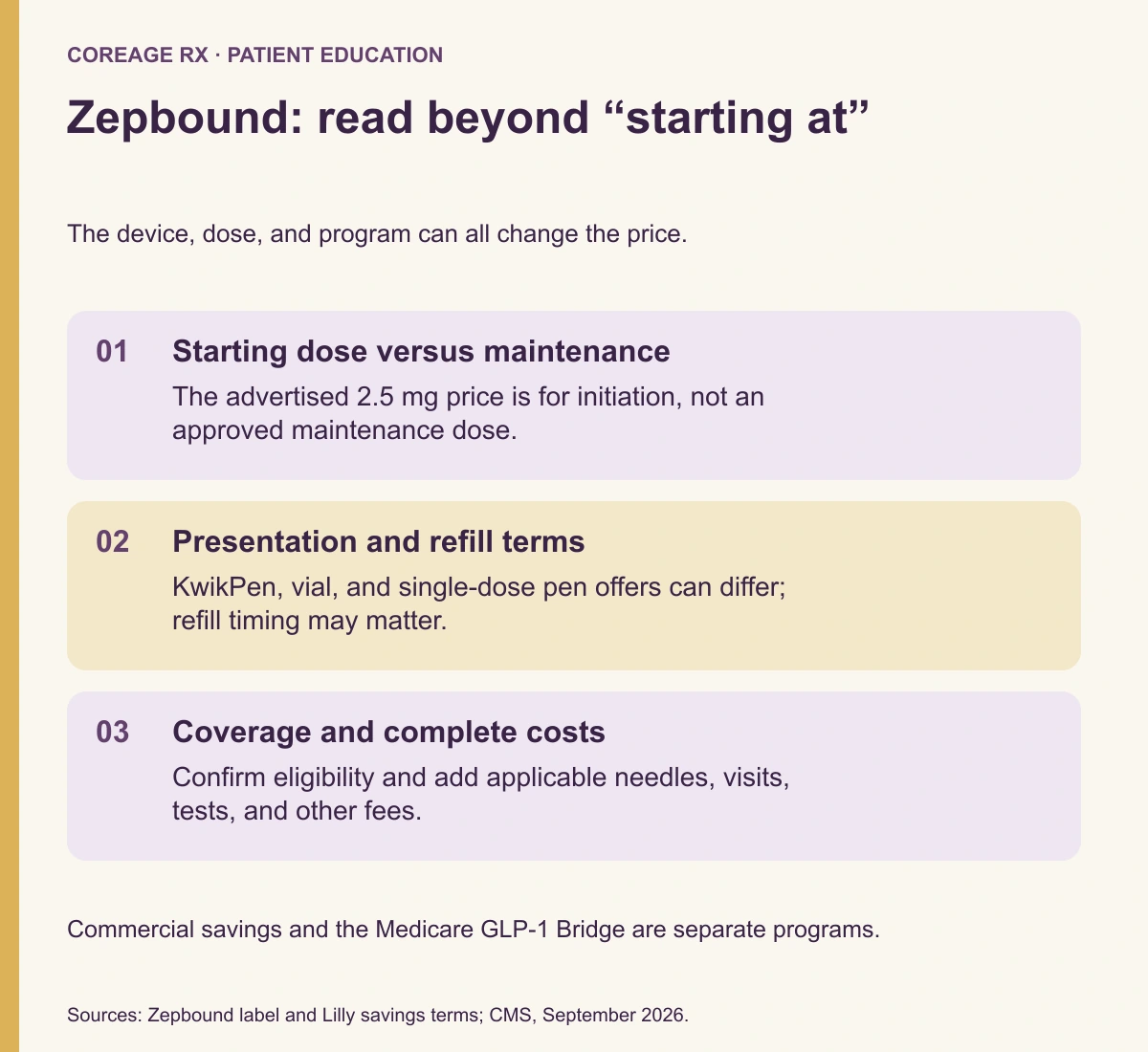
The manufacturer’s page identifies 2.5 mg as the starting dose and states that it is not an approved maintenance dose. A budget built around remaining indefinitely at the lowest advertised price can therefore misrepresent the labeled treatment plan.
The Zepbound dosage chart explains how initiation and maintenance differ. The appropriate maintenance dose depends on the condition being treated, response, and tolerability. The prescriber should make that decision, with affordability discussed as part of finding a workable plan.
Ask what the next fill would cost at the dose being considered and whether the price depends on meeting a refill condition. Do not alter treatment to fit a promotion without talking to the clinician.
Single-dose pens, KwikPens, and vials are different comparisons
The name Zepbound can appear across several presentations. The device changes how the medicine is supplied and administered, and the applicable offer may also change.
Lilly’s page explicitly says the advertised $299 starting figure is for KwikPen or vial options, not the single-dose pen. The manufacturer also describes a separate commercial-insurance savings route for single-dose pens when the plan does not cover that presentation, with an advertised amount as low as $499 for a qualifying one-month fill.
For a vial prescription, obtain a dose-specific current quote rather than copying the KwikPen table above. Confirm whether the quantity is one dose, four single-dose vials, or another labeled presentation. Your pharmacist should explain the exact product and required supplies.
What if commercial insurance covers Zepbound?
For eligible patients with commercial coverage for the single-dose pen, Lilly currently advertises savings that can reduce a qualifying one-, two-, or three-month prescription fill to as little as $25. The terms include maximum savings amounts and annual limits.
The current maximum savings is up to $100 for a one-month fill, $200 for two months, or $300 for three months, with a separate annual cap of $1,300. The manufacturer defines those supplies as 28, 56, or 84 days. Eligibility and other limits apply. Source: Lilly savings terms.
The savings cap matters. A hypothetical $260 patient responsibility reduced by a maximum $100 would still leave $160. That is only an illustration of the arithmetic; the actual claim and program determine your payment. The advertised minimum should not be treated as a guarantee.
What if the plan does not cover Zepbound?
Having commercial insurance without coverage for a particular presentation is different from having no insurance or being enrolled in a government program. Lilly’s offer terms distinguish those situations.
Ask which program the pharmacy is considering, whether the exact device is eligible, and whether the quote depends on commercial insurance information. Do not assume that an insurance denial qualifies you for every manufacturer card or that two different discounts can be combined.
If your insurer is a Blue company, the BCBS weight-management coverage guide explains how plan design, renewal dates, prior authorization, and exclusions can affect the answer. Get the reason for a denial in writing before deciding what documentation or alternative discussion is needed.

GoodRx Zepbound prices: read the offer description
The GoodRx Zepbound page, checked September 26, 2026, displayed a $299 manufacturer offer described as self-pay for a one-month KwikPen prescription. The page states that eligibility and terms apply, that taxes or fees may apply, and that the program is not insurance.
That description matters as much as the large number. It does not establish a $299 price for every maintenance strength, every presentation, or every insured claim. Follow the linked manufacturer terms and select the product that matches the prescription.
Before filling, ask the pharmacist for the final amount using the correct dose, device, quantity, and program. A general discount-site result can help identify a possible route, but the processed prescription provides the useful quote.
Medicare and the GLP-1 Bridge
CMS describes a Medicare GLP-1 Bridge running from July 1, 2026, through December 31, 2027. It offers selected medicines to qualifying beneficiaries for a $50 copay under specific plan, clinical, and prior-authorization requirements.
For Zepbound, the current CMS provider guidance includes KwikPen only. Zepbound single-dose pens and vials are outside that eligible-product list. Do not assume that a prescription for any Zepbound presentation can be filled through the Bridge unchanged.
Prescription purpose also matters. For example, prescriptions for applicable Part D-coverable indications follow the relevant Part D pathway rather than automatically qualifying under the Bridge. The prescriber and plan need to determine which rules fit the individual case.
Bridge medication operates outside Part D’s usual payment flow. Its $50 copay does not count toward the Part D true out-of-pocket calculation. This program is separate from Lilly’s commercial savings card, which excludes government-program beneficiaries under its terms.
Budget for the actual supply interval
The manufacturer defines a month in the KwikPen offer as 28 days. Four weekly doses cover four weeks. That is not the same as a 30-day tablet supply or every calendar month.
When planning longer-term expenses, record the number of doses and expected fills. Twelve four-week supplies cover 48 weeks. Treatment changes, eligibility limits, offer expiration, and interruptions make a simple headline-times-12 calculation incomplete.
Ask for a budget that identifies the initial fill, a typical ongoing fill, and the price if a conditional offer is unavailable. Do not change the injection interval to make a supply last longer without a prescribed change to the clinical plan.
Add supplies and clinical care
A pharmacy price may exclude some expenses needed for treatment. The manufacturer’s page notes that KwikPen needles are required and sold separately. Ask which compatible supplies you need and whether they are included in the pharmacy or clinic quote.
Other possible charges include an assessment, follow-up appointments, membership fees, laboratory work, or delivery. Some services bundle selected items, but the scope needs to be clear.
| Question | Detail to request |
|---|---|
| What is the medication quote? | Brand, dose, presentation, quantity, dispensing pharmacy, and date. |
| What makes this price available? | Insurance status, enrollment, savings cap, refill condition, and expiration. |
| What else will be billed? | Needles, visits, tests, delivery, membership, and additional appointment charges. |
| What happens after a change? | Cost if the dose, device, treatment plan, or eligibility changes. |
| How does the service renew? | Billing interval, cancellation deadline, and refund terms. |
Also ask how to reach the prescribing team if symptoms or device questions arise. Follow-up access belongs in the service comparison, even when it is harder to reduce to one number.
Compounded tirzepatide is not generic Zepbound
A compounded preparation is not FDA-approved Zepbound or an approved generic equivalent. A lower advertised service price may involve a different preparation, quantity, pharmacy arrangement, or set of included fees.
FDA’s guidance describes concerns with unapproved GLP-1 preparations, including dosing errors, fraudulent labeling, and quality issues. The agency recommends compounding when an individual’s medical needs cannot be met by an approved medicine.
If considering CoreAge Rx’s tirzepatide service, ask which preparation is offered, why it is appropriate, who dispenses it, and how dosing and follow-up are handled. The service should be evaluated on its actual terms rather than presented as a Zepbound manufacturer discount.

How much does Zepbound cost through Walgreens?
The answer depends on the presentation, strength, eligibility and payment pathway. On October 2, 2026, the Walgreens page advertises Zepbound KwikPen starting at $299 for the 2.5 mg self-pay presentation, with its clinical visits priced separately at $49 each. It describes a $449 offer for eligible higher-strength KwikPens or single-dose vials with refill and delivery timing conditions through December 31, 2026. That is not a universal local retail or insured price. Request a processed quote for the exact prescription and check the current offer terms before paying. Get Zepbound for Weight Loss – Online Prescription | Walgreens Weight Management.
Frequently asked questions
How much does Zepbound cost at Walmart?
There is no verified nationwide Walmart cash quote in this update. Ask the local pharmacy to price your exact Zepbound presentation, strength, quantity, and supply interval under the payment method you will actually use. Insurance, a manufacturer program, and a cash or discount-card quote are different transactions; do not assume they stack. Ask for the dated final patient price, any separate supplies, and whether the product is available. A public starting-price headline is not your processed claim. Zepbound U.S. prescribing information.
Is every Zepbound prescription $299 now?
No. The figure is tied to selected starting-dose offers and presentations. Dose, device, program, and eligibility matter. Get the exact ongoing quote rather than assuming the lowest headline applies throughout treatment.
Can a refill delay change the $449 offer?
Yes. The current higher-strength KwikPen purchase offer has a 45-day refill-purchase condition. Ask the pharmacy to explain how that condition applies if your clinician changes or pauses treatment. It is not a reason to alter the prescribed schedule independently.
Does Medicare use the same savings card?
No. The commercial card and CMS Bridge are separate routes with different eligibility. The Bridge currently includes Zepbound KwikPen, not its single-dose pens or vials, and requires a qualifying prescription and authorization.
How does Zepbound compare with Wegovy on cost?
Compare clinically appropriate products using the same supply period, payment route, and full care costs. Our Wegovy cost guide and tirzepatide versus semaglutide cost comparison separate current offers and explain why a starting price alone cannot settle the choice.
Get the price for the plan you will actually follow
A useful Zepbound quote identifies the prescribed dose, device, quantity, eligibility rules, refill terms, and additional care expenses. With those details in writing, you and the clinical team can discuss affordability without relying on a price that applies to a different prescription.
Educational information for adults; individual treatment decisions require a qualified clinician. Sources checked September 26, 2026. Original AI-generated article illustrations depict fictional people and objects, not patient outcomes. Other editorial images are illustrative. Graphics summarize the cited sources.