
Yes: testosterone is an anabolic-androgenic steroid. Testosterone replacement therapy, or TRT, uses that hormone for a medical purpose. The useful distinction is between treating a confirmed deficiency and using testosterone or related drugs to pursue performance or appearance goals outside an appropriate treatment plan.
Calling something “TRT” does not make it risk-free, and calling testosterone a steroid does not make every prescribed use misuse. Diagnosis, treatment goals, the actual product, exposure, and follow-up all matter. This guide explains those differences and the questions worth asking before starting or changing treatment.
What does the word steroid mean here?
In this context, anabolic refers to effects on tissue building, including muscle, while androgenic refers to effects associated with male sexual development and function. Testosterone has both kinds of effects. The body produces it naturally, and medicines can supply testosterone when a clinician determines that replacement is appropriate.
The National Institute on Drug Abuse discusses anabolic-androgenic steroids and explains that some have legitimate medical uses. Its report specifically focuses its misuse discussion on nonprescribed testosterone and testosterone-like substances. That scope matters: findings about nonmedical use should not be presented as though they describe every person receiving supervised replacement.
For an introduction to the clinical pathway, start with our testosterone replacement guide. The name of the hormone is only the beginning of the decision.
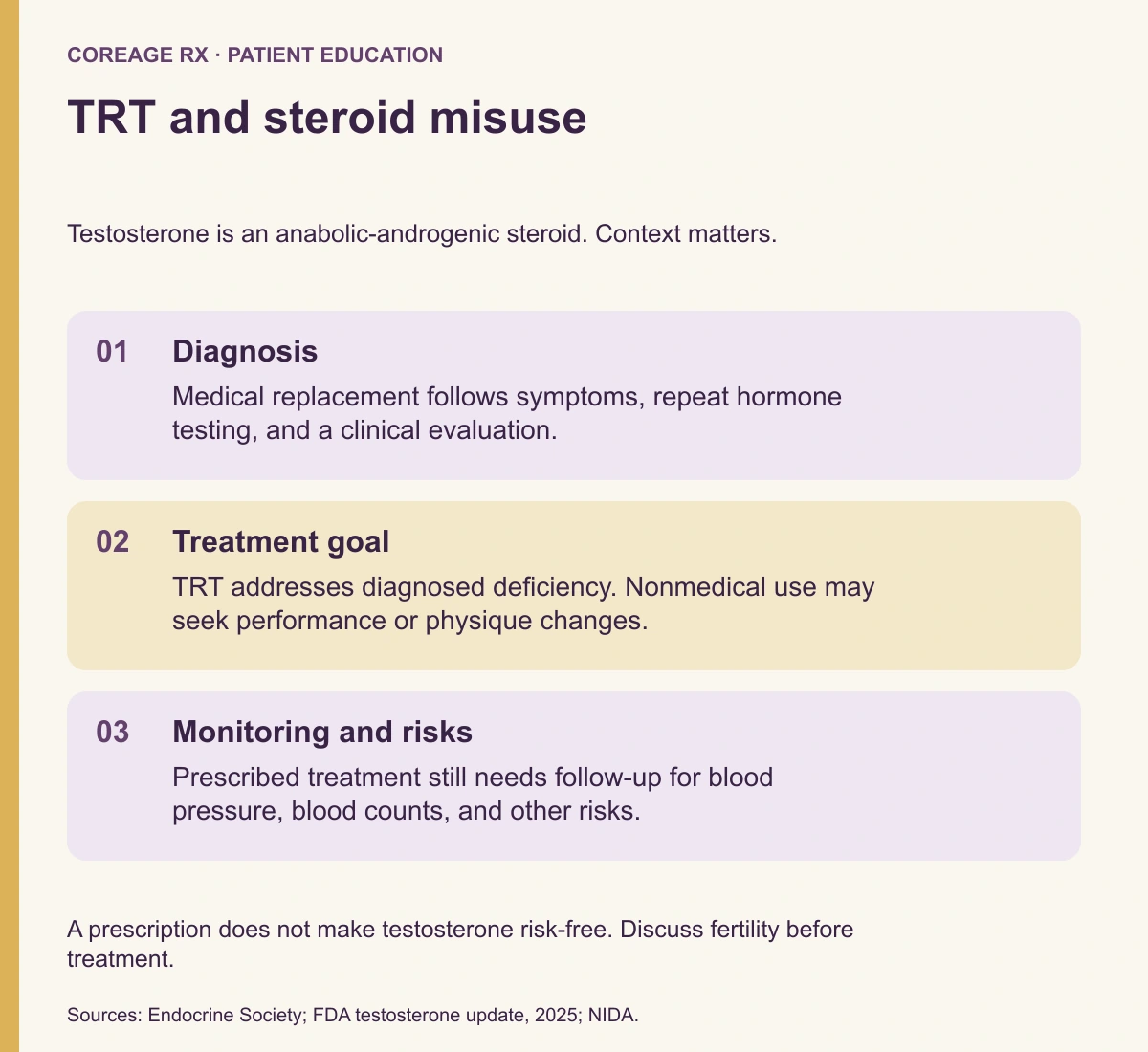
How medical replacement differs from nonmedical use
| Question | Medical testosterone replacement | Nonmedical anabolic-steroid use |
|---|---|---|
| Why is it being used? | To treat an appropriately diagnosed deficiency and relevant symptoms | Commonly to change appearance, strength, or performance without an appropriate medical indication |
| What guides the plan? | Symptoms, repeated testing, cause of deficiency, product instructions, and individual risks | Goals or advice that may not be tied to a clinical diagnosis or appropriate monitoring |
| How is exposure assessed? | Clinician interpretation of formulation, timing, response, laboratory results, and adverse effects | Exposure can be excessive, uncertain, or involve multiple substances |
| What happens afterward? | Planned follow-up and reassessment of benefit and harm | Follow-up may be absent, incomplete, or disconnected from what is actually being taken |
These are clinical distinctions, not guarantees based on a label. A prescription requires appropriate assessment, and monitoring only helps when the clinician knows the complete regimen. Adding extra testosterone or another hormone without telling the prescriber changes the situation being evaluated.
Low energy alone does not establish a need for TRT
Fatigue, poor sleep, reduced sexual interest, and difficulty maintaining strength can have several explanations. An advertisement or symptom checklist cannot distinguish testosterone deficiency from sleep apnea, medication effects, stress, or another health condition.
The Endocrine Society guideline recommends diagnosing hypogonadism when compatible symptoms and signs occur with unequivocally and consistently low testosterone concentrations. It recommends confirmation with repeat morning fasting testing and evaluation of the underlying cause. A clinician may need additional tests to distinguish a testicular problem from a pituitary or hypothalamic cause.
Our low-testosterone testing guide explains why one result may not settle the diagnosis. If poor sleep and fatigue are the main concerns, low testosterone versus stress and poor sleep can help organize the history before an appointment.
Is there a dose that automatically separates TRT from misuse?
A single number from the internet cannot classify every regimen. Formulations, routes, dosing intervals, absorption, and the timing of laboratory measurements differ. The same printed amount on two products may not describe the same exposure or clinical situation.
The meaningful questions are whether there is an appropriate indication, what range and symptom response the clinician is aiming for, and how safety is being assessed. A dose advertised as “replacement” can still be inappropriate for a particular person. Conversely, a plan should not be judged from a number without knowing the product and clinical context.
Do not adjust a prescription to match a gym forum, another patient’s laboratory result, or a promised physique outcome. Our injections versus gel guide explains why the route and routine belong in that conversation.
Does TRT build muscle?
Correcting a genuine deficiency can affect body composition and function, but that does not turn TRT into a general muscle-building treatment for people with normal testosterone. Changes in lean mass, strength, symptoms, and everyday function are different outcomes and should not be treated as interchangeable.
Ask what improvement is realistic for the condition being treated and how it will be assessed. A change in a body-composition measurement does not prove that a person will become stronger, recover faster from every workout, or achieve a particular appearance. Food intake, physical activity, sleep, and other illnesses remain relevant.
Our TRT and body composition article separates those outcomes. The treatment goal should be discussed before starting, so there is a clear basis for deciding whether continuing the medication is worthwhile.

Prescribed testosterone still needs safety monitoring
Appropriate care includes reviewing symptoms and adverse effects after treatment begins. Blood pressure, blood counts, fertility plans, sleep-related symptoms, and prostate considerations can all matter, depending on the person and the product.
An elevated hematocrit means the proportion of blood occupied by red cells is high. It is a reason for the treating clinician to assess the plan, not a reason to improvise a workaround while continuing an unchanged regimen. Read our hematocrit and blood-count guide for the role of monitoring.
The Endocrine Society recommendations identify several situations in which testosterone should not be started, including elevated hematocrit, untreated severe obstructive sleep apnea, certain prostate or breast conditions, and particular cardiovascular or clotting concerns. Eligibility requires an individual review; a normal testosterone result after treatment does not by itself establish safety.
What changed in FDA’s cardiovascular warning?
In February 2025, FDA announced class-wide labeling changes following its review of the TRAVERSE trial and blood-pressure studies. FDA recommended removing boxed-warning language concerning increased adverse cardiovascular outcomes, while retaining the limitation of use for age-related hypogonadism. It also required warnings about increased blood pressure.
This is more precise than saying either “testosterone always causes heart attacks” or “testosterone is now proven safe for everyone.” The evidence and labeling action concern medical use in the relevant clinical context. They do not establish the safety of excessive exposure, multiple nonprescribed substances, or every individual risk profile.
Our TRT, heart health, and blood-pressure guide explains the follow-up questions. Tell the clinician about hypertension and cardiovascular history before treatment rather than waiting for symptoms.
Fertility is a separate decision
Testosterone treatment can suppress sperm production. Feeling better or seeing a higher blood testosterone level does not mean fertility is preserved. The Endocrine Society recommends against starting testosterone in men planning fertility in the near term.
Discuss present and future plans for children before accepting a prescription. If fertility matters, the cause of low testosterone and appropriate alternatives need specialist consideration. Adding another medicine on your own is not a reliable way to protect fertility or undo suppression.
Our TRT and fertility guide covers that conversation. Be clear about timing: “perhaps someday” and “trying to conceive now” both deserve discussion, even though the immediate plan may differ.
What if you have used anabolic steroids before?
Tell the clinician what you used, when, how long, and whether you are still taking anything. Include products marketed as hormone boosters or performance supplements. Accurate information helps interpret symptoms and laboratory tests and reduces the chance of treating an incomplete picture.
NIDA’s review describes hormonal suppression, cardiovascular and other harms, and withdrawal symptoms associated with misuse. Mood symptoms can be significant. Severe depression, suicidal thoughts, chest pain, fainting, or serious breathing difficulty requires urgent help rather than an online recovery plan.
Do not design a stopping regimen or “post-cycle” medication combination from this article. Our stopping TRT guide describes questions to bring to a qualified clinician, but previous nonmedical use may need a different assessment from routine prescribed replacement.

Evaluate the care plan, not just the clinic’s terminology
Before committing, ask who establishes the diagnosis, who interprets repeat testing, what medication is proposed, and how follow-up works. Ask what happens if treatment does not improve symptoms or if a safety concern appears. A service should be able to explain these matters without promising a particular physique or a prescription for every applicant.
The CoreAge Rx TRT information page currently describes a service being introduced and lists it as coming soon. Confirm availability and the exact preparation. Compounded testosterone is not an FDA-approved generic simply because the active ingredient is familiar; FDA’s compounding explanation describes that distinction.
Use our TRT cost guide to compare evaluation, medication, and monitoring charges together. Affordable follow-up matters because a treatment plan extends beyond the first prescription.
Frequently asked questions
Is TRT the same thing as “taking steroids”?
TRT uses a steroid hormone, testosterone. In everyday speech, “taking steroids” often means nonmedical performance use. Clarify which meaning is intended, then assess the diagnosis, actual regimen, and monitoring rather than relying on the phrase alone.
Does a natural hormone have no side effects?
No. A substance can be naturally produced by the body and still cause harm when supplied as medication in an unsuitable amount or situation. Blood pressure, blood counts, fertility, and other risks still require review.
Is TRT a treatment for normal aging?
Age alone does not establish an indication. FDA retained its limitation concerning age-related hypogonadism, and clinical guidance calls for compatible symptoms, consistently low results, and an individualized assessment. The aim is to treat an appropriate medical problem, not to promise reversal of aging.
What should I take to a first appointment?
Bring previous laboratory results with dates and collection times, a complete medication and supplement list, relevant symptoms, fertility plans, and any history of testosterone or steroid use. Our starting-TRT questions provide a practical checklist for that visit.
Educational information for adults; individual treatment decisions require a qualified clinician. Sources checked September 26, 2026. Original AI-generated article illustrations depict fictional people and objects, not patient outcomes. Other editorial images are illustrative. Graphics summarize the cited sources.