
Ginger chews are sweetened foods that some people enjoy for their flavor or find soothing when they feel mildly nauseated. They are not an established weight-loss treatment, and evidence about ginger supplements cannot automatically be applied to a piece of candy. Their ingredients, sugar content and the cause of the nausea all matter.
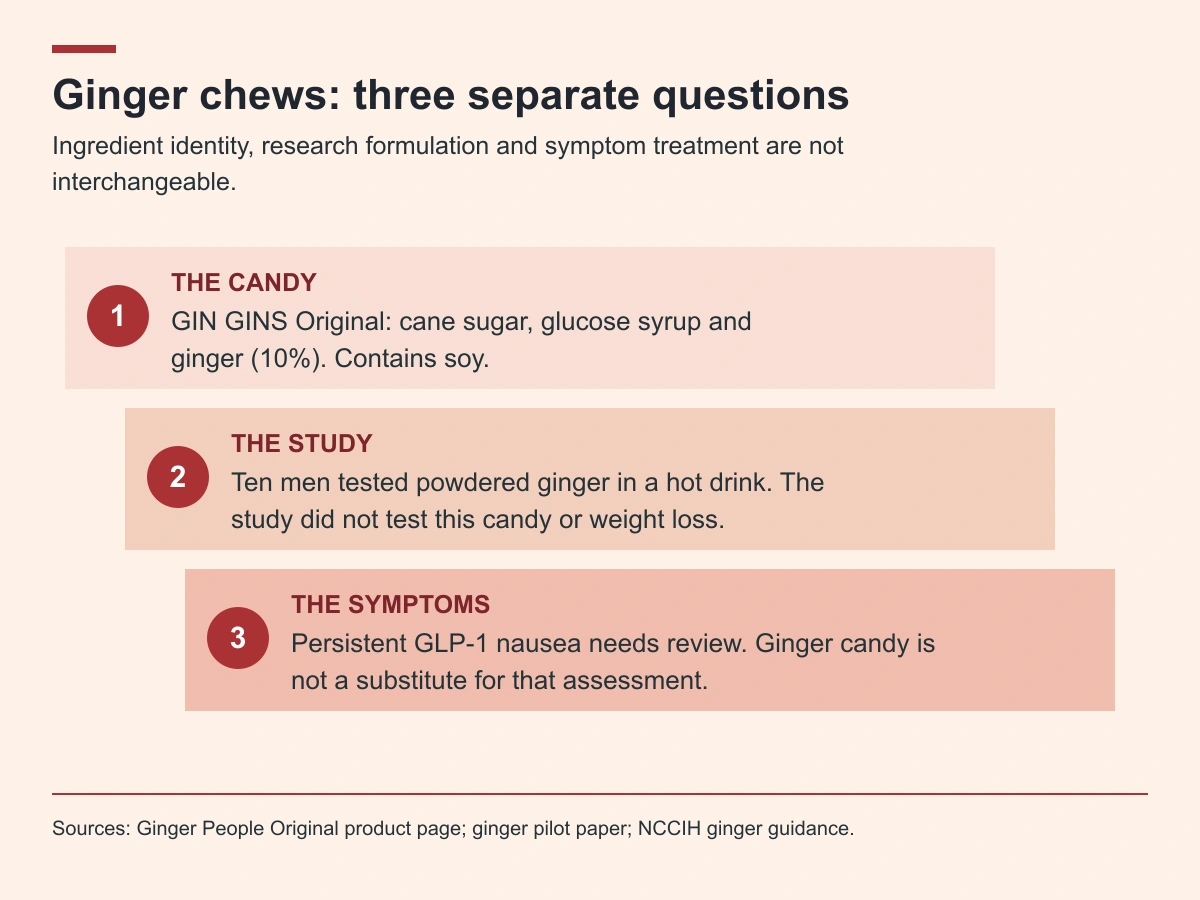
If you are looking for help with nausea during semaglutide or tirzepatide treatment, a chew should not replace review of persistent vomiting, severe abdominal pain or difficulty staying hydrated. The useful question is what is causing the symptoms and what response fits that situation.
What is in a ginger chew?
Products differ. A ginger chew may contain sugar, syrup, starch, flavorings and different amounts of ginger. A fresh piece of ginger, a ginger extract capsule and a sweetened chew are not interchangeable formulations.
The current manufacturer page for GIN GINS Original Ginger Chews, reviewed October 2, 2026, lists cane sugar, glucose syrup, ginger at 10%, tapioca starch, rice flour, soy lecithin, salt and citric acid. The product contains soy, and the page includes facility information concerning peanuts.
Those ingredient details describe the named Original product, not every chew in the brand’s range or every ginger candy. The Nutrition Facts image was not extracted into verified numerical values for this review, so this article does not supply an assumed number of calories or grams of sugar per piece.
Use the package you actually have. Size, flavor, market and formulation changes can affect what a serving means. A front-of-package ginger claim does not establish that the food is sugar-free or nutritionally equivalent to a supplement.
Are ginger chews good for nausea?
The answer depends on the kind of nausea, the formulation and the person. The NCCIH’s ginger guidance discusses evidence suggesting that ginger may help nausea and vomiting during pregnancy. It also notes that most research studied supplements, rather than ginger foods.
NCCIH describes different levels of evidence for other settings. Most studies have not shown benefit for motion sickness, and benefit in chemotherapy-related or postoperative nausea remains uncertain. These distinctions should stay attached to the evidence.
That guidance does not establish that the named candy treats nausea caused by a GLP-1 medicine. Enjoying the taste or feeling briefly more comfortable is different from showing reliable benefit in a clinical trial of that exact product and condition.
If you are pregnant or breastfeeding, discuss ginger products and ongoing nausea with your clinician. A food may be familiar, but persistent vomiting or inadequate intake needs attention. Do not replace a prescribed nausea plan with a number of chews taken from an online article.
Candy, supplements and research doses
The amount and form of ginger used in a study can differ substantially from a chew. “Contains ginger” does not reveal whether the preparation matches a research product, and an ingredient percentage does not establish an equivalent medicinal dose.
For example, an original pilot study tested a hot drink containing two grams of powdered ginger in ten men. Researchers observed energy expenditure and subjective appetite ratings for six hours after breakfast. They did not test ginger chews or track long-term weight loss.
Participants reported less hunger, while the fullness finding was a trend rather than a conventionally significant result. The study did not measure how much they subsequently ate at a freely chosen meal. It also did not show a significant effect on total energy expenditure or establish a fixed daily calorie-burning benefit.
The investigators described limitations including the small sample, lack of blinding and uncertainty about generalizing to women or longer-term use. The research supports further study, not a calculation of how many candies to eat to reproduce a weight-loss effect.
| Form or evidence | What is known here | What should not be assumed |
|---|---|---|
| Named Original ginger chew | Sweetened food with listed ginger and soy ingredients | Sugar-free food or a validated weight-loss dose |
| Powdered-ginger hot-drink pilot | Short observations in ten men | Evidence that this candy causes sustained weight loss |
| NCCIH review of nausea evidence | Findings differ by condition; most studies used supplements | Established benefit for every cause of nausea or every formulation |
Can ginger chews help you lose weight?
The reviewed evidence does not establish them as a dependable weight-loss intervention. A candy can fit an eating pattern, but its ginger content does not erase the energy supplied by sugar or turn it into a substitute for a balanced meal.
If you use a chew instead of another sweet food, the effect on your intake depends on what changed and the amounts involved. If you add several chews to your usual food because they are advertised for metabolism, that is a different change. Neither situation supports a guaranteed weight-loss result.
Avoid converting a short-term appetite rating into a promise of pounds lost. Hunger, fullness, actual food intake and body-weight change are separate measurements. A pleasant spicy sensation does not prove increased fat burning.
Our calorie-intake guide explains the importance of the overall pattern. Water weight versus fat loss also helps explain why a rapid scale change after illness or poor intake should not be credited to a candy.

Read the sugar and serving information
When comparing chews, find the serving size, number of pieces per serving, calories, total sugars and added sugars. Check whether the package contains multiple servings.
The FDA’s Nutrition Facts guidance explains that the labeled amount applies to the listed serving. If you eat a different number of pieces, the amount changes accordingly. Serving size is a reference, not a recommendation to consume that number daily.
Do not assume that an individually wrapped piece is nutritionally negligible. Equally, you do not need to label one sweet as a diet failure. The useful information is how it fits your actual pattern and whether you are taking repeated pieces to manage symptoms that need a different response.
If you have diabetes, use your individual carbohydrate and glucose-management plan. The word ginger does not mean the sugar in a chew disappears from the carbohydrate calculation.
Can ginger chews worsen symptoms?
Ginger can cause gastrointestinal effects, including abdominal discomfort, heartburn and diarrhea, according to NCCIH. Whether a particular chew is comfortable also depends on the whole product and the person.
If you repeatedly feel worse after taking one, keep track of the product, amount and symptoms. Do not increase the number to overcome the reaction or assume discomfort is a necessary stage before benefit.
People with allergies should check the exact ingredients and facility information. The named Original product contains soy. Other products may differ, so a prior uneventful experience with one flavor does not establish suitability for all ginger sweets.
Bring ginger supplements and regularly used ginger products into a medication review. NCCIH advises discussing herbal products with health professionals because interactions can occur. “It is just ginger” is not enough information for reviewing a concentrated supplement or frequent use alongside other treatments.
Nausea while taking semaglutide or tirzepatide
Start with the symptom timeline. Did nausea begin after the first dose, an increase, an illness or a change in eating? Are you vomiting, struggling with fluids, experiencing pain or unable to eat adequately?
A clinician can use those details to decide whether the medicine plan needs review or another cause needs investigation. A candy’s marketing description cannot make that determination.
Our semaglutide nausea and vomiting guide and tirzepatide nausea and reflux guide explain practical questions for the discussion. If symptoms are persistent, do not continue escalating the prescription or adding remedies without contacting the care team.
The joint nutrition advisory for GLP-1 treatment emphasizes assessment of intake and nutritional risk. Chews may contribute a small food amount, but they do not provide a complete protein, fluid or nutrient plan when you are eating poorly.
For someone exploring treatment, semaglutide product information can help prepare questions about the specific formulation and monitoring. It does not establish that nausea should be managed with candy or that everyone is eligible for treatment.
Timing matters with some oral medicines
Directions for an oral prescription may restrict food or other medicines around the dose. A ginger chew counts as food; it should not be treated as an exception because it is being used for nausea.
For example, the current Wegovy tablet label includes specific fasting, water and waiting instructions. Those directions differ from weekly injection routines and from other oral products. Follow the exact package and pharmacist’s instructions rather than adopting a generic “GLP-1 morning routine.”
Our oral semaglutide versus injections guide explains why route and formulation matter. If nausea makes the prescribed routine hard to follow, discuss it directly rather than inserting a chew into the waiting interval on your own.

A useful symptom record
For recurring nausea, a brief record can be more informative than a list of remedies. Note when it occurs, how long it lasts, recent medicine changes, whether vomiting occurs and whether food or fluids stay down.
Also record the chew’s name and amount if you try one, along with whether you feel better, unchanged or worse. Keep other new products in the same timeline. Changing several remedies at once can make the response difficult to interpret.
Bring this information to your clinician or pharmacist. Ask what symptoms need prompt contact, whether your prescription schedule needs review, and what the plan is if nausea persists. Balanced meals during weight management can help organize intake questions once the symptom cause and severity are addressed.
Frequently asked questions
How many ginger chews should I eat for weight loss?
The reviewed sources do not establish a weight-loss dose or daily number of pieces. Use the package to understand the food’s serving and ingredients, without turning that serving into a therapeutic prescription.
Are all ginger chews sugar-free?
No. The named Original example lists cane sugar and glucose syrup. Verify the exact product rather than relying on a broad ginger description or a different flavor’s label.
Can they replace prescribed nausea medicine?
Do not make that substitution without the prescribing clinician. The evidence varies by condition and formulation, and persistent symptoms may require a review of their cause.
Are chews the same as the ginger drink used in the pilot study?
No. The pilot used powdered ginger in a hot-water beverage, not candy. Its short appetite observations cannot establish an equivalent chew amount or sustained weight-loss benefit.
When should I stop relying on home remedies?
Seek prompt advice for persistent vomiting, poor fluid intake, severe abdominal pain or other worsening symptoms. Do not let temporary relief from a chew delay assessment of a problem that affects hydration or nutrition.
Educational information for adults; individual treatment decisions require a qualified clinician. Sources reviewed October 2, 2026. Original AI-generated article images depict fictional people and objects, not patient outcomes. Other editorial images are illustrative. Graphics summarize the cited sources.