
Ox bile is sold as a digestive supplement, but the sources reviewed for this article do not establish it as a reliable weight-loss treatment. Helping the body handle fat in food is different from causing the body to lose stored fat. A product’s description of bile or digestion does not bridge that evidence gap.
If you are considering ox bile because you have abdominal symptoms, have had your gallbladder removed, or are unexpectedly losing weight, start with the reason for those concerns. The appropriate response depends on what is causing the symptoms—not simply on finding a stronger supplement.
What is ox bile?
Ox-bile supplements contain animal-derived bile ingredients. Products can differ in amount, formulation, additional ingredients and directions, so “ox bile” is not a single standardized prescription.
One identified example, Nutricology Ox Bile 125 mg, lists 125 milligrams of bovine bile per capsule. Its other listed ingredients include a capsule shell and additional excipients. The product name includes “Vegicaps,” but the bile ingredient itself is bovine. A plant-derived capsule shell does not make an animal-derived ingredient vegan.
The manufacturer describes a digestive purpose and includes cautions about gastrointestinal distress and professional review for higher doses, prolonged use or liver and gallbladder dysfunction. Those statements do not establish a tested weight-loss dose.
This article does not recommend the manufacturer’s serving schedule for your circumstances. A label can identify what a supplement contains without proving that you need it, that it treats your symptoms, or that it will change your body weight.
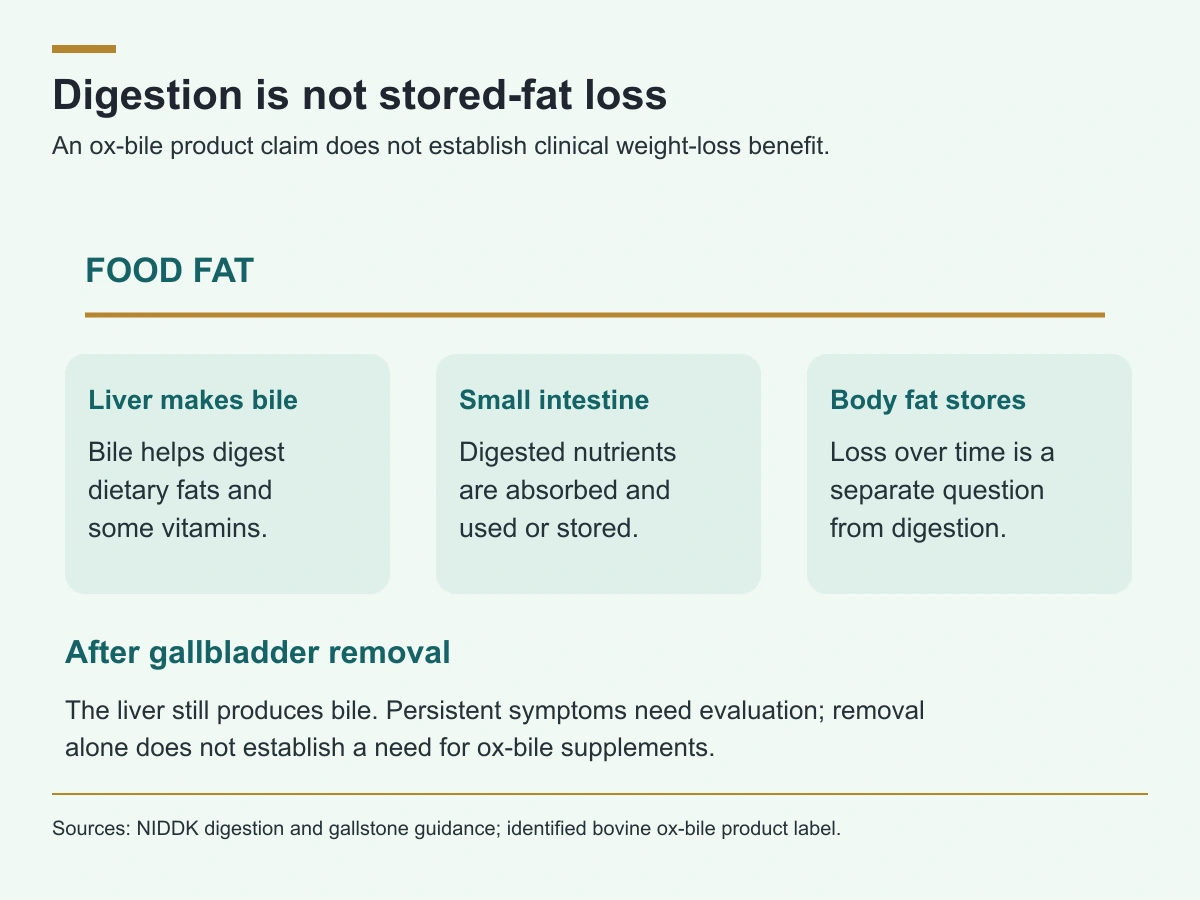
What bile does in normal digestion
The NIDDK’s explanation of the digestive system describes bile as a digestive fluid made by the liver. The gallbladder stores bile between meals, and bile enters the small intestine to help with digestion of fats and some vitamins.
Food digestion and nutrient absorption are part of how the body obtains energy and nutrients. They are not the same process as a deliberate reduction in stored body fat over time.
That distinction is easy to lose in phrases such as “breaks down fat.” A statement about handling dietary fat in the intestine does not establish that a supplement burns abdominal fat or causes fat to leave the body through a detox process.
The small intestine absorbs digested nutrients, which the body can use or store. A product intended to assist that process should not be described as a proven way to block calories or flush stored fat.
Does ox bile cause weight loss?
The manufacturer label and the NIDDK guidance reviewed here do not establish clinical weight-loss efficacy for the finished ox-bile supplement. They answer different questions: what the product contains, what bile normally does, and how specific digestive conditions are treated.
Research about bile-acid biology, animal experiments or associations between bile acids and metabolism does not automatically demonstrate that an over-the-counter ox-bile product causes sustained weight loss in humans. The tested substance, population, outcome and duration would need to match the claim.
Customer reviews also cannot resolve that question. A person may change food intake, medications, activity or several supplements at once. An observed weight change does not identify which change caused it or whether the result was healthy.
| Common claim | What to check before accepting it |
|---|---|
| “Bile breaks down fat, so the supplement burns body fat” | Whether the statement concerns dietary digestion or measured loss of stored fat |
| “A study of bile acids proves this capsule works” | Whether the exact finished supplement was tested in people for weight outcomes |
| “People lost weight after starting it” | Other changes, unintended illness, study design and nutritional consequences |
| “A higher amount will work faster” | A clinical indication, safety information and evidence for that specific dose |
For an intentional weight goal, our calorie-intake guide and balanced meals guide explain a more useful starting point. They address the overall eating pattern without treating digestive symptoms as a desirable route to weight loss.
Do you need ox bile after gallbladder removal?
Gallbladder removal does not mean the liver stops making bile. The NIDDK’s gallstone treatment guidance explains that bile can flow directly from the liver into the small intestine after the gallbladder is removed. People can live normally without the gallbladder.
Some people experience softer or more frequent stools after surgery. That does not, by itself, establish that they have too little bile or that an ox-bile supplement is the appropriate treatment.
If symptoms persist, tell the clinician when the surgery occurred, what has changed, how often symptoms occur and whether your weight or intake is affected. The evaluation may need to distinguish several possible explanations rather than assuming that replacing stored bile solves the problem.
Do not use “everyone without a gallbladder needs ox bile” as a purchasing rule. The source does not support that conclusion, and a product label is not a substitute for evaluating your symptoms after surgery.

Diarrhea and weight change are not proof of fat loss
If you start a supplement and develop diarrhea, do not interpret a lower scale reading as evidence that it is flushing fat. Fluid changes and reduced intake can affect body weight, and persistent diarrhea can create its own health problems.
The identified manufacturer label itself cautions about gastrointestinal distress. More symptoms are not a reason to increase the supplement or continue an escalating schedule to reach a promised detox stage.
Record the product, amount, start date and symptom timeline. Keep the actual package available so your clinician or pharmacist can review the ingredients. Include other medicines and supplements that changed around the same time.
Our water weight versus fat loss guide explains why rapid scale changes need context. A supplement’s effect on bowel habits is not a reliable measure of a change in body-fat stores.
Digestive symptoms deserve their own evaluation
Abdominal discomfort, persistent diarrhea, an unusual stool pattern, reduced appetite or unintentional weight loss can have different causes. An online symptom list cannot establish that you have low bile, a blocked duct or a condition affecting absorption.
A useful history includes the location and duration of discomfort, whether it follows meals, any recent surgery, the appearance and frequency of stools, and whether you can eat and drink normally. Bring any known liver, gallbladder, pancreatic or intestinal diagnoses into the discussion.
Seek prompt medical advice for severe or persistent symptoms rather than trying a sequence of increasingly strong supplements. Difficulty maintaining hydration, severe abdominal pain, fever or yellowing of the skin or eyes needs timely assessment; an ox-bile purchase should not delay care. The NIDDK’s gallstone symptom guidance specifically describes symptoms that require care right away during or after a gallbladder attack.
The goal of evaluation is to identify the problem and an appropriate treatment. It is not simply to confirm that a supplement marketed for digestion is suitable.
Ox bile is different from prescription bile-acid medicines
The NIDDK describes prescription treatments such as ursodiol or chenodiol for selected gallstone circumstances. These medicines have a defined clinical role and are not interchangeable with an over-the-counter bovine bile capsule.
Similar-sounding names or a shared connection to bile do not establish equivalent effects, dosing or suitability. A supplement is not a replacement for a prescribed medicine, and a prescription used in one condition does not establish a general weight-loss benefit for another product.
If you are already taking a prescription for a liver or gallbladder condition, ask the prescriber before adding an ox-bile supplement. Bring the exact product and explain the intended purpose. Do not assume that “natural” means it adds no relevant risk or changes nothing about the treatment plan.
What if you take semaglutide or tirzepatide?
People taking appetite-reducing medicines may look for digestive supplements when meals cause nausea, reflux or other symptoms. An ox-bile label does not establish that it treats those medication effects.
The timing matters. Note whether symptoms followed starting the medicine, a dose change, a dietary change, an illness or another product. A clinician needs that timeline and the severity of symptoms to decide what requires evaluation.
Our semaglutide nausea and vomiting guide and tirzepatide nausea and reflux guide explain practical questions for that review. Adding a supplement without discussing ongoing symptoms can make the timeline harder to interpret.
If you are exploring treatment options, review tirzepatide product information with a qualified clinician. Discuss the exact formulation, medical history and follow-up. An unsupported supplement weight-loss claim should not become a reason to choose or combine prescription treatments.
Questions to ask before buying a digestive supplement
First identify the intended goal. “I want less discomfort after meals,” “I have diarrhea after surgery,” and “I want to lose weight” are three different questions. A product marketed for digestion does not necessarily answer any of them for you.
Then ask what evidence concerns the exact formulation and your situation. A study of a different bile acid, an animal experiment or a customer testimonial is not a clinical trial of the product you plan to buy.
Review the full ingredient list, including animal sources, other active ingredients and allergens. Clarify how a clinician would know whether the product helps and when it should be stopped. If nobody can define that plan, a larger bottle is unlikely to clarify the decision.
For a broader supplement review during weight treatment, see supplements while taking GLP-1 medicines. Keep each product’s proposed purpose and evidence separate rather than building a stack around repeated digestive marketing claims.
Frequently asked questions
Will ox bile burn belly fat?
The reviewed sources do not establish that effect. Bile’s role in handling dietary fat does not demonstrate selective loss of abdominal fat from a supplement.
Is there a weight-loss dose of ox bile?
No validated weight-loss dose is established by the sources reviewed here. A manufacturer’s digestive serving schedule should not be converted into a personal weight-loss prescription or increased to chase a scale change.
Is an ox-bile capsule vegan if the shell is plant-based?
Not when its active ingredient is bovine bile. Read both the ingredient source and the capsule description. The identified Nutricology example explicitly lists bovine bile.
Does gallbladder removal mean I cannot digest fat?
The liver continues to make bile after removal, and bile can flow into the intestine without gallbladder storage. Individual persistent symptoms still need assessment; surgery alone does not establish an automatic supplement requirement.
Should I continue if the supplement causes diarrhea?
Do not treat diarrhea as a desirable fat-loss effect. Review the product and symptoms with a clinician, especially if symptoms are persistent, severe or affect hydration. The identified label includes a gastrointestinal-distress caution.
What is a better starting point for weight management?
The NIDDK’s guide to successful weight-loss programs describes sustainable eating, activity and support. Start with your health and goals, and investigate digestive symptoms separately instead of using them as a measure of progress.
Educational information for adults; individual treatment decisions require a qualified clinician. Sources reviewed October 2, 2026. Original AI-generated article images depict fictional people and objects, not patient outcomes. Other editorial images are illustrative. Graphics summarize the cited sources.