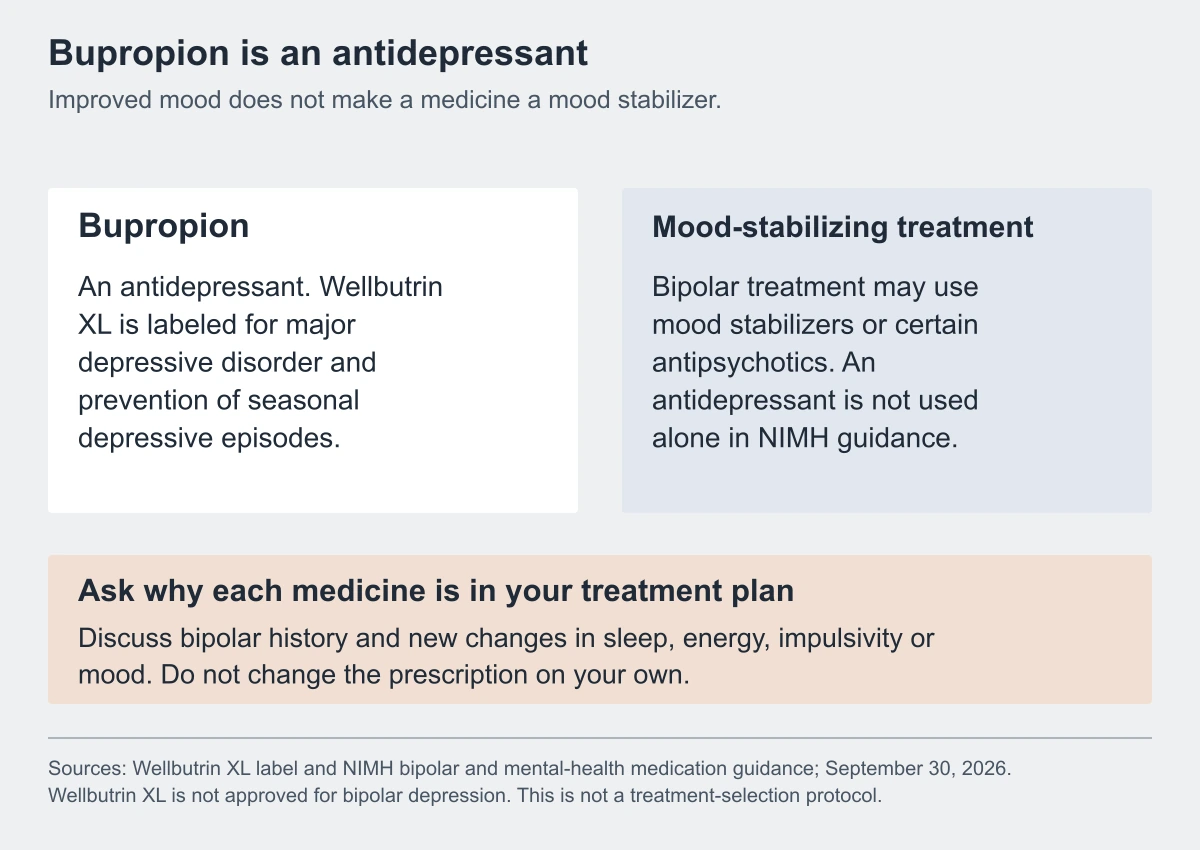
Bupropion is an antidepressant, not a mood stabilizer. A person may describe feeling more emotionally steady when depression improves, but that experience does not change the medicine’s category. Wellbutrin XL, a bupropion extended-release product, is labeled for major depressive disorder and prevention of seasonal major depressive episodes in people with seasonal affective disorder. It is not approved for bipolar depression. Wellbutrin XL prescribing information.
The distinction matters because depression and bipolar disorder can require different treatment plans. If you have a history of unusually high energy, reduced need for sleep, impulsive behavior or a bipolar diagnosis, discuss it with the prescriber. Do not use an online category comparison to start, stop or replace a medication yourself.
What does “mood stabilizer” mean?
In everyday conversation, “stabilizing my mood” may mean feeling less depressed, anxious or emotionally reactive. In bipolar care, mood-stabilizing treatment concerns the prevention or management of mood episodes, including mania and depression. Those meanings are related but are not interchangeable medication categories.
NIMH describes mood stabilizers and certain atypical antipsychotics among treatments for bipolar disorder. Different medicines may be used for an acute episode and for longer-term care. Lithium and valproate are examples in its explanation of mood stabilizers; that is an explanation of treatment roles, not a recommendation for an individual. NIMH bipolar-disorder guidance.
Bupropion’s antidepressant role does not mean it can replace a mood stabilizer. Conversely, the phrase “mood stabilizer” does not mean that every medicine in a bipolar treatment plan performs the same job. Ask the prescriber what each prescription is intended to do and how its benefit and risks will be monitored.
What is bupropion prescribed for?
The product and formulation matter. The current Wellbutrin XL label describes treatment of major depressive disorder and prevention of seasonal major depressive episodes in patients with seasonal affective disorder. MedlinePlus also describes bupropion’s use for smoking cessation, with formulation-specific instructions. Wellbutrin XL label, MedlinePlus drug information.
Do not assume that every bupropion-containing product has the same approved purpose, release pattern or dosing schedule. Immediate-release, sustained-release and extended-release products have different instructions. A combination medicine containing another ingredient is a separate product with its own labeling.
| Question | What to verify |
|---|---|
| Why was this prescribed? | The diagnosis or symptoms the prescriber intends to treat. |
| Which formulation is it? | The exact name and release type on the pharmacy label. |
| Is another medicine part of the plan? | Its separate purpose and the reason for the combination. |
| When will we reassess? | The follow-up plan for benefit, tolerability and new symptoms. |
| Does a mood change need attention? | Its severity, duration and relationship to sleep, energy and behavior. |
A medication name alone cannot answer all five questions. Bring the actual pharmacy label to the conversation if the terminology is confusing.
How does bupropion work?
The Wellbutrin XL label says that bupropion’s precise antidepressant mechanism is unknown. It describes effects on neuronal uptake of norepinephrine and dopamine and a presumed role for those pathways. That is more accurate than claiming that the medicine fixes one measured chemical deficiency or guarantees emotional stability. Clinical pharmacology information.
This mechanism discussion does not establish bipolar-treatment suitability. Medicines can have effects on mood while serving different clinical roles. The diagnosis, history, symptoms and evidence for the intended use remain part of the decision.
If you have heard bupropion called a dopamine-related antidepressant, ask how that description relates to your treatment goal. It does not tell you whether your current symptoms are depression, bipolar disorder, an adverse reaction or something else. Those questions require clinical assessment.
Can bupropion be used in someone with bipolar disorder?
MedlinePlus notes that bupropion is sometimes used for depressive episodes in people with bipolar disorder. That describes a possible clinician-directed use; it does not make bupropion a mood stabilizer or supply a personal treatment protocol. Wellbutrin XL’s label specifically states that it is not approved for bipolar depression. MedlinePlus, Wellbutrin XL label.
NIMH explains that, for selected people with bipolar depression, an antidepressant may be added to a mood stabilizer or certain antipsychotic treatment. Its guidance says antidepressants are not used alone because they can trigger mania or rapid cycling in a person with bipolar disorder. NIMH guidance.
The appropriate plan depends on the person’s history and current condition. Do not add a medicine, remove a companion prescription or decide that bupropion alone is sufficient from a general article. If the purpose of a combination is unclear, ask the treating clinician to explain the role of each component.

Why does screening for mania or hypomania matter?
The label warns that antidepressant treatment can precipitate a manic, mixed or hypomanic episode. It instructs clinicians to screen for bipolar history and relevant risk factors before starting Wellbutrin XL. This is a reason to share a fuller history than how depressed you feel at the current appointment. Wellbutrin XL warnings.
Tell the prescriber about periods of markedly increased energy, unusually little need for sleep, racing thoughts or risky behavior. Include previous reactions to antidepressants and any known family history that the clinician asks about. These details do not establish a diagnosis by themselves, but they can change the assessment.
Improvement in energy as depression lifts is not automatically mania. The nature, intensity and pattern of the change matter. New or extreme changes should be evaluated rather than assumed to be proof that the medicine is working especially well.
Which mood changes need prompt help?
MedlinePlus advises contacting the prescriber immediately about new or worsening depression, thoughts of self-harm, marked agitation or unusually excited behavior. It also identifies concerning patterns such as greatly increased energy, severe sleep difficulty, racing thoughts, reckless behavior and unusual grand ideas. MedlinePlus safety information.
Antidepressant labeling includes a warning about increased suicidal thoughts and behaviors in children, adolescents and young adults, with close monitoring for worsening or emerging symptoms in people of all ages. Do not wait for a routine appointment if the change is serious or safety is uncertain. Wellbutrin XL boxed warning.
In the United States, call or text 988 for a suicidal or mental-health crisis. For an immediately life-threatening situation, call 911. NIMH lists these crisis resources. NIMH help guidance.
This does not mean every ordinary mood fluctuation is a crisis. It means that severity and safety take priority over a medication-category question.
How long does an antidepressant benefit take?
MedlinePlus notes that the full benefit of bupropion may take four weeks or longer. That is a general expectation, not a deadline that guarantees response. The prescriber should explain how the intended benefit will be assessed and when follow-up is planned. MedlinePlus.
Ask which changes to look for, such as improvement in the symptoms being treated, and which changes to report sooner. A medicine’s benefit and its adverse effects are assessed together. Trouble sleeping or new agitation should not be dismissed merely because the antidepressant has not yet reached its expected assessment point.
Do not increase the dose to accelerate a response. Follow the prescription, and ask about any missed-dose question. MedlinePlus advises against taking an extra dose to make up for one missed. Release-type instructions also matter; sustained-release and extended-release tablets should not be crushed or split. MedlinePlus administration information.
What else should be reviewed before treatment?
The prescribing information includes seizure-risk precautions and contraindications, including seizure disorders and a current or prior diagnosis of anorexia nervosa or bulimia. It also addresses abrupt withdrawal from certain substances or medicines, other bupropion-containing products and important drug interactions. A full medication and health-history review matters. Wellbutrin XL label.
Tell the prescriber and pharmacist about prescriptions, nonprescription products, supplements and changes in alcohol or sedative use. Do not create a personal withdrawal or combination plan from a list of interactions. The clinician can assess the actual circumstances and give appropriate instructions.
Blood pressure, sleep and tolerability may also be part of follow-up. If a side effect is persistent or interferes with daily life, report it rather than compensating with another medicine on your own. A careful review can distinguish an expected adjustment from a concern that requires a change in care.

Does weight loss change bupropion’s category?
No. An appetite or weight change does not make an antidepressant a mood stabilizer, and bupropion alone should not be treated as an interchangeable substitute for a labeled weight-management combination. The bupropion and weight article discusses that separate question.
If weight or nutrition is a concern during treatment, describe the change and whether it was intended. The balanced-meal guide and calorie-intake guide can help organize food questions. Persistent inadequate intake, restrictive eating or a history of an eating disorder deserves clinical attention rather than praise for a smaller number on the scale.
People considering a GLP-1 medicine should share their mental-health history and full medication list with the prescribing team. The GLP-1 selection guide and semaglutide questions guide address weight-related treatment questions. CoreAge Rx’s semaglutide and tirzepatide pages describe offered compounded care, whose eligibility and product evidence require a separate assessment.
Questions to ask about your treatment plan
- What condition or symptoms is bupropion intended to treat for me?
- Have my previous sleep, energy and mood patterns been considered?
- Why is each other medicine included, and which role does it serve?
- What benefit should we look for, and when will we review it?
- Which new symptoms should prompt a same-day call or urgent help?
- What are the instructions for missed doses and troublesome side effects?
The clear answer to the category question is that bupropion is an antidepressant. The more personal question—whether it belongs in your treatment plan—depends on an assessment of the diagnosis, history, current symptoms, other treatments and safety. Use the distinction to ask better questions, not to change the prescription independently.
Educational information for adults; individual treatment decisions require a qualified clinician. Sources reviewed September 30, 2026. Original AI-generated article images depict fictional people and objects, not patient outcomes. Other editorial images are illustrative. Graphics summarize the cited sources.