
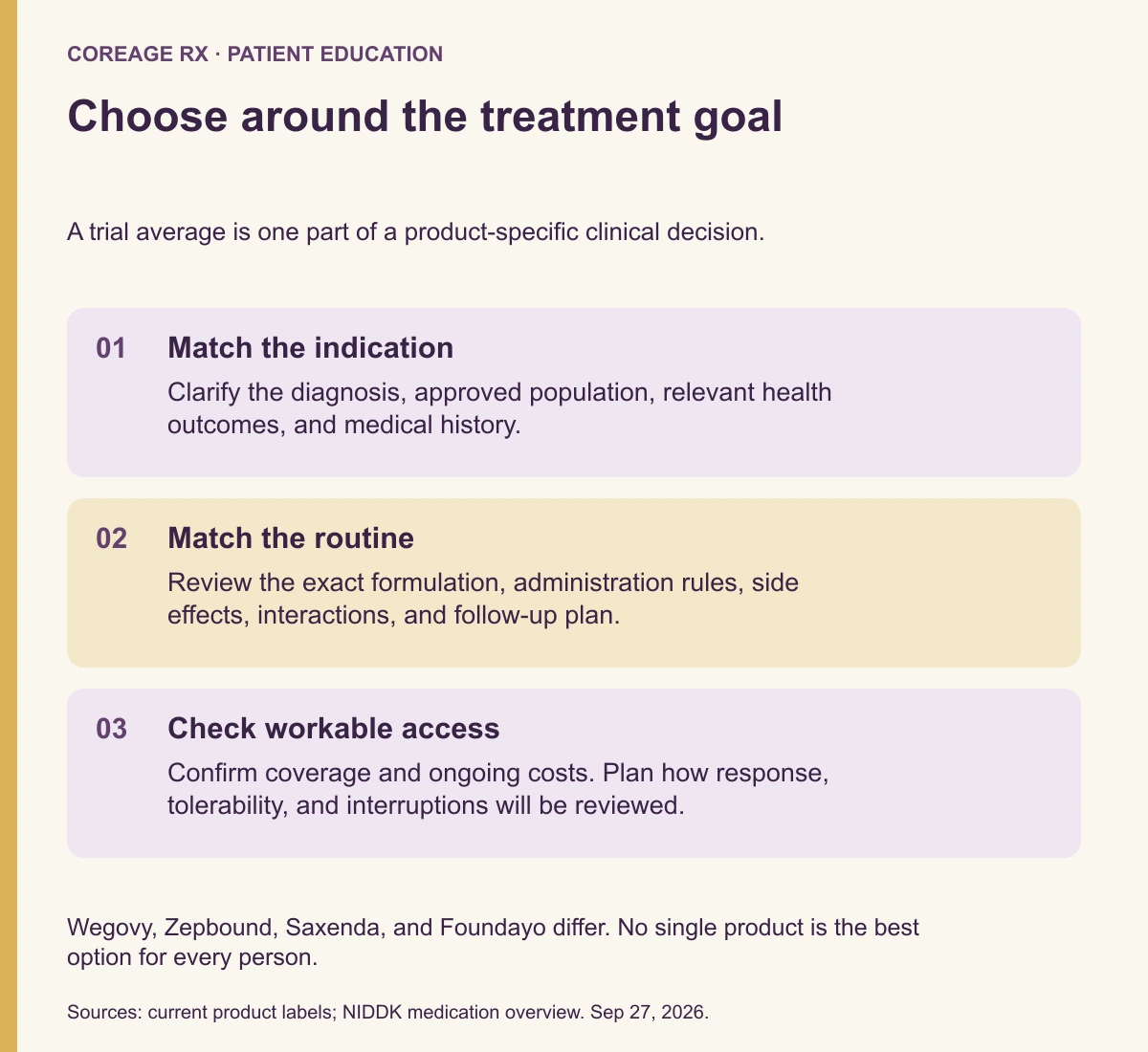
The best GLP-1 medicine for weight loss depends on the condition being treated, medical history, treatment routine, response, and access. A medicine with a larger average result in one trial is not automatically the most appropriate choice for every person. The exact brand and formulation matter as much as the ingredient name.
Current options also include both injections and tablets. A useful comparison starts by identifying the approved purpose and the practical requirements, then considers the evidence and what follow-up will look like. This guide focuses on adult weight-management decisions and the questions to discuss with a qualified clinician.
Start with the health goal
Weight management, diabetes care, cardiovascular risk reduction, sleep apnea treatment, and liver disease treatment are distinct clinical purposes. Some products have more than one indication, but the evidence and eligible populations differ.
Ask what condition the medicine is intended to address and which outcomes will be reviewed. A lower HbA1c, less hunger, a change in body weight, and fewer cardiovascular events are not interchangeable measures. The product should fit the actual diagnosis and treatment goal.
Our weight-loss basics guide provides broader context. NIDDK’s prescription weight-management medication overview explains how medicines fit alongside other care rather than replacing every part of a long-term plan.
Which products are used for weight management?
| Product | Ingredient and action | Main routine to discuss |
|---|---|---|
| Wegovy | Semaglutide; GLP-1 receptor agonist | Weekly injection or adult daily tablet; instructions and approved uses differ by formulation |
| Zepbound | Tirzepatide; dual GIP and GLP-1 receptor activity | Weekly injection with presentation-specific device instructions |
| Saxenda | Liraglutide; GLP-1 receptor agonist | Daily injection and product-specific response assessment |
| Foundayo | Orforglipron; oral GLP-1 receptor agonist | Daily tablet, with its own interaction and escalation requirements |
Sources: Wegovy, Zepbound, Saxenda, and Foundayo prescribing information. These products have defined eligibility requirements; the table is not a determination that a reader qualifies.
Zepbound is often grouped into GLP-1 conversations, but its dual receptor activity is a meaningful pharmacologic distinction. There are also weight-management medicines outside this group. Our phentermine versus GLP-1 guide explains one such comparison.
Are Ozempic and Mounjaro the same options?
Ozempic contains semaglutide, and Mounjaro contains tirzepatide, but their diabetes-related indications and product instructions should not be replaced with those of Wegovy and Zepbound. Sharing an ingredient does not make brands interchangeable for prescribing or insurance purposes.
Our Mounjaro versus Ozempic comparison focuses on diabetes evidence and the current injection indications. If diabetes treatment is the primary goal, that can change which outcomes and studies are most relevant.
Ask the clinician to use the actual diagnosis and the appropriate product. Changing the wording of a diagnosis to fit an insurance rule is not a legitimate solution to a coverage exclusion.
How should you compare weight-loss results?
Direct randomized comparisons can answer a narrower question more reliably than a table assembled from unrelated trials. In STEP 8, for example, semaglutide 2.4 mg weekly was compared directly with liraglutide 3 mg daily in adults with overweight or obesity without diabetes over 68 weeks.
Average weight reduction was greater with semaglutide in that study, but its result does not compare all current semaglutide doses or tablets. Our Saxenda versus Wegovy article explains the doses, outcomes, and different treatment rules. Source: STEP 8 trial.
For tirzepatide and semaglutide obesity evidence, see our treatment-results comparison. Always preserve the trial population, dose, duration, and outcome definition before deciding what a number means for a real treatment choice.
For an investigational molecule, our guide to retatrutide dosing research separates trial target doses, escalation research, study populations and current approval and compounding status.
Why unrelated trial rankings can mislead
A study in people with type 2 diabetes may produce a different average weight change from a study excluding diabetes. Trials also differ in follow-up duration, dose escalation, counseling, discontinuation, missing-data methods, and which participants are included in an analysis.
Those differences make a simple league table look more decisive than the evidence permits. A percentage from one trial is not a prediction of what would have happened if the same people had received a different medicine in another trial.
Use trial evidence to inform expectations and questions. Then ask how response will be assessed in your own care and what would prompt a review. Our weight-loss timeline guide explains why group results should not be converted into a guaranteed personal date.
Is a tablet better than an injection?
Route preference matters, but tablets are not automatically simpler or safer. Wegovy tablets are taken on an empty stomach in the morning with a limited amount of water, followed by a waiting period before food, other drinks, or oral medicines. Foundayo can be taken with or without food and has different instructions.
Both require attention to the exact label, dose progression, interactions, and adverse effects. Do not split or improvise doses using instructions from a different oral product. Sources: Wegovy tablet instructions and Foundayo administration instructions.
Weekly injections may fit some routines, while others prefer a daily tablet or injection. Consider work, travel, storage, swallowing, device use, and other morning medicines. Our oral semaglutide versus injections guide explores those practical distinctions.

Which other diagnoses may affect the choice?
Wegovy has a cardiovascular-risk-reduction indication for adults with established cardiovascular disease and overweight or obesity. Its injection also has an accelerated-approval indication for adults with noncirrhotic MASH and specified moderate to advanced liver fibrosis; the tablet does not automatically share that liver indication.
Zepbound has an indication for moderate to severe obstructive sleep apnea in adults with obesity. These uses are not class-wide approvals, and treatment of sleep apnea or liver disease still requires the relevant diagnostic and follow-up care. Sources: Wegovy indications and Zepbound indications.
Bring relevant diagnoses, test results, and current therapies to the appointment. A product selected for a particular health outcome may be appropriate even when a different product appears more convenient or has a different average weight-loss result.
What safety questions come first?
The selected medicine’s full contraindications and precautions need review. The products in this comparison include boxed thyroid-tumor warnings and contraindications involving medullary thyroid carcinoma or MEN2, but the underlying label wording is not identical for every ingredient.
For example, Foundayo’s label explains a distinct preclinical situation for orforglipron rather than stating that it produced rodent tumors in the same way as certain other agents. The clinical contraindication still matters. Source: Foundayo boxed warning and precautions.
Discuss pancreatitis history, severe digestive disease, gallbladder concerns, dehydration, allergies, diabetic eye disease, and planned anesthesia as applicable to the product. A tablet, a newer brand, or a smaller starting dose does not remove the need for this review.
What interactions and reproductive questions matter?
Bring a complete medication and supplement list. Insulin and certain other diabetes medicines can affect hypoglycemia risk. Delayed gastric emptying can matter for oral medicines, and some products have additional metabolism-related interactions.
Foundayo has specific interaction instructions involving CYP3A4-related medicines and certain other drugs. Its label also advises a nonoral contraceptive method or added barrier method for 30 days after starting and after each dose increase. Zepbound’s corresponding oral-contraceptive instruction uses four weeks after initiation and each increase. Sources: Foundayo and Zepbound labels.
Pregnancy plans and breastfeeding should be discussed before treatment. Do not assume the same stopping interval or contraceptive instruction applies to every product, and do not change other essential medicines without a coordinated plan.
What if side effects are the deciding issue?
Nausea, vomiting, diarrhea, constipation, and other gastrointestinal symptoms can affect treatment. The pattern and severity matter more than a broad claim that one drug is “gentler.” A person who tolerates one product may respond differently to another.
Ask what symptoms should trigger contact, whether escalation can be reconsidered, and how the team evaluates persistent difficulty eating or drinking. Severe abdominal pain, inability to maintain hydration, or signs of a serious allergic reaction require prompt assessment.
Our Wegovy side-effects guide and Zepbound side-effects guide provide focused questions. The goal is an effective, tolerable plan with adequate nourishment—not the strongest possible appetite suppression regardless of symptoms.
How much should insurance and cost influence the decision?
Access matters because a plan must be workable over time. Check the exact product, formulation, indication, formulary rules, prior authorization, pharmacy network, and ongoing cost. A low introductory price may not describe the cost after escalation or several refills.
Our GLP-1 insurance guide explains the coverage process. Medicare beneficiaries should also read the Medicare weight-loss drug guide, because ordinary Part D coverage and the separate GLP-1 Bridge program follow different rules.
An insurer’s preferred product is not proof that it is clinically appropriate, and clinical eligibility does not guarantee payment. Discuss suitable alternatives and the implications of interrupted access before relying on a single offer.

What about compounded products or care programs?
Verify the actual medication, formulation, dispensing pharmacy, and clinical arrangement. FDA-approved branded trial findings should not be presented as proof that every compounded preparation has equivalent quality, safety, or effectiveness. The FDA explains that compounded drugs are not FDA-approved. Source: FDA information on unapproved GLP-1 drugs.
If exploring CoreAge Rx semaglutide care or tirzepatide care, ask what is being prescribed and how product-specific instructions, adverse effects, and follow-up are handled. A program name alone does not answer those questions.
Bring a short decision list to the appointment
Write down the condition you want treated, relevant diagnoses, current medicines, route preferences, coverage information, and any previous adverse effects. Ask how benefit will be measured and what happens if the first option is ineffective, poorly tolerated, or unaffordable.
The most useful choice combines appropriate evidence with the person’s actual circumstances. A clear plan for reassessment is part of choosing well, because the initial prescription is the beginning of treatment rather than the final decision.
Educational information for adults; individual treatment decisions require a qualified clinician. Sources checked September 27, 2026. Original AI-generated article illustrations depict fictional people and objects, not patient outcomes. Other editorial images are illustrative. Graphics summarize the cited sources.