
Christina Aguilera’s comments about body image offer useful context for a conversation about public scrutiny. They do not establish a private weight-loss regimen. A photograph, a repeated rumor, or a headline about an appearance change cannot tell readers which medicine someone takes, how much their weight changed, or whether a treatment would suit another person.
The useful distinction is between what a person actually says and what other people infer. This guide explains that distinction, then turns the conversation toward evidence and questions that can help with your own health decisions.
What did Christina Aguilera actually say about body image?
In her 2024 Glamour cover interview, Aguilera discussed earlier pressure around her appearance, the way public criticism affected her confidence, and becoming less concerned with other people’s judgments as she grew older. She said, “Other people’s opinions of me are not my business.” Those are comments about scrutiny and self-esteem. The reviewed body-image passages do not identify a medicine or a specific weight-loss program. Glamour’s direct interview.
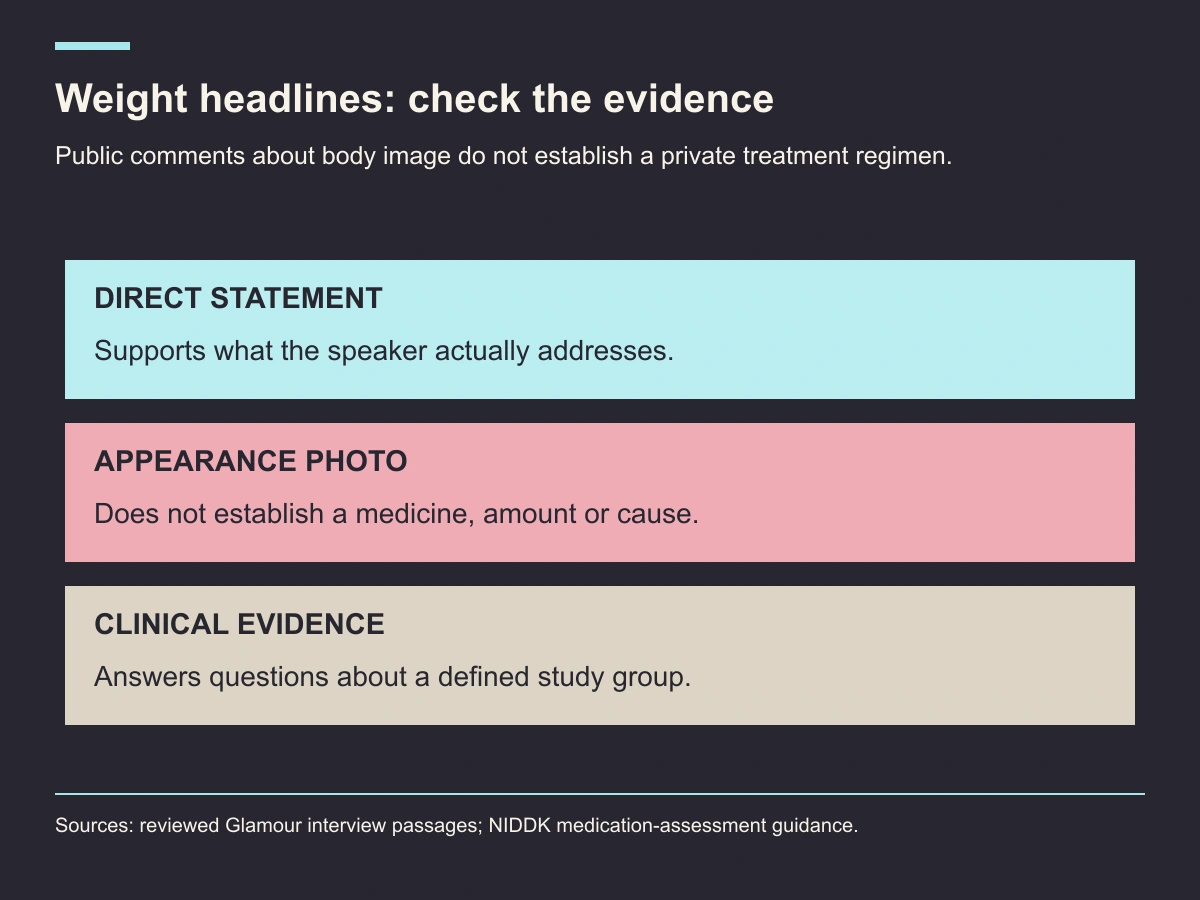
Treat a direct statement as evidence of the subject it addresses. A statement about confidence is not a prescription disclosure. A discussion of earlier criticism is not a verified measurement of later weight change. These boundaries help avoid turning a real interview into an unsupported medical story.
Why an appearance change cannot establish a treatment
People often encounter a collage with two dates and a confident explanation underneath it. The collage may show a different outfit, camera angle, lighting setup, pose, hairstyle, or point in someone’s life. Even if an appearance difference is apparent, its cause remains a separate question.
A photo does not provide a diagnosis, a medication list, a reliable starting weight, a measured end weight, or the length and conditions of a treatment course. It also does not reveal whether an image was edited. Guessing from an image cannot fill in those missing records.
This applies in both directions. A person looking different does not prove they used a GLP-1 medicine. Looking similar does not prove they did not. An article should not imply a denial either unless it has an attributable statement that actually addresses the medication question.
Our guide to interpreting Wegovy before-and-after results explains why controlled trial measurements and individual photos answer different questions. Trial evidence can describe outcomes in a defined group; it cannot identify a celebrity’s private care.
A simple way to evaluate a weight-loss headline
Before accepting the explanation in a story, separate the claim, the evidence, and the missing information. This takes less time than trying to decide whether a comparison photo looks convincing.
| What the story presents | What it can support | What still needs verification |
|---|---|---|
| A direct interview about body image | The speaker’s reported experience and views | A medicine, diagnosis, or private regimen |
| A comparison photograph | How the person appears in those images | Actual weight measurements and cause |
| A named clinical study | Results for that study’s participants and conditions | Whether another person received that treatment |
| A promotional testimonial | What the advertiser or speaker claims | Independent evidence, eligibility, risks, and typical results |
Look for an original interview rather than a chain of sites quoting one another. Check whether the quoted words address the headline’s actual question. Also distinguish a source’s date from the date of a photograph. Reposting an old interview does not make it a new treatment disclosure.
If the evidence stops at an appearance comparison, the honest conclusion is that the treatment explanation remains unverified. Repetition across websites does not create a medical record. That conclusion can coexist with interest in the person’s work and respect for their privacy.
What matters when the question becomes your own weight
Interest in a public figure can lead to a reasonable personal question: would a weight-management medicine help me? That requires a clinical assessment rather than a resemblance, a target clothing size, or a desire to reproduce someone else’s appearance.
NIDDK’s prescription weight-management guidance describes adult assessment using weight-related health, BMI, prior approaches, medical history, medicines, likely benefits, side effects, and cost. It also advises against taking a weight-management medicine solely to improve appearance. Medication is part of a broader care plan, not a substitute for adequate food or follow-up.
Our BMI and waist-measurement guide explains the practical limits of these measurements. A clinician can use them alongside blood pressure, glucose, symptoms, function, and history. A BMI value alone cannot determine every treatment decision or capture every aspect of health.
Prepare for an appointment by describing what is happening: a gradual change, an unexplained loss, hunger that is difficult to manage, an existing diabetes diagnosis, or distress about eating. These are different starting points. Each may call for a different evaluation, even when the initial search was the same celebrity headline.

Separate the active ingredient from the brand and care plan
Semaglutide is an active ingredient, not a guarantee that every semaglutide preparation has the same indication, dose, device, or evidence. Ozempic and Wegovy have different approved uses and instructions. Compounded preparations are a further distinct category and are not FDA-approved versions of the branded medicines.
The current Ozempic label lists type 2 diabetes-related indications. The current Wegovy label includes weight-management indications with product-specific requirements. Neither label tells us what a particular public figure takes. Our semaglutide and Ozempic comparison provides a starting point for understanding that distinction.
If you are exploring care, the CoreAge Rx semaglutide product page can introduce the service and its current information. Ask about the exact prescribed preparation, clinician assessment, pharmacy, recurring charges, and follow-up. A product page or questionnaire does not establish that you personally qualify for a prescription.
For a separate active ingredient, our tirzepatide versus semaglutide evidence guide keeps trial populations and treatment conditions visible. Selecting care by a rumored celebrity preference skips those important comparisons.
Keep nutrition and everyday function in the conversation
A smaller number on a scale is not the only outcome worth tracking. Being able to eat regular meals, stay hydrated, work, sleep, and maintain everyday strength matters. Severe nausea, repeated vomiting, or inability to eat adequately should not be treated as evidence that a medicine is producing a desirable result.
Ask who will help you adjust a meal plan when appetite changes. Describe foods you can tolerate, your schedule, existing dietary restrictions, and any diabetes medicines that make skipped meals risky. A registered dietitian can help translate broad advice into meals that fit your circumstances.
Our semaglutide, protein, and muscle guide discusses function and nutrition during treatment. The calorie-intake guide explains why a fixed intake from a social-media post is not a universal target. Avoid converting a public figure’s alleged routine into instructions for your own body.
If weight is falling unexpectedly, or fatigue, weakness, vomiting, or swallowing problems are interfering with meals, bring those symptoms to a clinician. The priority is to understand and address the problem, rather than celebrate an unexplained change.
When comparison starts affecting eating or mental health
Occasional interest in appearance differs from persistent distress that changes eating, activity, or daily life. If comparison leads to severe restriction, compensatory behavior, repeated loss of control around food, or an increasingly narrow set of foods, seek support.
NIMH’s eating-disorder guidance explains that eating disorders can occur at any body weight, including in people who appear healthy. Appearance cannot establish or rule out one. These illnesses are treatable, and early assessment can help. A primary care professional can connect you with appropriate mental health and nutritional care.
Describe behaviors and symptoms rather than trying to label yourself from a post. You might say that you are skipping meals after viewing photos, avoiding social meals, exercising despite exhaustion, or feeling unable to stop a cycle of restriction and overeating. Those descriptions give a professional useful information.
You do not need to reach a particular weight before asking for help. Weight-management goals and concerns about eating can be discussed together. Your care plan should make room for physical health, mental health, and a sustainable relationship with food.

Questions to bring to a health appointment
- What health concern are we treating, and how will we measure progress beyond appearance?
- Do unexplained weight changes or other symptoms need evaluation first?
- What does my medical and family history mean for possible treatment?
- Which exact medicine or formulation are you considering, and why?
- How will we protect adequate nutrition and everyday function?
- Who can help if body-image distress is affecting eating?
- What are the follow-up arrangements, recurring costs, and options if treatment is unsuitable?
Write down your current prescriptions, supplements, relevant symptoms, and priorities before the visit. Include pregnancy plans where relevant. An accurate starting history is more useful than a guessed celebrity regimen and helps the clinician explain a decision you can understand.
Frequently asked questions
Did Christina Aguilera confirm Ozempic use in the reviewed interview?
The reviewed body-image passages do not establish use or denial of Ozempic. They address public scrutiny and confidence. This is a limited statement about those passages, not a claim that every statement she has ever made has been reviewed.
Can a picture prove how much weight someone lost?
No. It does not supply reliable starting and ending measurements, consistent conditions, or a verified time interval. Avoid treating a repeated numerical claim as confirmed when the underlying evidence is missing.
Should I ask for the same treatment a celebrity is rumored to use?
Ask about your own health and suitable options. A rumor supplies no diagnosis, contraindication review, nutrition plan, or monitoring arrangements for you. A clinician may recommend medication, a different approach, further testing, or support for eating concerns.
Can someone with a normal BMI have diabetes-related treatment needs?
Yes, BMI is not a complete diabetes assessment. Product indications and an individual’s diagnosis matter. Our Ozempic at a normal BMI guide separates diabetes-related care from using weight medication for an appearance goal.
What is a useful takeaway from these headlines?
Use them as a prompt to check evidence and reflect on your own questions. Direct statements, clinical trial results, advertisements, and photographs have different limits. A sound personal care decision starts with your history and goals, not an unsupported explanation of someone else’s appearance.
Educational information for adults; individual treatment decisions require a qualified clinician. Sources reviewed October 2, 2026. Original AI-generated article images depict fictional people and objects, not patient outcomes. Other editorial images are illustrative. Graphics summarize the cited sources.