
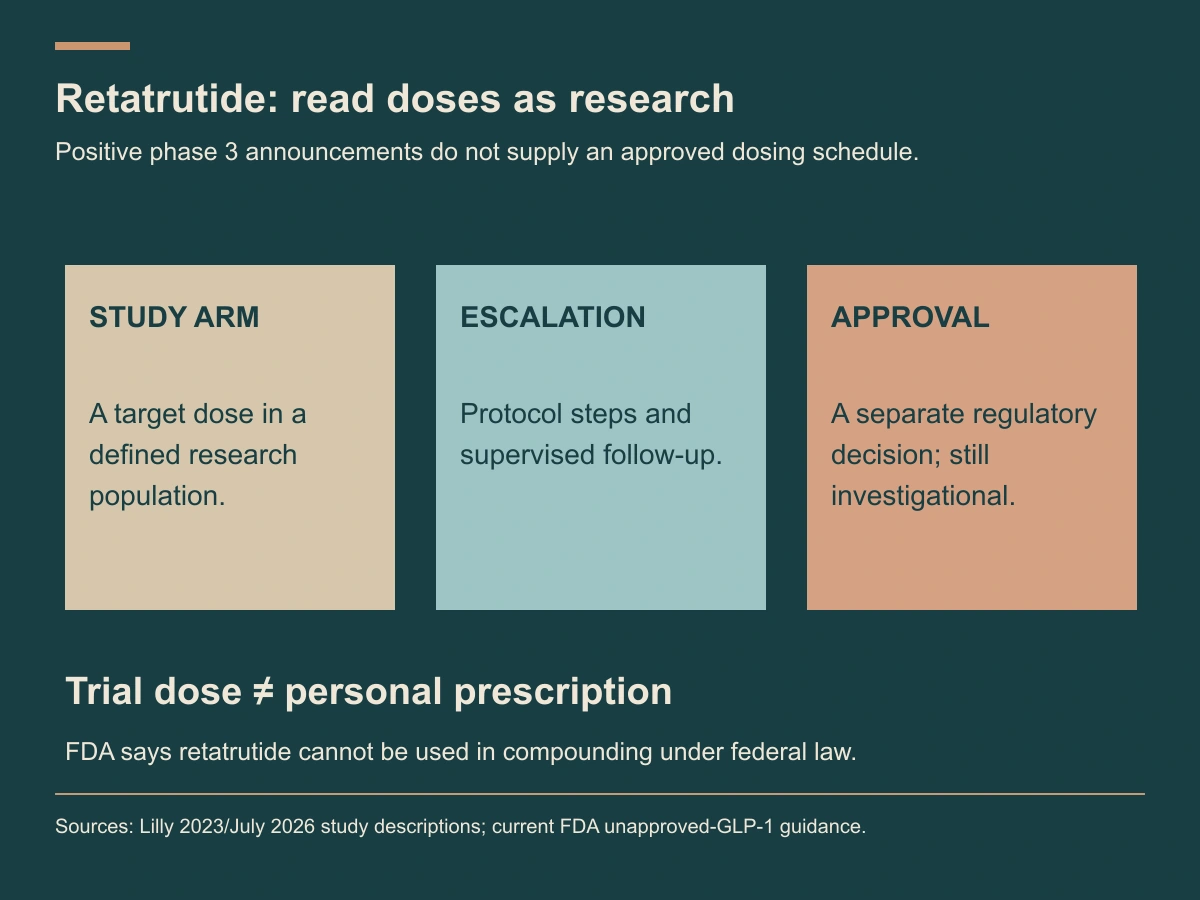
Retatrutide dosing information comes from clinical research, not an FDA-approved prescribing schedule. Current FDA guidance says retatrutide cannot be used in compounding under federal law and has not been found safe and effective for any condition. Lilly continues to describe it as investigational, despite positive phase 3 announcements.
If you are looking for a retatrutide dose chart, first distinguish a trial’s target dose, its starting dose and its escalation method. Those describe what researchers tested in selected participants under supervision. They do not provide a personal starting dose, syringe-unit conversion or safe self-treatment plan.
What is retatrutide?
Retatrutide is an investigational molecule that activates GIP, GLP-1 and glucagon receptors. Lilly describes it as a once-weekly triple hormone receptor agonist. That description differs from tirzepatide, which has GIP and GLP-1 receptor activity, and semaglutide, which acts at GLP-1 receptors. Lilly current retatrutide research announcement.
The additional receptor target does not by itself establish that retatrutide is the best treatment for a particular person. Clinical outcomes, safety, study populations and approval status all matter. A mechanistic comparison is not a prescribing decision.
Our Mounjaro versus Ozempic guide discusses currently labeled diabetes medicines and their evidence. Do not extend their dose schedules or package instructions to an investigational molecule simply because all three are discussed in weight-related research.
Current approval status comes before a dose discussion
FDA’s current unapproved-GLP-1 guidance specifically states that retatrutide and cagrilintide cannot be used in compounding under federal law. It also states that they are not components of approved drugs and have not been found safe and effective for any condition. FDA retatrutide guidance.
A positive trial result is a research milestone, not regulatory approval. A website offering a vial, a certificate or a protocol does not change that status. Neither does describing the product as “research use only” establish that it is suitable for human injection.
This is also different from the discussion of compounded semaglutide or tirzepatide for a specific medical need. FDA’s compounding framework has conditions, and the retatrutide statement is explicit. Our compounded GLP-1 guide explains why an approved active ingredient and an investigational molecule should not be treated as interchangeable categories.
What the phase 2 study tested
Lilly’s June 2023 announcement describes a 48-week randomized, double-blind, placebo-controlled phase 2 study involving 338 participants with obesity or overweight and weight-related conditions, excluding type 2 diabetes. Researchers tested several target doses and different starting-dose approaches. Lilly phase 2 study description.
The target doses were 1, 4, 8 and 12 mg once weekly. Some groups assigned the same target began at different amounts. That design matters because tolerability and escalation are part of the research question, not just the final milligram number.
The primary weight endpoint was at 24 weeks, with 48-week results as a secondary endpoint. The announcement reported the highest-dose group’s mean weight reduction at those time points, but a group mean does not predict an individual’s response.
Do not read the highest target dose as a recommended starting dose. Participants were enrolled under a study protocol with eligibility criteria and follow-up. Repeating the number without those conditions strips away the context that makes it interpretable.
What changed in the 2026 phase 3 reports?
Lilly’s July 23, 2026 announcement describes results from TRIUMPH-2 and TRIUMPH-3, both 80-week phase 3 studies. TRIUMPH-2 enrolled adults with type 2 diabetes and obesity or overweight; TRIUMPH-3 involved severe obesity and established cardiovascular disease, with or without type 2 diabetes. Current phase 3 announcement.
The studies did not simply repeat the earlier phase 2 dose grid. TRIUMPH-2 studied target doses of 4, 9 and 12 mg; TRIUMPH-3 studied 9 and 12 mg. The announcement describes planned stepwise escalation, beginning at 2 mg and increasing at four-week intervals until the assigned target was reached.
That is a description of study conduct, not an approved schedule. The article does not convert those research steps into a patient-facing dose chart. A future approved label, if one is issued, could differ from a sponsor’s trial description.
| Research context | Population | Target doses described | Why the context matters |
|---|---|---|---|
| Phase 2, 2023 report | Obesity or overweight with relevant conditions, without type 2 diabetes | 1, 4, 8 and 12 mg | Different starting-dose groups and shorter endpoints |
| TRIUMPH-2, July 2026 announcement | Type 2 diabetes plus obesity or overweight | 4, 9 and 12 mg | Diabetes status and 80-week outcomes |
| TRIUMPH-3, July 2026 announcement | Severe obesity and established cardiovascular disease | 9 and 12 mg | Different risk profile and cardiovascular analyses |
| TRIUMPH-9 current listing | Adults without type 2 diabetes meeting trial requirements | Escalation schemes are the study question | Continuing research does not establish a universal titration plan |
These are study-arm descriptions. They are not instructions to obtain, prepare or administer retatrutide.
How to interpret weight-loss headlines
The July 2026 announcement reports up to 20.8% mean weight reduction at 80 weeks in TRIUMPH-2 and up to 22.6% in TRIUMPH-3 under the efficacy estimand. The announcement defines that analysis as estimating efficacy had participants remained on study treatment without specified prohibited or rescue treatments. Phase 3 results and analysis definition.
An estimand is the particular treatment effect a study analysis aims to estimate. Different analyses can answer different questions about adherence, discontinuation and additional treatments. A headline percentage should not be presented as what every person who starts treatment will lose.
The populations also differ from each other and from older studies. Comparing a 48-week result in one population with an 80-week result in another does not by itself prove which dose or medicine is better for a new patient.
Lilly said detailed TRIUMPH-2 and TRIUMPH-3 results would be presented at future meetings and published in peer-reviewed journals. The source used here is the sponsor’s announcement, not a claim that the complete trial reports have been reviewed.
Tolerability is part of dosing research
The phase 2 announcement identified gastrointestinal events as the most common reported adverse events, generally occurring during escalation. The current phase 3 announcement also reports digestive reactions and treatment discontinuations due to adverse events. Phase 2 safety context, phase 3 safety context.
A statement that many events were mild or moderate does not mean every participant tolerated every dose or that an unsupervised user can manage symptoms by guessing a slower schedule. Trial follow-up includes procedures that a purchased vial and online chart do not supply.
Safety discussion also needs the denominator, comparison group and dose arm. A percentage from one study should not be assigned to another population or portrayed as a complete retatrutide safety profile.
Do not copy the prescribing warnings of another medicine onto retatrutide as though an approved retatrutide label exists. Equally, the absence of an approved label should not be treated as absence of risk.
Why TRIUMPH-9 is relevant
Lilly’s current TRIUMPH-9 listing identifies phase III research into different dose-escalation schemes in adults without type 2 diabetes who have obesity or overweight. The captured listing shows completed enrollment, an approximate 113-week participation period and key inclusion and exclusion requirements. TRIUMPH-9 study listing.
The existence of this study reinforces that escalation remains a research question. It does not supply a universal regimen or promise an available trial slot. A trial’s eligibility summary is also not the same as a full screening decision.
If you are interested in research participation, use official study information and the study team. Ask about recruitment status, eligibility, visits, consent, treatment assignment and follow-up. Do not send health information or payment to an unrelated seller claiming to provide the study medicine.
What if a seller offers a dose chart or “compounded retatrutide”?
FDA’s current statement should be part of that assessment. An online chart does not verify a vial’s identity, concentration, sterility or suitability. A laboratory-style document also does not create approval or an individualized prescription.
This article deliberately does not provide syringe-unit conversions, reconstitution instructions or a self-start schedule. Those would imply a usable clinical regimen that the reviewed sources do not establish. If you have already used a product, tell a clinician the actual source, label, amount and symptoms rather than relying on the seller to assess a reaction.
FDA’s broader guidance identifies red flags in online GLP-1 sales and recommends licensed clinical and pharmacy involvement for prescription care. FDA online-product concerns.

Discuss current care while research continues
Ask a qualified clinician about the condition you want treated, available approved medicines, contraindications, costs and follow-up. Waiting for a possible future approval should not replace care for diabetes or another current health concern.
Our GLP-1 treatment-choice guide and switching medicine guide cover current treatment questions. CoreAge Rx describes its semaglutide service and tirzepatide service; these are different care pathways, not retatrutide access. Any compounded medicine requires an individual medical-need assessment and is not FDA-approved. FDA compounding questions.
Frequently asked questions
What is the half-life of retatrutide?
The reviewed 2022 phase 1b primary abstract reported an approximately six-day half-life. That was an early 12-week trial in adults with type 2 diabetes, not an approved consumer regimen or a study of every product sold under the name. Half-life describes how drug exposure declines; it does not tell you that a product is safe, when symptoms must end, when it is completely cleared, or how to dose, restart or combine it. Current approval and clinical-trial status still need to be considered before treatment questions. 2022 retatrutide phase1b pharmacokinetic abstract.
What is the approved retatrutide dose?
There is no FDA-approved retatrutide prescribing schedule in the current sources reviewed here. Trial doses describe research, not a personal prescription.
Why do dose charts show different amounts?
Different studies tested different target doses and starting approaches. A phase 2 grid and a phase 3 description do not answer the same question.
Is 12 mg the correct starting dose?
A high target dose from a trial is not a starting recommendation. Participants followed a research protocol with screening, escalation and monitoring.
Do positive phase 3 results mean approval?
No. Research results and regulatory approval are different milestones. Check current official sources rather than assigning approval from a headline.
Can retatrutide be compounded?
Current FDA guidance explicitly says it cannot be used in compounding under federal law. An online seller’s description does not override that statement.
Can I join TRIUMPH-9?
The captured official listing shows completed enrollment. Check official study information for current status and other research opportunities; this article does not establish personal eligibility or access.
Educational information for adults; individual treatment decisions require a qualified clinician. Sources reviewed October 2, 2026. Original AI-generated article images depict fictional people and objects, not patient outcomes. Other editorial images are illustrative. Graphics summarize the cited sources.