
Medicare coverage for a weight-related prescription depends on the medicine, the reason it is prescribed, the person’s plan, and the payment program involved. A blanket answer that Medicare either covers every GLP-1 medicine or never covers weight-loss treatment misses important distinctions.
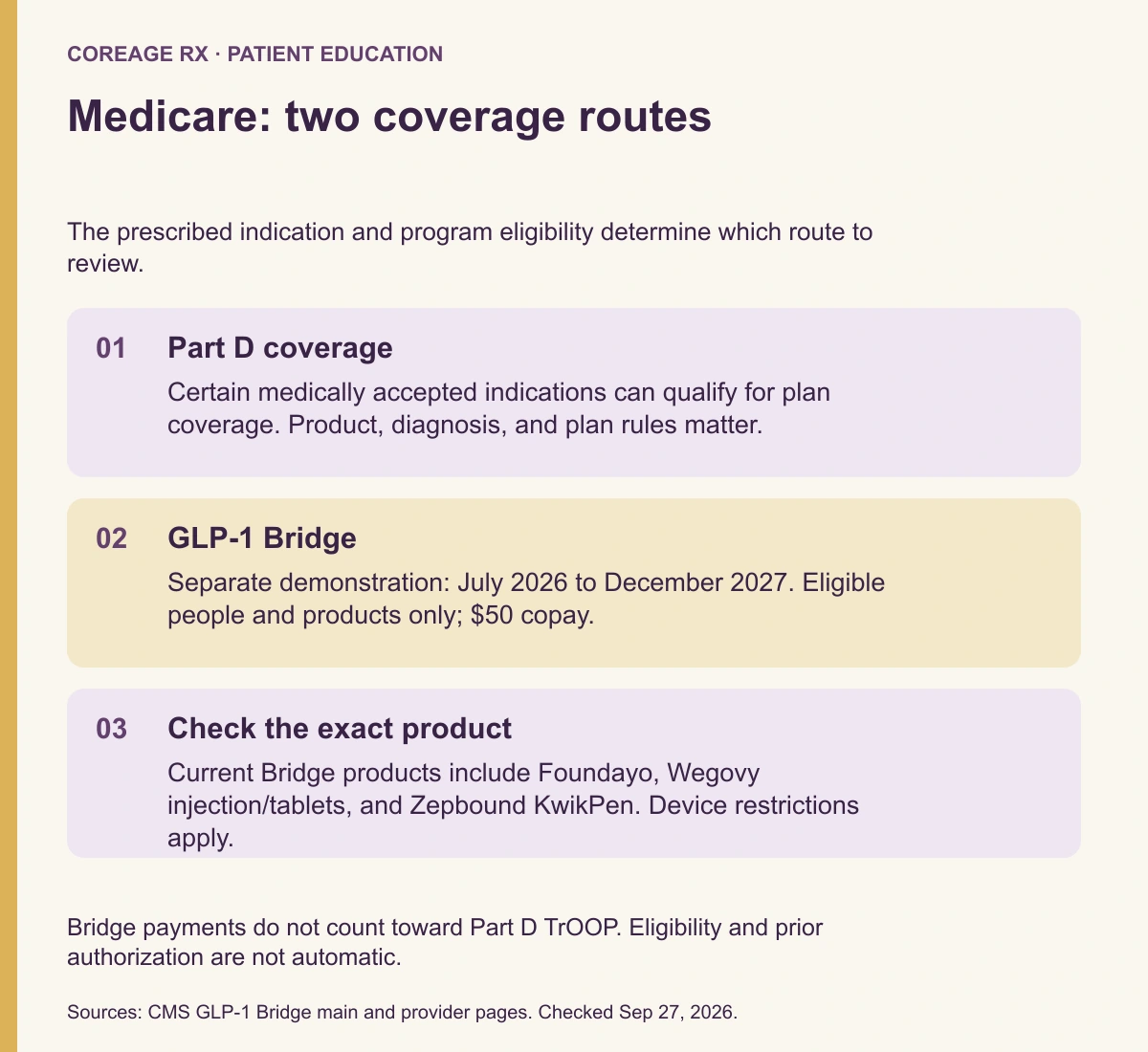
As of September 27, 2026, there are two particularly important routes to understand: coverage through a Medicare Part D plan for an eligible indication, and the separate Medicare GLP-1 Bridge demonstration for eligible weight-management prescriptions. They have different eligibility and payment rules.
Start with the reason for the prescription
A product may have more than one approved use. The same ingredient can also appear in different brands with different indications. That makes the diagnosis and exact product essential to a coverage discussion.
CMS identifies type 2 diabetes, moderate to severe obstructive sleep apnea, and specified noncirrhotic MASH liver disease as indications eligible for Part D coverage. Certain cardiovascular-risk-reduction prescriptions also belong in the Part D pathway. “Eligible for Part D coverage” does not mean that every plan automatically pays for every product without review. See CMS’s provider coverage explanation.
For example, Mounjaro and Zepbound both contain tirzepatide, but their approved uses differ. Our Zepbound versus Mounjaro guide explains why a shared ingredient does not settle the prescription or coverage question.
What is the Medicare GLP-1 Bridge?
The Bridge is a temporary CMS demonstration operating from July 1, 2026, through December 31, 2027. It provides certain GLP-1 medicines to eligible Medicare Part D beneficiaries when prescribed for weight management under the program’s criteria.
It operates outside the ordinary Part D coverage and payment flow. Part D plans do not have to opt into the demonstration for an otherwise eligible beneficiary to access it. CMS uses a central process for prior authorization, claims, and pharmacy payment. Source: CMS Medicare GLP-1 Bridge overview.
This is a defined program with an end date and eligibility rules. It should not be described as a permanent change that makes every weight-loss medicine a covered Part D benefit. Check the current CMS information again when arranging treatment or renewing authorization.
Who can qualify for the Bridge?
The clinician must attest that the requested drug is prescribed to reduce excess weight and maintain weight reduction alongside ongoing lifestyle modification consistent with the approved label. The patient must be at least 18 and meet one of the following clinical pathways at the time GLP-1 treatment began:
| BMI at treatment initiation | Additional clinical requirement |
|---|---|
| 35 or higher | No additional condition is listed for this BMI pathway |
| 30 or higher | Heart failure with preserved ejection fraction, specified uncontrolled hypertension, or chronic kidney disease stage 3a or above |
| 27 or higher | Prediabetes, previous myocardial infarction, previous stroke, or symptomatic peripheral artery disease |
For this program, CMS defines the hypertension pathway as systolic pressure above 140 mm Hg or diastolic pressure above 90 mm Hg despite treatment with two antihypertensive medicines. Prediabetes must meet the referenced American Diabetes Association criteria. These details come from CMS’s current clinical criteria.
These are program-specific requirements, not a universal definition of who should receive any weight-management medicine. A clinical assessment still needs to establish that the particular drug is appropriate and safe.
Does the BMI before treatment count?
CMS specifies BMI at the time GLP-1 therapy was initiated. That includes people who started before joining Part D or before the Bridge began.
CMS gives an example of a person who began therapy with a BMI of 37 and later had a BMI of 34: the prescriber can attest to the qualifying initial BMI rather than treating the later reduction as automatic disqualification. The relevant records and other requirements still matter. Source: CMS provider eligibility guidance.
Bring accurate historical measurements and treatment dates to the appointment. Do not change or invent diagnoses to fit a payment pathway. If records are missing, ask the prescribing team which documentation can establish the treatment history.
Which Medicare plans are eligible?
Eligible plan types include standalone prescription drug plans and specified Medicare Advantage coordinated-care plans with prescription coverage, including HMO and local or regional PPO arrangements. CMS also includes Special Needs Plans, employer or union group waiver plans, and the LI NET program under its stated rules.
Other arrangements are excluded unless the person is also enrolled in an eligible standalone prescription drug plan, as applicable. People enrolled in both Medicare and Medicaid can participate if their Part D plan type and clinical circumstances meet the criteria.
Because plan names and arrangements can be confusing, verify the exact enrollment rather than assuming that any Medicare card establishes eligibility. CMS directs people who need help understanding coverage to Medicare or a State Health Insurance Assistance Program. The provider FAQ lists the included and excluded plan types.

Which medicines and devices are included?
CMS currently lists these products for eligible weight-management use:
- Foundayo, containing orforglipron.
- Wegovy, including injection and tablet formulations.
- Zepbound KwikPen, the specified four-dose pen presentation.
The single-dose Zepbound pen and single-dose vial are not included in the Bridge’s current product list. CMS also states that pen needles are not covered by the Bridge and must be purchased separately. Check the actual prescription and product code with the pharmacy. Source: CMS eligible products and presentations.
A brand name alone therefore may not be enough. Our Zepbound injection-site and device guide explains presentation differences, while the Wegovy prescription guide discusses route-specific assessment.
What does the $50 copay include?
CMS states that eligible beneficiaries have a $50 copay under the Bridge. Because the medicine is supplied outside the Part D payment flow, the Part D deductible does not apply to that program purchase.
The $50 does not count toward Part D true out-of-pocket costs, often called TrOOP. CMS also states that no low-income subsidy is provided for the Bridge copay. These details are different from assuming that every prescription purchase contributes to the usual Part D spending calculation. Source: CMS Bridge payment FAQ.
Ask the pharmacy to confirm that the claim is being processed through the intended program, the exact product supplied, and any separate supplies. Clinical visits or services may involve their own coverage or charges; do not assume that the drug copay describes every cost associated with care.
What if you also have diabetes, sleep apnea, or liver disease?
CMS’s current provider guidance says beneficiaries with type 2 diabetes, moderate to severe obstructive sleep apnea, or the specified MASH indication should obtain eligible treatment through Part D and are ineligible for the Bridge, even if they otherwise meet its clinical criteria.
Cardiovascular disease requires a more specific explanation. The Bridge authorization does not require a clinician to attest that established cardiovascular disease is absent. However, if the prescription is intended to reduce major adverse cardiovascular events, CMS directs that prescription to Part D, even if weight reduction is also a goal. Source: CMS guidance on overlapping indications.
The care team should identify the actual diagnosis and treatment purpose. A controlled condition does not automatically mean the diagnosis has disappeared; CMS asks prescribers to use accepted clinical standards when evaluating those circumstances.
How do you request access?
Start with the prescribing clinician. Bridge access requires an appropriate prescription and a prior authorization request submitted through the program’s process. CMS accepts electronic or fax submissions and encourages electronic submission.
Before the visit, gather the exact plan information, current medicines, relevant diagnoses, treatment-start date, initial measurements if applicable, and the pharmacy you intend to use. Ask who submits the request and how you will learn its status. An advertised price or a completed appointment is not an authorization decision.
If the prescription belongs in Part D, ask the plan about its formulary, documentation requirements, network pharmacy, and final patient cost. Our GLP-1 insurance-coverage guide explains that workflow and why a denial reason matters.

Savings cards and cash programs are separate
A manufacturer commercial-insurance savings card is not the same as Medicare coverage or the Bridge. Eligibility exclusions and program rules vary. A separate self-pay offer may have its own restrictions on reimbursement or counting purchases toward insurance spending.
The Wegovy cost guide, Zepbound cost guide, and Mounjaro cost guide separate these payment routes. Ask about the actual program rather than assuming that a coupon advertised online can be combined with a Medicare claim.
Similarly, CoreAge Rx’s semaglutide care information describes a care option; it does not establish Medicare coverage, Bridge participation, or access to branded Wegovy. Confirm the preparation, dispensing arrangements, service charges, and payment terms for any program you consider.
Frequently asked questions
Does having Part D automatically qualify me?
No. Plan type, clinical criteria, treatment indication, eligible product, and authorization all matter.
Can I use the Bridge for compounded semaglutide?
Compounded semaglutide is not one of the products CMS lists for the Bridge. Read our compounded GLP-1 guide for the distinction from FDA-approved brands.
What should I ask first?
Ask which condition the prescription addresses, whether it belongs in Part D or the Bridge, and what documentation and final pharmacy price apply to that route.
Educational information for adults; individual treatment decisions require a qualified clinician. Sources checked September 27, 2026. Original AI-generated article illustrations depict fictional people and objects, not patient outcomes. Other editorial images are illustrative. Graphics summarize the cited sources.