Mounjaro’s list price, a pharmacy cash quote, an insurance copay, and a manufacturer savings offer are different numbers. The amount you pay depends on the prescription, payment pathway, eligibility, and dispensing pharmacy. A headline saying “as low as $25” does not mean everyone can buy a month’s supply for $25.
Lilly currently lists Mounjaro’s wholesale acquisition cost as $1,112.16 per fill. It also advertises a separate LillyDirect self-pay option starting at $499 per month and commercial-insurance savings-card options with their own limits. This guide separates those routes using U.S. information checked September 27, 2026.
A quick comparison of the payment pathways
| Pathway | Current advertised example | Important limitation |
|---|---|---|
| Manufacturer list price | $1,112.16 per fill | A wholesale benchmark, not a personal pharmacy quote |
| LillyDirect self-pay purchase offer | Starting at $499 per month for single-dose pens | On-label prescription and purchase eligibility; no insurance reimbursement |
| Commercial insurance that covers Mounjaro, with eligible savings card | As little as $25 for a one-, two-, or three-month fill | Maximum savings caps can leave a higher payment |
| Commercial insurance that does not cover Mounjaro, with eligible savings card | As low as $499 for a one-month fill | Separate monthly and annual savings limits; commercial insurance is still required |
Sources: Lilly’s list-price information, LillyDirect Mounjaro pricing, and Mounjaro savings-card terms. These examples describe programs, not a guarantee that a particular person qualifies or that every fee is included.
What does the list price mean?
Lilly defines the list price, also called wholesale acquisition cost, as the price at which it sells the product to wholesalers. The page identifies $1,112.16 per fill, using wholesale pricing accessed January 1, 2026.
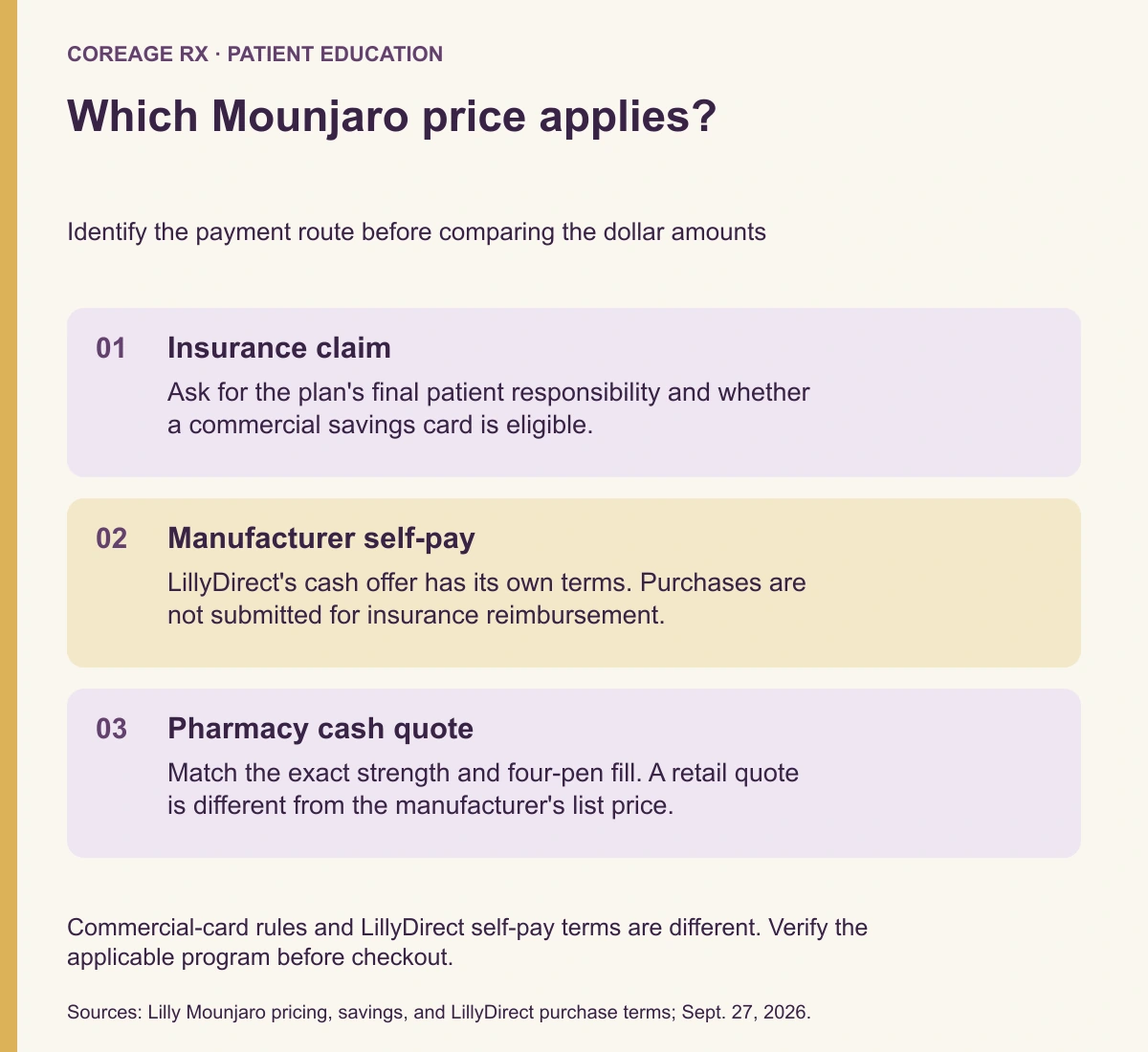
The pharmacy payment can differ because of insurance, pharmacy charges, discounts, or other assistance. Therefore, the list price should not be presented as the exact amount every uninsured person pays. It is a reference point for understanding the market, not the final answer to your purchasing question.
Request a quote for the actual brand, strength, presentation, and quantity. Ask whether it uses insurance or a particular cash program. If you compare multiple pharmacies, keep those details identical and record when the quote was obtained.
The separate LillyDirect self-pay option
LillyDirect currently displays Mounjaro single-dose prefilled pens at a starting self-pay price of $499 per month across the six displayed strengths, from 2.5 mg through 15 mg per 0.5 mL. Its purchase terms define one fill as four pens. See the current product page.
The self-pay terms require a prescription for an FDA-approved use, personal use of the medicine, residence in the United States or Puerto Rico, and age 18 or older. They prohibit seeking insurance or other third-party reimbursement for the purchase.
The terms also say the payment must not count toward an insurance deductible or out-of-pocket spending requirement. For Medicare Part D beneficiaries, it does not count toward true out-of-pocket costs. That condition matters when comparing a cash purchase with a covered prescription.
This program is separate from the commercial savings card. Do not assume that needing commercial insurance for one offer establishes the same requirement for the other. Confirm the current terms and the final pharmacy amount before arranging a fill.
If commercial insurance covers Mounjaro
Lilly’s current single-dose pen savings card advertises payment as low as $25 for a one-, two-, or three-month fill when the patient has commercial drug coverage for Mounjaro and meets the other requirements.
The offer has limits. The card’s maximum savings are $150 for a one-month fill, $300 for two months, or $450 for three months, with a separate annual maximum of $1,950. It can be used for up to 13 prescription fills per calendar year under the current terms. Savings end December 31, 2026, subject to the manufacturer’s right to change or end the program. Source: Mounjaro savings-card terms.
“As little as $25” is therefore not a universal copay. If the patient’s responsibility is larger than the amount the card can offset, the remaining payment may be higher. Ask the pharmacy to process the actual claim and explain the final amount rather than estimating from the advertised minimum.
If commercial insurance does not cover it
The same manufacturer page describes a different savings-card pathway for commercially insured patients whose plan does not cover Mounjaro. The current advertised amount is as low as $499 for a one-month fill of single-dose pens.
That offer requires commercial drug insurance even though the plan does not cover this medicine. Its maximum savings are $647 per month and $8,411 per calendar year, with up to 13 fills. The current end date is December 31, 2026. Other eligibility rules and restrictions still apply.
Do not describe this commercial-insurance offer as an unrestricted uninsured coupon. Compare it with the separate LillyDirect self-pay program on its own terms. Similar advertised amounts do not make the programs identical.

What if you have Medicare, Medicaid, or another government program?
The commercial Mounjaro savings card excludes people enrolled in the government-funded programs listed in its terms, including Medicare and Medicaid. That exclusion does not answer whether the person’s insurance plan covers Mounjaro for a qualifying medical indication.
Ask the plan about coverage, prior authorization, deductible, cost-sharing, and the required pharmacy. Mounjaro’s current label includes type 2 diabetes treatment in adults and children ages 10 and older and cardiovascular risk reduction in specified adults with type 2 diabetes. Coverage must be checked for the actual prescription and diagnosis.
The separate self-pay purchase offer addresses purchases made without reimbursement, including how Medicare Part D spending is treated. Read those conditions carefully before choosing cash payment. A lower immediate payment and progress toward an insurance spending limit are not necessarily the same financial outcome.
Mounjaro and Zepbound should not be mixed in a price table
Both medicines contain tirzepatide, but they have different approved uses and payment programs. A $299 Zepbound starting offer is not a Mounjaro price. Nor does a Mounjaro savings card automatically apply to Zepbound.
If the main goal is weight management, ask the clinician why a particular product is appropriate and how its indication relates to the proposed treatment. A shared active ingredient does not guarantee that an insurer will cover both brands for the same diagnosis. Our Zepbound versus Mounjaro comparison explains the distinction.
For a broader comparison of weight-management options, see tirzepatide versus semaglutide cost. The comparison should begin with medically suitable choices, not with a price that encourages a different diagnosis or an unnecessary prescription change.
What can GoodRx or another pharmacy quote tell you?
A pharmacy-discount listing can help you compare a specific cash transaction. It does not necessarily include every manufacturer pathway. GoodRx’s current Mounjaro page, for example, displays coupon estimates that differ from LillyDirect’s advertised self-pay starting amount.
Check the exact selected strength and carton quantity, pharmacy, and location. Confirm whether the quoted amount is still available when the prescription is ready. Our tirzepatide on GoodRx guide explains the difference between a drug-price listing, a manufacturer offer, and a paid clinical membership.
Do not assume several discounts can be combined. Lilly’s commercial card terms prohibit combining that card with other listed discount programs or coupons. Let the pharmacy identify the applicable pathway and final responsibility.
Include the cost of ongoing care
A medication quote may not include the initial assessment, follow-up visits, laboratory tests, supplies, or a separate service membership. Ask for an itemized comparison rather than treating an unspecified charge as zero.
Also compare supply intervals. Under the commercial-card terms, one month means 28 days and up to four single-dose pens; three months means 84 days and up to twelve pens. A calendar-month clinical membership can renew on a different schedule.
Ask how refills, dose changes, treatment interruptions, and cancellation are handled. An introductory amount should not determine your dose. The Mounjaro dosage guide explains why dose changes depend on the prescribed clinical plan rather than a promotion or package size.

Compounded tirzepatide is a separate comparison
Compounded tirzepatide is not FDA-approved Mounjaro and is not an FDA-approved generic equivalent. A clinic’s compounded-product quote should not be placed in a branded Mounjaro price table without clearly identifying the different preparation and care arrangement.
Review the dispensing pharmacy, concentration, ingredients, quantity, clinical rationale, and follow-up. FDA’s current GLP-1 concerns and our compounded medication guide explain why price alone cannot establish equivalence or suitability.
If you explore CoreAge Rx’s tirzepatide care information, ask which exact preparation is proposed and what the full recurring charges include. It is more useful to compare clearly described care plans than to treat every product containing tirzepatide as the same purchase.
How much does Mounjaro cost at Walmart?
There is no universal Walmart price established by the manufacturer information reviewed here. Ask the pharmacy to process the exact strength and quantity under your actual insurance, savings-card or cash pathway. LillyDirect separately advertises single-dose Mounjaro pens starting at $499 per month for self-pay, with a prescription required and terms, taxes or fees potentially applicable. That manufacturer pathway is not automatically your Walmart checkout price, and a commercial-insurance savings card is a different eligibility route. Compare actual processed quotes rather than assigning one amount to every pharmacy. Authentic Mounjaro® (tirzepatide) Shipped to You | LillyDirect®. Savings & Coverage | Mounjaro® (tirzepatide).
Questions to resolve before the first fill
Ask the pharmacy and care team which payment program is being used, what you will pay now, what the next fill is expected to cost, and whether any terms expire or depend on insurance status. Confirm that the prescribed product and quantity match the quote.
Then confirm how medication questions are handled after dispensing. Persistent digestive symptoms, a missed dose, or an interrupted supply need clinical or pharmacy advice. Our tirzepatide questions guide can help you prepare. Affordable care needs a sustainable payment plan and a clear route for ongoing support.
Educational information for adults; individual treatment decisions require a qualified clinician. Sources checked September 27, 2026. Original AI-generated article illustrations depict fictional people and objects, not patient outcomes. Other editorial images are illustrative. Graphics summarize the cited sources.