Mounjaro starts at 2.5 mg injected once weekly under the current U.S. label. If additional blood-glucose control is needed, the clinician can increase the dose in 2.5 mg steps after at least four weeks at the current dose. The maximum is 15 mg weekly for adults and 10 mg weekly for pediatric patients aged 10 and older.
This article summarizes the U.S. prescribing information revised August 2026, checked September 26, 2026. It explains the labeled options and device differences; it is not an individualized prescription or a syringe-units conversion guide. Source: Mounjaro prescribing information.
What Mounjaro is prescribed to treat
Mounjaro contains tirzepatide. The current label includes improving glycemic control with diet and exercise in adults and children aged 10 and older with type 2 diabetes. It also includes reducing major cardiovascular events in adults with type 2 diabetes who are at high risk for those events.
Mounjaro should not be described simply as the weight-management version of tirzepatide. Zepbound is a different branded product with its own approved indications and maintenance instructions. A shared ingredient does not make every part of the two labels interchangeable.
Our tirzepatide questions guide explains the broader treatment discussion. The separate Zepbound dosage chart is the relevant reference for that brand rather than copying Mounjaro instructions into a different prescription.
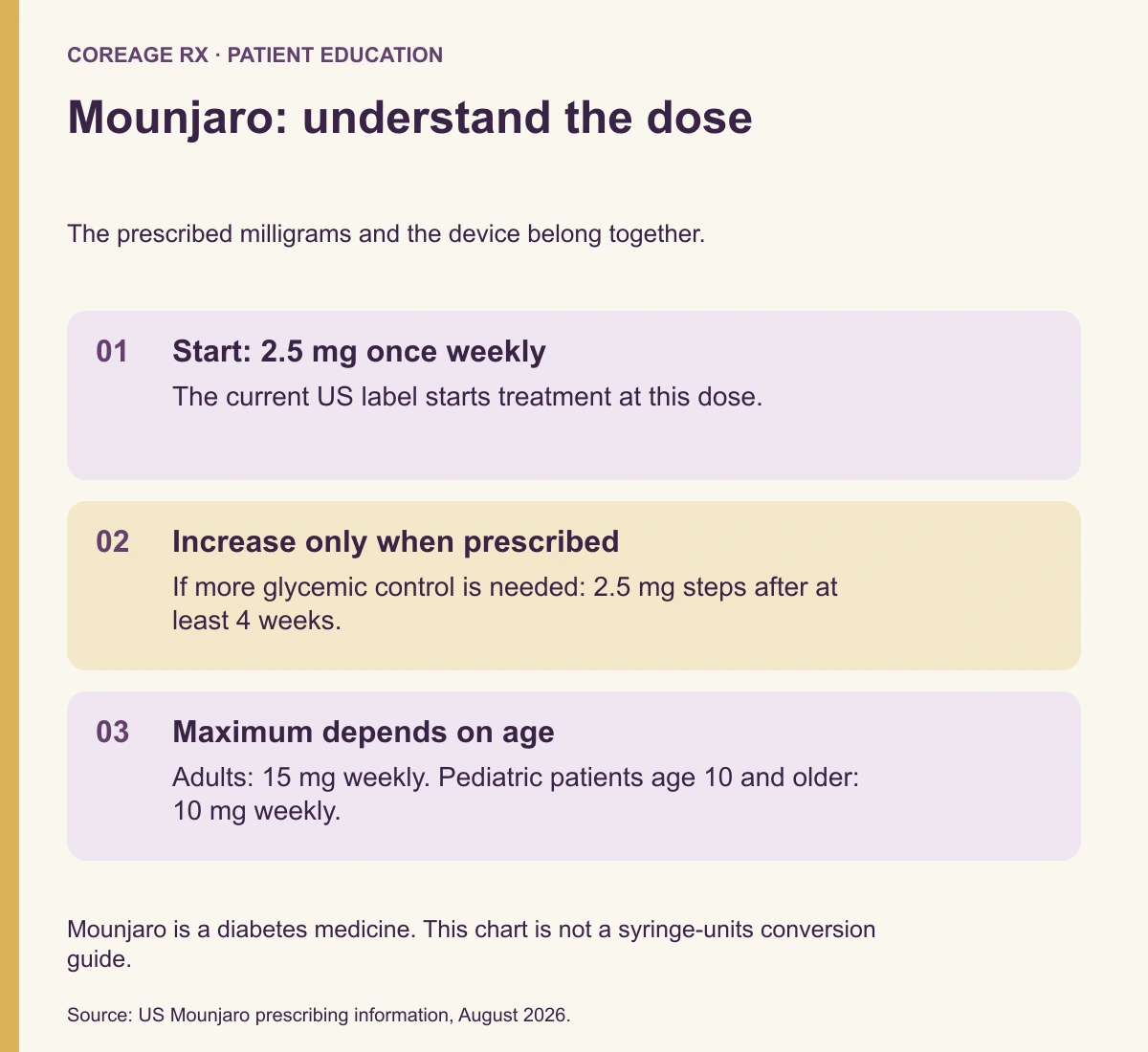
Mounjaro dose chart: available weekly strengths
The table shows available doses and their place in the current label. Higher rows are not an automatic schedule that every patient must complete.
| Weekly dose | Place in the labeled plan |
|---|---|
| 2.5 mg | Starting dose. |
| 5 mg | A possible increase after at least four weeks at 2.5 mg if additional glycemic control is needed. |
| 7.5 mg | A possible next increase after at least four weeks at the current dose, when clinically indicated. |
| 10 mg | An available dose and the maximum for pediatric patients aged 10 and older. |
| 12.5 mg | An adult dose option when further escalation is prescribed. |
| 15 mg | Maximum adult dose. |
For each increase, the current label requires at least four weeks at the current dose and a need for additional glycemic control. The August 2026 instructions should not be replaced with an assumption that everyone automatically moves to 5 mg after four weeks or continues upward every month.
A clinician may keep a patient at a dose that fits the treatment goal and tolerability. If your glucose readings, symptoms, or other medicines change, bring that information into the review before the next prescribing decision.
Why four weeks is a minimum between increases
The label uses gradual escalation to reduce gastrointestinal adverse reactions. “At least four weeks” describes a minimum time before a possible increase; it does not mean an increase becomes mandatory on that date.
The practical decision also depends on response and tolerability. A prescription should be reviewed if nausea, vomiting, reduced intake, or other symptoms make daily life difficult. Increasing despite troublesome symptoms is not a measure of commitment to treatment.
Do not independently combine devices, change the interval, or take extra medicine to reach another chart row. If the plan needs to change, the prescriber should specify the new dose and presentation. Our Mounjaro side-effects guide helps organize symptom questions.
Milligrams and milliliters answer different questions
Milligrams, or mg, describe the amount of tirzepatide. Milliliters, or mL, describe the volume of liquid. The concentration connects those measurements for a particular product. A volume from one presentation cannot be carried over to another without checking its exact labeling.
Under the current U.S. label, single-dose Mounjaro pens and single-dose vials use 0.5 mL per dose across the available strengths. Multidose vials and the single-patient-use KwikPen are different presentations, containing four doses with their own labeling and instructions.
| Presentation | What the label describes |
|---|---|
| Single-dose pen or single-dose vial | One dose in 0.5 mL; the amount of tirzepatide depends on the labeled strength. |
| Multidose vial | Four doses per vial; dose-volume and concentration information must be read from that specific product. |
| Single-patient-use KwikPen | Four prescribed doses per pen; use the matching pen instructions rather than measuring or extracting liquid. |
For example, the fact that a single-dose product uses 0.5 mL does not mean another vial should also be measured that way. The safest reference is the actual pharmacy label, prescription, and presentation-specific Instructions for Use together.
Why a generic “tirzepatide units” chart is inadequate
Syringe markings do not identify the ingredient amount by themselves. A chart that omits the product concentration, prescribed amount, and appropriate measuring device can cause confusion. Different compounded preparations introduce another layer of variation.
Mounjaro is an FDA-approved branded product. Compounded tirzepatide is not FDA-approved Mounjaro or an approved generic equivalent. FDA’s unapproved GLP-1 guidance describes dosing-error concerns with compounded preparations.
If a measurement instruction is unclear, pause and ask the dispensing pharmacist or prescriber to explain the exact prescription using the supplied device. Our compounded tirzepatide side-effects article explains why both the person’s symptoms and the preparation need review when an error is suspected.
What to do after a missed dose
The Mounjaro label provides a specific missed-dose window:
- If the dose was missed no more than four days, or 96 hours, ago, administer it as soon as possible.
- If more than four days have passed, skip that dose and take the next dose on the regular scheduled day.
- If the weekly administration day changes, leave at least three days, or 72 hours, between doses.
Do not double a dose to make up for a missed injection. If several doses have been missed, if you are uncertain about the last injection time, or if treatment stopped because of side effects, ask the prescriber for a restart plan.
A one-dose missed-dose rule does not answer every question about a longer treatment gap. Previously tolerating a higher dose is not a reason to assume that resuming it without review is appropriate after a break.

Administration and device training
Questions about partial doses or extra injection days need a separate review. Our Mounjaro dose-splitting guide distinguishes labeled four-dose presentations from improvised changes to the weekly regimen.
Mounjaro is injected under the skin once weekly, at any time of day, with or without meals. The label identifies the abdomen and thigh and allows another person to inject the back of the upper arm. Rotate sites with each dose.
The current label emphasizes training for the specific presentation. A person moving from a single-dose pen to a vial or KwikPen needs the instructions for the new device. It also says KwikPen self-administration is not recommended for pediatric patients or for people who are visually impaired.
Never share a Mounjaro KwikPen, even after changing the needle. Do not extract residual medicine or try to obtain extra doses from a device. If the delivered product looks unfamiliar, contact the pharmacist before using it.
Our guide to Mounjaro medication interactions covers insulin and sulfonylureas, oral-medicine absorption, narrow-therapeutic-index monitoring and the four-week oral-contraception precautions around initiation and escalation.
Insulin and other diabetes medicines need coordinated review
Using Mounjaro with insulin or a sulfonylurea can increase the risk of low blood glucose. The label notes that the risk may be reduced by adjusting those other medicines when clinically appropriate. Only the treating team should determine that adjustment.
Mounjaro and insulin should be administered separately and never mixed. The label permits the same body region, but the injections should not be adjacent. Ask for practical training that accounts for both products and their devices.
Bring glucose information and a complete medication list to follow-up. A dose increase should be considered within the whole diabetes plan, rather than as an isolated change to one weekly injection.
Birth control and pregnancy questions
Tirzepatide delays gastric emptying and can reduce the effectiveness of oral hormonal contraceptives. The Mounjaro label advises switching to a nonoral method or adding a barrier method for four weeks after initiation and for four weeks after every dose increase.
Discuss a suitable contraception plan with the prescribing clinician. This is particularly relevant when reviewing the next dose because each escalation creates another period covered by the label’s advice.
Tell the team about pregnancy or plans for pregnancy. The label warns of potential fetal harm based on animal studies, and diabetes treatment during pregnancy requires individualized care. Do not use a blog chart to manage the transition independently.
Safety concerns that can change the plan
Mounjaro has a boxed warning about thyroid C-cell tumors in rodents; whether it causes those tumors in humans is unknown. It is contraindicated with a personal or family history of medullary thyroid carcinoma, MEN2, or serious hypersensitivity to tirzepatide or its ingredients.
The label also warns about pancreatitis, severe gastrointestinal reactions, kidney injury related to volume depletion, gallbladder disease, and other risks. It is not recommended for people with severe gastroparesis. Tell the care team about retinopathy and planned surgery or procedures involving anesthesia or deep sedation.
Severe or persistent abdominal pain, repeated vomiting, or inability to keep fluids down needs prompt medical attention. Trouble breathing or swelling of the face or throat requires emergency help. A suspected dosing error also deserves immediate advice; do not wait for the next routine visit to report it.
For an illness-related prescription question, our guide to amoxicillin while taking Mounjaro reviews allergies, kidney function, oral medicines and gastrointestinal symptoms without inventing a universal dose-spacing or injection-hold rule.
Nutrition remains part of treatment
Lower appetite does not mean that food, fluids, and muscle-supporting care become unimportant. The joint GLP-1 nutrition advisory recommends assessment and nutritional support during therapy.
Tell the prescriber if symptoms or appetite changes prevent regular nourishment. Our tirzepatide protein and muscle guide discusses food intake and physical function. The goal is a tolerable plan that supports the medical treatment, rather than the lowest possible intake.

Frequently asked questions
Can you start Mounjaro at 7.5 mg?
The current Mounjaro label starts at 2.5 mg once weekly. Previous use of another medicine does not establish a universal conversion authorizing a 7.5 mg start, and a restart after an interruption needs its own review. Discuss the exact prior product, last dose, treatment gap, symptoms and clinical goal with the prescriber rather than choosing a higher starting strength from an online chart.
Is 15 mg the goal for everyone?
No. It is the adult maximum, not a universal target. Dose increases depend on the need for additional glycemic control and the prescribed plan. Pediatric patients have a lower maximum under the current label.
Does a higher milligram dose always mean a larger liquid volume?
No. The single-dose presentations use the same 0.5 mL volume across strengths because concentration differs. Other presentations have different labeling. Always identify the exact product and dose rather than using volume alone.
Can I use Zepbound instructions for Mounjaro?
Use the instructions for the prescribed brand and presentation. Although both contain tirzepatide, approved indications and maintenance guidance differ. The Zepbound guide covers that separate product.
What if my prescription does not match an older online chart?
Ask the clinician or pharmacist to reconcile the current prescription with the current U.S. label. Labels and available presentations can change, and a chart may also describe another country or formulation.
What should I ask a tirzepatide service?
If considering CoreAge Rx’s tirzepatide service, ask which preparation is provided, the dispensing pharmacy, the clinical rationale, and how administration is taught and monitored. Do not assume that any tirzepatide service supplies branded Mounjaro.
Keep dosing decisions tied to follow-up
The most useful chart is one understood alongside your diagnosis, prescription, device, response, and symptoms. Keep those details together and confirm changes with the prescribing team. That makes each refill a continuation of an appropriate care plan rather than an automatic move toward the maximum dose.
Educational information for adults; individual treatment decisions require a qualified clinician. Sources checked September 26, 2026. Original AI-generated article illustrations depict fictional people and objects, not patient outcomes. Other editorial images are illustrative. Graphics summarize the cited sources.