Prescription weight-loss care in New Jersey starts with an individual assessment, an appropriately authorized treating professional, and a clear explanation of the medicine and follow-up. A clinic’s name, a telehealth advertisement, or a low introductory price cannot establish that a particular treatment is right for you.
Coverage is a separate question. A medicine may be clinically appropriate yet require prior authorization or fall outside a plan’s benefit. This guide explains how to check the professional, prepare for a visit, compare costs, and understand New Jersey-specific resources without relying on a ranked list of clinics.
Identify the professional responsible for your care
Ask for the treating professional’s full name, profession, and New Jersey license information. A business registration or an online service’s brand name does not identify the person assessing you or establish that person’s authority to prescribe.
New Jersey’s Division of Consumer Affairs provides a real-time professional-license verification system. Use the appropriate profession and match the name and license details to the person who will actually treat you. If a record or professional role is unclear, ask the relevant licensing board or service to resolve it before relying on the appointment. New Jersey license verification.
The same question matters for a video visit. Tell the service your physical location at the time of care, including when you travel. Ask it to confirm the treating professional’s authorization for that location and the arrangement for any examination or testing that cannot be completed remotely.
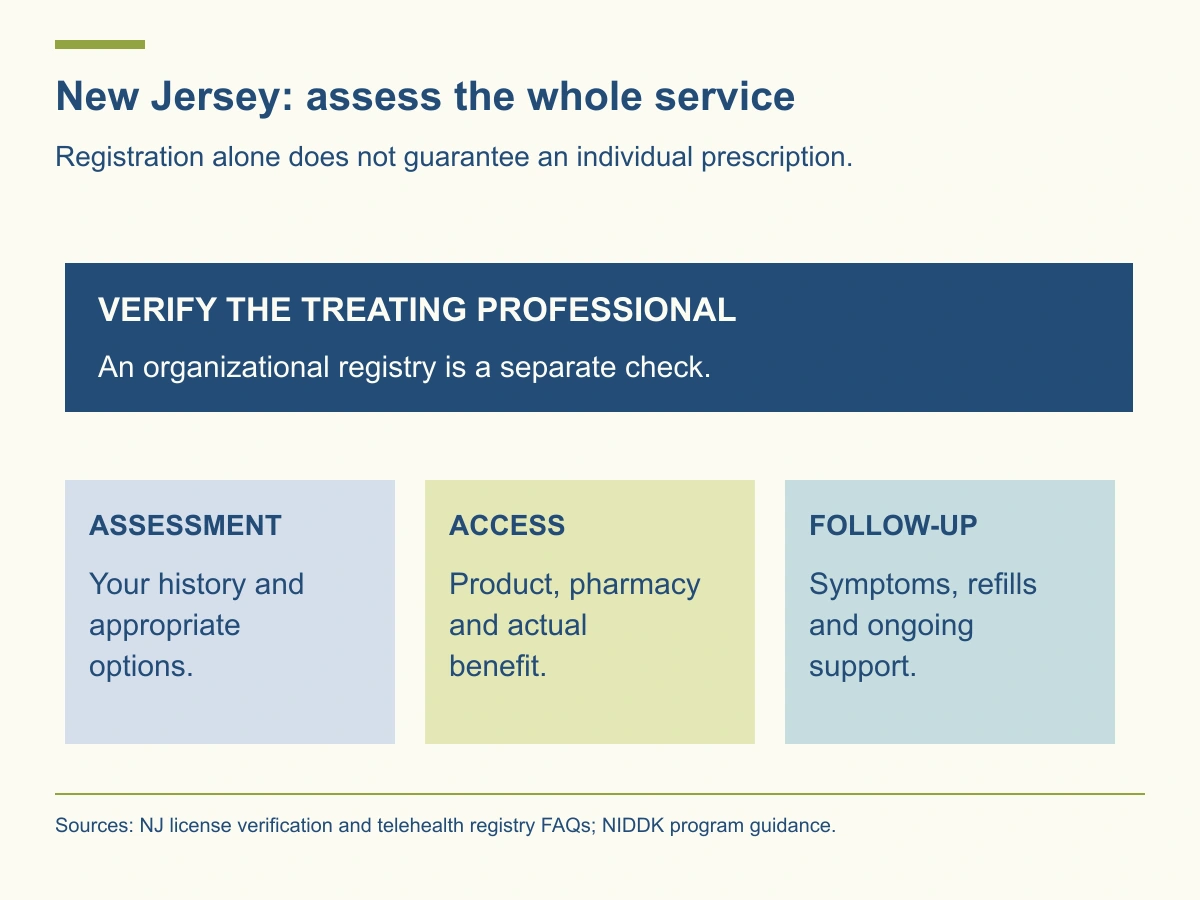
A telehealth organization listing is a different check
New Jersey’s Department of Health maintains a telemedicine and telehealth organization registry with definitions and exceptions. Its FAQ distinguishes certain organizations involved in telehealth technology from individual licensed professionals or practices using that technology to deliver care. New Jersey registry guidance.
That means a company’s registration and an individual’s professional license answer different questions. A registry entry should not replace checking the clinician, and the absence of a company from a particular registry should not be interpreted without considering the registry’s scope and exceptions.
For readers, the practical task is to identify who diagnoses and treats you, how that professional is authorized, and how you obtain follow-up. Our online prescription guide provides a broader checklist for remote services and dispensing pharmacies.
Prepare for an assessment, not a guaranteed prescription
Bring your current medicines and supplements, relevant diagnoses, prior weight-management treatments, and the reasons those treatments stopped. Discuss eating patterns, symptoms, pregnancy or pregnancy plans, and practical barriers such as cost, work schedules, and access to regular meals.
The clinician may consider weight-related health conditions, appropriate measurements, past responses, examination findings, and testing when indicated. A single questionnaire response cannot replace the complete evaluation. The same treatment can be suitable for one person and inappropriate for another.
Ask how nutrition, physical activity, symptoms, and functioning will be followed. NIDDK describes effective weight-management programs as individualized plans with ongoing support and strategies for maintaining results. A medicine should be part of an explainable care plan. NIDDK program guidance.
Keep the exact medicine and indication attached
Wegovy and Ozempic contain semaglutide, but their labeled indications and product instructions differ. Mounjaro and Zepbound contain tirzepatide, with their own indication distinctions. A diabetes prescription is not automatically an FDA-approved weight-loss prescription, and shared ingredients do not establish identical insurance benefits.
Wegovy’s current label includes weight-management uses in appropriate populations and other specified indications. Ozempic’s labeling addresses type 2 diabetes and specified cardiovascular or kidney outcomes. The exact formulation also matters, including whether treatment is an injection or a tablet. Wegovy label. Ozempic label.
Ask why the clinician is considering a particular product and what alternatives make sense. Our Wegovy prescription guide, Zepbound versus Mounjaro comparison, and semaglutide versus tirzepatide results article explain separate parts of that discussion.
Ask the insurer about your actual benefit
An insurer’s name alone is not enough to determine coverage. Employer plans, individual coverage, public programs, and different pharmacy benefits can have different rules. Ask about the exact prescription, formulation, indication, and current benefit year.
| Question for the plan | What to request |
|---|---|
| Is this product covered for this indication? | The applicable benefit and formulary information |
| Is prior authorization needed? | The current criteria and submission route |
| Are other treatments required first? | The relevant step-therapy rule, if any |
| Are there pharmacy or quantity limits? | In-network locations and permitted days’ supply |
| What will I pay? | Current deductible, copayment, or coinsurance information |
| How long does approval last? | Renewal requirements and review timing |
Keep the response date and reference number. If information from the insurer and pharmacy conflicts, ask which part of the claim differs. Our GLP-1 coverage guide explains why a prescription, prior authorization, and final payment are separate steps.

NJ FamilyCare needs a program-specific answer
New Jersey’s published analysis of weight-loss drug coverage for the SFY 2026 budget describes limited NJ FamilyCare coverage circumstances, including certain FDA-approved indications other than weight loss and some pediatric EPSDT circumstances. The document discusses potential broader coverage and cost projections; it should not be read as an individual authorization or a promise that an expansion has occurred. New Jersey coverage analysis.
For a current answer, contact the member-services team for your actual NJ FamilyCare arrangement and have the prescriber check the applicable product and authorization criteria. Ask whether the decision concerns the indication, the drug, or missing documentation.
Do not substitute the policy for a commercial insurance plan, another state, or another family member. A medicine associated with weight loss may be considered under a different eligible clinical indication, but the record must accurately reflect the condition being treated.
Medicare coverage has a separate current pathway
Medicare’s public information describes the temporary Medicare GLP-1 Bridge program, which began July 1, 2026. It lists certain products, including Wegovy, for eligible people with Part D coverage and specified clinical criteria, with a $50 monthly copayment. The Bridge is separate from regular Part D coverage for other eligible indications. Medicare coverage information.
This is not an automatic benefit for every person with Medicare. The product, clinical criteria, existing coverage, and authorization matter. Ask the clinician and Medicare which pathway applies to your circumstances, and verify the current rules before relying on an older article or advertisement.
Manufacturer commercial-insurance coupons are also separate from Medicare benefits and may exclude government beneficiaries. An advertised savings card should not be treated as proof of Medicare eligibility or payment.
Understand a denial before deciding what to do
Ask for the written reason for a denial and the relevant review or appeal instructions. A benefit exclusion, missing prior authorization, insufficient documentation, or a nonpreferred product can lead to different next steps. Ask the plan which information is needed and which deadlines apply to your case.
The prescribing office may be able to clarify the clinical record or discuss an appropriate alternative. It cannot guarantee that every appeal will succeed. Do not alter your reported diagnosis to fit a coverage rule or assume that changing clinics will remove a plan exclusion.
If continuing treatment becomes uncertain, contact the care team before the supply runs out. A prolonged interruption can require a separate clinical restarting decision; affordability should not be managed by changing the dosing schedule without guidance.
Compare the full cost of care
Request written details about the consultation, ongoing visits, membership charges, medication, testing, supplies, and delivery. Ask what is charged if no prescription is appropriate and what happens when you cancel or pause the service.
A pharmacy quote should identify the product, strength, presentation, quantity, days’ supply, and payment route. An introductory service price may not include medication, and an advertised medication amount may depend on eligibility or a temporary offer.
Our Wegovy cost guide and Mounjaro cost guide provide examples of the questions to ask. Those national resources do not verify stock or a checkout price at a New Jersey pharmacy.
If a service offers compounded treatment
Ask explicitly whether the proposed product is FDA-approved or compounded. FDA states that compounded drugs are not FDA-approved and are not reviewed for safety, effectiveness, and quality before marketing in the same way as approved medicines. They may serve patients whose medical needs cannot be met by an approved product. FDA GLP-1 guidance.
Identify the dispensing pharmacy and the preparation, concentration, instructions, and supplies. Do not transfer a branded pen tutorial or another vial’s measurement to a different preparation. The compounding-pharmacy guide and compounded tirzepatide comparison explain these questions.
For CoreAge Rx semaglutide or tirzepatide information, ask the team to confirm its assessment process, availability where you are located, exact preparation, and ongoing care. These links are starting points for a service discussion, not a guarantee of eligibility or prescribing.

Follow-up should be clear before you enroll
Ask how to report side effects, who reviews questions between visits, how prescriptions are renewed, and what happens if the clinician leaves or the service changes. Know how records can be sent to your regular healthcare team.
Discuss what to do if you cannot maintain food or fluids, develop severe persistent abdominal pain, or have another concerning symptom. A routine message queue should not be your only option for urgent care. The medicine’s own warnings and your clinician’s instructions remain important after the first appointment.
A useful care plan includes nutrition and function alongside the scale. Our calorie-intake guide explains why low appetite does not remove nutritional needs and why a number from an app is not a universal prescription.
Frequently asked questions
Is online care available to New Jersey patients?
Services may offer remote assessment, but you should verify the treating professional’s authorization for your physical location and the arrangements for necessary in-person services. A technology platform’s registration is not a substitute for a professional-license check.
Does paying a consultation fee guarantee medication?
No. Assessment may conclude that a different treatment or further evaluation is appropriate. Ask about fees, refunds, and ongoing charges before booking.
Does an insurance approval guarantee a low price?
No. Deductibles, coinsurance, quantity rules, pharmacy networks, and other benefit details can affect payment. Have the actual prescription processed for a usable quote.
What should I do first?
Identify the treating professional, gather your medical and medication history, and ask for the written care and cost arrangements. Then check the exact proposed medicine with the insurer and pharmacy. Each step answers a different part of access.
Educational information for adults; individual treatment decisions require a qualified clinician. Sources reviewed October 5, 2026. Original AI-generated article images depict fictional people and objects, not patient outcomes. Other editorial images are illustrative. Graphics summarize the cited sources.