Bay leaf and cinnamon tea is not an established weight-loss treatment. Its safety depends on the actual ingredients, preparation, amount, frequency, and your health and medicines. Cinnamon can cause gastrointestinal problems or allergic reactions, and prolonged use of some cassia-cinnamon products raises additional concerns for people sensitive to coumarin, particularly those with liver disease.
The familiar kitchen ingredients do not make every concentrated drink, supplement, or “detox” recipe equivalent to ordinary culinary use. This guide explains the evidence, the side-effect questions, and how to distinguish a flavored beverage from a medical claim.
What is in the tea?
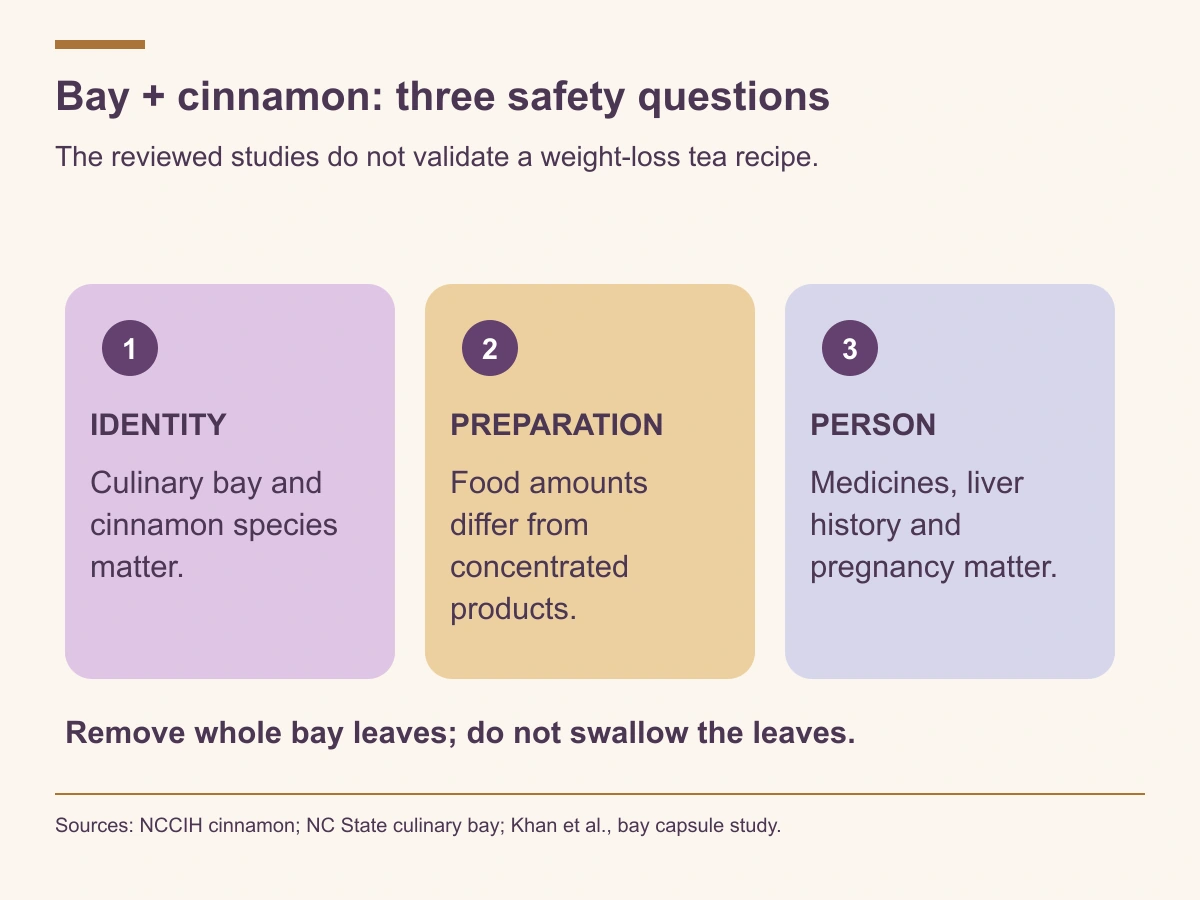
Start with the ingredients rather than the name of a recipe. Culinary bay is commonly Laurus nobilis. Cinnamon comes from several Cinnamomum species, including cassia and Ceylon cinnamon. Products may not clearly identify the species or plant part, which complicates comparison with research. NCCIH cinnamon review.
A homemade infusion, a prepared tea bag, a powdered spice swallowed in a drink, and a concentrated supplement are different exposures. A commercial blend may also contain caffeinated tea, sweeteners, laxative ingredients, or other herbs. Read the full label instead of assuming that the two ingredients on the front are the only ones present.
Use food products from a reliable source. Do not identify a garden plant as safe to drink merely because its common name contains “bay” or “laurel.” A plant-identification concern requires reliable identification, not comparison with an attractive recipe photograph.
What side effects can cinnamon cause?
NCCIH describes cinnamon as likely safe in amounts ordinarily used as a food spice or flavoring. Larger amounts or longer use can be associated with adverse effects, commonly gastrointestinal problems or allergic reactions. The source also warns against swallowing dry cinnamon powder as an internet challenge because serious harm is possible.
If a beverage repeatedly causes stomach discomfort, mouth irritation, rash, or other symptoms, do not assume that discomfort is evidence of detoxification. Stop the product and seek advice appropriate to the symptoms. Trouble breathing, swelling of the mouth or throat, or collapse requires emergency assistance.
A general article cannot identify which ingredient caused a reaction. Keep the product label, preparation details, and timing available. If the mixture contained several herbs, evaluating cinnamon alone will not answer the whole question.
Cassia, Ceylon, and coumarin
Cassia cinnamon can contain coumarin, and the amount can vary between products. NCCIH notes that ordinary use does not usually provide enough to cause significant problems, but some cassia products have high levels. Prolonged use can be an issue for sensitive people, including those with liver disease. Ceylon cinnamon may contain only trace amounts. Cinnamon safety guidance.
That distinction does not create a guaranteed safe medicinal dose of Ceylon cinnamon, nor does it validate unlimited tea consumption. Product identification, frequency, and other exposures still matter. A package that simply says “cinnamon” may not answer the species question.
If you have liver disease or use medication that needs liver monitoring, discuss a regular concentrated cinnamon routine with the clinician. Do not try to calculate a personal coumarin exposure from an unverified recipe or a generic internet average.
Remove whole bay leaves from the drink
North Carolina State University’s extension plant reference describes Laurus nobilis leaves as a culinary flavoring but warns against eating whole leaves because their sharp, tough structure can create choking or injury concerns. Its entry also notes that large ingestion of whole leaves can cause obstruction. NC State Extension bay reference.
Use appropriate food handling and remove whole leaves before consuming the prepared drink or food. Do not treat swallowing the leaves as a way to make a tea stronger or more effective. The amount used in a research capsule is not a home-preparation instruction.
This is separate from the question of whether an herb has a clinical benefit. An ingredient can have a long culinary history while still requiring sensible preparation, and concentrated or unusual uses need their own safety assessment.
What did the bay-leaf study measure?
A small study assigned 40 adults with type 2 diabetes to four groups. Participants received ground bay-leaf capsules or placebo for 30 days, followed by a washout period. They continued their usual diabetes medicines and routines. Researchers measured fasting glucose and blood lipids. Bay-leaf study.
The reported changes were in those laboratory outcomes. The study did not test a bay-leaf-and-cinnamon tea as a weight-loss intervention, and it did not establish that an ordinary homemade cup produces the same exposure as capsules. Small groups and a short duration also limit what can be inferred about sustained benefits and safety.
Keep these differences attached to any claim you read. “Bay leaves were studied in people with diabetes” is not the same statement as “this mixed tea causes body-fat loss.” The latter would require relevant evidence for the mixture and outcome.

Does cinnamon research prove the combination works?
No. NCCIH states that research does not clearly support cinnamon for a health condition and that its usefulness for diabetes or weight loss remains unclear. Interpretation is complicated by differences in species, plant parts, and study methods.
Even a positive study of one ingredient would not automatically establish the effect of combining it with another ingredient in a different preparation. The recipe’s strength, frequency, population, and measured outcome would still need evaluation.
| Evidence or claim | Question to ask |
|---|---|
| A capsule study in adults with diabetes | Was the tea itself tested, and was weight measured? |
| A blood-glucose change | Does the study establish a body-fat outcome? |
| A cinnamon supplement result | Which species, amount, and preparation were used? |
| A combined-drink testimonial | What else changed, and was there a comparison group? |
| A lower scale reading after diarrhea | Could fluid loss explain the change? |
Our cloves evidence article and water weight versus fat loss guide explain why laboratory findings and rapid scale changes need careful interpretation.
What if you take diabetes medication?
Bring the actual product or recipe to your diabetes team. The bay-leaf study involved people continuing medication, but it was not a broad interaction study that clears every combination. You should not reduce, skip, or replace prescribed diabetes treatment because you started a tea.
If a product changes your eating pattern, causes vomiting or diarrhea, or makes it difficult to maintain fluids, the clinical situation needs review. People who use insulin or certain diabetes medicines may need an individualized glucose and illness plan. Do not assume that feeling shaky or unwell is an expected cleansing reaction.
The Mounjaro low-blood-sugar guide addresses medication-related glucose questions separately. A supplement claim about glucose control should not be used to improvise changes to that regimen.
Pregnancy, breastfeeding, and concentrated products
NCCIH distinguishes cinnamon in ordinary food amounts from larger medicinal amounts. It notes that larger amounts of Ceylon cinnamon during pregnancy are considered unsafe and that little is known about larger amounts while breastfeeding. A tea’s name alone does not establish how its concentration compares with culinary exposure.
Discuss a regular herbal regimen with the relevant clinician if you are pregnant, breastfeeding, trying to conceive, or managing a significant health condition. Do not infer safety from the absence of a warning on a recipe website.
Essential oils, concentrated extracts, and capsules should not be substituted for a beverage. Their use cannot be derived from the number of leaves or sticks in a tea recipe. NCCIH’s supplement guidance explains why natural origin does not establish compatibility or clinical benefit.
Could an unsweetened beverage still be useful?
An ordinary unsweetened beverage may fit your preferences or replace a drink containing added sugar. That possible role depends on the complete eating pattern and the beverage being replaced, not a demonstrated special action of bay leaves and cinnamon on body fat.
Consider the actual serving size, additions such as honey or syrup, and how often you drink it. If you enjoy a flavored beverage, there is no need to give it a weight-loss promise to justify the preference.
Our sweet tea versus soda comparison explains serving-size questions. The peppermint and green-tea guide discusses caffeine and preparation differences that may be more practical than a claim about boosting metabolism.

Avoid turning a tea into a restriction routine
Tea is not a replacement for regular nourishment or a treatment for persistent digestive symptoms. If you are deliberately using a drink to suppress hunger, provoke diarrhea, or offset a meal, review that pattern with a qualified clinician or dietitian.
The calorie-intake article discusses a sustainable eating plan and signs that a target needs reassessment. The Pinalim tea article explains why a laxative effect does not establish fat loss; adding another herbal product does not change that distinction.
If you want to explore medical weight management, CoreAge Rx tirzepatide information can support an assessment conversation. Ask about the exact preparation and follow-up. Compounded drugs are not FDA-approved and should not be represented as inheriting a branded product’s approval or results. FDA guidance.
Frequently asked questions
How many cups should I drink for weight loss?
The reviewed evidence does not establish a weight-loss dose for this mixture. A capsule study or a cinnamon supplement trial cannot be converted into a validated number of homemade cups.
Is Ceylon cinnamon always safe?
Ceylon generally raises a different coumarin question from cassia, but lower coumarin does not mean unlimited use or guaranteed compatibility with every medicine. Amount, formulation, health history, and pregnancy or breastfeeding still matter.
Is diarrhea a sign the drink is working?
No. Diarrhea does not demonstrate body-fat loss and can contribute to dehydration. Persistent or severe symptoms require assessment rather than a stronger recipe.
Does drinking it before bed burn belly fat?
There is no established bedtime or belly-fat advantage for the combination. Focus on the actual ingredients, tolerance, and overall routine rather than an unsupported timing claim.
What should I ask before regular use?
Confirm the ingredient identities and preparation, then discuss medicines, liver health, pregnancy or breastfeeding, and any symptoms with the appropriate professional. Treat the product as something to evaluate, not a required addition to weight-management care.
Educational information for adults; individual treatment decisions require a qualified clinician. Sources reviewed October 5, 2026. Original AI-generated article images depict fictional people and objects, not patient outcomes. Other editorial images are illustrative. Graphics summarize the cited sources.