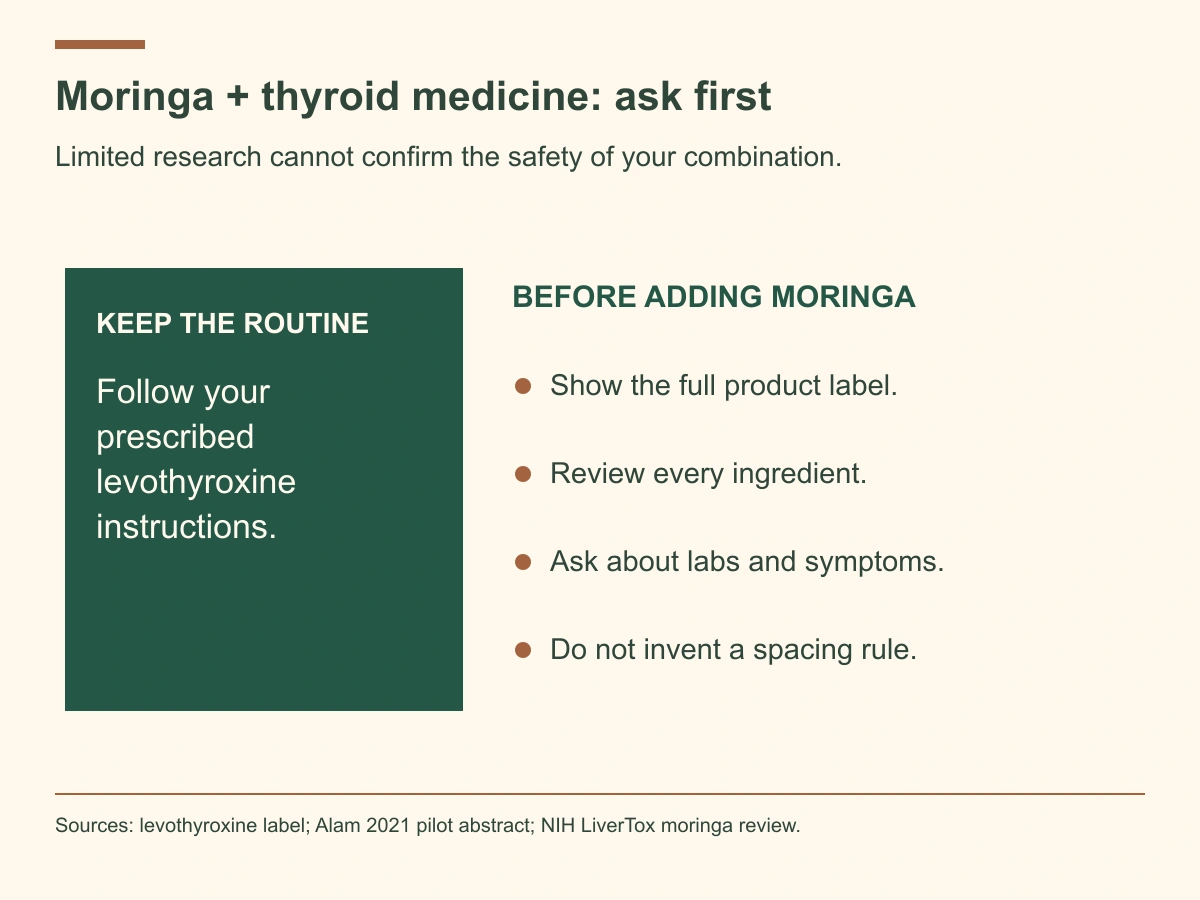
If you take thyroid medication, ask your pharmacist or prescriber to review the exact moringa product before adding it. The available human evidence does not establish that moringa and levothyroxine are a reliably safe combination, a useful thyroid treatment, or a substitute for prescribed hormone replacement. It also does not provide a validated moringa-specific spacing rule.
The answer depends on more than the plant’s name. Leaves used as food, powdered supplements, extracts, and multi-ingredient “thyroid support” products can have different compositions. This guide explains what the small thyroid study actually found, what levothyroxine instructions do establish, and what information makes a medication review useful.
First identify your thyroid medicine
“Thyroid medication” can mean replacement hormone for an underactive thyroid or a medicine used for an overactive thyroid, among other treatments. Advice about levothyroxine should not be transferred automatically to every thyroid prescription.
For levothyroxine, the goal is to replace the hormone your body needs and monitor the response appropriately. The reviewed tablet label emphasizes individual dosing and monitoring using clinical status and thyroid laboratory tests. It also contains a boxed warning against using thyroid hormone to treat obesity or produce weight loss. Levothyroxine tablet label.
Bring the medicine name, formulation, dose, and usual administration routine to the discussion. Include why you take it, any thyroid surgery, and the clinician managing follow-up. Our Ozempic after thyroid-removal guide addresses a separate question and explains why the reason for thyroid surgery matters.
What is in the moringa product?
Moringa oleifera is a tree whose parts are used in foods and traditional preparations. Commercial products may use leaf powder, extracts, or other plant material, and may combine moringa with additional ingredients. NIH’s LiverTox review describes considerable variation in marketed preparations and notes that proposed medical benefits have not been convincingly established in human clinical studies. LiverTox moringa review.
Photograph or bring the entire label, including the ingredient list, serving size, manufacturer, lot number, and any directions. A name on the front cannot tell the pharmacist whether a product also contains iron, calcium, iodine, another herb, or ingredients that require a separate review.
A teaspoon from a kitchen container is not automatically equivalent to a capsule or research preparation. Do not convert between them based solely on the total weight printed on a label. Nor does a “natural” label establish purity, appropriate dosing, or compatibility with medication.
What did the human hypothyroidism study show?
A pilot report published in 2021 described an open observational study of a moringa-leaf decoction in people with primary hypothyroidism. Ten participants enrolled and eight completed 45 days. The abstract reports changes in TSH, T3, and T4 compared with measurements before treatment, without a randomized comparison group. Alam and colleagues’ abstract.
This is a very small, short study. A before-and-after change cannot by itself establish that moringa caused the change, that the effect is dependable, or that long-term use is safe. The abstract does not provide a controlled levothyroxine interaction study or validate a routine for combining the two products.
The authors’ preliminary conclusion should therefore be read alongside the design’s limits. It is not a reason to stop hormone replacement, reduce a prescription, or copy the study preparation at home. The absence of significant changes in the reported safety laboratory measures in eight completers is not proof that adverse effects cannot occur.
Animal research does not settle the combination question
Some online discussions cite laboratory or animal findings about moringa and thyroid hormones. Such research may help generate hypotheses, but it does not identify the appropriate effect, amount, or safety profile in a person taking prescribed thyroid medication.
A proposed biological mechanism also cannot establish a practical instruction such as “take it four hours later” or “it improves absorption.” Those claims would need relevant evidence for the preparation, medicine, and outcome involved.
A useful source should make clear whether it studied people, whether they used the same medication, and whether the outcome was a clinical benefit or merely a laboratory measurement. The clove evidence article provides another example of how a narrowly defined study can be overstated when its measured outcome is omitted.
What levothyroxine instructions do establish
The reviewed levothyroxine tablet label directs a single daily dose on an empty stomach, one-half to one hour before breakfast, with water. It also describes separation from known absorption-interfering agents and specifically addresses iron, calcium, and certain other medicines. Follow the instructions for your own formulation and your prescriber’s plan. Administration and interaction sections.
These established instructions should not be renamed a proven moringa rule. If a moringa blend contains an ingredient known to interfere with levothyroxine, that ingredient needs attention. If it does not, the absence of that ingredient still does not prove that the herbal product has no relevant effect.
Ask the pharmacist to review the complete routine: medicine, food, supplements, other prescriptions, and timing. A plan should preserve consistency and make clear whether any change requires follow-up laboratory assessment. Do not independently change levothyroxine because you started a supplement.

What to bring to the review
| Information | Why it helps |
|---|---|
| Exact thyroid medicine and formulation | Different treatments have different instructions |
| Your usual medicine and breakfast routine | Changes can complicate interpretation of thyroid tests |
| Full moringa product label | Other ingredients may matter more than the product name |
| Other prescriptions and supplements | The complete regimen needs review |
| Recent thyroid results and symptoms | The clinician needs the trend and clinical context |
| Pregnancy, plans to conceive, or major health changes | Treatment needs and monitoring may change |
Include the start date if you have already taken moringa. Describe how much you actually used and whether anything else changed around the same time. That information helps the clinician evaluate the sequence without assuming that the supplement caused every symptom or laboratory change.
What about liver safety?
LiverTox describes moringa as generally well tolerated in small clinical studies but a possible rare cause of clinically apparent liver injury. Its review includes a published case report with recurrence after re-exposure. A rare report is a reason to recognize uncertainty, not a basis for claiming that ordinary food use routinely damages the liver.
The patient described in that report also used other medicines, including levothyroxine. That does not establish that levothyroxine and moringa form a specific toxic interaction. Case reports require careful interpretation, particularly when several exposures and health conditions are involved.
Tell the clinician about liver disease or unexplained symptoms before using a supplement. If you develop jaundice, dark urine, persistent nausea, or other concerning symptoms after starting a product, seek medical advice and provide the product details. Do not deliberately restart a suspected product to test whether symptoms recur.
What if you also use a GLP-1 medicine?
Add that medicine to the same review rather than treating each combination as an isolated question. Exact products and routes matter. Oral medication timing, digestive symptoms, glucose monitoring, and the ability to maintain food and fluids may all affect the discussion.
If you are considering a weight-management service, tell the clinician about thyroid disease and hormone replacement before treatment decisions are made. Do not assume that every thyroid disorder is the same as the specific medullary-thyroid-carcinoma or MEN2 warnings in some GLP-1 labels. Conversely, do not use a supplement to work around a contraindication.
Our Mounjaro medication-interaction guide and oral semaglutide comparison explain why the actual prescription and route must remain attached to advice. A general article cannot clear an individual combination.
Weight concerns deserve a separate plan
Fatigue, weight change, and appetite concerns should be discussed in context rather than treated as proof that you need more thyroid hormone or a herbal “metabolism booster.” Appropriate thyroid replacement and intentional weight management are different treatment questions.
The calorie-intake guide explains individualized nutrition planning, while the semaglutide plateau guide discusses treatment review without automatically escalating restriction or medication. Neither requires a moringa supplement.
For CoreAge Rx semaglutide information, ask how the team reviews medical history, existing prescriptions, the exact compounded preparation, and follow-up. FDA-approved branded medicines and compounded preparations are distinct; compounded drugs are not FDA-approved. FDA guidance.

Why supplement quality claims need care
NCCIH notes that dietary supplements are not FDA-approved for safety and effectiveness before sale in the way drugs are. A manufacturer’s quality statement, an online testimonial, or a laboratory-themed package is not evidence that a product treats hypothyroidism or is compatible with your prescription. NCCIH supplement guidance.
Ask what testing a company actually performed and what it measures. Testing for identity or contamination does not by itself establish clinical benefit or rule out interactions. Avoid products that suggest replacing prescribed treatment without an appropriate clinical evaluation.
If you choose not to use a supplement while the question is reviewed, you have not missed an established thyroid therapy. The current evidence does not make moringa an essential part of thyroid treatment.
Frequently asked questions
Can I take moringa four hours after levothyroxine?
There is no validated moringa-specific four-hour rule in the reviewed evidence. Levothyroxine’s separation instructions apply to particular known interfering agents. A pharmacist should assess the actual supplement and complete routine before advising on use or timing.
Does the small study prove moringa treats hypothyroidism?
No. It was an open observational pilot with eight completers and no randomized comparison. It provides preliminary findings, not a replacement for established treatment or a controlled interaction study.
Is eating moringa the same as taking an extract?
No. Preparation, amount, plant part, and other ingredients can differ. Describe the actual use to the clinician rather than assuming findings from one form apply to another.
Should I stop my thyroid prescription to try it?
Do not stop or alter prescribed thyroid treatment on the basis of a supplement claim. Discuss symptoms, test results, and any proposed changes with the clinician responsible for your thyroid care.
Educational information for adults; individual treatment decisions require a qualified clinician. Sources reviewed October 5, 2026. Original AI-generated article images depict fictional people and objects, not patient outcomes. Other editorial images are illustrative. Graphics summarize the cited sources.