Spearmint tea is not an established weight-loss treatment, and there is no proven time of day or number of cups that makes it burn body fat. The small human trial often used to promote it studied hormone levels and hirsutism (unwanted coarse hair growth) in women with polycystic ovary syndrome, or PCOS. Those findings do not demonstrate that the tea causes meaningful weight loss.
An unsweetened cup may still be an enjoyable beverage. The useful questions are what is in the product, what it replaces, how it fits your health and medicines, and whether a marketing claim matches the study it cites. This guide separates those questions from promises about metabolism or “hormone balancing.”
What is spearmint tea?
Spearmint tea is an infusion made from spearmint leaves. A product may contain only spearmint or combine it with other herbs, green or black tea, flavors, sweeteners, or supplement ingredients. The front of the box is a starting point; the ingredient list identifies what you are actually drinking.
Do not treat spearmint, peppermint, and every product called mint tea as the same research intervention. They may differ in species and formulation. A study of a particular tea cannot validate an essential oil, concentrated capsule, or a blend with additional active ingredients.
Our peppermint and green-tea comparison explains similar distinctions between a beverage, an extract, and a clinical claim. Those distinctions are especially important when a familiar food name appears on a supplement bottle.
What did the PCOS trial actually measure?
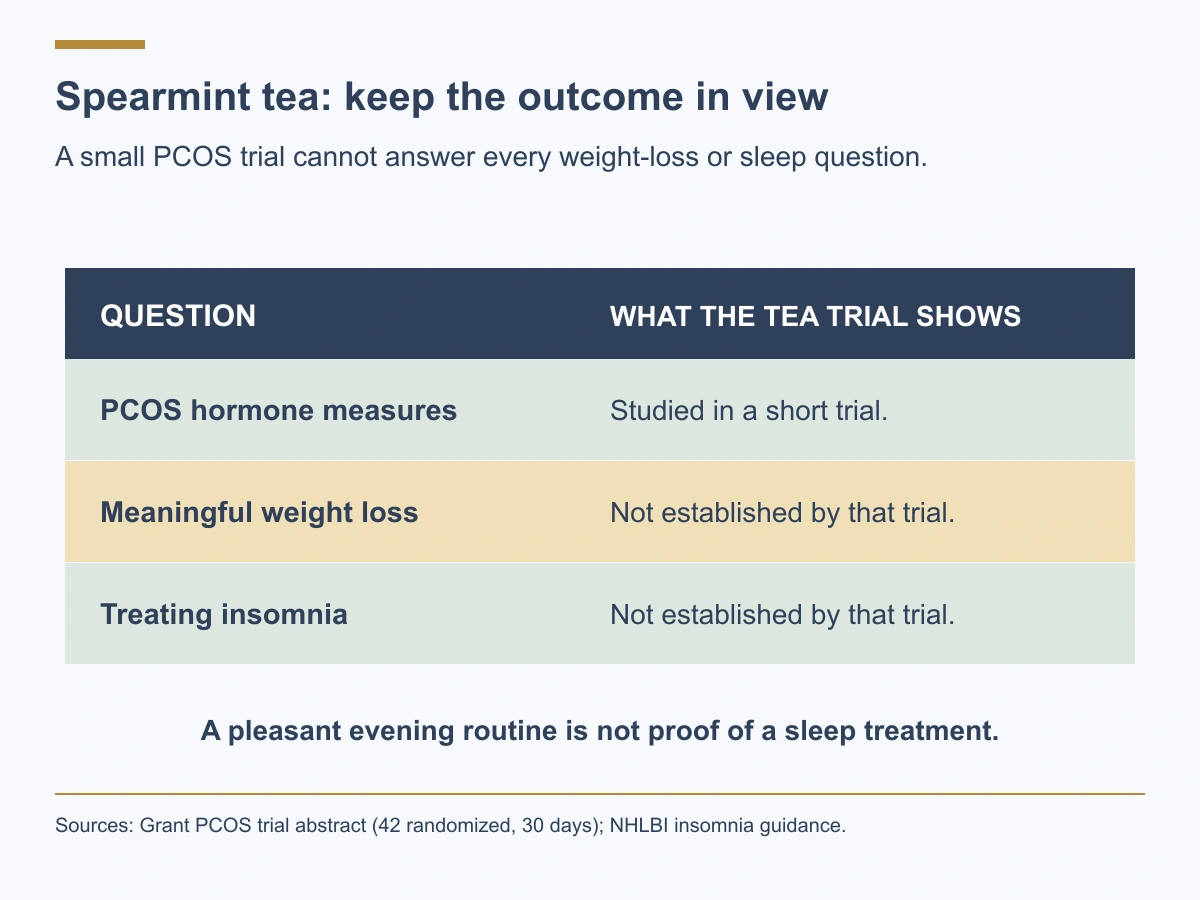
A randomized trial published in 2010 enrolled 42 volunteers and compared spearmint tea twice daily with a placebo herbal tea over 30 days. Forty-one participants completed the study. Researchers measured hormone levels, participants’ own assessments of hirsutism, and an objective clinical hair-growth score. Grant trial abstract.
The abstract reports reductions in free and total testosterone in the spearmint group and improvement in self-reported hirsutism. However, the objective hair-growth score did not show a statistically significant difference between groups over the study period. The authors discussed the short duration as a limitation.
The reported outcomes were not proof of fat loss, a validated PCOS treatment program, or a demonstrated long-term benefit. A study can offer a reason for further research without providing a dependable result for every person who buys a similar tea.
Why a hormone result is not a weight-loss result
A laboratory measurement and a clinical outcome answer different questions. Even when a hormone changes, the study still needs to measure whether a treatment produces a meaningful effect on the outcome being claimed, in the relevant population, for a sufficient period.
The trial’s participants, duration, and preparation also matter. Findings in a selected group of women with PCOS and hirsutism do not automatically apply to men, people without PCOS, pregnancy, or long-term use. They do not establish that lowering testosterone is appropriate for everyone.
| What was studied or reported | What it does not establish |
|---|---|
| A 30-day tea intervention | A long-term treatment plan |
| Hormone measurements in a selected population | A universal “hormone balance” effect |
| Self-reported hirsutism improvement | A confirmed objective hair-growth benefit in that trial |
| A specific study preparation and schedule | A validated fat-loss dose for commercial products |
When an advertisement moves from “a study found a hormone change” to “this melts belly fat,” it has changed the outcome. The original study should remain attached to what it actually measured.
Does spearmint tea help with sleep?
The spearmint PCOS trial discussed above does not establish that the tea treats insomnia. Its measured outcomes were hormones and hirsutism, not a validated sleep-treatment benefit. The reviewed evidence therefore does not support a proven number of cups, bedtime dose, or predictable improvement in sleep from spearmint tea. Grant trial abstract.
A warm drink may feel pleasant as part of a quiet evening routine. That personal experience can be worthwhile without proving that the herb has a medicine-like sedative effect. The routine, time away from screens, usual caffeine intake and many other factors could influence how the evening feels.
NHLBI recommends a consistent sleep schedule and a relaxing wind-down routine among healthy sleep habits. It also advises avoiding caffeine, nicotine and alcohol near bedtime. Those recommendations support the routine itself; they do not identify spearmint as an established insomnia treatment. NHLBI insomnia guidance.
Could a mint-tea blend keep you awake instead?
Check the full ingredient list. Plain spearmint and a blend containing green or black tea are different products. A mint flavor does not tell you whether caffeine is present, and a front label such as “nighttime” does not explain every ingredient.
If you notice poorer sleep after a new drink, record the product, serving size, time and what else you consumed. Consider caffeine across the whole day rather than evaluating only the final cup. Our decaf-tea guide explains why decaffeinated and caffeine-free should not be treated as synonyms.
Large amounts of fluid immediately before bed can also interrupt sleep with bathroom trips. NHLBI suggests limiting drinks close to bedtime when that is an issue. More cups are not necessarily a better evening routine, and the advice does not mean restricting hydration throughout the day. NHLBI healthy sleep habits.
When should you seek help for ongoing sleep problems?
If difficulty sleeping keeps recurring or affects daytime function, discuss it with a healthcare professional. Explain whether the problem is falling asleep, waking repeatedly, waking too early, or feeling unrefreshed despite time in bed. Include medicines, supplements, alcohol, caffeine, work hours and other symptoms.
NHLBI describes cognitive behavioral therapy for insomnia, or CBT-I, as the usual first treatment option for long-term insomnia. It is a structured treatment that addresses habits and thoughts affecting sleep, and can be delivered in person, by telephone or online. It is more specific than simply being told to relax. NHLBI treatment guidance.
Do not use a tea routine to postpone assessment of troublesome symptoms or add multiple sleep supplements because one beverage has not helped. Our sleep and weight-management guide discusses why rest belongs in the broader health picture. The HRT and sleep article addresses a different question when menopausal hot flashes disrupt sleep; it does not mean every sleep complaint requires hormone treatment.
Is a concentrated spearmint supplement equivalent to tea?
No. A capsule, extract or essential oil can differ substantially from a brewed beverage. A trial using tea does not supply a safe amount for a concentrated product, and adding other sleep ingredients creates additional questions about effects and interactions.
Bring the actual package to a pharmacist or clinician if you take prescription medicines or are considering a supplement for sleep. NCCIH recommends discussing dietary supplements with healthcare professionals and evaluating evidence for the specific product and purpose. NCCIH supplement guidance.
The practical conclusion is modest: enjoy a suitable beverage if you like it, check the blend and timing, and keep persistent sleep problems within appropriate care. The PCOS findings should remain attached to the outcomes they actually measured.
Does drinking it morning or night make a difference?
The reviewed trial does not establish a superior time of day for losing weight. Its twice-daily research schedule should not be turned into a personal prescription for fat loss, and there is no reason to add cups solely to imitate a promotional routine.
Choose an ordinary beverage time that fits your preferences and tolerance. If a blend contains caffeinated tea, consider whether it affects sleep, anxiety, or palpitations. If it contains a medicine-like ingredient or you take time-sensitive oral medication, discuss the actual product and schedule with the pharmacist.
The decaf-tea guide explains why decaffeinated and caffeine-free are different terms. Read the blend’s label rather than assuming that a mint flavor tells you its caffeine content.
Could replacing another drink help?
Replacing a regularly consumed sugar-sweetened drink with an unsweetened beverage can change the amount of sugar and energy in the eating pattern. That is a substitution question. It does not demonstrate a special fat-burning property of spearmint.
Compare like with like. A plain cup, a large sweetened café drink, and a bottled mint beverage can have very different ingredients and serving sizes. Honey and syrups also contribute to the finished drink, even when the base tea is unsweetened.
A useful first step is to identify one drink you actually buy or prepare, then look at its amount, added ingredients, and frequency. Our sweet tea versus soda article shows how portion size changes a comparison. No individual beverage swap guarantees a particular amount of weight loss.
Tea should not become a way to avoid meals
A warm drink may be part of a pleasant routine, but it does not provide the same nourishment as a meal. Using tea to postpone eating despite weakness, hunger, or poor intake can make it harder to meet nutritional needs.
This is particularly relevant when medication or illness has already reduced appetite. The joint nutrition advisory on GLP-1 therapy emphasizes nutrition assessment, adequate intake, and support for muscle and function. The appropriate response to difficulty eating is to review the problem, rather than add another appetite-suppression ritual. GLP-1 nutrition advisory.
Our calorie-intake guide explains why the smallest possible daily total is not a universal goal. Regular nourishment and a plan that fits your circumstances matter more than reaching a prescribed number of cups.
What if you have PCOS?
PCOS care depends on the symptoms and goals involved, such as menstrual patterns, unwanted hair growth, fertility, metabolic health, and longer-term risk. A tea study focused on one set of measurements cannot replace that assessment.
Bring any supplement or tea routine to your clinician’s attention, particularly if you are trying to conceive, are pregnant, or use prescription treatment. Ask which outcomes should be monitored and how the team will decide whether the plan is helping. Do not use a change in how you feel as proof that hormone levels are appropriate.
The Ozempic and PCOS guide discusses a separate prescription-treatment question, including the limits of evidence and pregnancy considerations. Neither that article nor a spearmint study means every person with PCOS needs a weight-management medicine.
Are herbal products automatically safe?
No. Safety depends on the actual ingredients, preparation, amount, frequency, health conditions, and other medicines. NCCIH advises discussing dietary supplements with healthcare professionals and notes that supplements are not approved by FDA for safety and effectiveness before sale in the way medicines are. NCCIH supplement guidance.
Do not substitute essential oils or concentrated extracts for brewed tea. A small study using a tea does not establish an ingestion dose for an oil or validate a highly concentrated product. For a blend, assess every ingredient; the familiar word “spearmint” does not clear the rest of the label.
If a product causes a concerning reaction, stop taking the product and seek appropriate advice. Trouble breathing, swelling of the mouth or throat, or collapse requires emergency help. Persistent symptoms deserve assessment even when a product is sold as natural.
How to check the next tea claim
Start with the name of the preparation and the outcome. Was the study performed in people, or only in cells or animals? Did it measure weight or body fat, or did it measure a hormone, glucose level, or self-reported symptom? How many people participated, and was there a comparison group?
Then compare the research with the product being sold. A different plant species, extract concentration, blend, duration, or population can make the comparison unreliable. A manufacturer should not turn a short exploratory study into a guaranteed result or a replacement for established care.
The cloves evidence guide provides another example of why a blood-glucose finding cannot simply be renamed a weight-loss benefit. Our dandelion tea article separates fluid and “detox” claims from body-fat outcomes.
Where prescription weight management fits
If you want clinical help with weight concerns, an assessment should consider health history, medicines, nutritional needs, goals, and follow-up. Tea use can be part of that conversation without becoming the centerpiece of treatment.
CoreAge Rx semaglutide information explains its assessment-based service. Ask about the exact preparation, pharmacy, suitability, and ongoing support. A compounded preparation is not FDA-approved; it should not be presented as interchangeable with a branded product or as a guarantee of trial results. FDA compounded GLP-1 information.
Prescription care and beverage preferences answer different needs. You can enjoy an ordinary tea without needing to prove that it treats PCOS or causes weight loss.

Frequently asked questions
How many cups should I drink to lose weight?
The reviewed evidence does not establish a weight-loss dose. The schedule used in a small PCOS study is not a validated fat-loss recommendation. Consider the product’s ingredients, your usual beverage pattern, and any clinical advice relevant to you.
Does spearmint tea lower testosterone in everyone?
The cited trial reports hormone changes in a selected study population. It does not establish the effect in every person or show that lowering testosterone is a desirable goal for everyone. Hormone concerns require an appropriate assessment.
Is it better to drink it before bed?
There is no established bedtime fat-loss advantage. Check whether the product is a caffeinated blend and whether drinking it late affects your sleep or comfort. Timing should fit your routine and medication instructions.
What is the most useful takeaway?
Treat spearmint tea as a beverage unless your clinician has a specific reason to discuss it otherwise. Evaluate clinical claims by the preparation, study population, and measured outcome, and keep regular nourishment and appropriate healthcare in the plan.
References reviewed for this update
Spearmint herbal tea has significant anti-androgen effects in polycystic ovarian syndrome. A randomized controlled trial – PubMed; Treatment; Using Dietary Supplements Wisely.
Educational information for adults; individual treatment decisions require a qualified clinician. Sources reviewed October 6, 2026. Original AI-generated article images depict fictional people and objects, not patient outcomes. Other editorial images are illustrative. Graphics summarize the cited sources.