
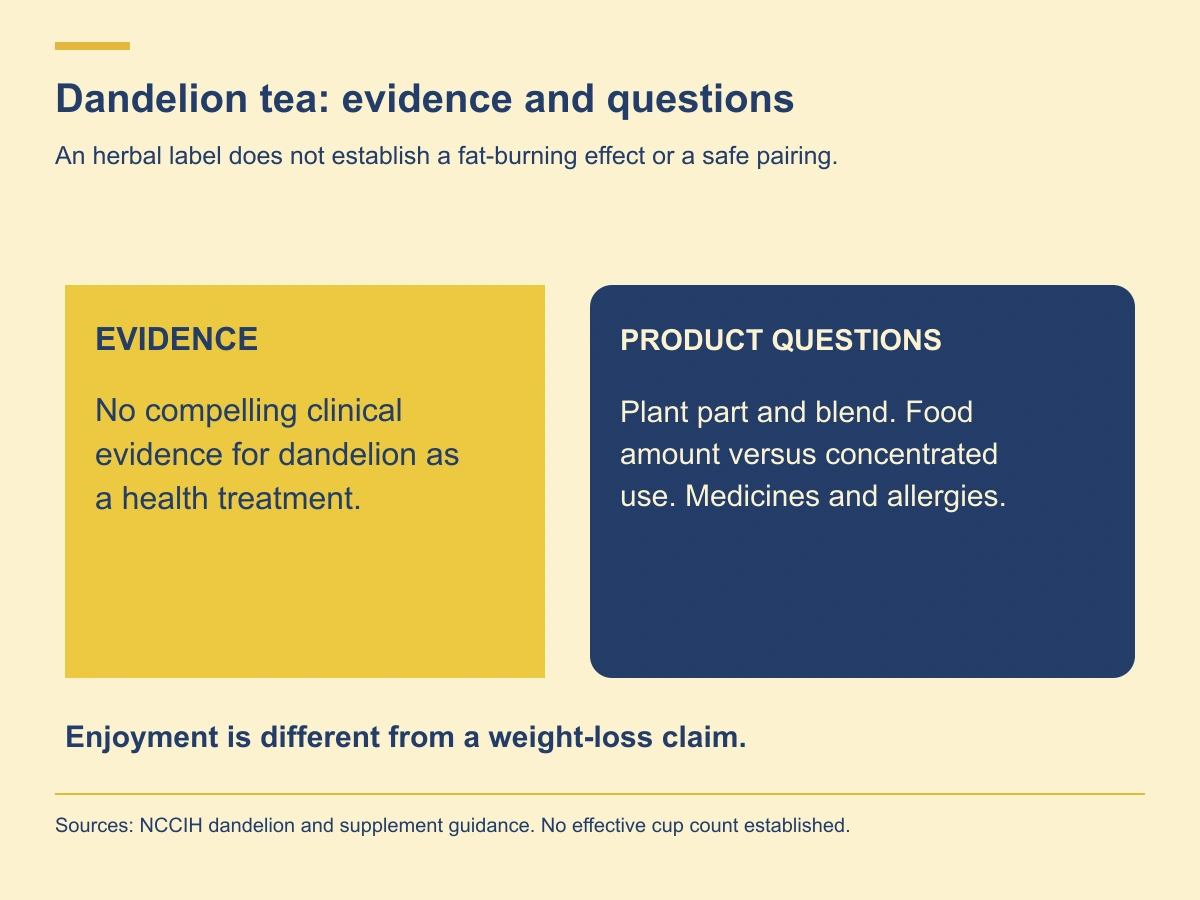
There is no compelling clinical evidence that dandelion tea produces weight loss. Dandelion has a long history of traditional use, but that history does not establish that a cup of tea burns fat, suppresses appetite reliably, or improves a medical condition. The National Center for Complementary and Integrative Health says evidence supporting dandelion for any health condition is not compelling. NCCIH dandelion fact sheet
If you enjoy the flavor, the useful questions are more ordinary: What is in the blend? Are you adding sugar or other ingredients? Could it interact with a medicine? Does the product contain the leaf, root, or a concentrated extract? Those details matter more than a promised “detox” schedule.
This guide separates a beverage choice from a treatment claim and explains how to evaluate dandelion-tea benefits, timing advice, and safety questions without assuming that natural means risk-free.
What is dandelion tea?
Dandelion is a plant whose flowers, leaves, and roots have been used traditionally. A product called dandelion tea may contain the root, the leaf, a combination, or a blend with other plants. Roasted-root beverages may also be marketed as coffee alternatives.
The product name does not establish an identical ingredient list across brands. A tea bag, a loose herb, a capsule, and a concentrated extract are different preparations. Findings about one preparation cannot simply be applied to all of them.
NCCIH notes that research has included laboratory work, while good evidence in people remains limited. Laboratory activity is a reason to investigate a question; it is not proof that a person drinking tea will lose body fat. NCCIH evidence overview
Before comparing products, read the complete label rather than relying on the word “dandelion” on the front. This same approach is useful in our guide to apple cider vinegar powder supplements.
Does dandelion tea help you lose weight?
The available evidence does not establish it as an effective weight-loss treatment. There is no supported universal number of cups, time of day, or duration that makes dandelion tea a fat-loss strategy.
A beverage can still fit into an eating pattern. For example, replacing a routinely sweetened drink with an unsweetened beverage changes what you consume. That is a substitution involving the whole diet, not evidence that dandelion itself has a special weight-loss effect.
Weight trends also need context. A short-term change on a scale does not identify how much body fat changed, what caused the change, or whether it reflects a sustainable pattern. Do not use a single morning’s measurement as proof that a tea “worked.”
The calorie intake guide explains why energy needs and plans differ between adults. The water and drinks guide provides a more practical starting point for comparing everyday beverage choices.
“Detox,” water weight, and fat loss are different claims
Marketing can blend these ideas into one promise. Ask what a claim actually means and whether it was tested in people using the same preparation and amount.
| Claim on a product or post | Question to ask | What would remain uncertain |
|---|---|---|
| “Supports detox” | Which measurable outcome is meant? | Whether a vague phrase establishes a health benefit |
| “Reduces water weight” | Was this measured with this preparation in people? | Whether a scale change represents fat loss or is appropriate for you |
| “Boosts metabolism” | What study tested the actual product? | Whether a laboratory finding predicts lasting weight change |
| “Natural weight-loss tea” | What controlled clinical evidence supports it? | Whether the product produces the promised result |
These questions help expose gaps without assuming that every product has the same ingredients or evidence. The absence of a precise claim can itself make the marketing difficult to evaluate.
What about other dandelion-tea benefits?
Traditional use and personal enjoyment are different from demonstrated treatment benefits. NCCIH’s review does not provide compelling evidence for dandelion as a treatment for a health condition. That includes the need to be cautious about confidently assigning digestive, liver, blood-sugar, or weight benefits to a tea. NCCIH usefulness and safety
You do not need a medical claim to enjoy a beverage. Taste, preparation time, cost, and whether it suits your routine are legitimate reasons to choose or skip it.
Keep a personal preference separate from a prescription decision. Do not replace a medicine, postpone an evaluation, or stop a treatment because a tea label promises “balance” or “cleansing.” A pharmacist can help review a supplement alongside the medicines you actually take.

Root, leaf, extracts, and blends: why the label matters
An ingredient list helps you establish what you are buying. It does not, by itself, prove efficacy or safety, but it makes the next questions more specific.
- Plant part: Is the product described as root, leaf, or both?
- Preparation: Is it a beverage ingredient or a concentrated supplement?
- Other ingredients: Are there additional herbs, tea leaves, flavorings, sweeteners, or stimulant ingredients?
- Serving directions: What amount does the label describe, and is that an instruction for this product rather than a treatment claim?
- Manufacturer information: Is there a way to ask about ingredients, allergies, or missing details?
NCCIH explains that supplements sold in stores may differ from products studied in research. Its supplement guidance also describes the different regulatory process from prescription medicines. Being on a shelf does not mean a supplement received premarket FDA review for effectiveness. NCCIH supplement guidance
If you are comparing tea with another wellness powder, greens-powder timing questions offers a related label-focused discussion. Neither a powder nor a tea needs to be added automatically to a weight-management plan.
Is dandelion tea safe?
NCCIH describes dandelion in amounts commonly found in food as likely safe, while much less is known about larger amounts. That distinction matters because concentrated products and repeated supplement use are not automatically equivalent to an occasional food ingredient.
Allergy is another question. NCCIH notes conflicting information about allergy concerns in people allergic to related plants. Do not conclude that a related-plant allergy guarantees a reaction, or that no reaction is possible. Bring the actual product and allergy history to a clinician or pharmacist. NCCIH safety discussion
Information about larger amounts during pregnancy or breastfeeding is limited. Seek professional advice rather than using a “natural” label as reassurance. This article does not provide a pregnancy, breastfeeding, or pediatric tea regimen.
If a new product causes concerning symptoms, stop experimenting with it and obtain medical advice. Breathing trouble or swelling of the mouth or throat requires emergency help.
Can it interact with medication?
NCCIH describes theoretical interactions with some medicines, including diabetes medicines, anticoagulant or antiplatelet medicines, and diuretics. “Theoretical” means the concern should be reviewed; it does not mean a harmful interaction has been established for every person or every tea. NCCIH interaction concerns
Tell the pharmacist what is in the blend, how you prepare it, how often you use it, and which prescriptions and over-the-counter products you take. A product photograph can help when the ingredient names are unfamiliar.
If you take a prescribed GLP-1 medicine, do not assume a tea improves the treatment or protects you from side effects. Our berberine and GLP-1 guide covers similar questions about combining supplements with treatment. Each ingredient needs its own assessment.
Do not change a prescribed medicine to make room for a supplement. If the information is incomplete, leaving the new product out until the question is resolved is a reasonable practical choice.
Is there a best time to drink it?
There is no established morning or bedtime schedule for dandelion-tea weight loss. Choose timing based on the actual beverage and your routine, rather than a fat-burning claim.
A blend may contain caffeine even if the main ingredient is an herb. Look for tea leaves and other caffeine sources. Caffeine sensitivity varies, and the total from drinks, supplements, and medicines matters. FDA caffeine guidance
If evening drinks repeatedly disturb your sleep or are associated with symptoms, bring that pattern to the care team. The sleep and weight-management guide explains why rest deserves attention in its own right, rather than being traded for a beverage routine.

A useful beverage comparison
Compare dandelion tea with what you would otherwise drink. Consider the actual cup, additions, frequency, and cost. An unsweetened tea and a tea prepared with honey, sugar, cream, or a sweetened mix answer different nutrition questions.
You can also ask whether the beverage is replacing a regular drink or simply being added. Adding several products to an existing routine because each promises a benefit may make the plan more expensive and harder to evaluate.
For food and drink questions together, balanced meals for weight management offers a broader framework. A beverage does not need to carry the entire weight-loss plan.
Frequently asked questions
Can dandelion tea reduce belly fat?
The evidence reviewed does not establish that result. A claim about “belly fat” also needs to specify what was measured; a temporary scale change cannot identify regional fat loss.
How many cups should I drink for weight loss?
There is no established effective cup count. Follow professional advice about safety for the actual product rather than increasing intake to chase a result.
Is roasted dandelion root better than leaf tea?
They are different preparations, and their taste or ingredients may differ. The reviewed evidence does not establish either as a superior weight-loss treatment.
Can I drink it at night?
There is no proven nighttime advantage. Check the blend for caffeine and consider whether the beverage fits your sleep and symptom pattern.
Is tea safer than a capsule?
The formulation and amount matter; the word “tea” does not guarantee safety. Bring the specific ingredients and directions to a pharmacist when medication or allergy questions apply.
What if I want to discuss medical weight management?
CoreAge Rx’s semaglutide information page explains one treatment topic to discuss with a qualified clinician. Dandelion tea is not a substitute for assessing whether any prescription treatment is appropriate.
Educational information for adults; individual treatment decisions require a qualified clinician. Sources reviewed October 3, 2026. Original AI-generated article images depict fictional people and objects, not patient outcomes. Other editorial images are illustrative. Graphics summarize the cited sources.