Cloves can add a strong, warm flavor to food, but the human evidence reviewed for this article does not establish that chewing cloves, drinking clove tea, or taking clove oil produces meaningful weight loss. A study of a particular extract and a blood-glucose measurement is not proof that a kitchen spice burns body fat.
The distinction between a culinary ingredient and a concentrated product matters for safety too. Whole cloves, ground cloves, supplements, and clove essential oil are not interchangeable forms of a proven weight-loss treatment. Here is what the evidence can support and how to assess the claims you may see online.
What are cloves, and why does the form matter?
Cloves are aromatic flower buds used as a spice. Eugenol is a major component of clove oil. The concentration and exposure in an essential oil differ from those in a small amount of spice used to flavor a meal. NIH’s LiverTox review distinguishes ordinary uses from serious poisoning after high-dose clove oil ingestion. LiverTox: eugenol and clove oil
A tea made from whole cloves is also not automatically equivalent to an extract used in a clinical study. Preparation, extraction, concentration, and the amount actually consumed can differ. Without testing the specific preparation, you cannot convert a capsule study into a number of cloves to chew or a tea recipe.
That is why this article does not provide a “weight-loss dose.” The evidence does not establish one. A precise-looking instruction such as chewing a certain number every morning can sound scientific while lacking a demonstrated benefit.
What did the small human clove study measure?
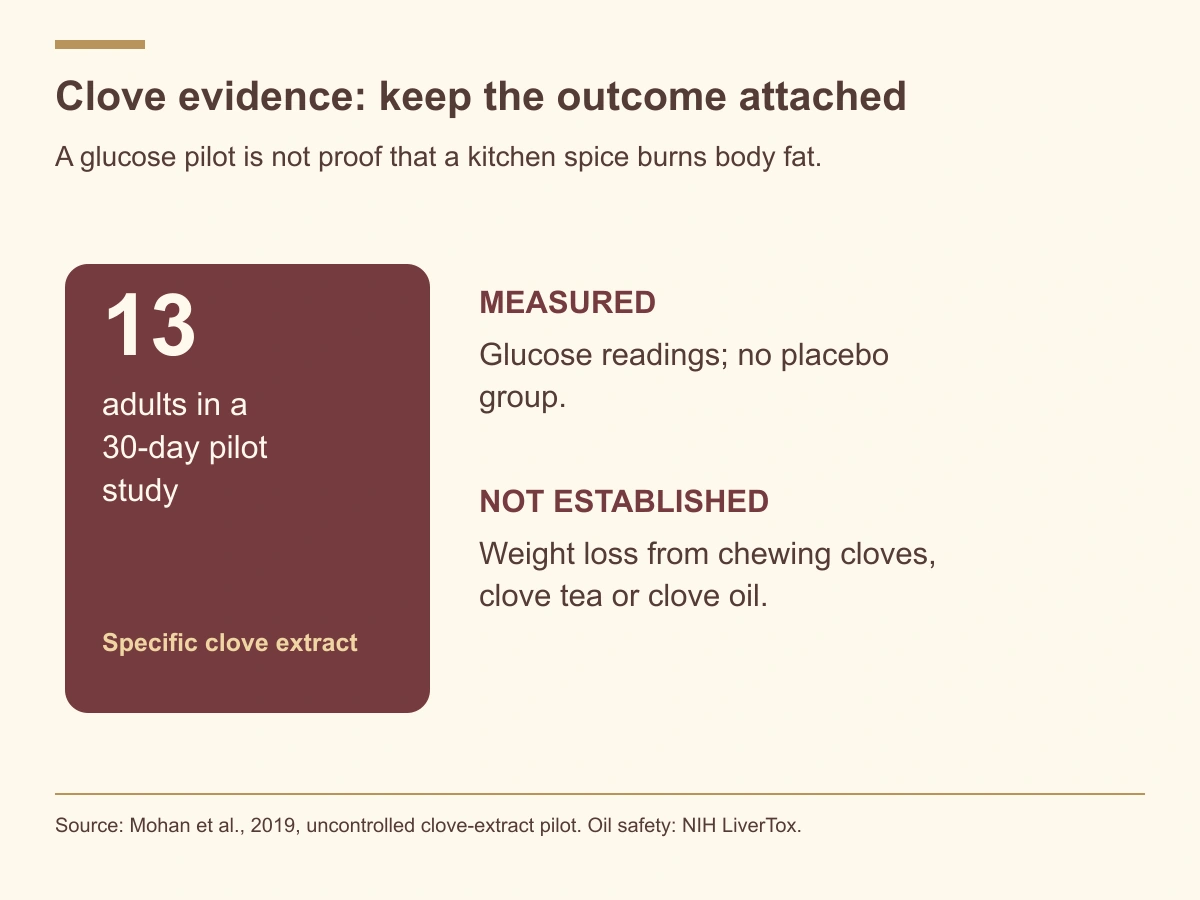
A 2019 pilot study enrolled 13 healthy or prediabetic adults, ages 25 to 35, who took 250 mg of a specific water-soluble polyphenol-rich clove extract daily for 30 days. It assessed glucose measurements, including before and after meals. The study was open-label, meaning the participants and researchers knew what was being taken, and it did not include a placebo comparison group. Mohan and colleagues, 2019 pilot study
The authors reported changes in glucose readings. However, the study was small, short, and concerned a particular extract. It did not establish that chewing whole cloves causes weight loss, that clove tea reduces abdominal fat, or that clove oil is an appropriate way to manage weight. Its funding and author disclosures included industry involvement, which is another reason to examine the methods and limits carefully.
The key question is not whether the paper contains a positive result. It is whether the people, preparation, comparison, and outcome match the claim being made. Here they do not establish the common claim that eating cloves will produce a slimmer body.
| What the study helps describe | What it does not establish |
|---|---|
| A specific extract taken for 30 days | A validated dose of whole cloves or homemade tea |
| Glucose readings in 13 selected adults | A predictable weight-loss result in the general population |
| An uncontrolled pilot observation | Proof that the extract caused every observed change |
| A limited research question | A replacement for diabetes treatment or weight-management care |
Does lower blood glucose automatically mean fat loss?
No. A glucose measurement and a change in body fat are different outcomes. A study can investigate one without demonstrating the other. Weight change also needs an appropriate time frame, measurement method, comparison group, and account of other changes in eating or activity.
Do not stop or reduce prescribed diabetes medicine because a supplement is advertised as helping glucose. Tell your clinician about any supplement you plan to take. People using insulin or medicines that stimulate insulin release have particular reasons to discuss low-glucose risk and their full regimen. NIDDK low-blood-glucose information
If your main question is about weight treatment rather than a spice, the semaglutide questions guide explains what a clinical discussion can cover. Evidence for a prescription medicine cannot be transferred to cloves, and a clove study cannot be used to predict a prescription response.
Can chewing cloves help with appetite or belly fat?
The reviewed human study does not answer that question. A strong flavor, a warm drink, or a change in an eating routine can feel noticeable without establishing a clinically useful appetite effect. There is also no basis in the reviewed evidence for promising targeted fat loss from the abdomen.
Chewing a spice should not become a way to suppress meals or ignore hunger. If someone eats less because their mouth hurts or they feel nauseated, that is a tolerability problem—not evidence of a desirable weight-loss mechanism. Clove and eugenol products can cause local irritation or allergic reactions. LiverTox clove review
For a more practical food question, consider how a meal supports your day. Our protein breakfast guide and macros guide discuss portions and meal composition. Those questions are more useful than assigning a fat-burning property to a single seasoning.

What about clove tea instead of a sweet drink?
An unsweetened beverage can contain less sugar and fewer calories than a sweetened drink it replaces. That is a substitution effect, not proof that the clove itself causes weight loss. CDC explains that replacing sugary drinks with water can reduce calorie intake. It does not identify clove tea as a weight-loss medicine. CDC water and healthier drinks
Look at the whole drink. Added sugar, honey, syrup, juice, or a large sweetened mixer changes what you are consuming. The word “herbal” does not establish that a beverage is unsweetened, harmless in unlimited amounts, or effective for a medical condition.
If you enjoy a mild culinary clove flavor, treat it as a preference rather than a treatment. Stop if it irritates your mouth or stomach, and ask about medicinal or concentrated use if you take prescriptions, are pregnant, or have a relevant health condition. The peppermint versus green tea guide and rosemary tea guide show how ingredient and evidence questions differ among drinks.
Why clove oil deserves a separate warning
Do not swallow clove essential oil for weight loss. Concentrated oil is not a shortcut to the effects of a culinary spice. LiverTox describes serious clove oil poisoning, including liver and kidney injury, seizures, and other severe effects after overdose. Much of the reported severe poisoning involved children. Clove oil toxicity review
Keep concentrated products out of children’s reach and in their original containers. A bottle intended for fragrance or another use should not be treated as a beverage ingredient. Marketing words such as “natural” do not determine a safe swallowed amount.
If a concentrated oil has been swallowed or poisoning is suspected, contact Poison Control in the United States at 1-800-222-1222 for individual guidance. Do not induce vomiting. Call 911 for collapse, a seizure, trouble breathing, or inability to awaken the person. Poison Control first-aid guidance
Supplements require product-specific questions
The National Center for Complementary and Integrative Health explains that dietary supplements are not reviewed and approved by FDA for safety and effectiveness before marketing in the same way as drugs. It also emphasizes interactions and the fact that the product studied may differ from the product on a store shelf. NCCIH: using dietary supplements wisely
For a clove supplement, ask what the actual ingredients are, whether the amount is disclosed, what outcome was studied in that preparation, and whether your medicines or conditions change the risk. A proprietary blend or a long list of plant compounds does not by itself demonstrate a weight benefit.
Bring the bottle or label to a pharmacist rather than reporting only “I take something natural.” Mention planned surgery, pregnancy or breastfeeding, and other supplements. This is a product review, not a reason to assume that every small culinary use carries the same exposure as a concentrated capsule.
What can cloves reasonably contribute to a meal?
They can contribute flavor. A small culinary amount may suit oatmeal, cooked fruit, a savory spice blend, or another food you already enjoy. That does not require turning the ingredient into a daily medicinal ritual or increasing the amount until it becomes unpleasant.
The broader eating pattern still matters. NIDDK’s adult healthy-eating guidance emphasizes a variety of nutrient-rich foods and amounts appropriate to individual needs. A spice does not replace protein, produce, fiber-containing foods, or enough food to support health. NIDDK healthy eating and activity guidance
If appetite is reduced during prescribed weight treatment, focus on tolerable, adequate meals instead of adding an unproven appetite-suppression routine. The semaglutide protein and muscle guide addresses nutrition and function during treatment. The CoreAge Rx semaglutide service page describes its assessment-based option; it does not establish a benefit from combining treatment with cloves.
How to judge the next weight-loss spice claim
The bay leaf and cinnamon tea guide applies these evidence questions to mixed-tea claims and explains cinnamon species, whole-leaf removal, and concentrated-product safety.
Before accepting a claim, look for the study itself and ask four questions: Was it conducted in people? Did it measure weight or body composition? Did it test the same preparation being sold or recommended? Was there a suitable comparison group?
Also check the duration, number of participants, funding, and whether adverse effects were assessed. A laboratory mechanism can suggest a research question without demonstrating a practical benefit. A testimonial can describe an experience without showing what caused it.
The water weight versus fat-loss guide is useful when a claim relies on a rapid scale change. A lighter reading after less food, fluid changes, or bowel movements does not identify how much body fat changed.
Frequently asked questions
How many cloves should I chew to lose weight?
There is no established weight-loss dose in the evidence reviewed here. Increasing the amount does not turn an unproven strategy into a proven one and can increase irritation or other risk.
Is taking cloves at night better than in the morning?
The reviewed evidence does not establish a weight-loss advantage for either timing. A precise schedule should not be presented as effective without a study that actually tests that claim.
Does clove tea detox the body?
“Detox” is not a specific, demonstrated weight outcome in the reviewed clove research. Ask what substance is supposedly being removed and what clinical evidence supports the claim. A bowel movement, sweating, or a change in urine does not prove fat loss.
Can I enjoy cloves without using them as a supplement?
Yes, culinary enjoyment and a treatment claim are separate questions. Use food in a way that suits your needs and tolerance; seek individual advice for concentrated or medicinal products and any concerning reaction.
Educational information for adults; individual treatment decisions require a qualified clinician. Sources reviewed October 5, 2026. Original AI-generated article images depict fictional people and objects, not patient outcomes. Other editorial images are illustrative. Graphics summarize the cited sources.