
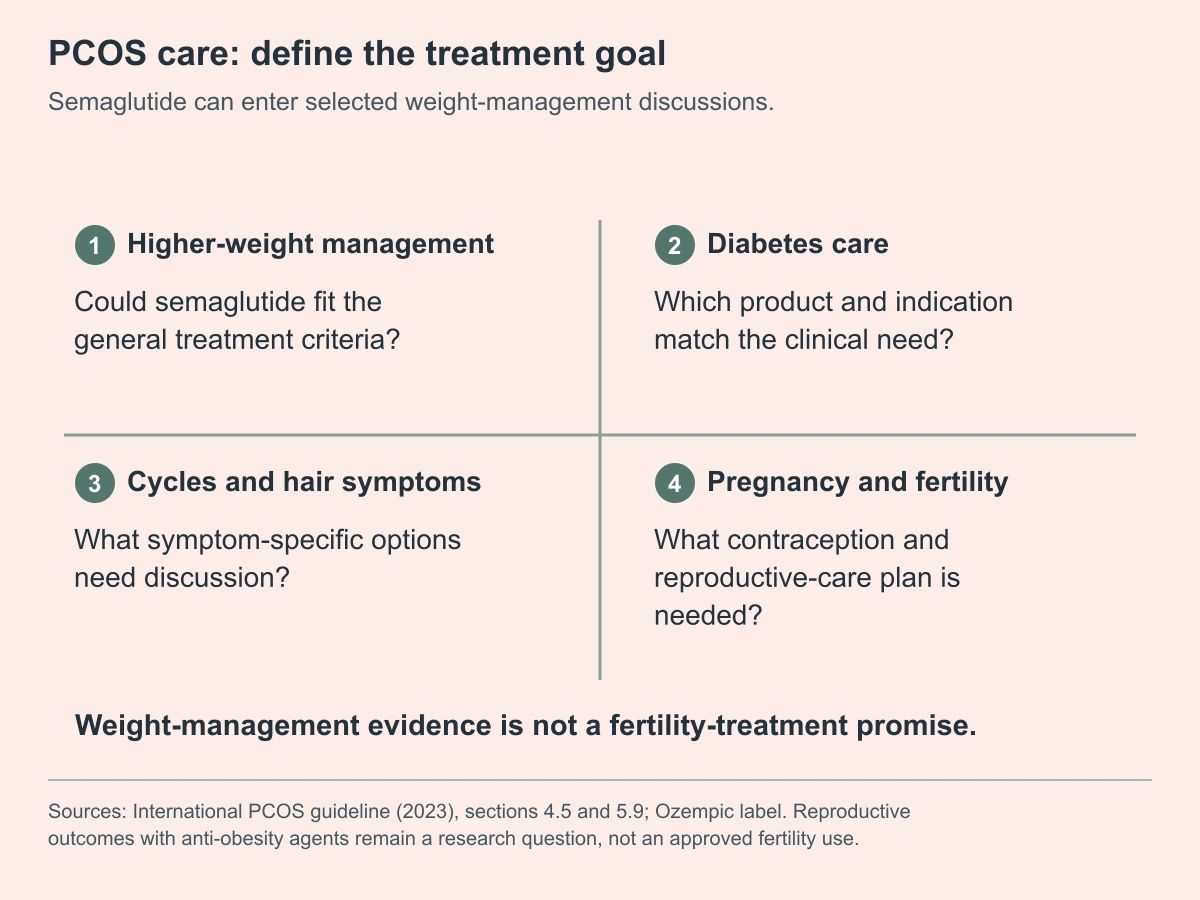
Semaglutide may be considered for weight management in some adults with polycystic ovary syndrome, or PCOS. That is different from saying Ozempic is approved to treat PCOS, restores fertility, or addresses every PCOS symptom. The right discussion starts with your goals: weight management, diabetes care, menstrual symptoms, unwanted hair growth and pregnancy planning are distinct questions.
The international evidence-based PCOS guideline allows consideration of anti-obesity medicines, including semaglutide, alongside active lifestyle measures for higher-weight management under general population guidance. It also calls for effective contraception when pregnancy is possible and careful discussion of side effects and longer-term treatment. International PCOS guideline, section 4.5.
Why is Ozempic discussed in PCOS care?
PCOS care can involve metabolic health as well as reproductive and androgen-related symptoms. Some people with PCOS also have higher weight, insulin resistance or type 2 diabetes. A clinician may therefore discuss a medicine for a particular metabolic or weight-related goal as part of broader care.
That does not mean everyone with PCOS needs a GLP-1 medicine. PCOS can occur in people with different body sizes and different priorities. A weight-centered conversation should not replace assessment of the symptoms that brought you to care or the concerns you want to address.
Use a specific question at your appointment: “Which part of my care would this medicine be intended to help?” The answer may involve an approved diabetes indication, consideration of weight treatment, or another clinically assessed use. It should not be a vague promise to “balance all hormones.”
Ozempic, Wegovy and semaglutide are not the same label
Semaglutide is an active ingredient. Ozempic and Wegovy are branded products with their own labeling and formulations. The current Ozempic injection label has specified adult type 2 diabetes-related indications, including cardiovascular and kidney-risk uses in defined populations. It does not list PCOS or fertility treatment as an approved indication. Ozempic injection prescribing information.
Wegovy has weight-management labeling in defined populations, with formulation-specific directions and other specified indications. A shared ingredient does not make every product, dose or study interchangeable. Wegovy prescribing information.
If a clinician considers Ozempic for an unapproved use, discuss why that product is being considered, the evidence relevant to your goal, alternatives, risks and access. Our GLP-1 medicine-selection guide helps frame that discussion. Do not transfer instructions between products because their ingredient names match.
What does the PCOS guideline support?
The 2023 international guideline’s weight-management recommendation is conditional: anti-obesity medicines, including semaglutide, could be considered for higher-weight management in adults with PCOS, alongside lifestyle measures and according to general population guidance. This is not a PCOS-specific approval or a recommendation for every person with the condition. Guideline section 4.5.
It also identifies practical issues that deserve attention before starting: effective contraception when pregnancy is possible, gradual escalation to reduce gastrointestinal effects, shared decisions about side effects, and the possibility of longer-term treatment because weight regain can follow discontinuation. The guideline notes limitations in long-term safety evidence.
The useful clinical question is therefore broader than “Will it make me lose weight?” Ask whether you meet criteria for an appropriate treatment, how it fits the rest of your PCOS care, and what monitoring and continuation would involve. A prescription should have a defined purpose and a follow-up plan.
Separate the treatment goals
| Goal or concern | Discussion to have | Assumption to avoid |
|---|---|---|
| Higher-weight management | Which evidence-based options fit my health and preferences? | PCOS automatically qualifies everyone for semaglutide. |
| Type 2 diabetes | Which medicine and monitoring fit my diabetes care? | A weight-treatment discussion replaces diabetes management. |
| Irregular cycles or unwanted hair | What symptom-specific assessment and options are appropriate? | A GLP-1 medicine necessarily treats every androgen or cycle symptom. |
| Pregnancy or fertility | What reproductive-care and medication plan do I need? | Weight loss proves ovulation, pregnancy safety or improved live-birth outcomes. |
| Scalp hair loss | What is the cause and what treatment fits it? | Every hair change is explained by the same hormone or medicine. |
The guideline addresses these areas separately. That structure is helpful: a medicine considered for one goal should not be expected to solve all the others. International PCOS care recommendations.
Is semaglutide a fertility treatment?
No fertility approval should be inferred from a weight-management recommendation. In its reproductive-care section, the international guideline recommends use of anti-obesity agents for reproductive outcomes only in research settings to establish efficacy and safety. That distinction is particularly important when an online story links weight loss, a more regular cycle and a pregnancy. Guideline section 5.9.
A personal account cannot determine whether the medicine caused the pregnancy or establish safe use while trying to conceive. If pregnancy is your goal, involve the clinician managing reproductive care before starting or continuing a weight-management prescription.
Discuss the whole timeline: contraception now, any planned treatment change, management of diabetes if relevant, and when attempts at pregnancy would be appropriate. Weight treatment and fertility treatment can intersect, but they should not be merged into a do-it-yourself protocol.

What does pregnancy planning require?
The Ozempic injection label states that it should be discontinued at least two months before a planned pregnancy because semaglutide takes time to clear. Arrange that transition with the prescriber, especially if it is being used for diabetes. Do not simply stop a diabetes medicine without arranging suitable ongoing care. Ozempic reproductive-potential labeling.
For Wegovy used for weight management, the label addresses discontinuation when pregnancy is recognized and at least two months before a planned pregnancy. Other labeled indications require their own benefit-risk discussion. This guide’s PCOS weight-management context is not a pregnancy-treatment recommendation. Wegovy pregnancy information.
If you become pregnant or think pregnancy is possible during treatment, contact the prescriber promptly. Ask about the exact product, next steps and other medicines. Breastfeeding is another product-specific discussion; do not assume that a general statement about PCOS answers it.
For a new menstrual concern, our guide to Ozempic and period changes separates pregnancy, nutrition, contraception and other possible causes from limited PCOS research.
Do irregular periods remove the need for contraception?
No. An irregular cycle should not be used as proof that pregnancy is impossible. The PCOS guideline specifically calls for effective contraception when pregnancy is possible during GLP-1 receptor agonist use because pregnancy safety data are lacking. Guideline contraception recommendation.
Discuss a method that is appropriate for you and ask how vomiting, other medicines or changes in treatment might affect its use. Instructions for tirzepatide and oral contraceptives are a separate product-specific issue. Our tirzepatide and birth-control guide covers that topic; its directions should not automatically be copied to semaglutide.
The key is a coordinated plan rather than a guess based on the frequency of your periods. Tell each clinician about the medicines and contraceptive method you use so the advice addresses the actual combination.
How does metformin fit the discussion?
Metformin has a distinct place in the PCOS guideline, particularly for metabolic outcomes in certain adults. The guideline separately discusses combined oral contraceptives for cycle and hirsutism-related goals. These are different treatment roles, not a ranking in which one medicine is automatically best for everyone. Guideline sections 4.3 and 4.4.
If you already take metformin, ask what adding or changing a medicine would be intended to accomplish. Review benefits, tolerability, laboratory needs, cost and your preferences. Do not stop one medicine or combine prescriptions based on a comparison of social-media success stories.
Likewise, a supplement advertised for PCOS should not be assumed to substitute for a prescribed medicine or an evaluation. Bring the ingredient list to your appointment so the care team can consider the actual product.
What side effects and health history matter?
The exact semaglutide product’s prescribing information should guide the safety review. Gastrointestinal effects, relevant gallbladder or pancreatic concerns, dehydration-related kidney injury, other medicines and particular contraindications can matter. The Ozempic and Wegovy labels include a contraindication involving personal or family history of medullary thyroid carcinoma or MEN2. This is a specific history, not a blanket statement that every thyroid condition has the same implications. Ozempic label, Wegovy label.
Report symptoms that interfere with eating or drinking. Severe or persistent abdominal pain, repeated vomiting, inability to keep fluids down or signs of a serious reaction require prompt medical assessment. Do not escalate treatment to chase a faster scale change when symptoms are already difficult to manage.
Our semaglutide first-month guide and semaglutide questions guide explain practical follow-up topics. They do not replace the individualized PCOS and pregnancy discussion.
What if hair loss is the main concern?
Scalp thinning, unwanted facial hair and medication-associated shedding are different problems. A clinician may need to establish which pattern is present and whether another cause is contributing. The DHT and hair-loss guide explains why a single hormone explanation is not enough for every hair change.
Do not assume that a reduction in body weight will necessarily reverse scalp hair loss or eliminate unwanted hair. Those goals may need their own assessment and treatment. If symptoms change after starting a medicine, document when the change began and discuss the full treatment and nutrition history.

What about compounded semaglutide?
FDA explains that compounded GLP-1 drugs are not FDA approved and do not receive the same premarket review as approved medicines. A branded semaglutide trial or PCOS guideline should not be presented as proof that a particular compounded preparation has the same approval, quality or demonstrated outcomes. FDA compounded GLP-1 guidance.
CoreAge Rx’s semaglutide service information describes an assessment-based compounded option for eligible adults. A service inquiry can help clarify clinical scope, medication source, charges and follow-up. It should not be interpreted as an offer to treat infertility or as confirmation that any person with PCOS is eligible.
Questions to bring to an appointment
- Which PCOS symptoms and health goals are we addressing first?
- Is the proposed use within this product’s approved labeling, or is it an off-label discussion?
- What evidence supports the specific goal, and what remains uncertain?
- How do my current medicines, nutrition and health history affect suitability?
- What contraception and pregnancy-planning instructions apply?
- Which symptoms require contact, and how will follow-up work?
- What would ongoing treatment, cost and eventual discontinuation involve?
A useful PCOS plan keeps the goals separate while coordinating the care. Semaglutide can be part of a weight-management discussion for selected adults; it should not become a promise to cure PCOS or a substitute for reproductive and symptom-specific treatment.
Educational information for adults; individual treatment decisions require a qualified clinician. Sources reviewed September 30, 2026. Original AI-generated article images depict fictional people and objects, not patient outcomes. Other editorial images are illustrative. Graphics summarize the cited sources.