
DHT, short for dihydrotestosterone, is an androgen made from testosterone through an enzyme pathway. It plays a role in genetically predisposed male pattern hair loss, but it is not the explanation for every receding hairline, widening part or episode of shedding. The useful first step is identifying the type of hair loss, rather than trying to lower a hormone number without a diagnosis.
This guide explains the DHT connection, what finasteride labeling actually supports, and why treatment, hormone testing and testosterone questions need individual review. It also covers the symptoms and history worth bringing to a dermatologist.
How are testosterone and DHT connected?
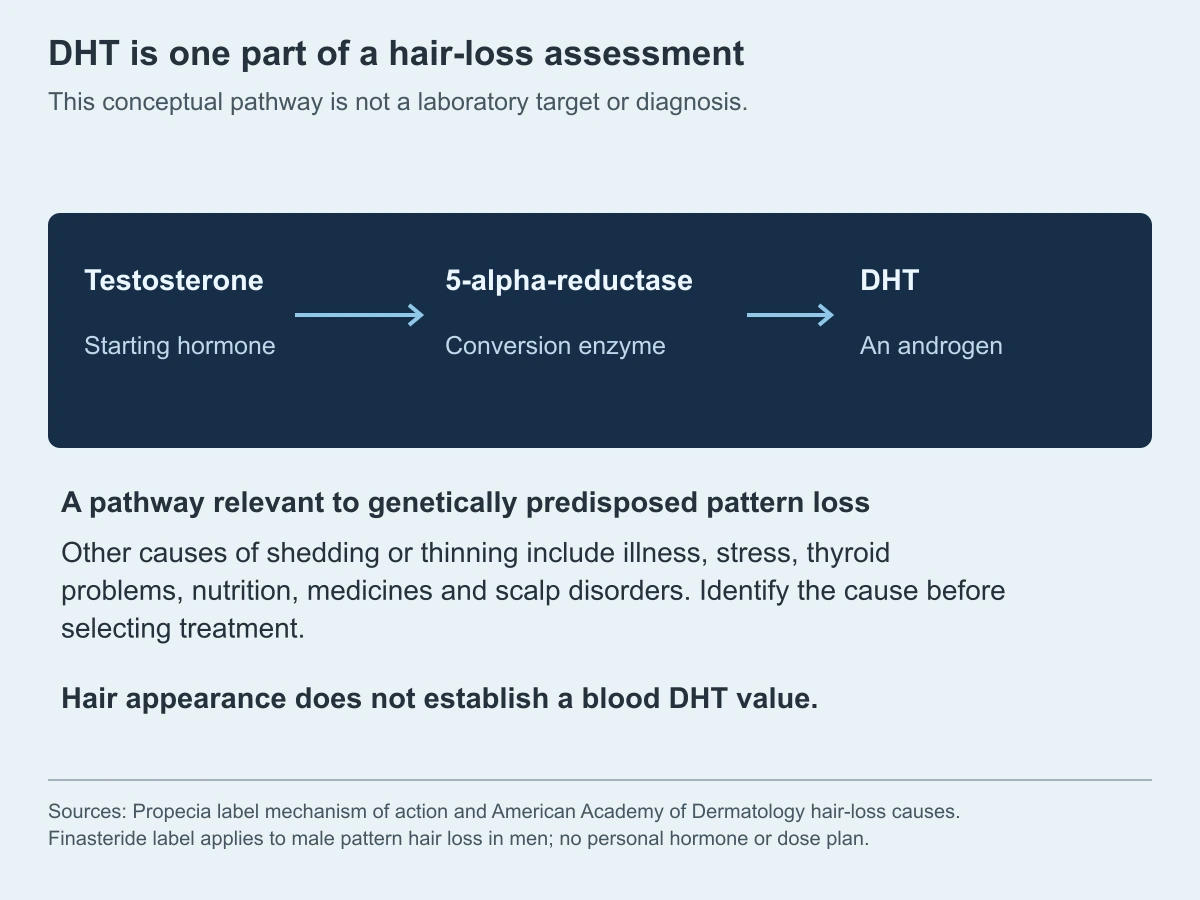
The enzyme 5-alpha-reductase converts testosterone to DHT. Finasteride acts on this pathway by inhibiting the type II enzyme. Its prescribing information explains that, in men with male pattern hair loss, the balding scalp contains miniaturized follicles and increased DHT compared with hairy scalp. Propecia prescribing information, mechanism of action.
Miniaturization means the affected follicles produce progressively smaller hairs. This is different from simply seeing a long hair fall out during washing. The label describes a DHT-related process in genetically predisposed patients; it does not establish that every hair-loss condition is caused by excess circulating DHT.
Think of the hormone pathway as one part of a particular diagnosis. A visible change in hair cannot tell you the hormone level in your blood, and a blood result alone cannot show the full pattern on your scalp. The medical history and examination still matter.
Is all hair loss androgen-related?
No. The American Academy of Dermatology describes hereditary hair loss alongside many other causes, including illness or stress-related shedding, thyroid disease, some medicines, nutritional deficiencies, scalp conditions and scarring disorders. Those causes can require different treatment. AAD overview of hair-loss causes.
The timing can be useful. A slow change at the crown or hairline may prompt a different discussion from a sudden increase in shedding after an illness. Patchy loss, scalp pain, scale or inflammation also deserves assessment. These observations help a clinician investigate; they are not a home diagnostic checklist that proves the cause.
Some conditions can coexist. An underlying pattern of thinning may become more noticeable during an episode of shedding. Treating every change with the same “DHT blocker” can delay recognition of another problem.
What details should you record?
Start with the change you actually see. Note when it began, whether it is gradual or abrupt, where it occurs, and whether the scalp feels different. Include recent illness, procedures, major stress, diet changes and new or changed medicines. A list of supplements is useful too.
Photographs taken in similar lighting and with a similar hairstyle can help document change over time. They should be private records for your care discussion, not evidence that you have established the diagnosis. A photo taken after a haircut or with different lighting may make the same hair look different.
If a medicine seems involved, contact the prescriber rather than stopping it yourself. AAD specifically cautions against abruptly stopping a medicine because of suspected hair loss. AAD medication-related hair-loss guidance.
Does hair loss mean my DHT is high?
You cannot infer a blood DHT value from hair appearance. The DHT pathway, follicle changes and genetic predisposition described in the finasteride label do not provide a universal laboratory cutoff for diagnosing hair loss. A numerical result also needs the laboratory’s method, range and clinical context. Finasteride mechanism and clinical scope.
Ask the clinician what a proposed test would change. Would it help investigate another condition? Would it affect treatment? Does the hair-loss pattern already suggest a different assessment? This is more useful than ordering a broad hormone panel only because an advertisement links DHT with hair.
This article does not recommend a target DHT level or a plan for manipulating testosterone. Hormone treatment has consequences beyond scalp hair and should not be adjusted to chase an unvalidated hair-growth number.
How does finasteride fit treatment?
Propecia, the finasteride product covered by the reviewed label, is indicated for male pattern hair loss in men. Its label says effectiveness for bitemporal recession has not been established, and it is not indicated for women. A general phrase such as “hair-loss pill” can hide these limits. Propecia indication.
The label describes reducing DHT through type II 5-alpha-reductase inhibition. It also explains that benefit generally takes at least three months of daily use to become apparent and that continued treatment is needed to sustain benefit. These statements describe the labeled product and use; they do not guarantee that a particular person’s hairline will return to an earlier state.
Before starting, discuss the actual diagnosis, likely goals, alternatives and safety. Slowing progression and regrowing visible hair are related but different outcomes. Set expectations that can be evaluated at follow-up rather than relying on a transformation photo.
What risks should be discussed with a prescriber?
The finasteride label lists sexual adverse reactions and addresses pregnancy-related handling precautions and changes in PSA interpretation. It also lists postmarketing reports, including mood and persistent sexual symptoms, while noting that voluntary reports do not reliably establish their frequency or causality. Finasteride safety information.
Tell the clinician about relevant symptoms, fertility plans and other medicines before treatment. If symptoms develop after starting, report what changed and when. Do not assume that every symptom is unrelated, and do not interpret a list of reports as proof that every listed problem will occur.
If you have suicidal thoughts or feel at immediate risk of harming yourself, seek urgent help. Other troublesome symptoms should be discussed promptly with the treating clinician so the plan can be reviewed. A cosmetic goal does not make safety concerns unimportant.
Why does pregnancy-related handling matter?
The reviewed Propecia label warns that people who are pregnant or may become pregnant should not handle crushed or broken tablets because of the potential risk to a male fetus. It distinguishes intact coated tablets from tablets that have been broken or crushed. Follow the product’s actual precautions and ask a pharmacist about a handling concern. Propecia pregnancy and handling information.
Do not share prescription hair-loss medicine or create a household plan by splitting tablets without professional advice. A prescription intended for one person is not a general remedy for everyone with thinning hair.
For women with scalp thinning, the clinical evaluation may involve a different set of options. Pregnancy plans, other conditions and the hair-loss pattern all affect the discussion. The PCOS and semaglutide article explains why scalp hair, unwanted hair, metabolic care and reproductive goals need to be kept distinct when PCOS is part of the history.
Is minoxidil the same kind of treatment?
Minoxidil is a different medicine with formulation-specific uses and precautions. The reviewed men’s topical solution label has its own directions, expected timeline and warnings; it is not a finasteride label or an oral-minoxidil instruction sheet. Men’s topical minoxidil labeling.
The oral minoxidil guide explains the separate off-label oral discussion. The minoxidil side-effects guide covers why the exact route and formulation matter. Do not assume that a topical product, oral tablet and another person’s combination can be swapped without review.
A clinician may consider more than one option, but the reason should be explained in terms of the diagnosis and expected benefit. Buying several products simultaneously can make it harder to identify the cause of a new symptom or judge which treatment is helping.
Can shampoo or supplements lower DHT enough to solve the problem?
A marketing claim is not the same thing as clinical evidence for your diagnosis. Ask what ingredient, dose, formulation and study support the claim, and whether the study measured a useful hair outcome rather than only a laboratory effect. “Natural” does not establish safety or treatment equivalence.
AAD notes that inadequate intake of certain nutrients can contribute to hair loss. That supports investigating a relevant deficiency; it does not mean every person should take high-dose supplements. The same AAD resource also describes hair loss associated with excessive amounts of certain nutrients. AAD causes and nutritional context.
The ketoconazole shampoo guide discusses a related scalp-treatment question. Shampoo used for a scalp condition should not be presented as a guaranteed substitute for treatment of androgenetic hair loss.
What if shedding began during weight treatment?
Review the timeline, nutrition, symptoms and exact medicines with your care team. A new period of shedding should not automatically be labeled DHT-related or blamed on one prescription without considering other causes. Illness, stress and inadequate nutrition can also be relevant. AAD assessment context.
Our Mounjaro and hair-loss article addresses that specific treatment question. The semaglutide protein guide explains nutrition topics during lower appetite. Neither guide proves the cause of an individual’s shedding.
If eating has become difficult, address that difficulty with the treating clinician. Repeatedly restricting food further or adding several supplements is not a substitute for assessing the problem.

How do TRT and testosterone questions fit?
Testosterone and DHT are connected, but hair loss alone does not establish that testosterone replacement therapy is needed, that a current dose is wrong, or that a DHT-lowering prescription should be added. Hormone care should be based on a proper clinical assessment and the reason treatment is being considered.
If you are taking TRT, tell the supervising clinician about hair changes and any hair-loss medicine. Finasteride can affect PSA interpretation, which is another reason the hormone and hair-care teams should know the complete medication list. Finasteride PSA warning.
The TRT guide and TRT monitoring article cover related evaluation questions. CoreAge Rx’s TRT service page was marked coming soon when reviewed September 30, 2026. It is service information, not a treatment for hair loss or a diagnosis based on scalp appearance.
A useful appointment checklist
Bring a brief timeline, current medicine and supplement list, any relevant prior test results and consistent photographs if available. Ask which pattern the clinician sees, whether another cause needs investigation, what outcomes are realistic and how progress will be reviewed.
Also ask which symptoms should trigger contact and what continued treatment would involve. The strongest plan begins with identifying the cause and matching treatment to it. DHT is an important part of one hair-loss pathway; it should not become a shortcut that replaces diagnosis, safety or follow-up.
Educational information for adults; individual treatment decisions require a qualified clinician. Sources reviewed September 30, 2026. Original AI-generated article images depict fictional people and objects, not patient outcomes. Other editorial images are illustrative. Graphics summarize the cited sources.