
Linzess is a prescription medicine for specific constipation conditions, not a weight-loss treatment. A lower scale reading after a bowel movement or diarrhea can reflect changes in stool and body fluid rather than fat loss. If your weight changes while taking it, the useful questions are how your bowel symptoms, eating, hydration, and overall health have changed.
What is Linzess used for?
Linzess contains linaclotide, a medicine that acts through guanylate cyclase-C receptors in the intestine. The prescribing information describes increased intestinal fluid secretion and movement of intestinal contents. It also describes effects on pain signaling relevant to irritable bowel syndrome with constipation. That mechanism is different from an obesity treatment. Linzess prescribing information
The May 2026 U.S. label includes irritable bowel syndrome with constipation in adults and children aged 7 years and older, chronic idiopathic constipation in adults, and functional constipation in children aged 2 years and older. Indications and ages differ, so an adult’s prescription is not a template for a child. The boxed warning concerns serious dehydration in children younger than 2, who must not receive the medicine.
Linzess is also contraindicated when mechanical gastrointestinal obstruction is known or suspected. A severe or changing bowel problem needs assessment; taking more constipation medicine is not an appropriate way to investigate it. This guide focuses on adult weight-related questions and does not provide a dosing plan.
Does Linzess cause weight loss?
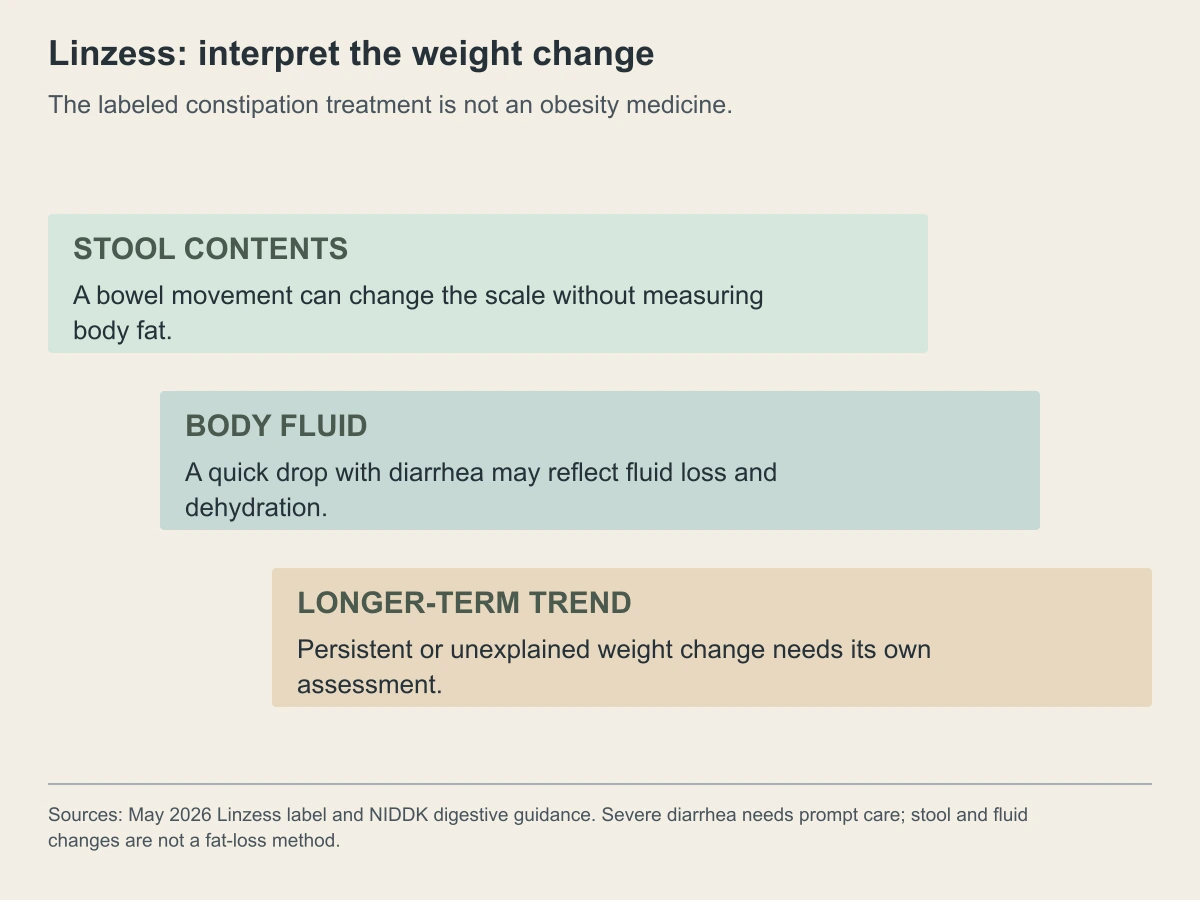
Weight loss is not a labeled treatment purpose, and the common adult adverse-reaction summaries do not establish Linzess as a medicine for losing body fat. Some people notice a scale change when constipation improves, when they eat differently because symptoms change, or when diarrhea causes fluid loss. Those possibilities are not interchangeable.
Passing stool removes material that has weight. Changes in intestinal contents can therefore move the scale without showing a change in body-fat stores. Our guide to bowel movements and weight explains why the immediate reading after using the bathroom is an incomplete measure of weight-management progress.
Diarrhea is another situation entirely. Losing fluid is a health concern, not evidence of successful fat loss. It may also reduce your ability to eat or drink. Do not take Linzess to produce diarrhea, use it as a weight-loss aid, or adjust a prescription in pursuit of a smaller scale number. Digestive-system overview, Linzess label
Does Linzess cause weight gain?
The label does not establish predictable weight gain as a typical treatment effect. However, a label cannot explain every change someone experiences. Increased appetite after abdominal symptoms improve, different food intake, another medicine, changing activity, or an unrelated health problem may deserve consideration.
Distinguish weight gain from feeling bloated. Abdominal distension is listed among the common adult adverse reactions. A tight waistband or a sensation of fullness does not tell you whether body fat increased. Conversely, a sustained upward weight trend should not be dismissed as “just bloating” without considering the context. Prescribing information
If the change is substantial, persistent, unexplained, or accompanied by swelling, breathlessness, significant pain, or worsening bowel symptoms, arrange an assessment. Bring the timeline and medication list rather than assuming Linzess is either definitely responsible or definitely unrelated.
Stool weight, fluid loss, and body fat are different
| What you notice | What it may reflect | Why it matters |
|---|---|---|
| A lower reading after a bowel movement | Less material in the digestive tract | It does not measure fat loss |
| A rapid drop during diarrhea | Fluid loss, reduced intake, and changed bowel contents | Dehydration can require prompt care |
| Less abdominal fullness | A change in bowel symptoms or distension | Feeling smaller is not a body-composition measurement |
| A continuing weight trend over weeks | Several possible changes in intake, health, activity, or treatment | The pattern needs its own assessment |
| Unintentional weight loss with persistent bowel symptoms | A possible underlying illness or inadequate intake | It should not be treated as a desirable side effect |
Daily weight measurements also vary with timing, clothing, food, and fluid. If monitoring weight is appropriate for you, compare measurements taken under similar conditions and discuss the overall pattern. Frequent rechecking around bathroom visits can make ordinary fluctuations feel more meaningful than they are.

Diarrhea is the main safety question
In the adult trials described in the label, severe diarrhea occurred in 2% of patients receiving the 145 or 290 microgram regimens for the studied constipation conditions, and in less than 1% of adults with chronic idiopathic constipation receiving 72 micrograms. These are severe-diarrhea figures for particular trial groups, not the percentage of all users who have any diarrhea. They are not instructions to select or change a dose. Linzess label, section 5.2
The label states that severe diarrhea requires suspending dosing and rehydrating the patient. Get prompt medical advice if severe diarrhea occurs; do not continue trying to produce a bowel response or wait for weight loss to stabilize. A clinician can assess dehydration, kidney function, other causes, and the treatment plan. Follow the medicine’s specific safety instructions and your care team’s advice.
The label also reports that many diarrhea cases in the studied adult constipation trials began within the first two weeks. That observation does not establish that later diarrhea is harmless or that all cases end on a certain day. A new illness, another medicine, or a change in food tolerance can arise later.
When should you seek care?
Contact a healthcare professional promptly for severe diarrhea, inability to keep fluids down, symptoms of dehydration, severe abdominal or rectal pain, blood or black stools, high fever, or diarrhea that is persisting. NIDDK also advises adults to seek care for diarrhea lasting more than two days or six or more loose stools in a day. Some people need assessment sooner because of age, pregnancy, immune problems, or another condition. NIDDK diarrhea guidance
Dehydration can cause marked thirst, reduced urination, dark urine, dry mouth, dizziness, or unusual tiredness. Fainting, confusion, severe weakness, or other serious symptoms warrant urgent care. Do not use an improved scale reading to decide that fluid loss is acceptable.
Constipation also has warning signs. Persistent abdominal pain, inability to pass gas, vomiting, rectal bleeding, blood in stool, fever, or unintentional weight loss should prompt medical attention. These can change what treatment is suitable. NIDDK constipation guidance
What should you eat and drink?
Your plan depends on whether you are managing ongoing constipation, diarrhea, another digestive condition, or a medication side effect. A food strategy for constipation should not be automatically carried over into an episode of severe diarrhea. Discuss your current symptoms and any existing fluid or dietary restrictions.
There is no universal daily fluid volume appropriate for every person. Kidney disease, heart conditions, diabetes, and other medicines may affect advice. If diarrhea is making it difficult to drink, or you have a fluid restriction, seek individualized guidance rather than following a generic hydration challenge.
Avoid turning reduced intake into a second weight-loss strategy. A person who feels uncomfortable eating may need help choosing tolerated meals and understanding the cause. Our protein shake meal ideas offer ordinary food combinations, but a drink cannot replace evaluation when pain or diarrhea prevents adequate intake.
What if you also take semaglutide or tirzepatide?
Tell each prescriber about the full medication list. GLP-1-related treatments can affect gastrointestinal symptoms, and diarrhea or constipation may have more than one contributor. The timing of a symptom after a new prescription is useful information, but it does not prove which medicine caused it.
Our constipation on GLP-1 medications guide discusses practical questions and warning signs. The Wegovy diarrhea, Ozempic diarrhea, and Zepbound diarrhea articles explain why exact products and their instructions matter. Do not independently add laxatives or antidiarrheal medicines to counteract another prescription.
If you are considering obesity treatment, review the semaglutide or tirzepatide product information as part of a clinician assessment. Neither is a substitute for investigating unexplained weight change, and neither makes Linzess an appropriate weight-loss drug.

A useful symptom and weight record
Write down when Linzess was started or changed, the reason it was prescribed, bowel frequency and consistency, abdominal symptoms, and other medicines or supplements. Note whether you are eating less, drinking differently, or recovering from an illness. If you record weight, include the dates rather than isolated numbers.
You do not need a detailed spreadsheet. A short record can help the clinician distinguish a bowel response from ongoing diarrhea, a temporary scale fluctuation, or a broader problem. Include missed doses or other changes honestly; the point is to understand the pattern, not demonstrate that treatment is working.
Useful appointment questions include: Is this bowel pattern expected for my condition? Could another medicine contribute? Does the weight trend need investigation? What symptoms mean I should stop waiting and seek care? What should I do if severe diarrhea occurs before I can reach the office?
Frequently asked questions
Will Linzess flatten my stomach?
Some people feel less full when constipation improves, but there is no guaranteed cosmetic result. Abdominal distension can also occur with treatment. Appearance cannot distinguish intestinal contents, gas, fluid, or body fat, and it should not determine how you take the prescription.
Is weight loss from diarrhea permanent?
Fluid-related weight changes can reverse as hydration and eating return, but the exact course varies. More importantly, severe diarrhea can be dangerous. It is not a method for reducing body fat or a reason to keep taking a medicine that is causing serious symptoms.
Can I take Linzess just when the scale goes up?
No. A scale increase is not an indication for the medicine. Use it only for the condition and instructions your prescriber has established. If constipation or unexplained weight change is recurring, ask for an assessment rather than treating the number itself.
Does Linzess stop calories from being absorbed?
It should not be viewed as a calorie-blocking treatment. The label describes intestinal secretion and transit for specific constipation conditions, not an approved strategy to prevent energy absorption. Diarrhea after taking it does not tell you how much energy was absorbed.
Can I use an over-the-counter diarrhea medicine with it?
Ask a clinician or pharmacist. Severe diarrhea needs assessment and the Linzess label’s safety response; adding another medicine without reviewing the cause may delay appropriate care. Other illnesses, medicines, and contraindications can affect what is suitable.
When is an unexplained weight change worth mentioning?
Mention a persistent or substantial change, especially if it is unintentional or occurs with altered eating, continuing bowel symptoms, pain, swelling, or reduced function. The calorie intake and weight-management guide can help frame nutrition questions, while your clinician evaluates the change itself.
Educational information for adults; individual treatment decisions require a qualified clinician. Sources reviewed October 1, 2026. Original AI-generated article images depict fictional people and objects, not patient outcomes. Other editorial images are illustrative. Graphics summarize the cited sources.