
Used Ozempic needles belong in a suitable sharps container immediately after use, followed by disposal through the program your local rules permit. A used pen, a detachable needle, a prefilled syringe, and an unused medicine supply are related but different disposal questions.
Have the container ready before an injection. This guide uses current U.S. Ozempic Instructions for Use and FDA household sharps guidance checked September 30, 2026. It explains containment and local disposal; the actual device instructions and professional training determine how to handle your supplied product.
Start by identifying the presentation
Ozempic injection is available in multi-dose pens and single-dose prefilled syringes under current U.S. labeling. The pen uses a separately attached disposable needle. A prefilled syringe contains one complete dose and has a different handling sequence.
Read the carton and pharmacy label rather than assuming that every Ozempic refill uses the device you have used before. The current manufacturer instructions contain separate sections for the pen and prefilled syringe. Our Ozempic device guide explains those distinctions.
Instructions for a different prescription may also vary. The Wegovy device guide describes several presentations; the Ozempic pen sequence should not be transferred to them. Check the actual supplied device whenever treatment or packaging changes.
Also distinguish the injection from an oral medicine, an unrelated diabetes device, or a compounded vial. A familiar ingredient name does not identify the disposal procedure. Ask the pharmacist if the presentation or supplies are unclear.
What should happen to a used pen needle?
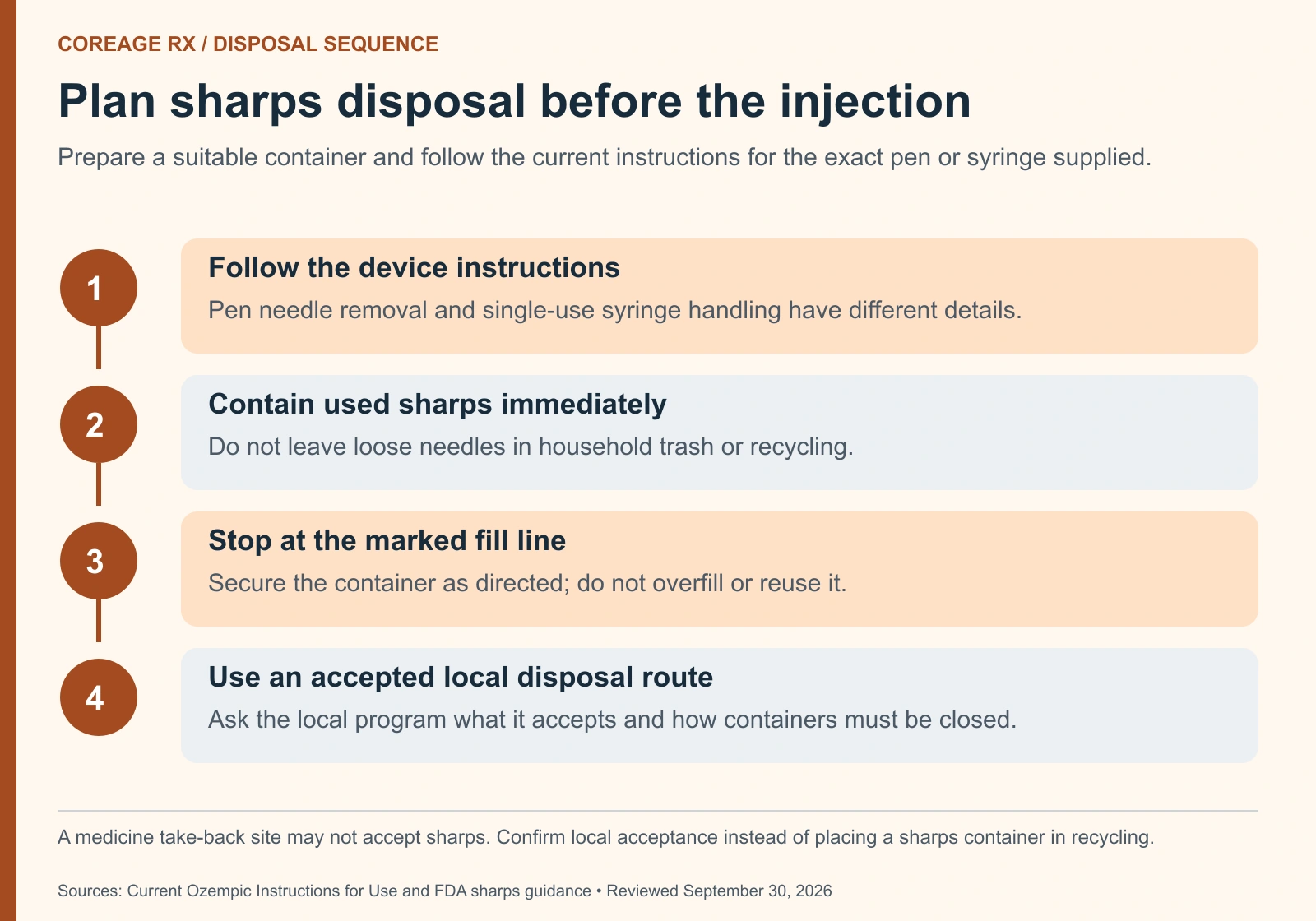
The current pen instructions say to remove the needle carefully after the injection and place it in a sharps container right away. They advise against putting the needle caps back on to avoid needle sticks. Keep the container available so disposal can be completed without carrying an exposed needle elsewhere.
Do not leave the used needle attached during pen storage. The manufacturer explains that removing it reduces contamination, infection, leakage, and blocked-needle problems. Put the pen cap back on the pen as directed to protect the medicine from light; the pen cap is different from a needle cap.
The instructions describe a specific contingency when a sharps container is unavailable. Have a pharmacist demonstrate any such handling that applies to your device instead of improvising. Never try to replace the inner needle cap. A ready container avoids needing that contingency in the ordinary routine.
What should happen to a used prefilled syringe?
The Ozempic prefilled-syringe instructions say to place the used syringe into an FDA-cleared sharps container immediately after use. Do not put the needle cap back on the syringe. It is a one-time-use product; it is not a pen that can be stored for another dose.
Do not detach, bend, or break a needle to make the syringe fit into a smaller container. Choose suitable containment before starting. Follow the presentation’s instructions and ask the pharmacist about the container opening and capacity if the device is difficult to accommodate.
If a package is damaged or the supplied product appears wrong, contact the pharmacy before using it. Disposal should be planned around the actual device rather than a generic picture of a “weight-loss shot.”
Does an empty Ozempic pen go in the regular trash?
The current Ozempic Instructions for Use direct used pens and needles into an FDA-cleared sharps container. Do not assume that removing the detachable needle makes the used pen appropriate for ordinary recycling. Check the supplied instructions and the local disposal program.
The instructions also prohibit using a syringe to withdraw medicine from a pen. Trying to take apart a pen or salvage visible leftover liquid creates a different handling problem and is not a disposal step. Ask the pharmacist if the pen no longer selects the prescribed dose or reaches its disposal date.
An unused or expired pen containing medicine still needs product-specific advice. Tell the pharmacy whether it is unused, partly used, damaged, expired, or no longer needed so it can explain the appropriate disposal route.
What is a suitable sharps container?
FDA describes FDA-cleared sharps containers as designed for safe containment of used needles and other sharps. They are available through pharmacies, medical-supply sources, and other retailers. Choose a size and opening appropriate to the devices you use and follow the container’s instructions.
A suitable container should resist punctures and leaks, stand upright during use, and close securely. Keep it in a place accessible for your routine while protecting children, pets, and anyone who might mistake it for an ordinary household bin.
Do not use a thin drink bottle, glass jar, paper container, or open bowl as a substitute. Do not rely on the appearance of a red plastic box alone to establish that it is suitable. Read the product description and closure instructions.

Can a heavy-duty household container be used instead?
The Ozempic instructions and FDA guidance describe a heavy-duty household container as an alternative when an FDA-cleared container is not available. It must have the necessary characteristics: puncture-resistant secure closure, upright stability, leak resistance, and a warning label identifying the hazardous contents.
FDA identifies heavy-duty plastic containers such as a laundry-detergent bottle as a possible household option. That does not mean every bottle is suitable or every disposal program accepts it. Check your local program’s requirements before choosing the alternative.
An alternative container is still a sharps container once used this way. It should not go back into ordinary household use or recycling. Clearly separate it from beverage containers, cleaning products still in use, and other items someone might handle without recognizing the contents.
How full can the container get?
Follow the marked fill line and closure directions. FDA’s disposal guidance advises avoiding overfilling and describes containers as ready for disposal at about three-quarters full. A manufacturer’s fill line or local program requirement should guide the actual container you have.
Do not force an extra pen or needle through an opening when the container is full. Do not reach inside, compress the contents, or transfer loose sharps into another vessel. Replace the container in time for your next injection.
Keep a spare if refills, travel, or delivery timing make replacement difficult. Plan how you will close and transport the container according to the receiving program’s instructions. The full container should remain safely contained until accepted for disposal.
Where can you take a closed sharps container?
Local options may include designated collection sites, household hazardous-waste services, supervised disposal programs, or mail-back arrangements. FDA explains that community rules and available services differ. The right route depends on where you live and the container or program you use.
Contact your municipal waste service, public-health department, or another official local resource. Ask the receiving program to confirm that it accepts household medical sharps, the container type, any fee, operating hours, and how the container should be presented.
Do not assume every pharmacy accepts used sharps because it sells the medicine or container. Ask that specific pharmacy about its service. A program for unused medication may have different acceptance rules from a program for needles and syringes.
Can a closed container go in household trash?
Only follow a household-trash route if your community guidelines permit it and specify how the container must be prepared. The Ozempic instructions explicitly make that route conditional on community rules. A statement from another state or city cannot establish what is allowed where you live.
Never put loose sharps into household trash or recycling, and do not flush them. FDA’s do-and-don’t guidance also advises against recycling sharps containers. Proper containment protects household members, waste workers, and other people handling the waste.
If you move, check the new location’s program before using your old disposal arrangement. A safe collection routine needs both suitable containment and an accepted final destination.
What about unused or expired medicine?
Unused medicine disposal is a separate question. FDA recommends medicine take-back options for most unused or expired medicines and directs people with uncommon dosage forms to the product instructions or a healthcare professional.
Tell the receiving service that the product is an injectable pen or syringe containing medicine. Confirm whether it accepts that presentation and whether it handles sharps. A medication drop box or mail-back envelope should not be assumed to accept a needle-containing device.
Remove personal information from packaging where appropriate without creating an exposed sharp or unidentified medicine-handling problem. Ask the pharmacist how to do that for the particular package. Do not pour injectable medicine down a drain because a general take-back location is inconvenient.
How should you plan disposal away from home?
Before leaving, work out where the used device will go immediately and how a container will be safely handled until final disposal. A small purpose-designed container may fit the routine, but it still needs sufficient capacity, secure closure, and acceptance by the destination program.
Our semaglutide storage and travel guide addresses medicine storage separately. A storage temperature limit does not determine a sharps-disposal rule. If you fly or cross borders, check the relevant authorities’ current requirements for medicines, supplies, and used sharps.
At a hotel, workplace, or another person’s home, do not leave used devices in an ordinary wastebasket. Ask about appropriate facilities before the injection is due. Do not assume another person’s waste service follows your home community’s rules.
A refill-day disposal checklist
Check the practical details while reviewing the new supply:
- Is the presentation the same, or do I need new training?
- Does the sharps container fit the used device and remain below its fill line?
- Is it positioned safely before I begin?
- Do I understand needle removal and device-specific disposal?
- Where will the closed container be accepted locally?
- Does unused or expired medicine need a separate arrangement?
Our GLP-1 injection-site guide and Ozempic site guide cover other preparation questions. Have the pharmacy clarify uncertain directions before using a product. The disposal routine should be as clear as the injection routine: contain it immediately, close it safely, and use a locally accepted destination.
Educational information for adults; individual treatment decisions require a qualified clinician. Sources reviewed September 30, 2026. Original AI-generated article images depict fictional people and objects, not patient outcomes. Other editorial images are illustrative. Graphics summarize the cited sources.