
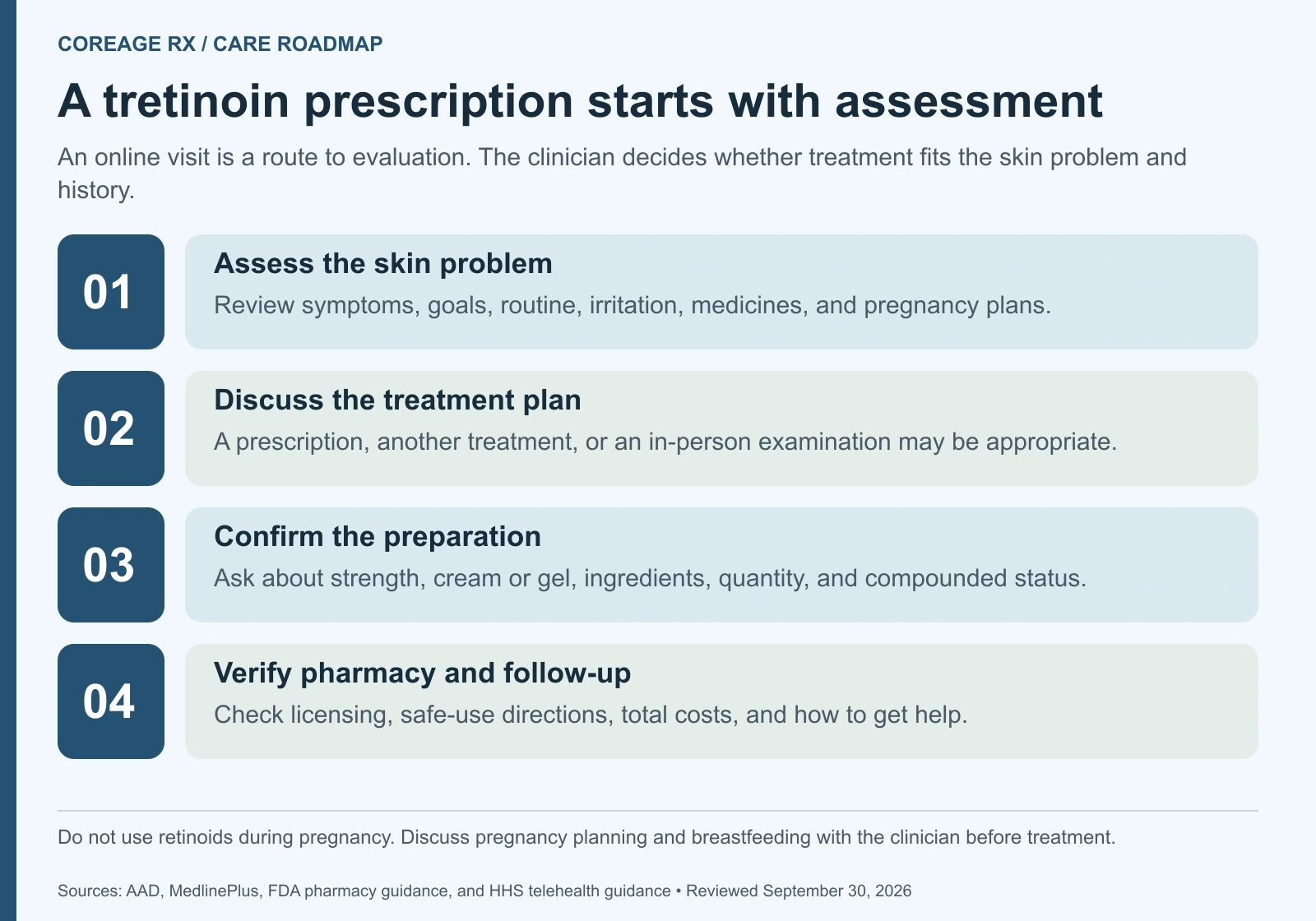
Prescription tretinoin begins with an assessment of your skin, treatment goals, health history, and current products. In the United States, topical tretinoin is a prescription medicine. An online service may offer an assessment, but completing a form or paying for a visit does not guarantee that tretinoin is the appropriate treatment.
The most useful first question is specific: are you seeking help for acne, visible fine lines, uneven texture, or another concern? Different problems can require different treatments. This guide explains what to prepare, how to compare formulations and services, and what should be clear before a prescription arrives.
Is tretinoin the same as retinol?
Tretinoin and retinol belong to the broader retinoid family, but they are different ingredients and are not interchangeable by percentage. The American Academy of Dermatology describes topical tretinoin as a prescription retinoid, while retinol is available in over-the-counter skincare products. Some adapalene products are also available without a prescription.
A larger printed percentage on a retinol bottle does not establish that it is stronger than a particular tretinoin preparation. Formulation, ingredient, instructions, skin tolerance, and the treatment goal all matter. Do not select a prescription by comparing percentage numbers across different retinoids.
Topical tretinoin is also different from oral isotretinoin, a medicine used for certain severe acne situations. Their assessment, monitoring, and instructions should not be mixed together. Make sure a search result or service page refers to the medicine you actually intend to discuss.
What can a tretinoin prescription address?
MedlinePlus explains that topical tretinoin is used for acne and that certain preparations address fine wrinkles. The exact product’s uses and limitations matter. A prescription cream is not a promise to remove every wrinkle, repair all sun damage, or treat any unexplained skin change.
For acne, a clinician considers the type and severity of breakouts, affected areas, previous treatments, and whether scarring is developing. For appearance concerns, the discussion may include sun exposure, pigmentation, sensitivity, and which results are realistic for the proposed preparation.
Our acne-versus-photoaging guide separates those goals. A useful prescription plan names the problem being treated and how progress will be judged. “Better skin” is too broad to tell you whether a formula, routine, or follow-up schedule fits.
Why does the skin assessment matter?
Not every breakout-like rash is acne. The AAD acne treatment page describes conditions that can resemble it and emphasizes diagnosis before treatment. An irritated rash, bumps around the mouth, or another new skin problem should not automatically be treated by adding a retinoid.
Tell the clinician about persistent redness, eczema, allergies, significant dryness, previous reactions, and painful or scarring acne. Explain whether the concern appeared suddenly or changed recently. These details can affect whether tretinoin, another treatment, or an in-person examination is appropriate.
Clear photographs may support a remote assessment when requested by the service. Follow its instructions for lighting, angles, and privacy. A clinician may still need an in-person examination; online access does not remove the limits of evaluating skin remotely.
What should you prepare for an online visit?
Gather information that helps the clinician understand both your skin and the routine surrounding it:
| Information | Why it is useful |
|---|---|
| Main concern and how long it has been present | Distinguishes a new problem from an ongoing treatment goal. |
| Previous prescriptions and skincare trials | Shows what helped, failed, or caused a reaction. |
| Current products and medicines | Helps identify overlapping active ingredients and relevant health considerations. |
| Allergies and skin conditions | May affect ingredient or formulation selection. |
| Pregnancy plans, pregnancy, and breastfeeding | Requires a specific treatment discussion before starting. |
| Your location during the visit | Helps the service determine whether the clinician can provide care there. |
Bring product names rather than only saying you use “an acne wash” or “a brightening serum.” If available, provide the active ingredients and strengths from the labels. Photos of packaging can reduce confusion about similar-looking products.
Can you get tretinoin prescribed online?
A qualified clinician may prescribe through an appropriate telehealth service when the assessment supports it. Available visit formats and rules depend on the provider, your location, and the clinical situation. An online checkout should clearly identify who assesses you and how questions or complications are handled.
HHS explains that cross-state telehealth practice depends on state requirements and several possible licensure pathways. Your location during care is relevant. Ask the service to confirm that its clinician can provide care where you will be, including if you travel or move.
Check whether a fee purchases an assessment, medication, a subscription, or some combination. A clinically appropriate outcome may be another treatment or no prescription. That possibility should be understandable before payment, along with the service’s refund and follow-up terms.

How do cream, gel, lotion, and strength choices differ?
Topical tretinoin is available in different preparations. The vehicle—the base carrying the active ingredient—can affect how a product feels and fits a routine. Individual formulations also have their own directions. The same ingredient name does not establish identical tolerability or approved uses.
Ask why the proposed product and strength fit your concern and history. Tell the clinician if a previous formula stung, peeled, or worsened irritation. Choosing the highest available percentage is not a shortcut to the best outcome; a usable plan needs to balance the treatment goal with tolerance.
If a pharmacy substitution or new formula changes what you receive, ask whether the instructions change too. Confirm the active ingredient, strength, application area, amount, frequency, and storage from the actual prescription. Our starting-tretinoin routine helps organize those questions.
Pregnancy and breastfeeding need an explicit discussion
The AAD retinoid guidance advises against retinoid use during pregnancy. MedlinePlus also instructs patients to discuss pregnancy, plans for pregnancy, and breastfeeding with their clinician. Do this before starting rather than treating topical use as automatically irrelevant to pregnancy planning.
If your circumstances change while using the medicine, contact the prescriber for advice. Do not substitute an oral-retinoid rule, a social-media schedule, or another person’s treatment plan. Ask which alternatives fit your skin concern and individual situation.
This is also a useful point to review every active product in the routine. A clinician can assess the whole arrangement instead of focusing only on the prescription tube.
What should happen to your existing skincare products?
Tell the clinician about exfoliating acids, scrubs, benzoyl peroxide, other retinoids, fragranced products, and any prescription creams. The answer may involve adjusting the routine or how products are used together. Do not assume that layering every active ingredient will improve results.
Irritation can make a treatment harder to continue and can contribute to dark marks in some skin types. Ask what mild reactions might occur, which symptoms require contact, and how the prescriber wants you to respond. A severe reaction should not be accepted as proof that the product is working.
Our tretinoin-and-moisturizer guide and sunscreen guide explain supporting care. Follow the directions for your preparation; do not increase the amount or make up missed applications with extra medicine.
How can you check the online pharmacy?
FDA recommends using a pharmacy that requires a prescription, has a U.S. physical address and phone number, provides access to a licensed pharmacist, and holds the appropriate pharmacy license. A polished website or unusually low advertised price is not enough to establish those safeguards.
Use the FDA state-license lookup resource to find the relevant board database. Confirm the dispensing pharmacy’s identity, not just the brand running the consultation website. Ask who prepares the medicine and who answers a dispensing or product-quality question.
When the package arrives, check the patient name, medicine, formulation, strength, expiration or beyond-use date as applicable, and instructions. Contact the pharmacy about damaged packaging, unclear directions, or a product that differs from the prescription. Do not guess how to use an unidentified tube.
What if the formula is compounded?
Compounding can meet a particular medical need, but a compounded formula is different from an FDA-approved generic medicine. FDA explains that compounded drugs do not undergo its premarket approval review for safety, effectiveness, and quality. Added ingredients do not automatically make a complete formula equivalent to a studied branded product.
Ask why the preparation is appropriate for you, who compounds it, which ingredients and strengths it contains, and what evidence supports the treatment goal. Confirm storage, the beyond-use date, and the directions for the complete formula.
CoreAge Rx Smooth Move is described as a compounded cream combining tretinoin, niacinamide, and vitamin C. Review its exact prescribed strengths and directions with the care team. General tretinoin evidence should not be presented as proof of a specific response to every combination cream.

Compare the complete cost and follow-up arrangement
A prescription’s advertised starting price may not include assessment, medication, delivery, refills, or ongoing care. Ask whether the product is supplied once or on a recurring schedule and how much arrives each time. Clarify renewal, cancellation, and refund rules before comparing services.
Also ask how to contact the clinician if irritation occurs, how formulation changes are handled, and when progress will be reviewed. A cheaper first shipment may be less useful if you cannot get clear advice about continuing the treatment.
Insurance payment may depend on the product and reason for treatment. Ask the pharmacy or plan for the actual prescription’s coverage and out-of-pocket amount rather than assuming an acne prescription and a cosmetic treatment goal have identical benefits.
How much does prescription tretinoin cost?
There is no single price for every prescription. Ask for a quote for the actual strength, cream or gel, tube size in grams, quantity and refill schedule. Confirm whether insurance covers that formulation for your indication, whether the pharmacy is in network, and whether the quote uses insurance or a separate discount. Include consultation, delivery and follow-up fees when comparing the complete service. A price for a different strength, tube or payment method is not an equivalent quote. Obtain the current total before paying; a general article cannot establish a pharmacy’s price or your coverage.
What should be clear before you start?
You should be able to name the condition being treated, identify the exact preparation, explain its application instructions, and describe when to contact the clinician. You should also know how your cleanser, moisturizer, sun protection, and other active ingredients fit the plan.
Results take time and vary by goal and product. Our tretinoin results timeline distinguishes early changes from longer assessment windows. A good plan does not guarantee a transformation by a particular date; it provides realistic expectations and a way to reassess.
Prescription tretinoin can be part of a considered skin-care plan. The assessment, complete product details, licensed pharmacy, and follow-up are what make that plan understandable and reviewable.
Educational information for adults; individual treatment decisions require a qualified clinician. Sources reviewed September 30, 2026. Original AI-generated article images depict fictional people and objects, not patient outcomes. Other editorial images are illustrative. Graphics summarize the cited sources.