
“Net calories” usually means calories logged from food and drinks minus calories an app credits to exercise. That number is not automatically your calorie deficit, your total daily energy need, or the amount of food you should eat. Understanding what the app subtracts is more useful than chasing the lowest number on its screen.
What does net calories mean?
In a common food-log setup, the calculation is simple: food energy minus exercise energy equals the displayed net. For example, 2,100 logged food calories minus an exercise estimate of 300 gives 1,800 net calories. This is an arithmetic illustration, not a recommended food intake or activity target.
Different apps may use different terms and adjustments. One may add a workout allowance to your food goal. Another may adjust its allowance using steps, a linked wearable, or a comparison with activity already included in its estimate. Before interpreting the result, look for the app’s definition and the origin of each number.
The body does not use the app’s display as its energy balance. It expends energy at rest, during ordinary movement, while processing food, and during exercise. A food-minus-workout calculation therefore leaves out important parts of the daily picture.
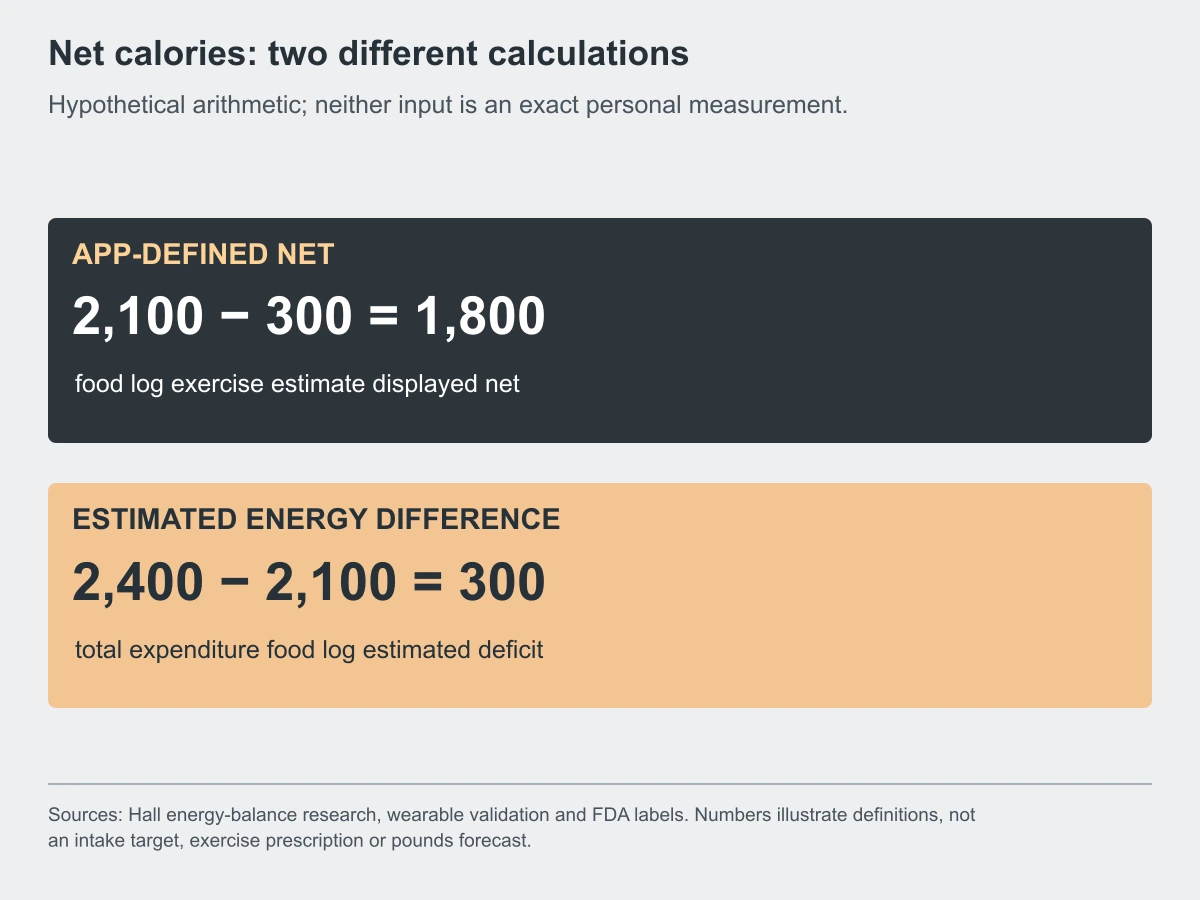
Net calories and a calorie deficit are different calculations
A calorie deficit refers to energy intake being below total energy expenditure over time. Total daily expenditure includes much more than one recorded workout. Subtracting an exercise number from food does not directly measure that deficit.
Imagine a hypothetical day with 2,100 calories logged from food, a 300-calorie workout estimate, and a separate total daily expenditure estimate of 2,400. The app’s net is 1,800. The estimated difference between total expenditure and food is 300. Those numbers answer different questions, and neither is an exact measurement of your physiology.
| Term | What it describes | A common misunderstanding |
|---|---|---|
| Food calories | Estimated energy from logged food and drinks | The log must be exact because it shows a precise total |
| Workout calories | An estimate related to a recorded activity | All of it is necessarily additional to the app’s baseline |
| Net calories | An app-defined subtraction or adjustment | It directly measures the body’s calorie deficit |
| Total daily expenditure | Energy used across the whole day | It consists only of resting energy plus the visible workout |
| Calorie deficit | Intake below total expenditure over time | One low app number guarantees a particular weight change |
Our calorie intake guide discusses how food estimates can inform planning without becoming a universal prescription. It is particularly relevant if your app’s goal feels difficult to meet or seems disconnected from hunger and daily function.
Where double counting happens
An activity setting may already assume a certain amount of movement. If you select a setting reflecting regular exercise and then add every workout again as extra expenditure, the displayed allowance may count some activity twice. A synced device can create a similar problem if the app imports overlapping step and workout entries.
Also check whether a device reports active calories or total calories during the session. A total may include energy you would have used at rest during that time. Treating all of it as additional energy can overstate what was added by the workout.
These are reasons to inspect the settings, not to compensate by eating an arbitrarily low amount. Check whether the workout appeared twice, whether the food goal already incorporates activity, and whether an automatic adjustment is positive or negative. If the app’s help text is unclear, bring the settings to a dietitian or other qualified professional.
How accurate are exercise-calorie estimates?
They are estimates. A wearable uses sensor information and a model, not a direct measurement of every calorie your body uses. Activity type, movement, body characteristics, and the device’s algorithm can affect the result. A precise-looking number should not be mistaken for a precise measurement.
A 2017 original validation study tested seven then-current wrist devices in 60 volunteers using laboratory measurements during sitting, walking, running, and cycling. Its energy-expenditure estimates were substantially less accurate than its heart-rate measurements; no tested device achieved energy-expenditure error below 20%. That finding concerns those devices and conditions, not every current watch or a fixed correction factor for your own readings. Original wearable study
Use a watch to support an activity routine, notice patterns, or record sessions if that is helpful. Avoid converting each workout estimate into an exact permission or obligation to eat a matching number of calories. Our exercise calorie guide explains why daily “burn” targets can be misleading.
Food logs have uncertainty too
A food log can help reveal meal patterns, missed meals, or foods you enjoy. Its total still depends on what was entered. Serving size, recipe ingredients, restaurant portions, cooking fat, drink additions, and database entries can change the estimate.
The Nutrition Facts label describes a particular serving, and a package may contain more than one serving. A food entry using a different amount can distort the comparison. Homemade dishes and restaurant meals also have variation. FDA label guidance
You do not need to eliminate every uncertainty to use a log thoughtfully. Instead, ask whether the information helps you make practical decisions. If checking every ingredient is becoming distressing or making meals difficult, a simpler record of meals, symptoms, and activity may be more appropriate.

Why a daily net number cannot predict pounds lost
Body weight changes dynamically. As intake, activity, and body size change, energy expenditure can change too. Short-term scale readings also reflect water, intestinal contents, and other factors rather than body fat alone.
The original Hall energy-balance paper explains why the familiar static 3,500-calorie-per-pound rule ignores physiological adaptation and can overpredict change when extended over time. The useful conclusion is that a repeated subtraction in an app does not guarantee a linear weight-loss timetable. It is not a reason to keep lowering intake when reality differs from a forecast. Original energy-balance research
If progress differs from what you expected, review the whole situation: the accuracy and purpose of the log, activity settings, eating pattern, symptoms, treatment, and the time period being considered. Our bowel movements and weight guide covers one reason a daily scale reading can change without a corresponding fat change.
Is there a minimum safe number of net calories?
There is no universal net-calorie minimum that can be safely applied to every adult through an internet calculator. First, apps define net differently. Second, subtracting a workout estimate does not describe nutritional adequacy. Two people with the same displayed number may have eaten different amounts, done different activities, and have very different health needs.
Consider the food actually consumed, meal variety, energy for ordinary life, and relevant medical conditions. Pregnancy, age, exercise demands, diabetes medications, illness, and a history of disordered eating can change the assessment. A low number on an app should not override dizziness, weakness, persistent hunger, poor recovery, or difficulty eating.
Our 900-calorie diet article discusses the limits and risks of very low intake. Its safety questions apply to the actual amount eaten; exercise subtraction does not make an inadequate eating pattern nutritionally complete.
Should you eat back exercise calories?
There is no automatic rule to eat back all, half, or none of the number. The appropriate plan depends on your baseline estimate, activity, health, appetite, and goals. A brief routine walk and a long demanding training session are different situations. A device estimate alone cannot decide the meal.
Ask whether the food goal already includes activity and whether your exercise pattern has meaningfully changed. Notice recovery, concentration, sleep, and your ability to complete ordinary tasks. If you are training regularly or often feel depleted after activity, individualized nutrition support is more useful than a rigid percentage.
Exercise does not need to serve as payment for eating. Planning enjoyable, sustainable activity can support health without assigning a debt to a meal. NIDDK’s weight-management guidance emphasizes realistic habits, support, and a program suited to the person. NIDDK program guidance
Net calories while using semaglutide or tirzepatide
Reduced appetite may make a food log look easy to keep under a goal, even when intake is becoming inadequate. A low displayed net can hide skipped meals, reduced fluids, or gastrointestinal symptoms. The goal of treatment includes health and function, not simply a smaller app total.
The joint nutrition advisory for GLP-1 therapy discusses nutritional assessment, supporting adequate intake, and preserving function. It does not establish an app-defined net target. If nausea, vomiting, diarrhea, or early fullness prevents eating, report the pattern to your care team. Joint nutrition advisory
Read the semaglutide protein and muscle guide or tirzepatide protein and muscle guide for related meal and activity questions. People exploring treatment can review the semaglutide and tirzepatide product pages with a clinician. Neither product makes exercise-calorie estimates exact or replaces individualized nutrition planning.

A practical way to review your app
Start with the definition of net calories and identify each input. Check the chosen activity setting, whether a wearable is linked, whether workouts are imported automatically, and whether you are also entering them manually. Record the settings before changing them so you can explain the current setup.
Next, compare the app’s numbers with everyday observations. Are you eating regular meals? Can you concentrate, recover from exercise, and manage usual tasks? Is the log useful or stressful? A few notes about meals, symptoms, and activity may provide more clinical context than a single daily net figure.
Finally, review sustained trends with a qualified professional when needed. They can help decide whether a calorie log is appropriate, how much activity to include in planning, and what to monitor. If tracking encourages fear of food, compulsive exercise, or escalating restriction, ask for support rather than a stricter target. NIMH eating-disorder information
Frequently asked questions
Are net calories the same as calories remaining?
Usually not, but the app’s definition controls. “Remaining” may compare your food total with a goal after activity adjustments. “Net” often subtracts exercise from food. Check the formula rather than assuming the labels are standardized.
Can a negative net calorie number be healthy?
A negative display means the app credited more activity energy than the food you logged. It does not establish good nutrition or superior progress. Check missing food entries, duplicated workouts, and the activity estimate, then consider whether you are eating adequately and feeling well.
Should I subtract resting calories from food too?
Do not invent an additional subtraction simply to make the number lower. Resting energy is already part of total expenditure, and your app may incorporate it into its goal. Combining multiple formulas without understanding them can create double counting and confusing advice.
What if my watch and treadmill disagree?
They use different models and inputs. Neither disagreement tells you the exact energy used. Log the activity consistently if useful, but avoid treating either estimate as a precise food allowance. The workout’s duration, effort, enjoyment, and your recovery can also inform planning.
Is a lower net always better for weight loss?
No. A low number can reflect under-eating, an inflated activity estimate, missing entries, or duplicated adjustments. Adequacy, sustainability, health, and the longer-term pattern matter. A number that produces worsening function is a reason to review the plan.
Can I plan meals without counting net calories?
Yes. Regular meals, food variety, attention to appetite and symptoms, and suitable activity can be discussed without a daily subtraction. Our protein breakfast guide gives practical examples, and a dietitian can help choose a method that fits your needs.
Educational information for adults; individual treatment decisions require a qualified clinician. Sources reviewed October 1, 2026. Original AI-generated article images depict fictional people and objects, not patient outcomes. Other editorial images are illustrative. Graphics summarize the cited sources.