
Tirzepatide has publicly documented human clinical research dating to 2016. Mounjaro, its first U.S. brand, was approved in May 2022 for adults with type 2 diabetes. Zepbound followed in November 2023 for chronic weight management, with an obstructive sleep apnea indication added in December 2024. Research history, approval history, and the current product label answer different questions.
The short answer depends on which date you mean
As of October 2026, there is roughly a decade of publicly documented clinical history, more than four years since the first U.S. Mounjaro approval, and almost three years since the original Zepbound approval. Those statements describe milestones; they do not mean every patient, dose, use, or device has been studied for that entire time.
A drug’s research can begin well before it becomes available by prescription. Publications may appear after a study has finished, and a registry’s results can be posted later still. New indications and presentations can also be added after the initial approval. If you want to assess your treatment, identify the exact medicine, reason for prescribing it, and current label first.
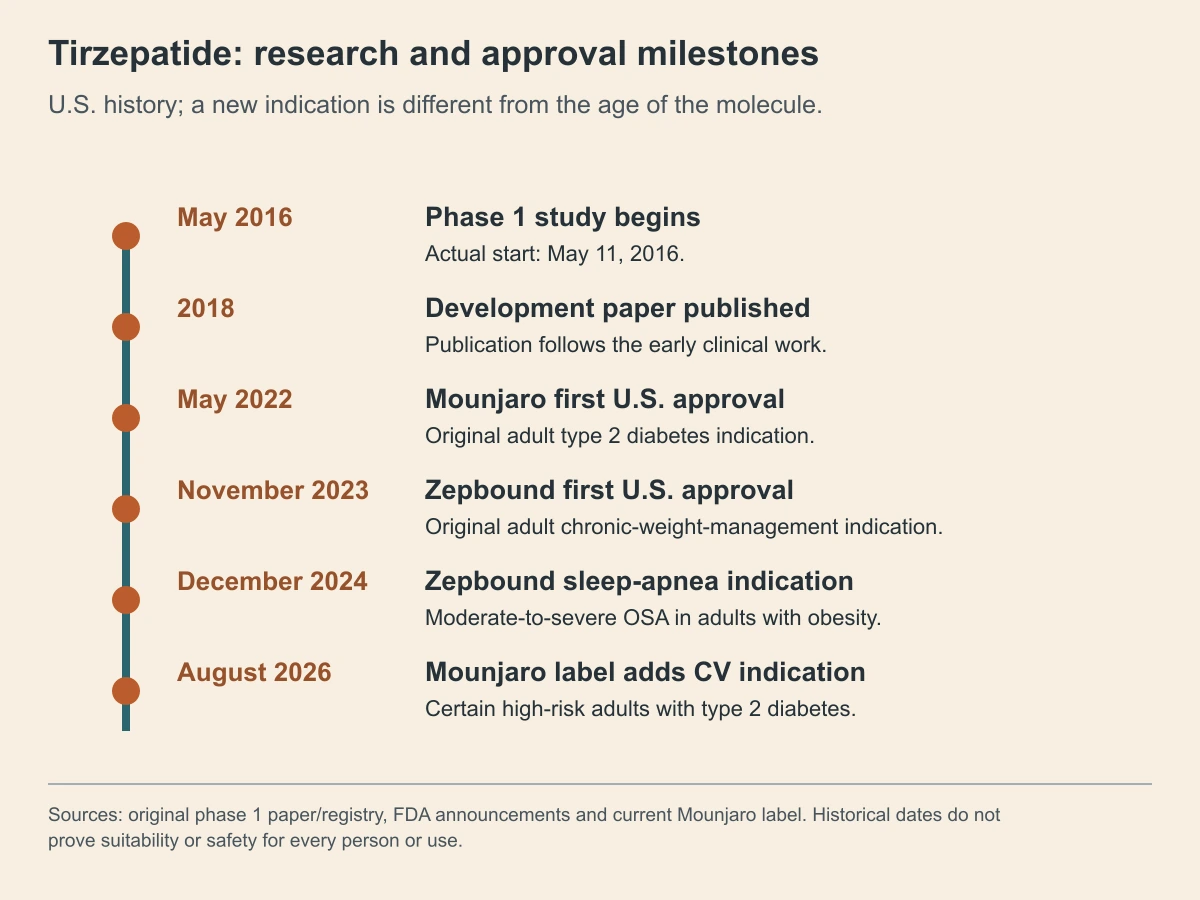
A timeline based on primary records
| Date | Documented milestone | What the date tells you |
|---|---|---|
| May 3, 2016 | First public posting of phase 1 registry NCT02759107 | A registry-posting date, distinct from the start of treatment |
| May 11, 2016 | Actual start of that phase 1 study | Human study activity recorded in the registry and original paper |
| June 26, 2017 | Actual completion of the study | Completion of the specific early trial, not the end of development |
| 2018 | Original development and early clinical paper published | Publication of findings from earlier work |
| May 13, 2022 | First U.S. Mounjaro approval | Initial adult type 2 diabetes indication |
| November 8, 2023 | First U.S. Zepbound approval | Original adult chronic-weight-management indication |
| December 20, 2024 | Zepbound obstructive sleep apnea approval | An additional indication for particular adults with obesity |
The early dates are documented in the phase 1 registry and original development paper. The later milestones come from the Mounjaro approval announcement, FDA weight-management announcement, and FDA sleep-apnea announcement. The dates are U.S. milestones; approvals and availability in other countries follow their own processes.
What was tirzepatide called during development?
The early research used the development code LY3298176. The original paper describes a single peptide designed to activate both glucose-dependent insulinotropic polypeptide, or GIP, and glucagon-like peptide-1, or GLP-1, receptors. The molecule was modified to support once-weekly subcutaneous administration.
This was more than a later brand-name change. The work included laboratory receptor studies, animal experiments, and early human studies examining safety, tolerability, pharmacokinetics, and physiological effects. Those parts supplied different kinds of evidence. Laboratory findings about a receptor do not establish a patient outcome, while animal results cannot simply be transferred to people. Original development paper
The fact that a paper was published in 2018 does not establish that the molecule was invented that year. The methods give the actual clinical-study dates, and the preclinical work necessarily has its own history. A useful patient-facing timeline should avoid inventing a precise discovery day from a publication year.
What did the early human study establish?
The phase 1 study included healthy participants and participants with type 2 diabetes. Its protocols investigated single ascending doses, repeated dosing over four weeks, and an early proof-of-concept component. The original paper reports that 142 participants received at least one study dose; the registry records actual enrollment of 142. Paper, Registry
The trial supplied information about tolerability, drug exposure, glucose-related effects, and weight changes under its specific conditions. The authors explicitly noted the limitations of short duration and a small sample. They called for larger and longer studies.
Its dose-escalation arrangements were experimental protocols, not a current prescription schedule. Do not use an old paper’s dosing sequence to start, restart, or increase a medicine. Our tirzepatide first-month guide explains why early follow-up should focus on the prescribed product, symptoms, intake, and practical questions rather than copying research regimens.
Mounjaro’s 2022 approval
The May 13, 2022 manufacturer announcement describes FDA approval of Mounjaro as an adjunct to diet and exercise to improve glycemic control in adults with type 2 diabetes. It also discusses weight changes observed in diabetes trials, while distinguishing them from an approved weight-loss indication at that time. Original announcement
That historical wording is useful for understanding the first approval, but a 2022 announcement is not the current prescribing information. The current label has since changed. Someone reading an older article may therefore encounter age ranges, indications, or device descriptions that no longer fully describe the product.
Our Zepbound versus Mounjaro guide explains the shared active ingredient and the importance of separate brand instructions. Shared tirzepatide does not make the brands’ indications, coverage, available presentations, or practical directions interchangeable.

Zepbound’s 2023 weight-management approval
On November 8, 2023, FDA announced approval of Zepbound for chronic weight management in specified adults with obesity, or overweight with at least one weight-related condition, alongside a reduced-calorie diet and increased physical activity. This created a separate branded product and indication history. FDA announcement
Approval for chronic weight management does not mean that every person wanting to lose weight is eligible or that treatment will produce the same result for everyone. Medical history, contraindications, other medicines, tolerability, and the prescribed plan remain relevant.
The what is Zepbound guide is a useful next step for questions about the product’s purpose. For treatment options through CoreAge Rx, the tirzepatide product page describes the service and supports a clinician discussion. Confirm the exact formulation and regulatory status of what is being prescribed rather than assuming it is the same as a named FDA-approved brand.
The 2024 sleep-apnea indication
On December 20, 2024, FDA approved Zepbound for moderate-to-severe obstructive sleep apnea in adults with obesity, with diet and physical activity. The announcement describes two randomized, double-blind, placebo-controlled studies lasting 52 weeks, including groups using positive airway pressure and groups unable or unwilling to use it. FDA sleep-apnea announcement
This is not a blanket indication for all types of sleep problems or all people with sleep apnea. It also does not authorize a patient to stop positive airway pressure without reviewing the treatment plan. The exact diagnosis and ongoing assessment matter.
An indication can be approved later even though the active ingredient is older. That is why “tirzepatide has been around since 2016” should not be read as “this particular sleep-apnea use has ten years of direct clinical evidence.”
Current labels continue to evolve
The current Mounjaro label reviewed for this article lists glycemic control in adults and pediatric patients aged 10 years and older with type 2 diabetes. Its highlights identify a December 2025 pediatric change and an August 2026 indication to reduce major adverse cardiovascular events in adults with type 2 diabetes at high risk for those events. These are label milestones, distinct from the original adult-only 2022 approval. Current Mounjaro prescribing information
Current Zepbound instructions also specify the applicable indications, available presentations, and safety information. A new pen, vial, or other presentation can change handling without changing the name of the active ingredient. Use the instructions for your actual product, including its storage and injection directions. Current Zepbound label
Our Zepbound storage guide discusses presentation-specific questions. A timeline cannot replace reading the label on the medicine you receive.
Does time on the market prove long-term safety?
Time provides opportunities to accumulate evidence, but it is not a guarantee that every risk is known or that treatment suits every person. Studies have particular populations, durations, comparators, and endpoints. Postmarketing reports add information but may not establish how often an event occurs or whether the medicine caused it.
Both named tirzepatide labels carry a boxed warning about thyroid C-cell tumors observed in rats. Whether tirzepatide causes those tumors in humans is unknown; the labels specify relevant contraindications, including personal or family history of medullary thyroid carcinoma and MEN 2. Other warnings cover gastrointestinal effects and conditions such as pancreatitis, gallbladder disease, and dehydration-related kidney problems. Mounjaro label, Zepbound label
The useful question is therefore not only “How old is this drug?” Ask what evidence supports your indication, what remains uncertain, and how your clinician will monitor benefit and tolerability. Our Zepbound side-effect guide covers practical follow-up questions without turning a study average into a personal prediction.
What history cannot tell you about your result
The number of years since development does not predict your first-month weight change, the dose you will tolerate, whether coverage will be approved, or how long you will use treatment. Those are separate clinical and practical questions.
Longer-term trial results also should not be divided by the number of weeks to produce an expected weekly loss. Changes may not be linear, trial groups differ, and an individual’s experience can vary. A first-month plan should include food intake, hydration, symptoms, activity, and a way to reach the care team.
Our tirzepatide protein and muscle guide explains why preserving nutrition and function matters during treatment. The history of the molecule is useful background; the current treatment plan is what guides day-to-day decisions.

Questions to bring to an appointment
Ask which exact product and presentation are being considered, which indication applies, and whether the cited evidence concerns people with circumstances similar to yours. Review the current label rather than relying on an old news release. Ask how the clinician will assess benefit, side effects, other medicines, and ongoing use.
If insurance is part of the decision, ask whether the plan covers the prescribed brand and reason for use, what authorization applies, and whether the product must come from a particular pharmacy. Approval of a medicine by FDA and approval of a claim by an insurer are different processes. Our Anthem GLP-1 coverage guide illustrates those plan-specific questions.
Frequently asked questions
Was tirzepatide invented in 2022?
No. The first U.S. Mounjaro approval was in 2022, but the cited phase 1 study began in 2016 and the original development paper appeared in 2018. An approval year is not the molecule’s discovery year.
Is Zepbound older than Mounjaro?
No. In the U.S. timeline, Mounjaro’s first approval came in May 2022 and Zepbound’s in November 2023. Both contain tirzepatide, but they have separate product and indication histories.
Does a new indication mean the medicine was reformulated?
Not necessarily. An indication concerns an approved use supported by evidence. A formulation or device change is a separate matter. Check the current prescribing information and the presentation actually dispensed.
Are older tirzepatide studies dosing guides?
No. Early studies tested experimental dose arrangements under research supervision. Follow the current prescription and exact product instructions, and ask the prescriber about interruptions or dose changes.
Does the history apply to compounded tirzepatide too?
It describes the molecule’s research and the named approved products. Compounded drugs are not FDA-approved products, and FDA does not review them for safety, effectiveness, and quality before marketing in the same way. Confirm what you are receiving and its instructions. FDA compounded-drug guidance
Educational information for adults; individual treatment decisions require a qualified clinician. Sources reviewed October 1, 2026. Original AI-generated article images depict fictional people and objects, not patient outcomes. Other editorial images are illustrative. Graphics summarize the cited sources.