
Yogurt can fit into a weight-management eating pattern, but there is no universally best yogurt for weight loss. Compare the actual serving, protein, added sugar, ingredients, and what you plan to eat with it. A yogurt that is satisfying, affordable, and compatible with your health needs is more useful than choosing by a “diet” claim alone.
What makes yogurt a useful option?
Depending on the product, yogurt can provide protein and other nutrients in a convenient food. It can be a snack, a breakfast ingredient, a savory sauce, or part of another meal. That flexibility may help someone build a practical routine, especially when cooking time or appetite is limited.
The category is broad. Plain Greek yogurt, sweetened conventional yogurt, drinkable yogurt, dairy-free alternatives, and dessert-style cups can have different nutrition. Even different sizes of the same product can produce misleading comparisons if you read only the headline protein number.
Start with the Nutrition Facts panel and ingredient list. Check whether the numbers refer to the entire container, a portion of a larger tub, or another defined serving. The labeled serving is a reference for the nutrition information, not a personal instruction about how much you must eat. FDA label guidance
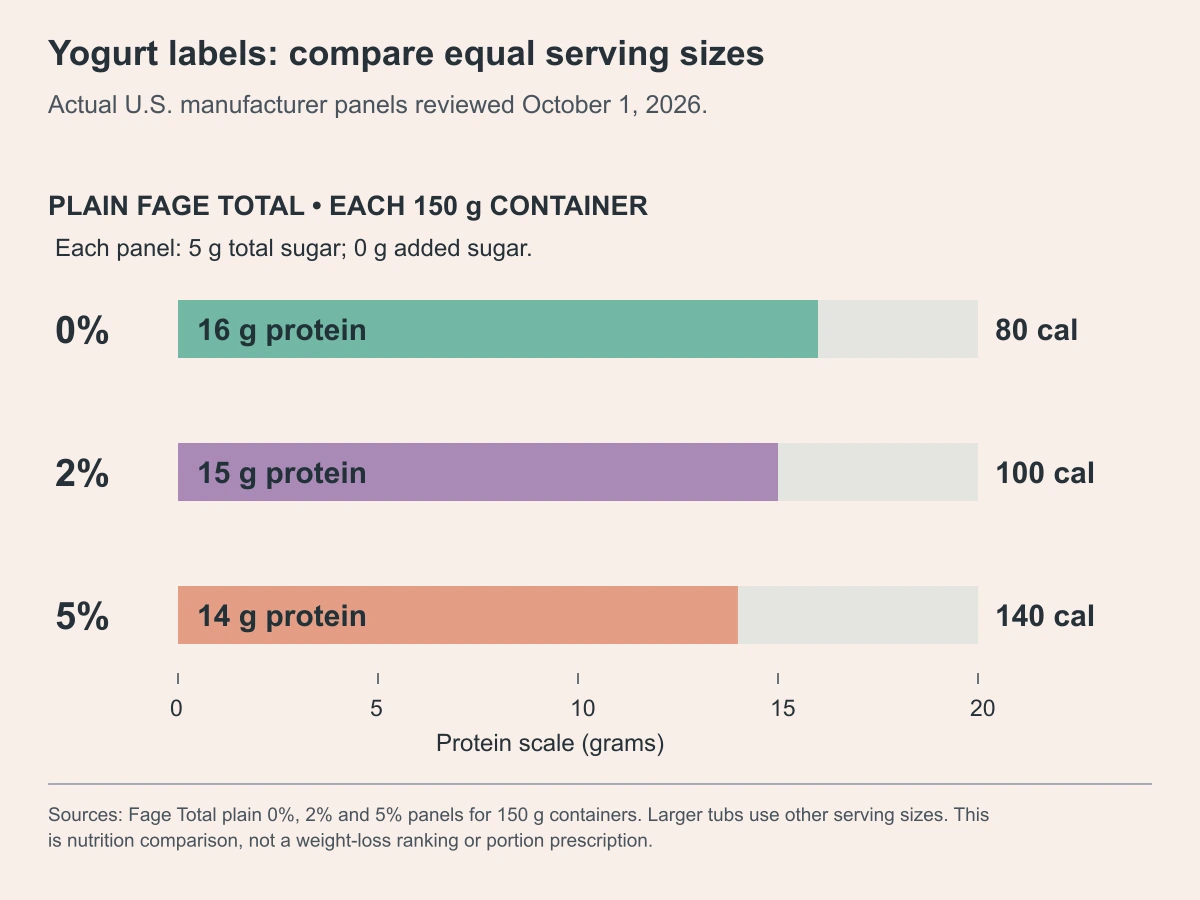
A fair comparison uses the same serving size
The following examples are plain U.S. Fage Total products listed by the manufacturer for a single 150 g container, reviewed October 1, 2026. They illustrate how milk-fat levels can change a panel within one product family. They do not rank every yogurt or prescribe a portion.
| Plain Fage Total example | Serving | Calories | Protein | Total fat | Total sugar / added sugar |
|---|---|---|---|---|---|
| 0% | One 150 g container | 80 | 16 g | 0 g | 5 g / 0 g |
| 2% | One 150 g container | 100 | 15 g | 3 g | 5 g / 0 g |
| 5% | One 150 g container | 140 | 14 g | 8 g | 5 g / 0 g |
Sources: the manufacturer’s 0% panel, 2% panel, and 5% panel. These pages also show larger-tub nutrition using a 170 g serving. Do not combine a 150 g calorie value with a 170 g protein value. Check your own package because formulations and sizes can change.
All three 150 g examples list zero grams of fiber. If you want fiber in the snack or meal, consider other foods rather than assuming a yogurt’s protein content provides it. The ingredient lists contain milk and live active cultures; the 2% and 5% examples also list cream.
Is Greek yogurt better than regular yogurt?
It can be a useful choice, but the word “Greek” does not settle every nutrition question. Compare actual products rather than applying one product’s panel to the whole category. Texture, protein, fat, added sugar, price, and preference can all affect what works for you.
If two yogurts have different serving sizes, put them on a comparable basis or simply recognize that the containers provide different amounts of food. Also consider how they are used. A yogurt you enjoy and regularly eat with other useful foods may fit better than a supposedly ideal product you dislike.
If the goal is a filling breakfast, ask what the whole breakfast supplies. Yogurt with oats and fruit is a different meal from a small yogurt eaten alone. Our protein breakfast guide offers ways to think about the combination without requiring a particular brand.
Does nonfat yogurt produce more weight loss?
The lower-calorie option in a specific comparison is not automatically the best choice for every person. In the Fage examples, the 0% cup has fewer calories than the same-size 5% cup, but the choice still sits within the whole eating pattern. Preference, satiety, overall intake, and other health considerations matter.
Choosing a richer yogurt might make a meal more enjoyable for someone. Another person may prefer nonfat or reduced-fat. Neither choice guarantees a particular weight outcome, and there is no need to treat a higher-fat plain yogurt as a failed diet decision.
Our calorie intake guide explains why an energy estimate is one part of planning rather than a reason to always choose the smallest number. Nutrition guidance also considers food variety and the person’s medical needs. NIDDK nutrition guidance
Total sugar and added sugar are different
Plain dairy yogurt can contain naturally occurring milk sugar even when the panel lists zero added sugar. “No added sugar” therefore does not necessarily mean “sugar-free.” Check both lines on the panel rather than assuming the total-sugar figure reflects sweeteners added during manufacturing.
Flavored products may add sugar, fruit preparations, sweeteners, or other ingredients, but the amount varies. You do not need to assume every flavored yogurt has the same panel. A product that suits your taste can still fit; compare the actual serving and consider the entire meal.
Toppings change the finished dish too. Honey, granola, fruit, nuts, seeds, and nut butter add different nutrients and amounts of energy. Adding them is not automatically a problem, but the yogurt’s printed panel no longer describes the whole bowl. FDA Nutrition Facts guidance

Practical yogurt meal and snack ideas
Yogurt, fruit, and oats: This combines a yogurt with produce and a grain. You can use fresh, frozen, or another suitable fruit, and adapt the texture to your preference. The portion can change with appetite and whether it is a snack or a meal.
Yogurt with toast: If you want a quick breakfast, toast can provide another food alongside the yogurt. A topping you enjoy may make the combination more satisfying. You do not need to turn it into a complicated recipe.
A savory dip or sauce: Plain yogurt can be mixed with herbs or seasonings and served alongside a meal. Its nutrition does not erase the nutrition of the foods it accompanies. Think about the complete plate, including carbohydrates, vegetables, protein sources, and fats as appropriate for you.
A small snack: Yogurt alone may work when you want a snack between meals. If you remain hungry, adding food or choosing a larger snack may be more useful than assuming hunger means you picked the wrong brand.
If drinks are more convenient for you, our protein shake meal ideas discuss a similar principle: a protein product can be one useful component, while other foods add variety and meet different needs.
What about dairy-free yogurt?
Check the exact product. Dairy-free alternatives can use different ingredients and may differ in protein, added sugar, fortification, and texture. A familiar-looking cup does not establish nutritional equivalence with a dairy yogurt.
If you avoid milk because of an allergy, read ingredients and allergen information carefully. Lactose intolerance and milk allergy are different conditions. A lactose-free dairy product may still contain milk proteins and therefore does not solve a milk allergy. FDA allergen information
For someone with lactose intolerance, suitability can depend on the amount and individual tolerance. NIDDK notes that some people tolerate yogurt and certain other dairy foods more easily, but it is not a guarantee for every yogurt or person. Discuss recurring symptoms and suitable alternatives if needed. NIDDK lactose-intolerance guidance
Do live cultures mean the yogurt burns fat?
No. The presence of live cultures on an ingredient list does not establish that the finished product produces weight loss. The named Fage panels tell you about ingredients and nutrition; they are not trials showing that a particular cup reduces body fat.
A claim about a microorganism, a laboratory mechanism, or another formulation cannot be automatically transferred to every yogurt. To evaluate a specific weight-loss claim, you would need relevant human evidence for the product, outcome, and population being discussed.
You can still choose yogurt because you enjoy it or find it practical. It does not need a fat-burning explanation to be part of a useful meal. Avoid paying more solely because a package implies a dramatic metabolism effect that its nutrition panel cannot demonstrate.
Yogurt during semaglutide or tirzepatide treatment
Yogurt may be an easy food for some people when appetite is lower. For others, its texture, sweetness, dairy ingredients, or richness may be less comfortable. A tolerated food is useful, but relying on a very small yogurt for repeated meals can leave gaps in overall intake.
The joint nutrition advisory for GLP-1 therapy emphasizes assessment, adequate nutrition, and maintaining function. It does not identify one yogurt as a complete solution. If early fullness, nausea, vomiting, or diarrhea makes eating difficult, share that pattern with the care team. Joint nutrition advisory
The semaglutide protein and muscle guide and tirzepatide protein and muscle guide cover related concerns. If considering treatment, review the semaglutide or tirzepatide product information with a clinician. A yogurt choice does not determine whether a medicine is appropriate.

A simple shopping checklist
Identify the product you actually want to compare, then read its serving in grams and servings per container. Check protein, total and added sugar, fat, fiber, and ingredients. If fortification matters to you, read the listed nutrients rather than assuming every dairy-free or dairy product supplies the same amount.
Next, consider how you will eat it. A breakfast, snack, and sauce need not use the same amount or toppings. Compare price and what is available consistently. The best practical choice is often a product you can use comfortably in a sustainable routine.
If you have a medical condition affecting food choices, bring the label to a clinician or dietitian. That is more helpful than asking for a universal best brand. A safe weight-management approach should remain realistic and support health rather than depend on one special food. NIDDK program guidance
Frequently asked questions
Can I eat yogurt every day while trying to lose weight?
Yes, it can be a regular food if it suits your preferences and health needs. Consider the overall pattern and variety. Eating it every day does not guarantee weight loss, and there is no need to force it if another food works better for you.
Is plain yogurt always better than flavored?
Plain yogurt makes it easier to see what you add yourself, but the right choice depends on the actual panels and what you enjoy. A flavored yogurt is not automatically unsuitable. Compare equivalent servings and the full meal rather than the flavor name alone.
How much yogurt should I eat?
There is no universal portion for all adults. The label’s serving is a nutrition reference. Appetite, whether it is a snack or meal, other foods, and your health needs determine what is appropriate. The 150 g comparison above is an example, not a prescription.
Can yogurt replace a meal?
A yogurt can be part of a meal, but a small cup alone is not automatically enough. Check the amount of food, energy, and variety you are getting. Repeatedly struggling to eat more should prompt support, especially during treatment or illness.
Does zero added sugar mean there are no carbohydrates?
No. The named plain dairy examples contain total carbohydrate and naturally occurring sugar. Read the carbohydrate line if it matters for your diabetes or meal plan; added sugar is a separate line.
Is yogurt a treatment for constipation or diarrhea?
Do not assume so. A food’s suitability depends on the cause and your tolerance. Persistent or severe symptoms need assessment. Our constipation on GLP-1 medicines guide and Wegovy diarrhea guide discuss when food questions need to be paired with medical follow-up.
Educational information for adults; individual treatment decisions require a qualified clinician. Sources reviewed October 1, 2026. Original AI-generated article images depict fictional people and objects, not patient outcomes. Other editorial images are illustrative. Graphics summarize the cited sources.