“Will testosterone give me more energy?” is a common question, but energy can mean several different things: less fatigue, better mood, more muscle strength, improved walking, or greater motivation. The Testosterone Trials measured some of these separately, and the results were not uniformly positive.
In older men with consistently low testosterone and relevant symptoms, treatment produced some benefits. It did not establish a significant benefit for the main vitality outcome or the main walking-response endpoint in the dedicated Physical Function Trial. That distinction is important when discussing what TRT can reasonably be expected to do.
Why does the word “energy” need unpacking?
Someone who says they have low energy may be describing sleepiness, breathlessness, low mood, muscle weakness, reduced endurance, or a lack of interest in activity. Those symptoms overlap in everyday language but may arise from different problems.
A study needs a precise endpoint to distinguish them. A fatigue questionnaire measures a person’s experience. A six-minute walk measures performance under specified conditions. A strength test measures a particular physical capacity. A fall count captures yet another outcome.
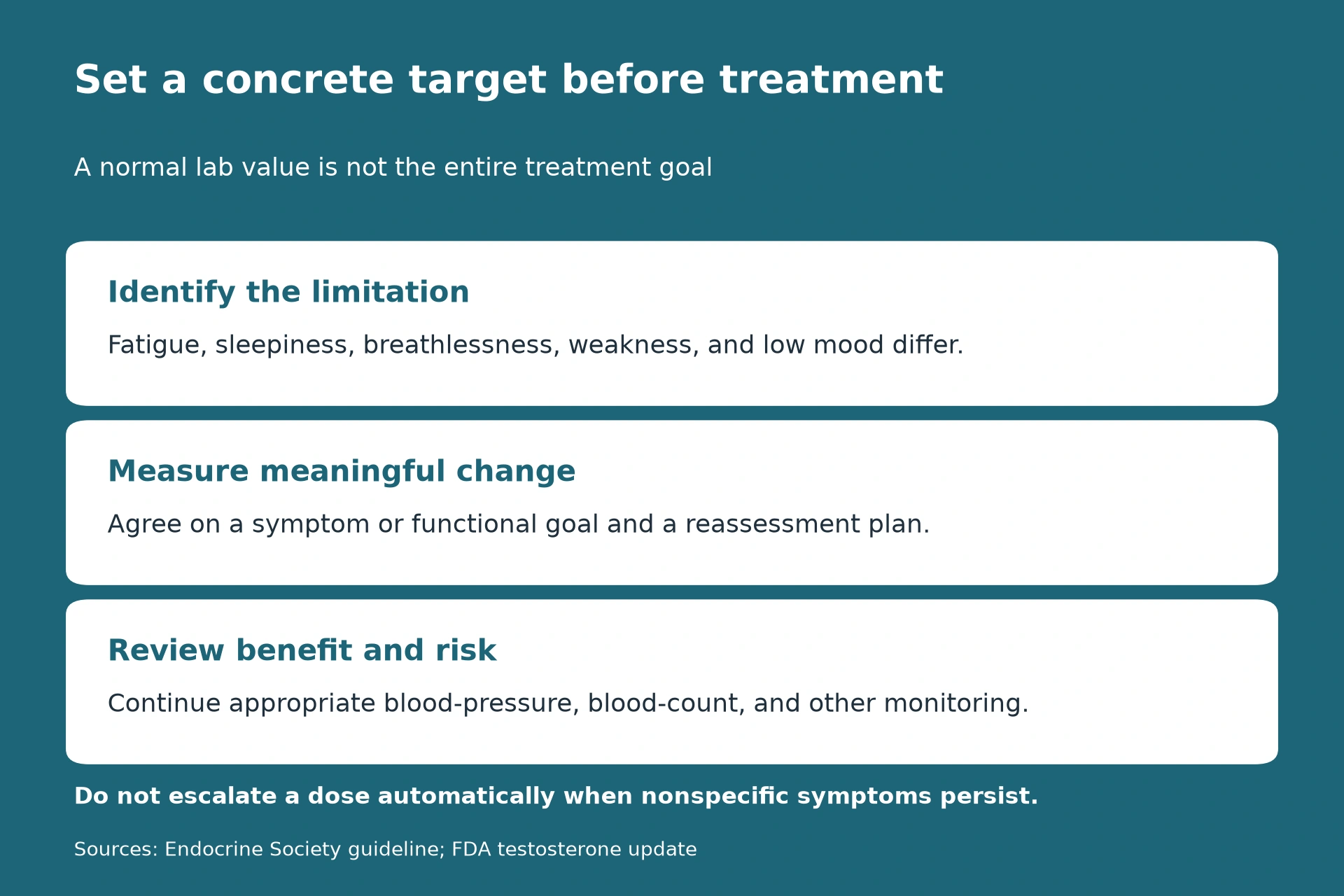
Before treatment, it helps to identify what has actually become difficult. “I cannot climb my usual stairs without stopping” provides a more concrete starting point than “I want more energy.” Our low testosterone versus stress and poor sleep guide outlines related assessment questions.
What were the Testosterone Trials?
The program included linked randomized trials examining different outcomes in older men with low testosterone. The main 2016 report described 790 men aged at least 65 with testosterone concentrations below 275 ng/dL and symptoms suggesting androgen deficiency. Participants received testosterone gel or placebo gel for one year. Original report.
Treatment raised testosterone into the mid-normal range for younger men. This matters because a negative endpoint cannot simply be dismissed as a failure to change the hormone measurement. The biological target moved, while the clinical outcomes still differed by domain.
The participants were selected and monitored for research. The results do not directly establish benefits for healthy younger men, people with normal testosterone, or people using supraphysiologic doses for performance enhancement.
What did the dedicated walking trial measure?
The Physical Function Trial enrolled 390 men who reported mobility limitation and had a walking speed below 1.2 meters per second. Its primary endpoint was the proportion improving their six-minute walking distance by at least 50 meters. Physical-function report.
A threshold endpoint asks how many people improve enough to cross a predefined line. It is different from calculating the average change in distance. A small average improvement might occur without many participants reaching a larger response threshold.
The trial did not find a statistically significant difference in the primary walking-response endpoint within this dedicated population. That is the result to keep visible when an advertisement claims that TRT reliably restores mobility.
Why do some summaries report a positive walking result?
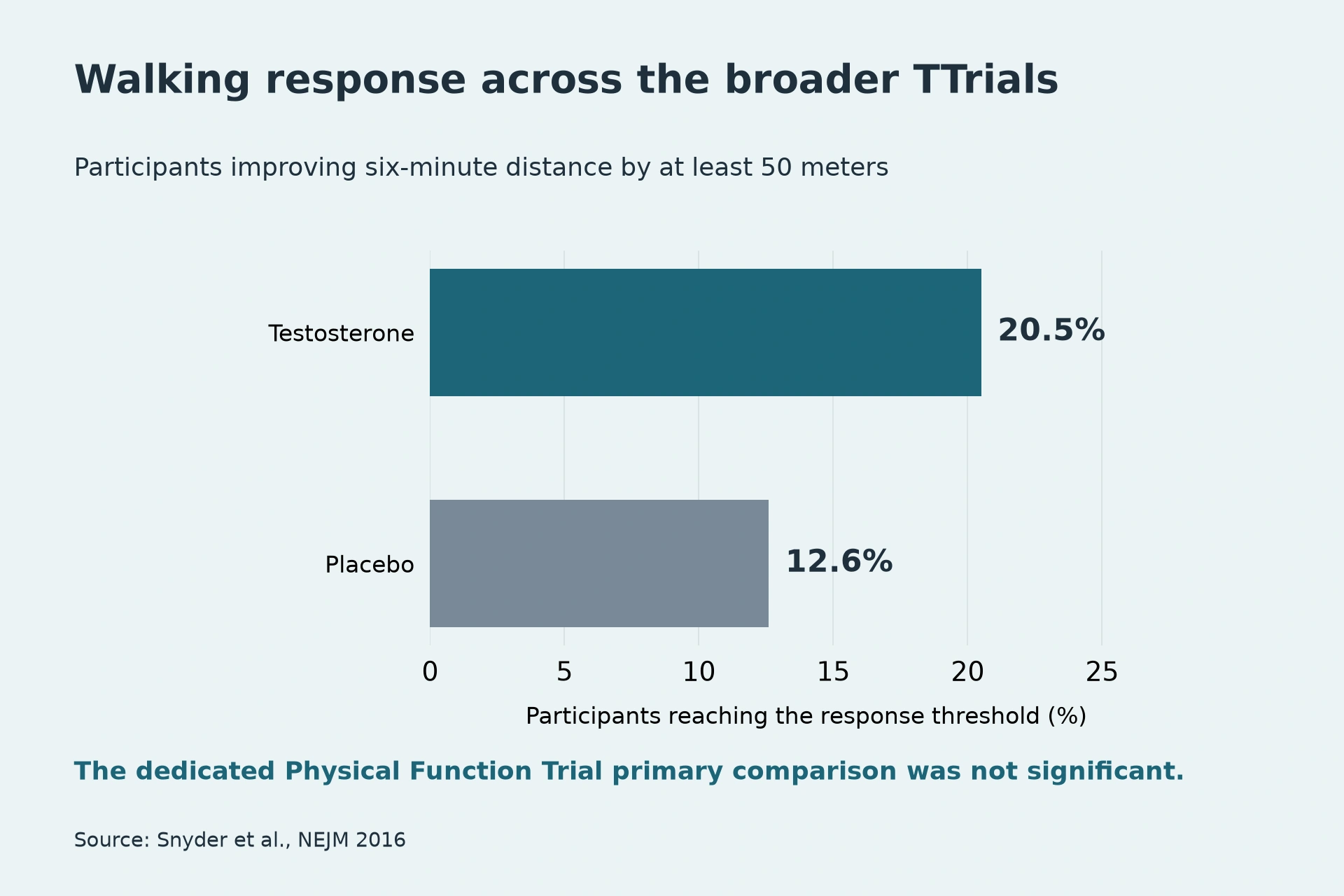
The main report also analyzed the walking endpoint across participants in all three principal trials, not only those in the Physical Function Trial. In that broader population, 20.5% with testosterone versus 12.6% with placebo achieved at least a 50-meter improvement, with P = 0.003. Broader walking analysis.
Both statements can be true: the dedicated trial’s main endpoint did not establish benefit, while a broader analysis did show a difference. The population and analysis label must remain attached to the number.
The 7.9-percentage-point difference between those proportions is not a claim that everyone walked 7.9% farther. It is a difference in the share of participants reaching a particular response threshold.
What did the later mobility analysis show?
A later report examined absolute walking changes, perceived function, falls, and factors associated with response. Across all Testosterone Trials participants, testosterone modestly improved measured walking distance and consistently improved self-reported walking ability. The effects varied with baseline walking speed and mobility characteristics. Secondary mobility analysis.
For participants not enrolled in the dedicated Physical Function Trial, the treatment effect on six-minute distance was 8.9 meters, with a 95% confidence interval of 2.2–15.6 meters. This is a modest average difference in a defined analysis, not a universal improvement or the same quantity as the 50-meter response threshold.
A statistically detectable difference does not automatically establish a large change in daily independence. The clinical importance depends on the measure, the starting limitation, and what the person is trying to do.
Did TRT reduce falls?
No reduction was established in the reported falls analysis. 103 of 380 assessed participants in each group, about 27%, experienced at least one fall during the intervention period. Falls results.
That result illustrates why better performance on one measure cannot be assumed to prevent injury. Falls involve balance, vision, medicines, blood pressure, environmental hazards, and other factors beyond hormone concentration or muscle size.
Our TRT bone and fracture review explains another important distinction: improvements in a bone measurement do not necessarily mean fewer fractures. For someone worried about falls, a focused fall-risk assessment is more informative than relying on a general promise of stronger bones or greater vitality.
What happened to fatigue and mood?
The main report did not establish a significant benefit on the primary vitality outcome, assessed with the FACIT-Fatigue instrument. Participants assigned testosterone reported slightly better mood and lower severity of depressive symptoms on other measures. Vitality and mood results.
The findings should not be compressed into either “testosterone fixes fatigue” or “testosterone has no effects.” Different outcomes produced different results. The trial was not a general depression-treatment study, and small average mood changes should not be presented as proof of treating major depressive disorder.
If fatigue persists, a clinician may need to review sleep, anemia, mood, medicines, metabolic conditions, and other causes. Our testosterone and anemia article addresses a specific blood-count endpoint; it does not mean every tired person has testosterone-responsive anemia.
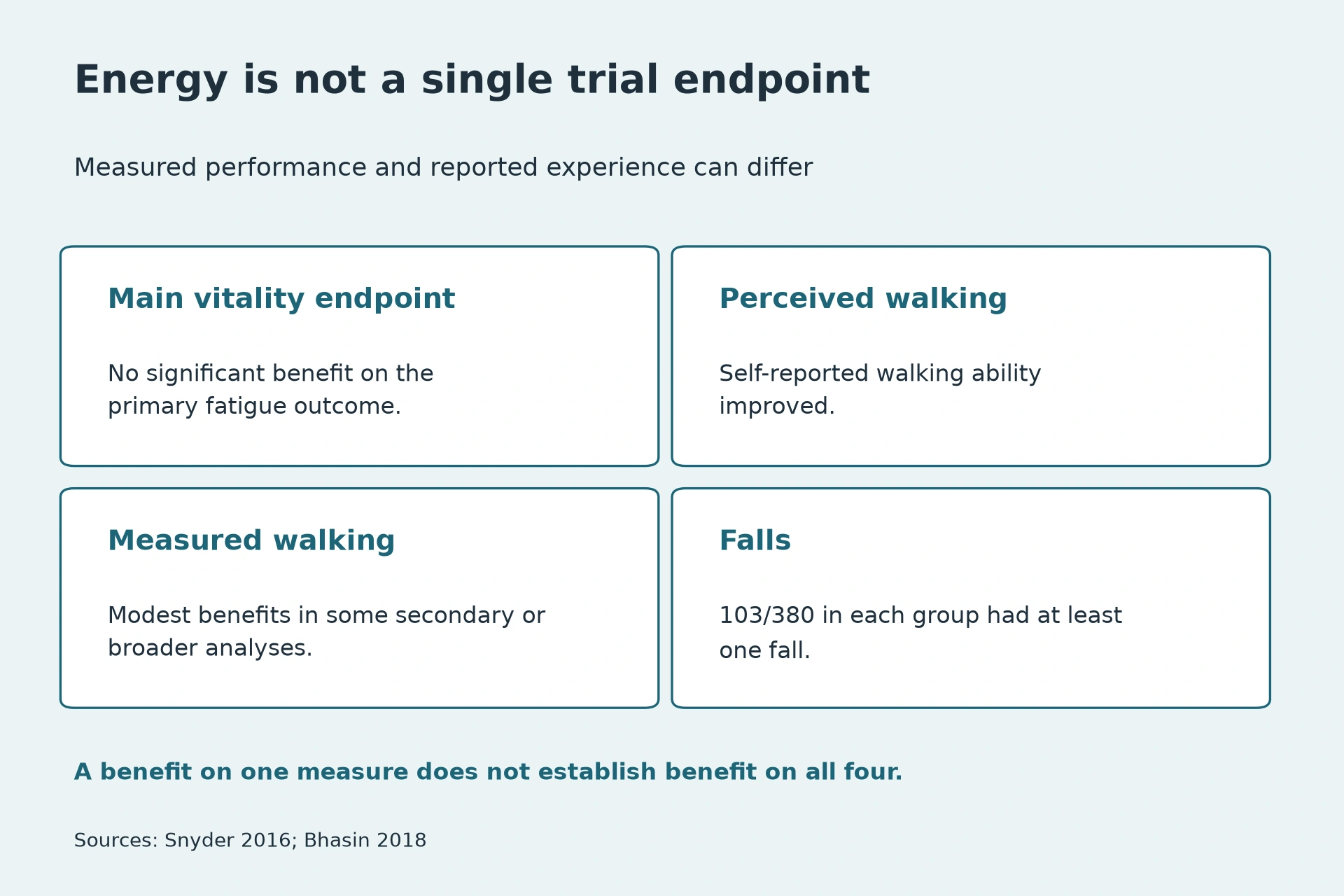
| Outcome | What the research reported |
|---|---|
| Main walking response in the Physical Function Trial | No significant treatment difference |
| Walking response across the broader trial population | More participants crossed the 50-meter threshold with testosterone |
| Average walking distance in secondary analyses | Modest improvements in some analyses |
| Self-reported walking ability | Consistent favorable effects |
| Falls | Same proportion with at least one fall in both assessed groups |
| Main vitality endpoint | No significant benefit |
| Mood measures | Small favorable average changes |
Why can perceived and measured function differ?
A participant may feel more capable without a large change in a timed performance test. Conversely, a small measured improvement may not alter the person’s daily experience. Both types of information matter, but neither should be relabeled as the other.
Self-reported measures can capture confidence and perceived limitations that a short walking test misses. Performance tests offer a standardized task but may not represent a person’s usual environment, pain fluctuations, or priorities. The most useful interpretation considers both.
For follow-up, choose a meaningful activity and describe it consistently. Examples include completing a familiar walk, carrying groceries, or climbing a usual flight of stairs. These are discussion points for a care plan, not substitutes for a clinical examination or validated testing when needed.
Does increased muscle mass guarantee more strength or endurance?
No. Muscle size, strength, endurance, balance, and function are related but distinct. A body-composition scan does not directly measure whether someone can get up safely from a chair or walk farther without symptoms.
Our TRT body-composition and strength guide and beginner strength-training guide provide useful context. Exercise, rehabilitation, and treatment of pain or other limiting conditions may be relevant even when testosterone is appropriately prescribed.
The trials reviewed here do not compare TRT with an individualized rehabilitation program. They also do not establish that adding other hormones or peptides improves these outcomes. A shared word such as “recovery” in product marketing is not a common clinical endpoint.
What safety information belongs in the decision?
The original one-year trials were too small to settle uncommon or long-term safety outcomes. Their reassuring or similar event counts should not be read as proof that treatment is risk-free. Later studies and current product information remain relevant. Original trial limitations.
The FDA’s 2025 labeling changes reflected TRAVERSE cardiovascular findings while adding or strengthening blood-pressure warnings. The agency retained limitations concerning age-related hypogonadism. These changes do not establish testosterone as a general anti-aging or energy medicine. FDA update.
Our blood-count monitoring guide, prostate-safety review, and fertility review cover important separate issues. Fertility plans are particularly important before starting exogenous testosterone.
How should expectations be agreed before treatment?
The Endocrine Society guideline emphasizes symptoms, consistently low testosterone, evaluation of the cause, shared decisions, and monitoring. A symptom checklist alone is not sufficient. Clinical guideline.
Agree on a specific target, a reasonable reassessment interval, and what would count as inadequate benefit or an unacceptable adverse effect. If testosterone normalizes but the original symptom does not improve, that is a reason to revisit the diagnosis and plan rather than automatically increasing the dose.
CoreAge Rx’s TRT service information can help identify practical questions about care. The gel studies described here do not demonstrate identical outcomes for every injectable regimen or formulation. The starting-TRT questions guide provides a broader appointment checklist.
Video: cardiovascular safety is a separate research question
This NEJM Group video summarizes TRAVERSE, a later cardiovascular safety trial. It adds context to the risk discussion; it does not establish improved energy, walking, or fall prevention in the Testosterone Trials.
Frequently asked questions
Will TRT reliably cure low energy?
The main vitality endpoint did not show a significant benefit in the studied older men. Some outcomes improved, but persistent fatigue needs a clear diagnosis and a broader assessment.
Why mention a positive walking result after a negative primary endpoint?
Because both were reported and answer different questions. Keeping the populations and endpoint definitions visible provides a fuller account without replacing the primary result.
Does feeling better justify skipping monitoring?
No. Subjective benefit does not rule out changes in blood pressure, hematocrit, fertility, or other treatment-related concerns.
What is the most useful takeaway?
Define the outcome before judging the treatment. A higher testosterone level, a better mood score, a longer walk, and fewer falls are different goals with different evidence.
Original papers and supporting sources
The references distinguish full research papers, published abstracts, and official guidance. This educational narrative review is not a systematic review or an individual treatment recommendation. Sources were checked in October 2026.
- Snyder PJ et al. Effects of Testosterone Treatment in Older Men. (2016). Published abstract reviewed. DOI: 10.1056/nejmoa1506119.
- Bhasin S et al. Effect of testosterone replacement on measures of mobility in older men with mobility limitation and low testosterone concentrations: secondary analyses of the Testosterone Trials. (2018). Full text reviewed. DOI: 10.1016/s2213-8587(18)30171-2. Open full text.
- Bhasin S et al. Testosterone Therapy in Men With Hypogonadism: An Endocrine Society Clinical Practice Guideline. (2018). Published abstract reviewed. DOI: 10.1210/jc.2018-00229.
- FDA: 2025 testosterone labeling changes. Official guidance.