Mood changes during the menopause transition deserve attention, but “HRT helps depression” is too broad to describe the research. Preventing new depressive symptoms, treating an existing depressive disorder, and studying symptoms after estrogen withdrawal are three different questions.
Randomized trials have found encouraging effects in selected populations, particularly around perimenopause. Their size, eligibility criteria, endpoints, and safety findings still matter. The evidence does not support treating every episode of low mood as a hormone deficiency or replacing a full mental-health assessment with a prescription.
Why separate symptoms from a diagnosis?
Low mood, irritability, poor sleep, fatigue, and difficulty concentrating can occur together. Their presence does not tell us by itself whether someone has a depressive disorder, menopausal symptoms, another medical condition, or several problems at once.
A symptom questionnaire can help researchers and clinicians identify a pattern or track change. A threshold score is not always equivalent to a diagnostic interview establishing major depressive disorder. That distinction becomes important when a prevention trial is described as “preventing depression.”
The National Institute of Mental Health describes assessment and treatment options, including psychotherapy, medication, or both. Persistent symptoms, loss of interest, impaired daily functioning, and safety concerns deserve clinical attention regardless of whether they coincide with menopause. NIMH information.
What did the 2018 prevention trial test?
Gordon and colleagues randomized 172 women aged 45–60 who were initially euthymic, meaning they were not experiencing a current depressive state as defined for trial entry. Participants were in perimenopause or early postmenopause. The intervention combined transdermal estradiol with intermittent oral micronized progesterone for twelve months, compared with matched placebo. Original prevention trial.
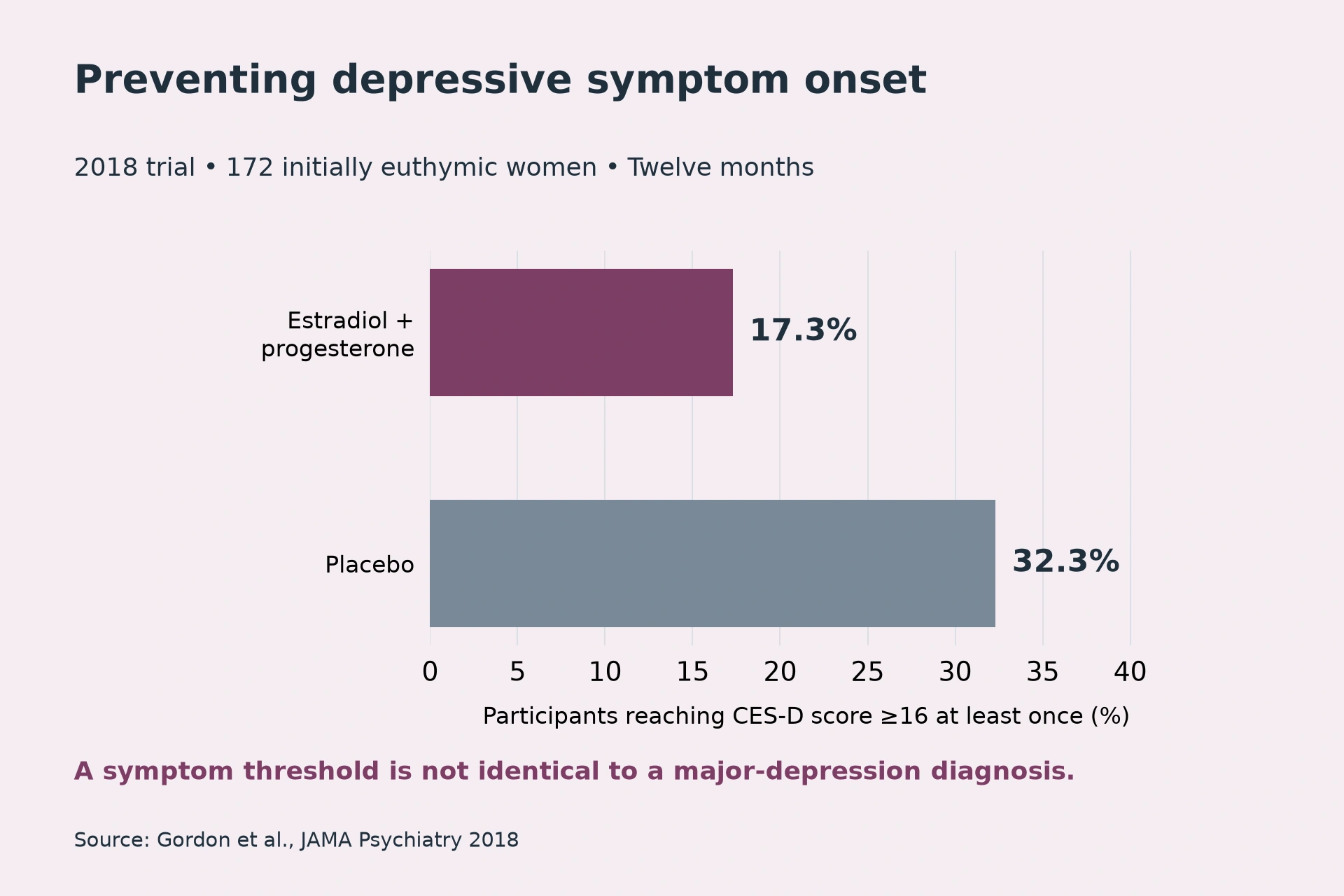
The study repeatedly measured symptoms with the Center for Epidemiological Studies-Depression scale, or CES-D. Its clinically significant symptom endpoint was a score of at least 16 at least once during the intervention period.
This was a prevention question in initially well participants. It was not a trial of hormone therapy versus an antidepressant in people seeking treatment for a current major depressive episode.
What was the main result?
Clinically significant symptoms developed in 17.3% of the hormone-treatment group and 32.3% of the placebo group. The reported odds ratio, expressed as placebo relative to active treatment, was 2.5, with a 95% confidence interval of 1.1–5.7. Prevention results.
The absolute difference between the displayed proportions is 15 percentage points over the study period. That result is clinically interesting, but it is not a prediction that every similar patient has exactly that chance of benefit.
An odds ratio is not the same as a risk ratio. Saying placebo participants were “2.5 times as likely” without explaining the measure can exaggerate the intuitive meaning when outcomes are fairly common. Reporting the actual proportions makes the result easier to understand.
Did all menopausal stages benefit equally?
The authors reported that reproductive stage modified the symptom-score effect: the clearest benefit appeared in women in the early menopause transition, rather than uniformly across late transition and postmenopause. Recent stressful life events also appeared to modify the response. Moderator analyses.
These analyses suggest useful research questions, but the subgroups are smaller than the full trial. They are not a reliable formula for predicting an individual’s response, and they should not be used to diagnose a hormone-responsive mood disorder from a brief questionnaire.
Our perimenopause symptoms guide explains the broader clinical setting. The timing of symptoms can help guide an assessment without proving that hormones are their only cause.
What safety findings should not be omitted?
Bleeding and spotting were more common with active treatment in the prevention trial. One participant in the active group developed an acute deep-vein thrombosis, while two placebo participants developed major depressive disorder requiring study termination and treatment. Full trial safety report.
These small counts cannot provide a precise estimate of uncommon risks. They do show why a favorable mood result should not be presented without safety context. A trial with 172 participants is not large enough to settle long-term cardiovascular, cancer, or clotting outcomes.
The progesterone schedule was part of the research protocol and should not be copied as a personal regimen. Clinical endometrial protection, bleeding evaluation, and product selection require individualized care. Our bleeding-on-HRT guide discusses when unexpected bleeding needs review.
What did the earlier treatment trial show?
Soares and colleagues conducted a twelve-week placebo-controlled trial of transdermal estradiol in 50 perimenopausal women with depressive disorders. The sample included major depressive disorder, dysthymic disorder, and minor depressive disorder, rather than only one diagnosis. Original 2001 treatment trial.
Remission was reported in 17 women receiving estradiol, or 68%, versus five receiving placebo, or 20%. This is an encouraging treatment signal in a small selected sample. It should not be generalized to all postmenopausal women or all forms of depression.
The study was also too short and small to define uncommon harms or an optimal long-term regimen. It did not compare estradiol head-to-head with contemporary psychotherapy or antidepressant treatment, so it cannot establish superiority to those options.
Why not combine the prevention and treatment percentages?
The 17.3% figure in the prevention study describes people who developed a symptom threshold. The 68% figure in the treatment study describes remission among people who already had a depressive disorder. One is an incidence-type outcome; the other is a treatment-response outcome.
Putting them in the same ranking chart without those labels would be misleading. Their baseline populations, duration, regimens, and definitions differed. Even though both involve estradiol and mood, they do not estimate one universal effect size.
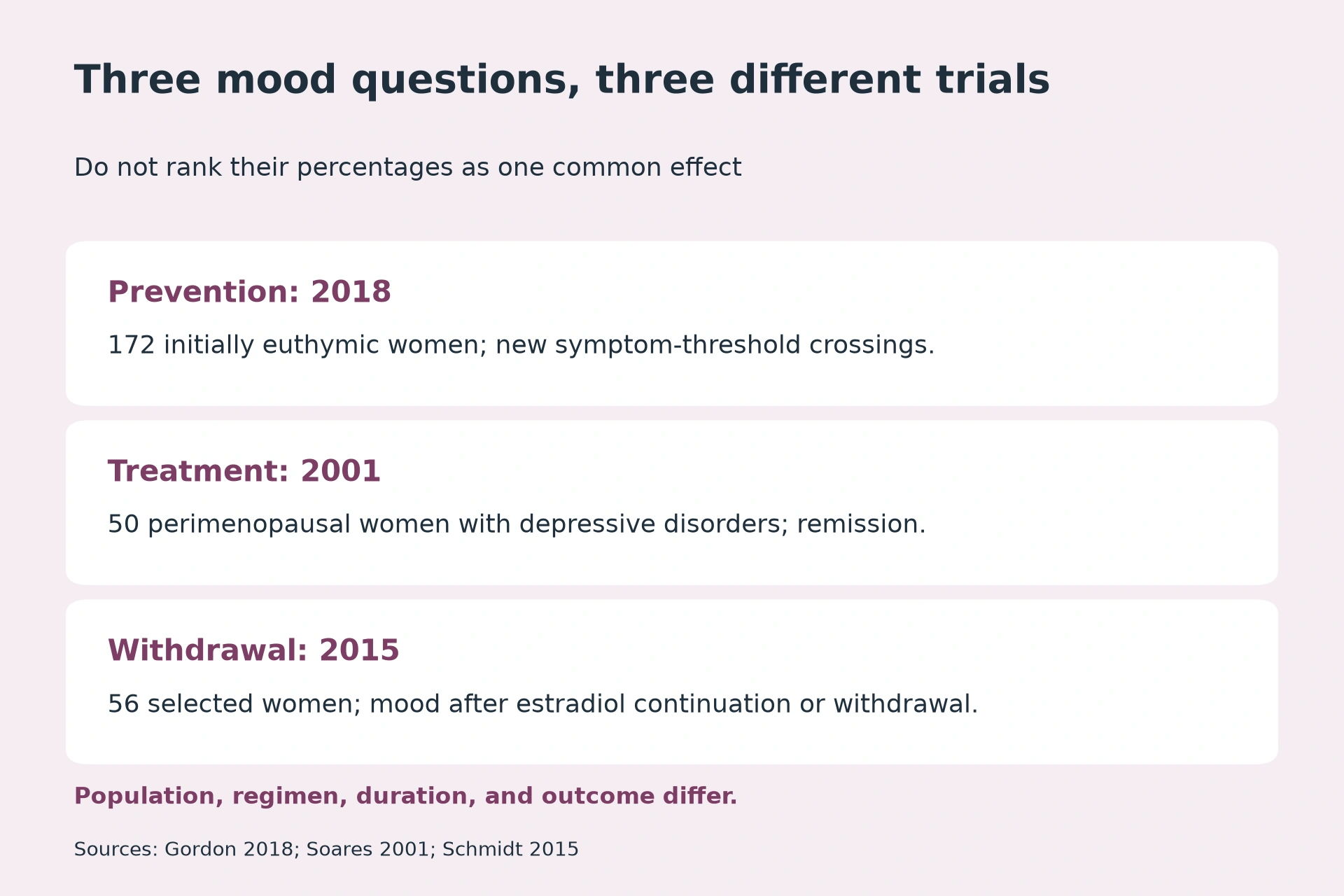
| Study question | Population | Outcome to keep attached to the result |
|---|---|---|
| Prevention, 2018 | Initially euthymic women in perimenopause or early postmenopause | Crossing a CES-D symptom threshold over twelve months |
| Treatment, 2001 | Perimenopausal women with depressive disorders | Remission during a twelve-week trial |
| Withdrawal, 2015 | Asymptomatic women with or without prior hormone-responsive perimenopausal depression | Mood change after short randomized estradiol continuation or withdrawal |
What did the withdrawal experiment add?
Schmidt and colleagues studied 56 asymptomatic postmenopausal women: 26 with a history of perimenopausal depression that had responded to hormone therapy and 30 controls without a depression history. After an initial three weeks of open-label estradiol, participants were randomized to continue estradiol or switch to placebo for three weeks. Original withdrawal trial.
Depressive symptoms increased after withdrawal in the selected group with past perimenopausal depression, while controls and women continuing estradiol remained relatively stable. The findings support sensitivity to hormone change in a susceptible group.
They do not establish that everyone who stops HRT will become depressed, that HRT causes dependence, or that treatment must continue indefinitely. The experiment was short, deliberately selected a particular history, and did not compare different tapering strategies.
Does a normal estrogen result rule out a hormone-related pattern?
These studies do not provide a single blood-test threshold that diagnoses or excludes a hormone-related mood problem. A laboratory value captures a moment, while the clinical question may involve symptoms, reproductive stage, variation over time, and prior response.
Equally, attributing symptoms to hormones without assessment can miss other treatable problems. The history should include sleep, stressors, medications, substance use, previous depression or bipolar symptoms, and effects on daily life. A clinician can decide which examinations or tests are appropriate.
Our HRT testing and monitoring guide and menopause brain-fog guide help organize those questions. A test panel is not a substitute for listening to the symptom history.
Where do sleep and hot flashes fit?
Sleep disruption and vasomotor symptoms can coexist with mood symptoms. Improving one may make daily life easier, but that does not establish that every mood change is caused by hot flashes or that symptom relief equals treatment of a depressive disorder.
Our HRT sleep evidence review and MsFLASH hot-flash review examine those endpoints separately. The distinction is practical: a person may need a sleep plan, menopausal-symptom treatment, mental-health care, or a combination.
The prevention trial’s analyses explored relationships with baseline vasomotor symptoms, but they do not settle the precise mechanism of the mood effect. A favorable clinical observation and a proven biological explanation are different levels of evidence.
How should treatment be discussed?
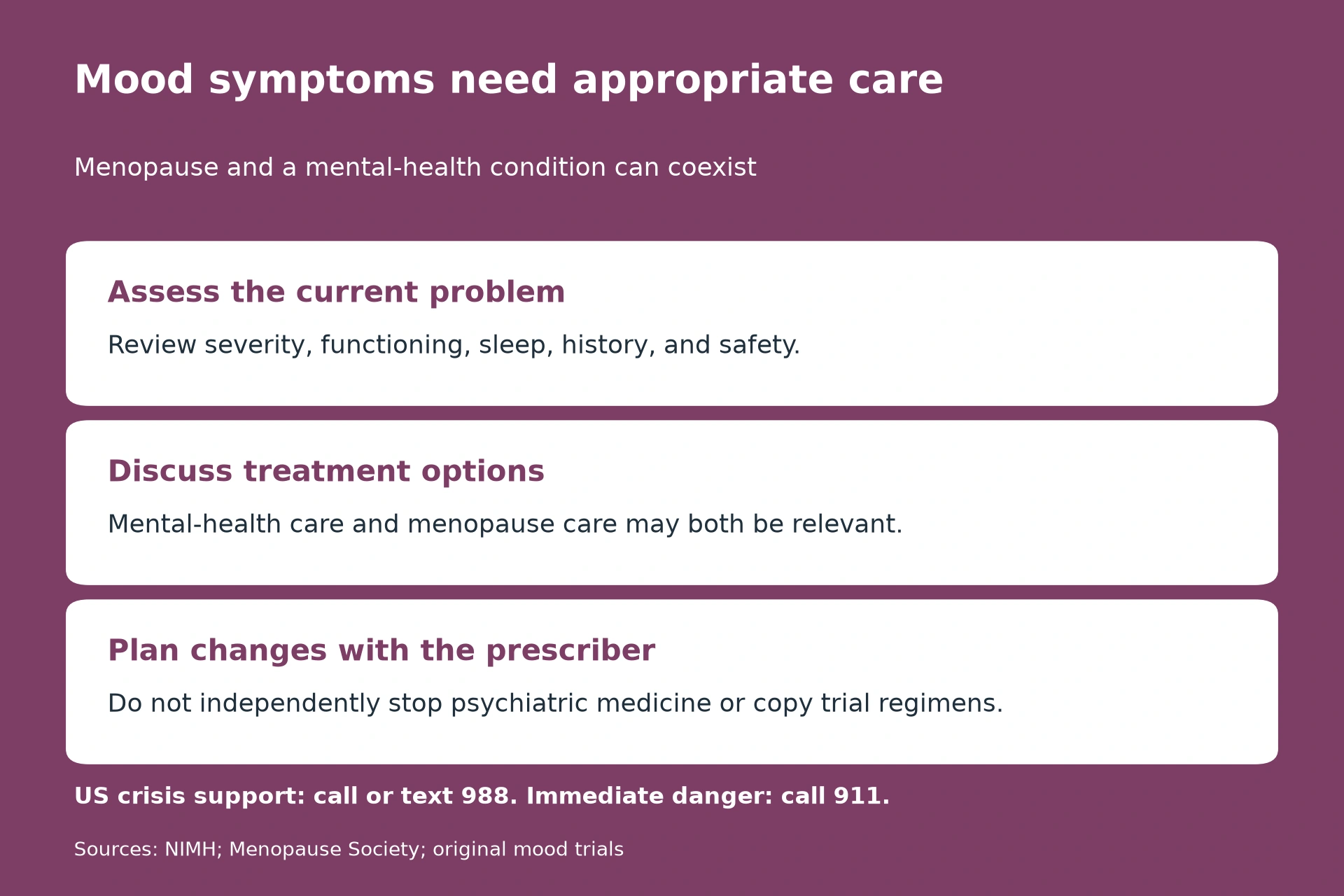
Start with the current problem and its severity. If a depressive disorder is present, discuss evidence-based mental-health treatment and follow-up rather than waiting to see whether a hormone change resolves everything. Do not stop an antidepressant or other prescribed psychiatric medicine on the basis of this article. NIMH treatment guidance.
For someone also considering menopausal hormone therapy, review symptom goals, uterus status, medical history, contraindications, route, and monitoring. The Menopause Society’s guidance emphasizes individualized benefit-risk discussion. Hormone-therapy guidance.
CoreAge Rx’s estrogen information and oral progesterone information can help identify product questions. The trials are not evidence that every offered formulation treats depression or reproduces the studied regimens.
When is more urgent help needed?
Thoughts of suicide, inability to stay safe, or severe deterioration require immediate support rather than a routine hormone follow-up. In the United States, call or text 988 for crisis support; call 911 or go to an emergency department for immediate danger. NIMH help information.
This is relevant to the topic because symptoms should not be minimized as “just menopause.” A hormonal transition and a serious mental-health condition can coexist, and the appropriate response depends on severity and safety.
For nonurgent follow-up, a brief symptom record can help: note mood, sleep, menstrual changes if relevant, medication changes, and functioning. It is a discussion aid, not a self-diagnostic score or a reason to change doses alone.
Video: understanding perimenopause
This Mayo Clinic overview introduces perimenopause and menopause. It provides background on the transition, not proof of a depression-treatment indication or a substitute for the trial distinctions above.
Frequently asked questions
Does this prove everyone should take HRT to prevent depression?
No. The prevention trial was relatively small and enrolled a defined population. Its promising result must be weighed against individual risks, alternative care, and the limits of the evidence.
Can HRT replace therapy or antidepressants?
These trials did not establish that general strategy. A clinician should assess the diagnosis and discuss appropriate mental-health treatment, with hormone therapy considered in its own clinical context.
Does the withdrawal study mean I should never stop?
No. It identified vulnerability in a selected group with a particular history. It supports planning and monitoring when treatment changes, not indefinite treatment for everyone.
What is the clearest takeaway?
Ask which question the evidence answers: prevention, treatment, or withdrawal. Then match that evidence to the person’s symptoms, history, goals, and safety needs.
Original papers and supporting sources
The references distinguish full research papers, published abstracts, and official guidance. This educational narrative review is not a systematic review or an individual treatment recommendation. Sources were checked in October 2026.
- Gordon JL et al. Efficacy of Transdermal Estradiol and Micronized Progesterone in the Prevention of Depressive Symptoms in the Menopause Transition: A Randomized Clinical Trial. (2018). Full text reviewed. DOI: 10.1001/jamapsychiatry.2017.3998. Open full text.
- Soares CN et al. Efficacy of estradiol for the treatment of depressive disorders in perimenopausal women: a double-blind, randomized, placebo-controlled trial. (2001). Published abstract reviewed. DOI: 10.1001/archpsyc.58.6.529.
- Schmidt PJ et al. Effects of Estradiol Withdrawal on Mood in Women With Past Perimenopausal Depression: A Randomized Clinical Trial. (2015). Full text reviewed. DOI: 10.1001/jamapsychiatry.2015.0111. Open full text.
- NIMH: depression, treatment, and getting help. Official guidance.
- The Menopause Society: hormone therapy. Official guidance.